
Global hiring has never been easier. Platforms such as Upwork and Fiverr have given businesses access to millions of professionals worldwide, enabling companies to source talent quickly and cost-effectively.
However, many employers make a critical mistake when building international teams: they continue using freelance platforms long after their workforce needs have evolved beyond project-based engagements.
While freelance marketplaces are effective for temporary assignments, they can create significant legal, tax, payroll, and compliance risks when contractors perform duties that closely resemble full-time employment.
As governments around the world increase scrutiny on worker classification and cross-border employment practices, businesses must carefully evaluate whether freelancers remain the right solution.
This is where the debate around Employer of Record vs. Freelancing Platforms becomes increasingly important.
Understanding the differences between these hiring models can help companies reduce legal risks, improve talent retention, and build compliant international teams.
Content Outline
Key Summary
Freelancing platforms are designed for short-term project work
Platforms like Upwork and Fiverr offer quick access to global talent, but they are primarily designed for independent contractors rather than long-term employees.
Worker misclassification is a growing compliance risk
Hiring contractors who function like employees may expose businesses to tax liabilities, penalties, employment claims, and regulatory investigations.
An Employer of Record provides a compliant employment framework
An EOR legally employs workers on behalf of your company, handling payroll, tax obligations, employment contracts, and labor law compliance.
EOR is often a better choice for scaling international teams
Businesses seeking long-term workforce stability, employee retention, and operational control often benefit more from an EOR model than freelance marketplaces.
EOR can be more practical than company incorporation
Companies can hire internationally without establishing a local entity, reducing costs, administrative burdens, and compliance complexity.
What Is an Employer of Record (EOR)?
An Employer of Record (EOR) is a third-party organization that legally employs workers on behalf of another company.
While employees perform work for your business, the EOR becomes the official employer for legal and administrative purposes.
An EOR typically manages:
- Employment contracts
- Payroll administration
- Income tax withholding
- Social security contributions
- Employee benefits
- Labor law compliance
- Employee onboarding and offboarding
This allows companies to hire employees in foreign countries without establishing a local legal entity.
Also Read: 10 Best Employer of Record (EOR) Services To Consider in 2026
What Are Freelancing Platforms?
Freelancing platforms connect businesses with independent contractors who provide services on a project, hourly, or contract basis.
Popular examples include:
- Upwork
- Fiverr
- Freelancer.com
- Toptal
- Guru
These platforms simplify:
- Talent sourcing
- Project management
- Contractor payments
- Short-term engagements
However, they generally do not act as the legal employer of the freelancer.
The responsibility for proper worker classification and compliance often remains with the hiring company.
Why Businesses Initially Choose Upwork and Fiverr
Many companies start with freelance platforms because they offer immediate access to talent.
Faster Hiring
Employers can often find candidates within hours rather than weeks.
Lower Initial Costs
There is no need for:
- Entity setup
- Employee benefits
- Payroll administration
Flexibility
Companies can:
- Hire for specific projects
- Scale resources up or down
- Access specialized expertise
Global Talent Access
Businesses can recruit professionals from virtually any country.
These advantages make freelance marketplaces attractive for startups and companies testing new markets.
However, problems often emerge when freelancers become long-term members of the team.
The Hidden Compliance Risks of Freelancing Platforms
Many employers assume that hiring through Upwork or Fiverr automatically eliminates employment obligations.
Unfortunately, this is not always the case.
Worker Misclassification Risks
Worker misclassification occurs when an individual is treated as an independent contractor despite functioning like an employee.
Regulators typically examine factors such as:
- Fixed working hours
- Direct supervision
- Exclusive working arrangements
- Long-term engagements
- Integration into company operations
If authorities determine that a contractor should be classified as an employee, businesses may face:
- Back taxes
- Social security liabilities
- Employee benefit obligations
- Employment law claims
- Regulatory penalties
This is one of the most significant risks associated with long-term contractor relationships.
Country-Specific Employment Regulations
Each country applies different tests to determine whether someone is an employee or an independent contractor.
A freelancer relationship that appears compliant in one country may violate labor regulations in another.
For international hiring, this creates substantial complexity.
Businesses must understand:
- Local labor laws
- Tax requirements
- Worker protections
- Mandatory benefits
Failure to comply can result in costly legal consequences.
Payroll and Tax Exposure
Many employers underestimate their responsibilities regarding international contractor payments.
Potential risks include:
- Tax withholding obligations
- Permanent establishment concerns
- Local reporting requirements
- Cross-border payment compliance
As international teams grow, payroll administration becomes increasingly difficult to manage without local expertise.
Intellectual Property Risks
Intellectual property ownership can become complicated when working with independent contractors.
Without properly drafted agreements, disputes may arise regarding:
- Software code ownership
- Product designs
- Marketing assets
- Proprietary business information
Employee agreements administered through an EOR often provide stronger protection for intellectual property rights.
Data Security and Confidentiality Concerns
Freelancers frequently work with multiple clients simultaneously.
This may increase exposure to:
- Data leaks
- Security breaches
- Confidentiality violations
- Intellectual property misuse
For businesses handling sensitive customer information, these risks can be significant.
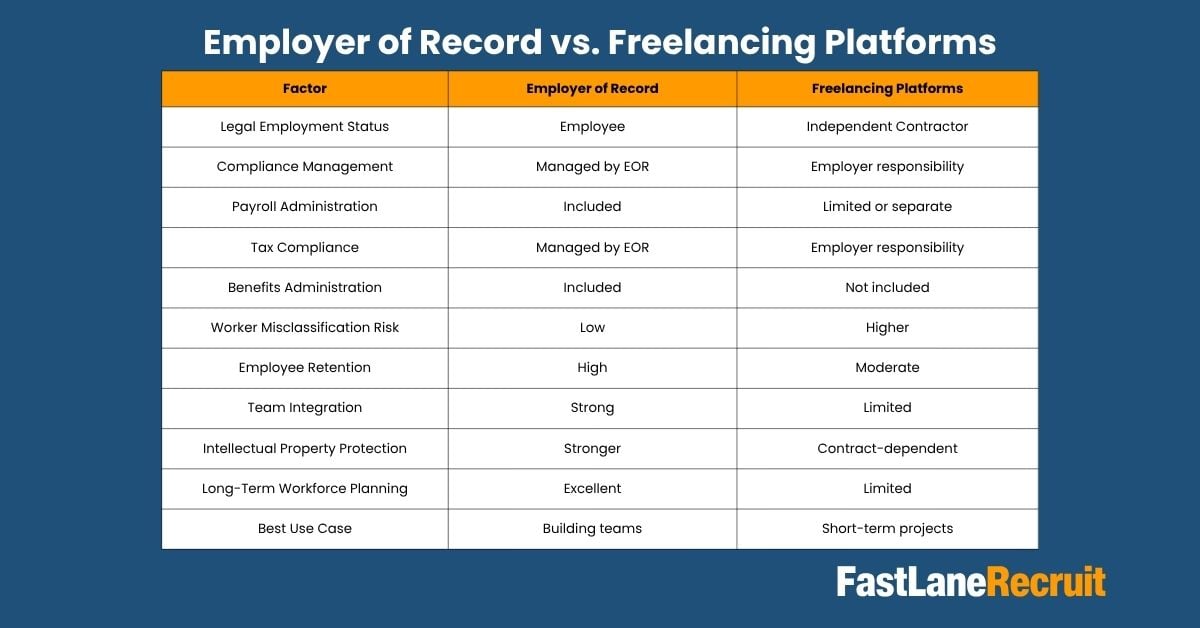
Employer of Record vs. Freelancing Platforms: A Detailed Comparison
When Freelancing Platforms Make Sense
Freelance marketplaces remain valuable in specific situations.
They are often suitable for:
Short-Term Projects
Examples include:
- Website design
- Content creation
- Video editing
- Temporary consulting
Specialized Expertise
Businesses may need niche skills that are unavailable internally.
Market Testing
Companies entering a new market may initially engage freelancers before making long-term hiring decisions.
For these scenarios, freelance platforms can be effective and cost-efficient.
When an EOR Is the Better Choice
An Employer of Record becomes increasingly valuable when companies need:
Full-Time Team Members
Employees working daily within your business should generally be hired through a compliant employment structure.
Long-Term Workforce Stability
EOR employees are typically more invested in organizational success than project-based contractors.
Stronger Retention
Employees often receive:
- Benefits
- Career progression opportunities
- Greater job security
This can improve retention and reduce turnover.
Global Expansion Without Entity Setup
An EOR allows companies to hire internationally without establishing a legal entity in every country.
This significantly accelerates expansion.
EOR vs. Company Incorporation: Which Is Better?
Many companies assume they must establish a legal entity before hiring internationally.
In reality, an EOR often provides a more efficient alternative.
Advantages of EOR Over Company Incorporation
Faster Market Entry
Companies can hire immediately rather than waiting months for entity registration.
Lower Setup Costs
Businesses avoid:
- Registration fees
- Legal costs
- Corporate administration expenses
Reduced Compliance Burden
The EOR handles employment-related obligations.
Greater Flexibility
Organizations can test markets before making long-term investments.
For many growing companies, EOR offers the optimal balance between compliance and scalability.
Why More Companies Are Moving Away from Freelance-Only Hiring
The global workforce is evolving.
Businesses increasingly seek:
- Workforce stability
- Compliance certainty
- Better employee retention
- Stronger intellectual property protection
- Scalable hiring infrastructure
As a result, many organizations are transitioning from contractor-heavy models to EOR-supported employment structures.
This trend is especially common among technology companies, startups, professional service firms, and international businesses expanding into new markets.
Why Choose a Malaysia EOR?
Malaysia has become a leading destination for international hiring due to its skilled workforce, strong English proficiency, competitive labor costs, and growing expertise in technology, finance, customer support, and shared services.
For foreign companies, hiring employees directly in Malaysia can be challenging due to employment laws, payroll requirements, tax obligations, and statutory contributions. Establishing a local entity also requires significant time, cost, and ongoing administration.
A Malaysia Employer of Record (EOR) offers a faster and more compliant alternative.
Hire Without Setting Up a Company
A Malaysia EOR allows businesses to legally employ Malaysian talent without establishing a local entity, reducing both setup costs and administrative burdens.
Ensure Compliance and Reduce Risk
An EOR manages employment contracts, payroll, tax compliance, and statutory contributions, helping businesses avoid worker misclassification and employment law risks.
Access Top Malaysian Talent Faster
Companies can quickly hire and onboard professionals in technology, finance, customer service, marketing, and other key sectors while focusing on business growth instead of compliance management.
For many international employers, a Malaysia EOR is the most practical way to test the market, build a team quickly, and scale operations before committing to company incorporation.
How FastLaneRecruit Helps You Build Compliant Global Teams
Hiring international talent should not expose your business to unnecessary legal and compliance risks.
FastLaneRecruit helps companies hire, manage, and scale global teams through comprehensive Employer of Record, recruitment, and payroll solutions, exclusively in Malaysia.
Employer of Record Services
FastLaneRecruit enables businesses to:
- Hire employees without establishing a local entity
- Ensure labor law compliance
- Manage employment contracts
- Handle statutory requirements
- Reduce worker misclassification risks
Recruitment Services
FastLaneRecruit helps organizations:
- Source qualified professionals
- Screen candidates
- Conduct hiring processes
- Build dedicated international teams
Payroll Services
FastLaneRecruit manages:
- Payroll processing
- Tax administration
- Statutory contributions
- Compliance reporting
This allows businesses to focus on growth while maintaining full compliance. Contact us to get started!
Conclusion
Freelancing platforms like Upwork and Fiverr have made global hiring fast and accessible, especially for short-term or project-based needs. However, when businesses begin relying on contractors as long-term team members, the risks shift from operational convenience to legal and compliance exposure—particularly around worker misclassification, payroll obligations, and intellectual property protection.
In contrast, an Employer of Record (EOR) provides a structured and legally compliant way to hire international talent. It enables companies to build stable teams, manage payroll and statutory requirements correctly, and expand into new markets without the cost and complexity of establishing a local entity.
For companies hiring in Malaysia, this distinction becomes even more important. Malaysia offers a highly skilled and multilingual workforce, but navigating local employment laws and compliance requirements can be complex without local expertise.
This is where an EOR model becomes a strategic advantage—allowing businesses to hire Malaysian talent quickly, compliantly, and at scale while focusing on growth rather than administrative burden.
For organizations planning serious international expansion, the choice is no longer just about finding talent—it is about building a compliant, scalable workforce model that supports long-term business success.
Frequently Asked Questions
What is the difference between an Employer of Record and a freelancing platform?
An Employer of Record legally employs workers on behalf of a company and manages compliance obligations. Freelancing platforms connect businesses with independent contractors but generally do not serve as the legal employer.
Is Upwork compliant for hiring international workers?
Upwork can be compliant for genuine contractor relationships. However, if a contractor functions like a full-time employee, worker misclassification risks may arise.
Can I hire full-time employees through Fiverr?
Fiverr is designed primarily for freelance and project-based work. Businesses seeking long-term employees should consider compliant employment structures such as an Employer of Record.
What is worker misclassification?
Worker misclassification occurs when an individual is treated as an independent contractor despite meeting the legal criteria of an employee.
Is an EOR better than company incorporation?
For many companies entering new markets, an EOR provides faster hiring, lower setup costs, and reduced compliance burdens compared to establishing a legal entity.
Why do global companies use Employer of Record services?
Companies use EOR services to hire internationally, ensure compliance, simplify payroll administration, reduce legal risks, and accelerate global expansion.
Does an EOR handle payroll and taxes?
Yes. Most EOR providers manage payroll processing, tax withholding, statutory contributions, and employment compliance requirements.
Can an EOR help hire talent in Malaysia?
Yes. An EOR enables companies to hire Malaysian employees legally without establishing a Malaysian company while ensuring compliance with local employment regulations.