Hiring needs are not always permanent. Businesses often need extra support for seasonal demand, special projects, employee leave coverage, or market expansion. In these situations, fixed term employment can provide the flexibility companies need while still offering structure and legal protection for employees.
For global businesses, startups, and growing companies, fixed-term contracts are commonly used to access specialized skills without making a long-term hiring commitment. However, employers must also understand the legal requirements, employee rights, and contract terms involved before using this employment arrangement.
In this guide, we explain what fixed term employment means, when businesses should use it, the pros and cons, and how to manage fixed-term employees compliantly across different countries.
Content Outline
Key Summary
What Fixed Term Employment Means
Fixed term employment is a hiring arrangement where an employee works for a set period or until a specific project is completed. It has a clear start and end date.
Flexible Hiring for Business Needs
It allows companies to scale their workforce for seasonal demand, projects, expansions, or temporary workloads without long-term commitments.
Employees Still Have Legal Rights
Even though the role is temporary, fixed-term employees are still protected under labor laws and may receive benefits like leave, insurance, and social contributions depending on the country.
Clear Contracts Are Essential
A proper fixed-term contract should include job scope, salary, duration, benefits, termination rules, and renewal terms to avoid misunderstandings.
Different from Permanent Employment
Unlike permanent roles, fixed-term employment has a defined end date and is used for temporary or project-based hiring needs.
Compliance Varies by Country
Labor laws differ globally. Some countries limit contract renewals or may convert repeated fixed-term contracts into permanent employment.
Helps Global Hiring When Managed Properly
Fixed-term employment supports international hiring, but businesses must manage compliance carefully, often with support from an Employer of Record (EOR).
What Is Fixed Term Employment?
Fixed term employment is a type of employment arrangement where a company hires an employee for a specific period of time or for a particular project. Unlike permanent employment, this arrangement has a clearly defined start date and end date that both the employer and employee agree to before work begins.
In simple terms, the employee is hired temporarily to fulfill a business need that is not expected to last forever. Once the agreed contract period ends or the project is completed, the employment relationship usually ends automatically unless the employer decides to renew or extend the contract.
Fixed-term employment is commonly used by businesses that need additional support for temporary workloads, seasonal demand, special assignments, or expansion projects. It gives employers more flexibility while still allowing employees to work under a formal employment structure.
For employees, fixed-term contracts can also provide opportunities to gain experience, work on different projects, and develop specialized skills in various industries.
Although the role is temporary, fixed-term employees are still considered official employees of the company rather than independent contractors or freelancers. In many countries, they are protected by labor laws and may receive statutory employee benefits such as:
- Paid annual leave
- Sick leave
- Public holiday entitlements
- Social security contributions
- Health insurance or retirement benefits (depending on local laws)
The exact benefits and protections may vary depending on the country’s employment regulations and company policies.
Common examples of fixed term employment include:
- Seasonal hiring during peak business periods such as holiday sales or festive seasons
- Project-based work with a clear completion timeline
- Temporary replacement for employees on maternity leave, medical leave, or sabbatical
- Market expansion projects in new countries or regions
- Event staffing for exhibitions, conferences, or campaigns
- Short-term specialist or consultant roles requiring specific expertise
- Temporary support during periods of rapid business growth
For example, a company expanding into Malaysia may hire fixed-term employees for six months to support customer service, recruitment, or local market research before deciding whether to build a permanent team.
How Does a Fixed-Term Contract Work?
A fixed-term employment contract is a formal agreement between the employer and employee that outlines the terms and duration of employment.
Unlike permanent employment contracts, fixed-term contracts clearly specify how long the employee will work for the company. This can either be:
- A fixed calendar period (for example, 6 months or 1 year), or
- Until a specific project or assignment is completed
The contract helps both parties understand their responsibilities, expectations, and employment conditions throughout the agreed employment period.
A fixed-term employment agreement usually includes the following details:
| Contract Element | Description |
| Employment Start and End Date | Clearly states when the contract begins and ends |
| Job Scope and Responsibilities | Explains the employee’s role, duties, and expectations |
| Salary and Benefits | Includes salary, bonuses, allowances, and employee benefits |
| Working Hours | Specifies work schedules, shifts, or weekly hours |
| Leave Entitlements | Covers annual leave, sick leave, and public holidays |
| Termination Clauses | Explains conditions for early termination by either party |
| Renewal Terms | States whether the contract can be extended or renewed |
| Confidentiality Obligations | Protects company information and sensitive business data |
At the end of the contract period, the employment arrangement usually concludes automatically. However, if the employer still requires the employee’s services and both parties agree, the contract may be renewed, extended, or converted into a permanent position.
In some countries, repeatedly renewing fixed-term contracts may eventually grant employees permanent employment rights. Because of this, businesses should always ensure their contracts comply with local labor laws and employment regulations.
Also Read: Terminating an Independent Contractor: How to Do It Compliantly
Fixed Term Employment vs Permanent Employment
Fixed term employment and permanent employment may appear similar because both involve hiring employees to work for a company. However, the biggest difference lies in the duration and long-term commitment of the employment relationship.
A permanent employee is hired without a predetermined end date and is expected to work for the company on an ongoing basis. In contrast, a fixed-term employee is hired only for a specific period of time or until a particular project is completed.
Understanding the differences between these two employment arrangements can help businesses choose the most suitable hiring model based on their operational needs, budget, and workforce planning strategy.
| Feature | Fixed Term Employment | Permanent Employment |
| Employment Duration | Has a specific start and end date | Continues indefinitely until resignation or termination |
| Job Security | Temporary employment arrangement | Greater long-term job stability |
| Flexibility | Offers higher flexibility for employers | Provides workforce consistency and retention |
| Benefits | Usually includes statutory or prorated benefits | Often includes full company benefits and long-term incentives |
| Termination | Employment usually ends automatically upon contract expiry | Requires formal resignation or termination procedures |
| Hiring Purpose | Used for temporary projects, seasonal work, or leave coverage | Used for ongoing operational and business needs |
Key Differences Explained
1. Employment Duration
A fixed-term contract clearly states how long the employee will work for the company. This could range from a few months to several years, depending on the business need.
Permanent employment does not have a fixed end date. The employee continues working unless they resign, retire, or are terminated according to company policy and labor laws.
2. Job Security
Permanent employees generally enjoy greater job security because their employment is ongoing. Fixed-term employees, however, understand from the beginning that the role is temporary unless the contract is renewed.
3. Flexibility for Employers
Fixed-term employment gives businesses more flexibility to manage temporary staffing needs, fluctuating workloads, or project-based hiring without committing to permanent headcount expansion.
For example, a company launching a new service in Malaysia may hire fixed-term employees for one year to support the initial setup phase before deciding on long-term staffing needs.
4. Employee Benefits
In many countries, fixed-term employees are entitled to statutory benefits such as annual leave, sick leave, and social security contributions. However, permanent employees may receive additional long-term benefits like:
- Retirement plans
- Performance bonuses
- Career development programs
- Long-service incentives
5. Termination Process
When a fixed-term contract reaches its agreed end date, the employment relationship usually concludes automatically unless renewed.
Permanent employment, on the other hand, requires formal resignation or termination procedures, including notice periods and compliance with local labor laws.
6. Hiring Purpose
Businesses typically use fixed-term employment for:
- Seasonal hiring
- Temporary business expansion
- Project-based assignments
- Employee leave replacement
- Short-term specialist support
Permanent employment is generally used for roles that are essential to daily operations and long-term business growth.
Also Read: What is Employee Tenure?
Fixed Term Employment vs Independent Contractors
Many businesses mistakenly assume fixed-term employees and independent contractors are the same. However, they are legally very different types of working arrangements.
A fixed-term employee works directly for the company under an employment contract, while an independent contractor is usually self-employed and provides services under a separate service agreement.
Choosing the wrong classification can create serious legal and compliance risks, especially when hiring across multiple countries.
| Fixed-Term Employee | Independent Contractor |
| Considered an employee of the company | Operates as a self-employed individual or business |
| Protected under employment laws | Governed mainly by commercial or service agreements |
| Receives employment protections and statutory rights | Usually not entitled to employee protections |
| Employer controls work schedule, duties, and processes | Contractor has more independence over how work is completed |
| May receive statutory employee benefits | Typically manages own taxes, insurance, and benefits |
| Included in payroll and HR processes | Usually invoices the company for services |
Key Differences Explained
1. Employment Relationship
A fixed-term employee officially becomes part of the company’s workforce during the contract period. They may report to managers, follow company policies, and work according to assigned schedules.
An independent contractor operates independently and usually has greater control over how, when, and where the work is completed.
2. Legal Protection
Fixed-term employees are generally protected by labor laws covering:
- Minimum wage
- Working hours
- Paid leave
- Employee benefits
- Workplace protections
Independent contractors are typically not covered by the same employment protections because they are considered self-employed service providers.
3. Taxes and Benefits
For fixed-term employees, employers are usually responsible for:
- Payroll processing
- Tax deductions
- Social security contributions
- Employee benefits administration
Independent contractors usually manage their own taxes, insurance, and retirement planning.
4. Business Control
One major difference is the level of control the company has over the worker.
If the company controls:
- Working hours
- Daily responsibilities
- Reporting structure
- Tools and systems used
the worker is more likely to be legally classified as an employee rather than a contractor.
5. Risks of Worker Misclassification
Incorrectly classifying employees as contractors can lead to:
- Financial penalties
- Back payment of taxes and benefits
- Legal disputes
- Compliance investigations
This is especially important for international hiring, where employment laws vary significantly across countries.
For example, some countries have strict worker classification rules and may impose penalties if a contractor is later determined to function as an employee.
Because of this, businesses hiring globally should always review local labor laws carefully or work with an Employer of Record (EOR) provider to ensure proper classification and compliance.
Benefits of Fixed Term Employment
Fixed-term employment offers several advantages for both employers and employees, especially in industries where workloads, business priorities, and staffing needs frequently change.
For businesses, fixed-term contracts provide flexibility and better workforce planning without the long-term commitment of permanent hiring. For employees, they can offer valuable work experience, skill development, and opportunities to work on diverse projects.
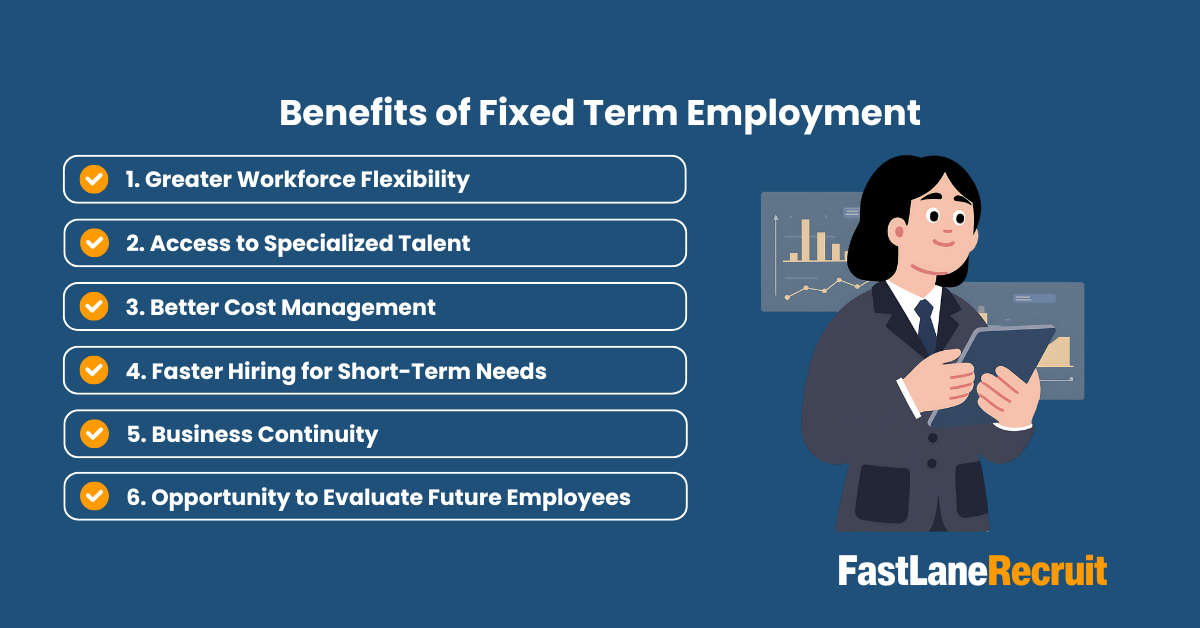
Here are some of the key benefits of fixed term employment:
1. Greater Workforce Flexibility
One of the biggest advantages of fixed-term employment is workforce flexibility.
Businesses can scale their teams up or down depending on:
- Seasonal demand
- Business growth
- Project timelines
- Market conditions
- Temporary operational needs
This allows companies to respond quickly to changing business requirements without increasing permanent headcount unnecessarily.
For example, an eCommerce company may hire fixed-term customer support staff during year-end shopping seasons when customer inquiries and order volumes increase significantly. Once the busy season ends, the contracts naturally conclude without requiring long-term workforce adjustments.
Similarly, companies entering a new market may hire temporary employees to test operations before committing to permanent expansion.
This flexibility is especially useful for:
- Retail businesses during festive seasons
- Hospitality and tourism industries during peak travel periods
- Technology companies handling short-term projects
- Startups experiencing rapid but uncertain growth
2. Access to Specialized Talent
Fixed-term contracts allow companies to hire professionals with specialized knowledge or niche expertise for temporary assignments.
Instead of hiring a permanent employee for a skill that is only needed for a limited time, businesses can engage experienced professionals specifically for the duration of the project.
This approach is especially valuable for:
- IT system implementation
- Software migration projects
- Digital transformation initiatives
- Website development
- Marketing campaigns
- Product launches
- International expansion projects
- Regulatory or compliance support
For example, a business expanding operations into Malaysia may hire fixed-term HR, recruitment, or compliance specialists to support local market entry for several months.
This gives companies access to expert support while maintaining cost efficiency.
3. Better Cost Management
Fixed-term employment can help businesses manage hiring budgets more effectively.
Because the contract duration is predetermined, employers can estimate:
- Salary expenses
- Employee benefit costs
- Project staffing budgets
- Workforce allocation
more accurately in advance.
This is particularly useful for project-based businesses or companies with fluctuating workloads.
Instead of committing to long-term salaries and employee overhead costs, businesses can align hiring expenses with actual operational needs.
For startups and growing companies, this reduces financial pressure while still allowing access to skilled talent.
Fixed-term employment may also lower costs associated with:
- Long-term employee benefits
- Retention programs
- Permanent workforce expansion
- Severance liabilities in certain jurisdictions
However, employers should still ensure compliance with local labor laws regarding employee rights and statutory benefits.
Also Read: Best Practices for Managing Remote Teams Effectively
4. Faster Hiring for Short-Term Needs
Fixed-term employment allows companies to fill urgent staffing gaps more quickly than traditional long-term recruitment processes.
Businesses often use fixed-term contracts when they need immediate support for:
- Sudden workload increases
- Temporary vacancies
- New project launches
- Short-term operational support
- Time-sensitive business initiatives
Because the employment duration is temporary and clearly defined, both employers and candidates may move through the hiring process faster.
For example, if an employee suddenly takes extended medical leave, a company may quickly hire a fixed-term replacement to maintain smooth daily operations.
This helps businesses avoid productivity disruptions and reduces pressure on existing team members.
5. Business Continuity
Fixed-term employees play an important role in helping businesses maintain continuity during temporary staffing gaps.
Companies commonly hire fixed-term workers to temporarily replace permanent employees who are unavailable due to:
- Maternity leave
- Paternity leave
- Medical leave
- Sabbaticals
- Long-term business travel
- Internal transfers
This ensures that important responsibilities and workflows continue without interruption.
For example, a finance department may hire a fixed-term accountant during an employee’s maternity leave to ensure payroll processing and reporting deadlines continue smoothly.
Business continuity is especially important for:
- Customer-facing roles
- Operational support teams
- Compliance-sensitive departments
- Time-sensitive projects
By using fixed-term employment strategically, companies can maintain operational stability while supporting workforce flexibility.
6. Opportunity to Evaluate Future Employees
In some cases, fixed-term employment also gives employers the opportunity to evaluate an employee’s performance before offering a permanent role.
During the contract period, employers can assess:
- Skills and expertise
- Work quality
- Team collaboration
- Communication abilities
- Cultural fit
If the employee performs well and the business requires long-term support, the company may later convert the role into permanent employment.
This can reduce hiring risks and improve long-term recruitment decisions.
For employees, fixed-term roles may also open the door to future permanent opportunities within the organization.
Challenges and Risks of Fixed Term Employment
While fixed-term employment offers flexibility and operational advantages, businesses should also understand the potential challenges and risks involved before adopting this hiring approach.
Managing temporary employees requires proper planning, clear communication, and compliance with local labor laws. Without the right processes in place, businesses may face increased operational costs, legal complications, or workforce management challenges.
Here are some of the most common challenges associated with fixed term employment:
1. Frequent Recruitment Cycles
One of the biggest challenges of fixed-term employment is the need for ongoing recruitment.
Because fixed-term contracts have a defined end date, businesses may need to repeatedly:
- Advertise positions
- Screen candidates
- Conduct interviews
- Onboard new employees
- Provide training
This can increase administrative workload and recruitment costs over time, especially for businesses with high turnover in temporary roles.
For example, companies that rely heavily on seasonal workers may need to repeat the hiring and onboarding process every year during peak business periods.
Frequent recruitment cycles can also place additional pressure on:
- HR teams
- Hiring managers
- Payroll departments
- Training resources
If not managed efficiently, constant employee turnover may affect productivity and operational consistency.
Tips to reduce recruitment challenges:
- Build a talent pool of previous fixed-term employees
- Maintain standardized onboarding processes
- Use workforce planning to anticipate staffing needs early
- Consider renewing high-performing employees where legally appropriate
2. Lower Long-Term Retention
Fixed-term employment is temporary by nature, which can lead to higher employee turnover compared to permanent roles.
Once the contract ends, employees may:
- Move to another company
- Seek permanent employment elsewhere
- Pursue freelance or contract opportunities
This can make it difficult for businesses to retain experienced workers and maintain long-term workforce stability.
High turnover may result in:
- Loss of institutional knowledge
- Repeated training costs
- Reduced operational continuity
- Increased workload for existing employees
For example, if a company continuously replaces project staff every few months, teams may spend more time onboarding new employees rather than focusing on productivity and growth.
In industries that require strong collaboration or technical expertise, frequent employee changes can disrupt workflow efficiency and project timelines.
3. Compliance and Legal Risks
Employment laws relating to fixed-term contracts vary significantly across countries and regions. This is one of the most important risks businesses must manage, especially when hiring internationally.
Different jurisdictions may impose rules regarding:
- Maximum contract duration
- Number of contract renewals allowed
- Notice period requirements
- Employee benefits entitlement
- Early termination procedures
- Equal treatment compared to permanent employees
In some countries, repeatedly renewing fixed-term contracts may automatically convert the employee into a permanent employee under local labor laws.
For example, certain jurisdictions may:
- Limit how many times a contract can be renewed
- Require employers to provide the same benefits as permanent employees
- Restrict the use of fixed-term employment without valid business reasons
Failure to comply with local employment regulations can lead to:
- Financial penalties
- Employment disputes
- Back payment claims
- Legal investigations
- Reputational damage
This becomes even more complex when managing employees across multiple countries.
Tips to reduce compliance risks:
- Review local labor laws before hiring
- Use compliant employment contracts
- Track contract renewal timelines carefully
- Seek legal or HR guidance for international hiring
- Work with an Employer of Record (EOR) provider when expanding globally
Also Read: Job Level Classification: How to Build a Fair, Consistent System Your Team Will Actually Use
4. Team Integration Challenges
Because fixed-term employees are hired temporarily, they may sometimes feel less connected to the company’s culture, long-term goals, or internal team dynamics.
Short-term employees may:
- Have limited time to build relationships
- Participate less in long-term planning
- Receive less training or development support
- Feel excluded from permanent workforce initiatives
This can affect collaboration and communication within teams, especially if businesses rely heavily on temporary workers.
For example, if project teams experience constant employee turnover, it may become harder to maintain consistent workflows and team cohesion.
Businesses should also avoid treating fixed-term employees differently from permanent employees in ways that negatively impact workplace culture.
Tips to improve team integration:
- Include fixed-term employees in team meetings and activities
- Provide proper onboarding and support
- Clearly communicate project goals and expectations
- Encourage collaboration between temporary and permanent staff
Creating a positive employee experience can improve engagement and productivity even for short-term roles.
5. Employee Morale Concerns
Some employees may view fixed-term employment as less secure than permanent employment.
Because the contract has a predetermined end date, employees may feel uncertain about:
- Future job stability
- Career progression opportunities
- Long-term financial planning
- Promotion opportunities
This uncertainty can sometimes affect employee morale, motivation, or long-term engagement.
In competitive job markets, highly skilled professionals may prioritize permanent positions that offer:
- Greater stability
- Career advancement
- Long-term benefits
- Stronger job security
As a result, businesses may occasionally face challenges attracting or retaining top talent for temporary positions.
However, this risk can often be reduced through:
- Clear communication about the role
- Competitive compensation packages
- Positive work culture
- Opportunities for contract renewal or permanent conversion
For some employees, fixed-term employment may still offer valuable flexibility, project experience, or international exposure.
6. Potential Impact on Business Continuity
If multiple fixed-term employees leave at similar times, businesses may experience operational disruptions.
This can affect:
- Project timelines
- Customer support quality
- Internal workflows
- Productivity levels
Businesses that depend heavily on temporary staffing should have workforce planning strategies in place to reduce disruption risks.
Examples include:
- Staggering contract end dates
- Cross-training employees
- Maintaining backup staffing plans
- Building a pipeline of replacement candidates
With proper planning, businesses can enjoy the flexibility of fixed-term employment while minimizing operational risks.
When Should Businesses Use Fixed Term Employment?
Fixed-term employment is most effective when a company needs additional support for a limited period of time, rather than building a permanent team structure. It gives businesses the flexibility to respond quickly to changing workloads, project demands, or market conditions without long-term hiring commitments.
This type of employment is especially useful when the scope of work is clearly defined, has a specific timeline, or is tied to a particular business objective.
Ideal situations for fixed term employment include:
1. Seasonal Hiring
Businesses often experience predictable busy periods during the year. Fixed-term employees help companies manage increased demand without permanently expanding headcount. For example, retail and eCommerce companies often hire extra customer service or warehouse staff during holiday seasons or promotional campaigns.
2. Product Launches
When launching a new product or service, companies may need temporary support for marketing, operations, customer support, or technical setup. Fixed-term employees help ensure smooth execution during the launch phase.
3. Temporary Workload Increases
Some businesses experience short-term spikes in workload due to unexpected demand, new contracts, or operational changes. Fixed-term employees help absorb this extra workload without overloading permanent staff.
4. Technology Migration Projects
When companies upgrade systems, migrate data, or implement new software, they may require specialized talent for a limited time. Fixed-term professionals such as IT consultants, developers, or project managers are often hired for these transitions.
5. Employee Leave Coverage
Fixed-term employment is commonly used to replace employees who are temporarily away from work due to maternity leave, medical leave, sabbaticals, or long-term travel. This ensures business continuity without disrupting daily operations.
6. Regional Market Expansion
When expanding into a new country or region, businesses often hire fixed-term employees to support early-stage setup activities such as:
- Market research
- Local recruitment
- Compliance and administration
- Customer onboarding
For example, a company expanding into Malaysia may hire fixed-term HR or operations staff to establish local processes before deciding on long-term hiring strategies.
7. Event Management Projects
Events such as conferences, trade shows, exhibitions, and corporate campaigns often require short-term staffing support. Fixed-term employees help manage logistics, coordination, customer engagement, and execution during the event period.
What Should Be Included in a Fixed-Term Employment Contract?
A well-drafted fixed-term employment contract is essential for setting clear expectations between the employer and employee. It also helps reduce misunderstandings, ensure compliance with labor laws, and protect both parties throughout the employment period.
Since employment regulations vary across countries, contracts should always be aligned with local legal requirements in the employee’s jurisdiction.
Below are the key elements that should be included in a fixed-term employment contract:
Key Elements of a Fixed-Term Employment Contract
| Contract Element | Purpose |
| Employment Duration | Clearly defines the start and end date of employment or project completion timeline |
| Job Scope | Outlines the employee’s responsibilities, duties, and reporting structure |
| Salary & Benefits | Specifies compensation, allowances, bonuses, and statutory benefits |
| Working Hours | Defines expected working schedule, shifts, or weekly hours |
| Leave Entitlements | Explains annual leave, sick leave, public holidays, and other time-off policies |
| Termination Clause | Sets conditions for early termination, notice periods, and related obligations |
| Renewal Terms | Describes whether the contract can be extended or renewed and under what conditions |
| Confidentiality Clause | Protects sensitive business information, intellectual property, and internal data |
Why These Contract Elements Matter
Each clause in a fixed-term employment contract plays an important role in ensuring clarity and legal protection:
- Employment duration helps both parties understand the exact timeline of engagement
- Job scope reduces confusion about responsibilities and performance expectations
- Compensation terms ensure transparency in salary and benefits
- Termination clauses protect both employer and employee in case the contract ends early
- Renewal terms provide structure for extending employment when needed
- Confidentiality clauses safeguard business information, especially in project-based roles
Without these details, businesses may face misunderstandings, disputes, or compliance risks.
Compliance Reminder for Global Hiring
Employers should always ensure that fixed-term employment contracts comply with the labor laws of the country where the employee is based. Employment regulations may differ significantly across jurisdictions, especially regarding:
- Minimum benefits
- Contract duration limits
- Renewal restrictions
- Mandatory employee protections
For global companies, this is especially important when hiring across multiple countries or managing remote teams.
Working with an Employer of Record (EOR) provider can help businesses ensure that contracts remain compliant while simplifying international hiring and payroll management.
Can Fixed-Term Contracts Be Renewed?
Yes, fixed-term contracts can usually be renewed or extended, depending on the business needs and local labor regulations. In many cases, employers choose to renew contracts when the project continues, workload remains high, or the employee’s performance meets expectations.
Renewals are a common practice in industries where work is ongoing but still not permanent in nature, such as project-based roles, seasonal operations, or market expansion activities.
However, renewal is not always as simple as extending a date on a contract. Many countries have strict employment laws that regulate how fixed-term contracts can be renewed and under what conditions.
Common restrictions on contract renewals include:
- Maximum renewal periods
Some jurisdictions limit how long a worker can remain on consecutive fixed-term contracts. - Number of consecutive renewals allowed
Certain countries restrict how many times a contract can be extended before it is no longer considered temporary. - Automatic conversion to permanent employment
In some cases, if a fixed-term contract is renewed multiple times or continues beyond a defined period, it may automatically become a permanent employment contract under local law.
Important compliance consideration
For example, in certain jurisdictions, repeated renewals without a clear and legitimate business reason may lead to the employee being legally classified as a permanent staff member. This can affect:
- Employee rights and benefits
- Termination procedures
- Employer obligations
- Payroll and tax requirements
Because of these variations, businesses must carefully manage contract timelines and renewal decisions.
Best practices before renewing a fixed-term contract:
- Review local employment laws in the employee’s country
- Confirm the business justification for renewal
- Check previous contract duration and renewal history
- Ensure updated contracts reflect current job scope and terms
- Seek guidance from HR professionals or legal advisors when needed
For global companies hiring across multiple regions, staying compliant becomes even more important due to different employment regulations in each country.
Working with an Employer of Record (EOR) provider can help businesses manage renewals correctly while ensuring compliance with local labor laws.
How to Terminate a Fixed-Term Employee
In most cases, fixed-term employment ends automatically when the contract reaches its agreed end date. This means no formal resignation or dismissal process is required when the contract expires naturally.
However, situations may arise where early termination is necessary. This must always be handled carefully to ensure compliance with the employment contract and local labor laws.
When early termination may occur:
- Business restructuring or budget changes
- Project cancellation or delay
- Performance or conduct issues
- Mutual agreement between employer and employee
- Legal or compliance requirements
Steps to properly terminate a fixed-term employee early
To reduce legal and operational risks, employers should follow a structured process:
1. Review the contract terms carefully
Check the fixed-term employment contract to understand:
- Notice period requirements
- Early termination clauses
- Compensation obligations
- Any penalties or conditions
The contract will usually define whether early termination is allowed and under what circumstances.
2. Follow notice period requirements
If notice is required, employers must provide written communication within the agreed timeframe. This ensures transparency and compliance with both contract terms and local labor laws.
3. Document the reason for termination
Clear documentation is important for legal and HR purposes. Employers should record:
- The reason for termination
- Supporting business justification
- Relevant internal approvals or decisions
This helps protect the company in case of disputes or audits.
4. Comply with local employment laws
Employment laws vary by country, and some jurisdictions may require:
- Severance payments
- Mandatory notice periods
- Government reporting
- Employee consultation processes
Non-compliance can lead to legal disputes or financial penalties.
5. Conduct a proper offboarding process
A structured offboarding process ensures a smooth exit for both parties. This may include:
- Returning company equipment
- Final payroll processing
- Revoking system access
- Exit interviews (if applicable)
- Providing employment confirmation documents
Key compliance reminder
Improper termination of a fixed-term employee can expose businesses to legal disputes, compensation claims, or reputational risks. In some countries, employees may even claim damages for early termination if contract terms are not properly followed.
For global employers, especially those managing teams across multiple jurisdictions, it is strongly recommended to seek local HR or legal guidance or work with an Employer of Record (EOR) provider to ensure compliant termination processes.
Tips for Managing Fixed-Term Employees Successfully
Treat Fixed-Term Employees Fairly
Provide clear communication, onboarding, and access to essential resources.
Set Clear Expectations Early
Define project goals, timelines, reporting structures, and performance expectations from the beginning.
Maintain Compliance Across Countries
Global employment laws vary significantly. Businesses hiring internationally should stay updated on:
- Payroll obligations
- Tax requirements
- Statutory benefits
- Employment classifications
Use Structured Documentation
Well-drafted employment contracts help reduce disputes and compliance risks.
How an Employer of Record (EOR) Can Help
Managing fixed-term employees across multiple countries can become complex, especially when businesses are unfamiliar with local labor laws.
An Employer of Record (EOR) helps companies:
- Hire employees legally in foreign countries
- Manage compliant employment contracts
- Handle payroll and statutory contributions
- Administer employee benefits
- Reduce worker misclassification risks
This allows businesses to expand globally without setting up a local entity immediately.
Hire and Outsource Malaysian Employees with FastLaneRecruit
If your business is looking to hire or outsource talent in Malaysia, FastLaneRecruit can help simplify the process.
Our Employer of Record (EOR) solutions help global businesses:
- Hire Malaysian employees compliantly
- Manage payroll and HR administration
- Support fixed-term and long-term hiring
- Reduce compliance risks
- Scale teams efficiently across borders
Whether you need temporary project support or want to test market expansion in Malaysia, FastLaneRecruit provides flexible hiring solutions tailored to your business needs.
Contact FastLaneRecruit today to learn how we can support your global hiring strategy.
Conclusion
Fixed term employment offers businesses a flexible and practical way to manage temporary hiring needs, support business growth, and access specialized talent without long-term commitments. From seasonal staffing and project-based work to international expansion and employee leave coverage, fixed-term contracts can help companies stay agile in a fast-changing business environment.
However, employers should also understand the legal responsibilities that come with fixed-term employment. Contract terms, employee benefits, renewal limits, and termination rules can vary significantly across countries. A well-structured contract and strong compliance process are essential to avoid unnecessary risks and maintain a positive employee experience.
For companies hiring across borders, partnering with an experienced Employer of Record (EOR) provider can simplify the process and ensure compliance with local employment laws. Whether you are hiring temporary staff for a short-term project or building a team in Malaysia, FastLaneRecruit can help you manage fixed-term employment smoothly and compliantly.
Frequently Asked Questions (FAQs)
What is fixed term employment?
Fixed term employment is an employment arrangement where an employee works for a specified period or until a project is completed.
Do fixed-term employees receive benefits?
In many countries, fixed-term employees are entitled to statutory employment benefits, although some benefits may be prorated depending on local laws and company policies.
Can fixed-term contracts become permanent?
Yes. In some jurisdictions, repeated renewals may result in automatic conversion to permanent employment.
Is fixed-term employment suitable for international hiring?
Yes, especially for temporary projects, market expansion, and seasonal hiring. However, businesses must comply with local employment laws.
What is the difference between fixed-term employees and contractors?
Fixed-term employees are company employees protected by labor laws, while contractors are self-employed service providers operating independently.