

Hiring independent contractors has become a common strategy for companies that want flexibility in building teams across different countries. Contractors can help businesses scale faster, access specialized skills, and manage projects without long-term employment commitments.
However, many companies still ask a critical question: can an independent contractor be terminated?
The short answer is yes, but not in the same way as employees. Independent contractors are not “fired” in the traditional sense. Instead, the business relationship is ended based on the terms of a contract or agreed conditions.
This guide explains how to properly and compliantly terminate an independent contractor, when it is legally allowed, and how companies can reduce risks during the process.
Content Outline
Key Summary
Contractor Termination Is Contract-Based
Independent contractors are not governed by employment law but by contract law, meaning termination must follow agreed terms, not employer discretion.
Written Contracts Are the Foundation
Clear agreements define scope, payment, notice periods, and termination rules, reducing misunderstandings and legal risks during offboarding.
Immediate Termination Is Limited to Serious Cases
Contractors can only be terminated without notice in cases such as fraud, criminal activity, or major breaches like confidentiality violations.
Notice Periods Support Smooth Exits
Most contracts require 10–30 days’ notice to allow proper handover, payment settlement, and continuity of work.
Good-Faith Handling Is Needed Without Contracts
If no written agreement exists, businesses should rely on fair communication, reasonable notice, and documentation to avoid disputes.
Payment Obligations Still Apply After Termination
Companies must pay for completed work or milestones, unless the contract explicitly states otherwise or there is a proven breach.
Misclassification Risks Must Be Avoided
Treating contractors like employees can lead to tax penalties and legal issues, so proper classification and working independence are essential.
Independent Contractor vs Employee
Before we talk about termination, it’s important to clearly understand the difference between an employee and an independent contractor. This difference is not just about job titles. It directly affects how the working relationship is managed, what protections apply, and how the relationship can be ended.
Many companies run into issues simply because they treat both roles the same way. But legally and practically, they are very different.
Comparison Table
| Factor | Employee | Independent Contractor |
| Work control | The company directs how, when, and where the work is done | The contractor decides how to complete the work |
| Schedule | Fixed working hours (for example 9 to 6) | Flexible schedule based on agreed deadlines |
| Benefits | May receive benefits like leave, insurance, or bonuses | No company benefits provided |
| Taxes | Employer is responsible for payroll contributions | Contractor manages their own taxes and filings |
| Work relationship | Long-term employment relationship | Project-based or contract-based relationship |
| Termination rules | Protected by employment laws and procedures | Governed by contract terms and agreements |
What This Means in Real Life
Employees
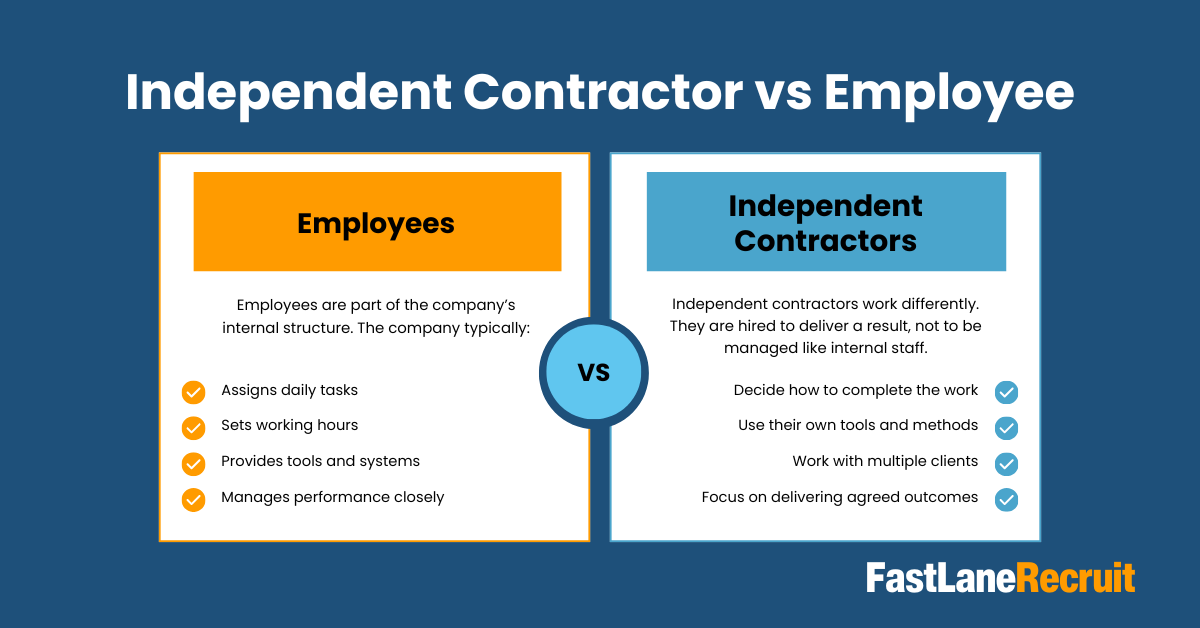
Employees are part of the company’s internal structure. The company typically:
- Assigns daily tasks
- Sets working hours
- Provides tools and systems
- Manages performance closely
Because of this level of control, employees are protected by employment laws. This means termination usually requires specific procedures, such as notice periods, performance management steps, or legal compliance depending on the country.
Independent Contractors
Independent contractors work differently. They are hired to deliver a result, not to be managed like internal staff.
They usually:
- Decide how to complete the work
- Use their own tools and methods
- Work with multiple clients
- Focus on delivering agreed outcomes
Because they are self-employed, they are not covered by employment protection laws in the same way employees are.
Instead, their relationship is based on a contract agreement between two parties.
Why This Difference Matters for Termination
This is where many businesses get confused.
For employees:
- Termination is governed by employment law
- There are strict rules on notice, process, and protection
For independent contractors:
- Termination is governed by contract law
- The agreement between both parties is the main reference point
In simple terms:
- Employees are protected by labor law
- Contractors are protected by what is written in the contract
Also Read: Understanding the Recruitment Process: Strategies for Success
What Governs the Termination Process for Contractors?
Since independent contractors are self-employed, their termination is not handled like a dismissal from employment. Instead, it is guided by:
- The written contract terms (most important)
- Agreed notice periods
- Scope of work completion
- Legal principles of contract law
This means the company and contractor both rely on what was agreed at the beginning of the relationship.
If the contract clearly states termination conditions, both sides must follow them. If not, the situation must be handled carefully through professional and fair communication.
Independent contractors are not “managed employees.” They are business partners working under a service agreement.
That is why their termination process is not about employment law procedures, but about:
- Contract terms
- Mutual agreement
- Clear communication
- Legal compliance under contract law
Understanding this difference is the foundation for handling contractor relationships correctly and avoiding unnecessary legal risk.
Can an Independent Contractor Be Terminated?
Yes, an independent contractor can be terminated, but not in the same way as an employee. The key difference is that the decision must always be based on contract terms, agreed conditions, or valid legal reasons.
Independent contractors are not part of the company’s employment structure. Instead, they operate under a service agreement. This means the relationship is governed by contract law rather than employment law.
Because of this, termination cannot be done randomly or without justification. It must follow clear rules that were agreed at the beginning of the working relationship.
When Termination Is Allowed
A contractor can only be terminated under specific conditions, such as:
1. Contract terms (termination clauses)
Most professional agreements include a termination section. This outlines:
- When either party can end the relationship
- Whether notice is required
- Whether termination can be immediate under certain conditions
If these clauses exist, they must be followed exactly. Ignoring them may lead to breach of contract disputes.
2. Notice requirements
Many contracts require advance notice before termination, commonly:
- 10 days
- 14 days
- 30 days
This notice period gives both parties time to:
- Complete ongoing work
- Hand over responsibilities
- Settle outstanding payments
Failing to provide required notice can create legal and financial risks, even if the decision to terminate is valid.
3. Legal justification (when serious issues occur)
In some cases, immediate termination may be justified without notice, such as:
- Fraud or financial misconduct
- Breach of confidentiality or data misuse
- Repeated failure to deliver agreed work
- Serious violation of contract terms
In these situations, the business is typically allowed to act immediately to protect operations and assets, but proper documentation is still essential.
Why Arbitrary Termination Is Not Allowed
Unlike employees, contractors are not under direct management control. That means:
- You cannot terminate based on performance preference alone
- You cannot end the contract without reference to agreed terms
- You cannot ignore contractual obligations
Every termination decision must be tied back to either:
- What was written in the agreement, or
- A clear legal reason supported by evidence
This helps ensure fairness and reduces the risk of disputes or breach of contract claims.
What If There Is No Written Contract?
In some cases, businesses engage contractors without a formal written agreement. Even then, termination is still possible.
However, the situation becomes more sensitive because there are no clearly defined rules to follow.
In this case, termination should be handled through good-faith business practice, which includes:
- Clear and respectful communication
- Providing reasonable notice where possible
- Explaining the decision in a professional manner
- Paying for all completed work
- Avoiding sudden or unexplained termination
Even without a written contract, courts and legal systems may still consider verbal agreements, emails, and past conduct when resolving disputes.
Also Read: In-House Recruiter vs. Recruiting Agency
Key Takeaway
Yes, an independent contractor can be terminated, but only when it is:
- Supported by a contract clause
- Aligned with notice requirements
- Justified by valid legal reasons
- Or handled fairly under good-faith practices when no contract exists
The safest approach is always to rely on clear documentation, follow agreed terms, and maintain professional communication throughout the process.
When You Can Terminate an Independent Contractor Immediately
Immediate termination means ending the working relationship without providing the usual notice period. This is a serious step and should only be taken in specific, high-risk situations where continuing the contract would harm the business or violate legal obligations.
In most cases, contracts require notice. However, there are exceptions where immediate termination is justified because the issue is severe enough that the business cannot safely continue the relationship.
1. Criminal activity or fraud
One of the clearest situations where immediate termination is allowed is when a contractor is involved in illegal or unethical conduct.
This includes actions such as:
- Fraud or financial manipulation
- Theft of company funds, data, or assets
- Misuse or unauthorized access to confidential systems
- Forging documents or invoices
- Any other criminal activity related to the work relationship
Why immediate action is necessary
In these situations, continuing the relationship can expose the company to:
- Financial losses
- Legal liability
- Data breaches or security risks
- Reputational damage
For example, if a contractor handling company accounts is found to be submitting false invoices or redirecting payments, the business is justified in ending the relationship immediately to prevent further harm.
2. Material breach of contract
A “material breach” means a serious violation of the contract that affects the core purpose of the agreement. It is not a minor issue or occasional delay, but a breakdown in the essential terms that were agreed upon.
A contractor may be terminated immediately if they:
Repeatedly fail to deliver agreed work
If a contractor consistently misses deadlines, delivers incomplete work, or refuses to correct issues after feedback, it may be considered a serious breach, especially if it affects business operations.
Breach confidentiality or NDA terms
If confidential business information is shared without permission, this is considered a major violation. It can include:
- Sharing internal documents with third parties
- Disclosing client data
- Revealing proprietary strategies or trade secrets
Misrepresentation of qualifications
If a contractor falsely presented their skills, experience, or certifications during hiring, and it later impacts performance or trust, this can justify termination.
Sharing sensitive business information
Even outside formal confidentiality agreements, sharing sensitive operational or client information can damage trust and justify immediate termination.
Why documentation is critical
Even in serious cases, companies should never rely on verbal decisions alone.
Proper documentation helps to:
- Support the reason for termination
- Protect the business in case of disputes
- Provide evidence if legal action is taken
- Show that the decision was justified and not arbitrary
Useful documentation includes:
- Email communications
- Project records and deliverables
- Performance reports
- Evidence of misconduct or breach
- Copies of the signed contract and relevant clauses
Also Read: Bridging The Talent Gap in Australia’s Job Market: Hiring Trends In 2026
Key takeaway
Immediate termination of an independent contractor is only appropriate in exceptional circumstances, typically involving:
- Illegal or fraudulent activity, or
- Serious breach of contract terms
In all cases, businesses should act carefully, rely on documented evidence, and ensure the decision is aligned with the contract to minimize legal and operational risk.
When Notice Should Be Given
In most independent contractor relationships, providing notice before ending the engagement is the preferred and more professional approach. Even when a company has the right to terminate a contract, giving notice helps ensure the process is smooth, fair, and less likely to lead to misunderstandings or disputes.
Notice is especially important in situations where the issue is not urgent or serious enough to justify immediate termination.
Common situations where notice is recommended
1. No termination clause exists in the contract
If the agreement does not clearly define how termination should happen, including notice periods or conditions, it becomes important to act reasonably and fairly.
In this case, providing notice helps fill the gap left by the contract and reduces the risk of disagreement. Without written terms, sudden termination may be viewed as unfair or unclear, especially if the contractor has ongoing responsibilities or expenses tied to the project.
2. Business priorities or budgets change
Companies often adjust direction due to market conditions, internal restructuring, or shifting priorities. In these cases, the contractor’s services may no longer be required at the same level.
Providing notice allows both parties to:
- Adjust workloads gradually
- Complete or close ongoing deliverables
- Plan for future work or transitions
This is especially important in long-term engagements where the contractor depends on steady project flow.
3. Project scope is reduced or completed early
Sometimes projects finish earlier than expected or the scope is scaled down. This does not usually involve any fault from the contractor.
For example:
- A marketing campaign ends sooner due to strategy changes
- A development project reaches completion ahead of schedule
- A business reduces deliverables due to internal restructuring
In these cases, notice gives the contractor time to close out tasks properly and ensures a clean handover of work.
4. Performance issues that are not severe breaches
Not all performance concerns justify immediate termination. Some issues may include:
- Missed deadlines without serious impact
- Work quality that needs improvement but is not critical
- Communication gaps or slower response times
In these situations, notice is often paired with feedback or improvement discussions. This gives the contractor a fair opportunity to adjust before the relationship ends.
Typical notice periods
The length of notice depends on what is stated in the contract. If the agreement is silent, companies often use a reasonable standard based on industry practice.
Common notice periods include:
- 10 days
- 14 days
- 30 days
Longer notice periods may apply for complex projects or long-term engagements where transition planning is needed.
Why providing notice is important
Even when not strictly required, giving notice offers several business advantages:
Maintain professional relationships
Contractors often work across multiple companies and industries. A respectful exit helps preserve goodwill and may support future collaboration.
Avoid disputes
Clear communication and advance notice reduce the chances of misunderstandings or legal disagreements about sudden termination.
Allow project transition time
Notice gives the contractor time to:
- Complete outstanding tasks
- Transfer knowledge or documentation
- Hand over responsibilities smoothly
This helps ensure business continuity.
Protect company reputation
How a company ends working relationships reflects its professionalism. A structured and fair termination process strengthens trust with contractors, partners, and future hires.
Also Read: Singapore Job Market: Hiring Trends In 2026
Importance of the Written Contract
A written independent contractor agreement is one of the most important tools a business can have when working with external talent. It creates clarity, reduces misunderstandings, and sets clear expectations for both sides from the beginning of the relationship.
Without a written contract, businesses rely on assumptions or verbal agreements, which can easily lead to confusion or disputes later. A properly structured contract acts as a reference point if questions arise during the project or at the time of termination.
What a strong independent contractor contract should include
A well-drafted agreement should clearly define the working relationship and remove ambiguity. At a minimum, it should include:
1. Scope of work
This outlines exactly what the contractor is responsible for delivering. It should clearly define:
- Tasks and responsibilities
- Deliverables and outcomes
- Project timelines or milestones
A clear scope helps prevent misunderstandings about what is included in the work and what is not.
2. Payment terms
This section explains how and when the contractor will be paid. It should include:
- Payment amount or rate
- Invoicing schedule (weekly, monthly, per milestone)
- Payment method and currency
- Payment conditions or approvals
Clear payment terms help avoid disputes and ensure smooth financial processing.
3. Quality expectations
This defines the standard of work expected from the contractor. It may include:
- Required level of accuracy or performance
- Revision or feedback process
- Delivery standards or formats
This ensures both parties agree on what “acceptable work” looks like.
4. Termination conditions
This is one of the most important sections. It explains:
- When the contract can be ended
- Under what circumstances termination is allowed
- Whether termination requires notice or can be immediate
Without this section, ending the relationship becomes more complex and legally uncertain.
5. Notice period requirements
This defines how much advance notice must be given before termination. Common structures include:
- 10 days
- 14 days
- 30 days
Notice periods allow both parties to prepare for transition and reduce disruption to ongoing work.
Example of a simple termination clause
A clear and effective termination clause often looks like this:
- Either party may terminate the agreement with 30 days written notice without cause
- Immediate termination is allowed in the event of a material breach of contract
This type of clause is simple, but it provides legal clarity and protects both sides by clearly defining expectations.
Why these terms must be followed strictly
If a contract exists, both parties are legally bound to follow it. This means:
- Notice periods must be respected
- Termination conditions must be followed
- Proper documentation must support the decision
Failing to follow the agreed terms can lead to:
- Breach of contract claims
- Financial penalties
- Legal disputes between parties
This is why reviewing the contract before taking any termination action is essential.
Also Read: High-Demand Jobs in Malaysia 2026
What if there is no written contract?
In some cases, businesses engage contractors without a formal written agreement. Instead, the working relationship is based on emails, conversations, invoices, and mutual understanding.
While this is possible, it creates more risk and uncertainty.
How to handle termination without a written contract
If no written agreement exists, termination should be handled carefully and professionally:
1. Review informal agreements
Look at:
- Email exchanges
- Messages or written instructions
- Past discussions about scope or duration
These can help determine what was originally agreed.
2. Communicate clearly before ending the relationship
Open communication is important. Clearly explain:
- Why the engagement is ending
- When the relationship will end
- What work needs to be completed before exit
This helps avoid confusion and reduces conflict.
3. Provide reasonable notice where possible
Even without a contract, giving notice is considered good business practice. It allows:
- Completion of ongoing tasks
- Smooth transition of responsibilities
- Fair treatment of the contractor
4. Document all communication
Keep records of:
- Termination discussions
- Emails or written notices
- Final deliverables and payments
This documentation can be important if disagreements arise later.
Key risk to be aware of
Even without a written contract, termination without notice or explanation can still lead to disputes. This is especially true when:
- The contractor has already delivered work
- Expenses have been incurred
- There was a clear verbal understanding of ongoing work
In such cases, legal systems may still recognize an implied agreement based on conduct and communication.
Payment Obligations After Termination
One of the most important compliance principles in independent contractor relationships is straightforward: if work has been completed or delivered, it must be paid for.
Termination of the relationship does not remove a company’s obligation to pay for services that have already been provided. The contract governs what has been agreed, not whether the relationship continues.
Even after termination, companies are generally expected to:
Settle outstanding invoices
All approved and unpaid invoices should be processed promptly. Delaying or refusing payment without valid contractual reasons can create disputes and damage trust.
Pay for completed milestones or deliverables
Many contractor agreements are structured around milestones or project phases. If a milestone has been successfully completed and accepted, payment is typically due, even if the overall project ends early.
Avoid withholding payment without contractual grounds
Some companies attempt to withhold payment due to dissatisfaction with work quality. However, this is only acceptable if:
- The contract explicitly allows it, or
- There is a documented breach that justifies non-payment
Otherwise, withholding payment can be considered a breach of contract.
Failing to meet payment obligations can lead to:
- Formal legal claims for unpaid invoices
- Damage to company reputation
- Difficulties in future contractor hiring
- Cross-border payment disputes in international engagements
Also Read: Talent Expectation Gap In Job Market Hong Kong Hiring Trend 2026
Legal Risks and Misclassification Concerns
Another major risk in contractor relationships is worker misclassification. This occurs when a person is hired as an independent contractor but is treated in practice like an employee.
This is a serious compliance issue in many jurisdictions.
Common risks of misclassification include:
- Tax penalties and unpaid employer contributions
- Violations of labour and employment regulations
- Retroactive payments for benefits or social security contributions
- Legal disputes with tax authorities or labour departments
How misclassification typically happens
Misclassification is often unintentional and occurs when companies:
- Direct the contractor’s daily work like an employee
- Set fixed working hours or strict schedules
- Integrate contractors into internal teams as permanent staff
- Provide employment-style benefits or controls
Even if a written contract states “independent contractor,” authorities will look at how the relationship works in practice, not just what is written.
How to reduce misclassification risk
To maintain a compliant contractor relationship, companies should ensure that contractors:
- Control how they complete their work
- Use their own methods, tools, and processes
- Work independently without direct supervision
- Provide services on a project or outcome basis rather than fixed employment roles
Maintaining this separation is essential for staying compliant with labour and tax regulations across different countries.
Practical Tips for Terminating Contractors Properly
Proper termination is not just about ending a relationship; it is about doing it in a structured, compliant, and professional way that reduces legal and operational risk.
1. Always review the contract first
Before taking any action, carefully check:
- Termination clauses
- Notice requirements
- Payment terms
- Breach conditions
This ensures the termination process aligns with agreed legal terms.
2. Document everything
Strong documentation protects the business in case of disputes. This includes:
- Performance issues or missed deadlines
- Emails and communication history
- Feedback provided to the contractor
- Final decision and reason for termination
Good documentation creates a clear record of fair process.
3. Communicate professionally
Even when termination is due to poor performance or breach, communication should remain:
- Clear and factual
- Free from emotional or personal language
- Focused on work outcomes rather than opinions
Professional communication helps reduce conflict and protects the company’s reputation.
4. Provide transition support when possible
Where appropriate, allow time for:
- Knowledge transfer
- Handover of files or systems
- Completion of urgent tasks
A smooth transition helps avoid operational disruption and ensures continuity for ongoing work.
5. Seek legal advice for complex cases
Legal support is recommended when:
- Contracts are unclear or missing key clauses
- There is a dispute over payment or performance
- The contractor operates across international borders
- There is a risk of breach of contract claims
Early legal guidance can help prevent costly mistakes and ensure compliance with local regulations.
How FastLaneRecruit Helps with Compliant Hiring and Offboarding
Managing independent contractors and international talent is not always straightforward. Once your business starts hiring across borders, you are no longer dealing with just recruitment and performance, you also need to consider local labour laws, tax rules, contract structures, and proper termination procedures.
This becomes even more important when handling sensitive processes like onboarding, managing contracts, or ending a working relationship. Even a small compliance mistake can create unnecessary legal or financial risks.
FastLaneRecruit helps businesses navigate these challenges with a structured and compliant approach to global hiring.
Supporting compliant global hiring through Employer of Record (EOR)
FastLaneRecruit’s Employer of Record (EOR) service allows companies to hire talent in Malaysia and other regions without needing to set up a local legal entity. This makes international hiring faster, simpler, and more compliant.
Through EOR support, businesses can:
Hire talent in Malaysia and other regions legally
FastLaneRecruit enables companies to onboard employees in different countries while ensuring local employment laws are fully followed. This reduces the complexity of cross-border hiring and helps businesses expand with confidence.
Manage compliant contracts and onboarding
Employment contracts are tailored to local regulations, ensuring that terms such as scope of work, compensation, benefits, and termination conditions are properly structured from the start. This helps avoid common compliance issues that often arise in international hiring.
Reduce administrative and legal risks
By handling payroll, statutory contributions, and employment compliance, EOR services reduce the burden on internal HR teams. This also helps minimise risks related to misclassification or incorrect contract handling.
Handle structured employment and workforce management
From onboarding to offboarding, FastLaneRecruit supports a structured employment lifecycle. This includes proper documentation, compliant termination processes, and smooth workforce transitions when roles change or end.
Why this matters for contractor termination and compliance
When dealing with independent contractors or global hires, one of the biggest challenges is ensuring that termination processes are handled correctly under local laws.
Without proper structure, companies may face:
- Contract disputes
- Misclassification risks
- Unclear termination procedures
- Cross-border compliance issues
Using a compliant hiring framework like EOR helps businesses avoid these issues by ensuring that every stage of the employment or contractor lifecycle is properly managed.
Conclusion
So, can an independent contractor be terminated?
Yes, but it must always be done according to contract terms, legal guidelines, and professional standards. Unlike employees, contractors are governed by agreements rather than employment law protections, which makes proper documentation and compliance essential.
The safest approach is always:
- Follow the contract
- Communicate clearly
- Provide notice when appropriate
- Pay for completed work
- Avoid misclassification risks
With the right structure in place, businesses can manage contractor relationships smoothly while staying fully compliant across global markets.
Simplify hiring and compliant offboarding with FastLaneRecruit
If your business is growing internationally, managing contractors, or building distributed teams, having the right compliance structure in place is essential.
FastLaneRecruit’s Employer of Record (EOR) service helps you:
- Hire global talent without setting up local entities
- Stay compliant with local employment laws
- Manage contracts, payroll, and HR administration
- Reduce risk during onboarding and offboarding
- Scale your workforce with confidence
Whether you are expanding into Malaysia or building a global remote team, FastLaneRecruit provides a safer and more structured way to manage hiring and workforce transitions.