Managing a workforce involves more than hiring the right people. It also requires ensuring employees are paid accurately, on time, and in compliance with local laws. This is where hr payroll plays a critical role in every organization.
Human Resources (HR) and payroll are closely connected functions, but they serve different purposes. HR focuses on people, policies, and workforce management, while payroll ensures accurate salary processing, tax compliance, and employee payments.
For global companies, especially those hiring across borders, understanding how HR payroll works together is essential to avoid compliance risks, payment errors, and operational delays.
In this guide, we’ll break down the differences, similarities, and how businesses can efficiently manage both functions, especially when expanding into markets like Malaysia using Employer of Record (EOR) solutions.
Content Outline
Key Summary
HR Payroll Overview
HR payroll refers to the connected system where HR manages employees and payroll manages payments, ensuring a smooth employee lifecycle from hiring to final salary.
HR Focuses on People and Growth
HR is responsible for hiring, onboarding, training, performance management, and employee engagement to build a strong and productive workforce.
Payroll Focuses on Accuracy and Payments
Payroll ensures employees are paid correctly and on time by managing salaries, tax deductions, benefits contributions, and compliance with regulations.
Different but Complementary Roles
HR focuses on workforce management, while payroll focuses on financial processing. Together, they ensure both employee experience and payment accuracy are balanced.
Collaboration is Essential
HR and payroll must work closely on hiring, promotions, benefits, attendance, and offboarding to avoid delays, errors, and compliance issues.
Integration Improves Efficiency
Using integrated HR payroll systems reduces manual work, improves data accuracy, speeds up payroll processing, and enhances compliance across teams.
Global Hiring Adds Complexity
International hiring introduces challenges like multi-currency payroll, tax differences, and local labor laws, making HR payroll coordination essential for compliance.
What is HR Payroll?
HR payroll refers to the combined system where Human Resources (HR) and payroll work together to manage the entire employee journey, from the moment a person is hired until their final paycheck when they leave the company.
In many traditional companies, HR and payroll are handled separately. HR teams focus on employees and workplace management, while payroll teams focus only on salary payments and taxes.
However, modern businesses are increasingly bringing both functions together into one connected system. This integration helps companies reduce errors, improve communication, and ensure employees are paid correctly and on time.
In simple terms:
- HR takes care of people and their experience at work
- Payroll takes care of paying employees accurately and on time
- HR payroll connects both functions so employee information flows smoothly from hiring to payment
For example, when HR updates an employee’s salary after a promotion, payroll immediately uses that updated information to calculate the next paycheck without delays or manual errors.
What is Human Resources (HR)?
Human Resources (HR) is the department that manages people within an organization. It focuses on creating a positive work environment, supporting employees throughout their career journey, and helping the business build a strong and capable workforce.
HR is not just about hiring, it plays a long-term role in shaping company culture, improving employee satisfaction, and ensuring the organization follows labor laws and workplace policies.
Key responsibilities of HR include:
1. Recruiting and onboarding employees
HR finds the right candidates for job roles, conducts interviews, and helps new employees settle into the company through onboarding programs.
2. Managing employee relations and workplace policies
HR acts as a bridge between employees and management, helping to resolve workplace concerns and ensuring fair treatment for everyone.
3. Training and development programs
HR organizes learning opportunities, workshops, and skill development programs to help employees grow professionally.
4. Performance reviews and promotions
HR supports managers in evaluating employee performance and deciding on promotions, salary adjustments, or career progression.
5. Employee benefits and engagement
HR manages benefits like health insurance, leave policies, and employee wellness programs to improve job satisfaction and retention.
6. Compliance with labor laws
HR ensures the company follows employment laws, workplace safety rules, and fair hiring practices.
Overall, HR plays a strategic role in building a productive, motivated, and well-supported workforce.
Also Read: Terminating an Independent Contractor: How to Do It Compliantly
What is Payroll?
Payroll is the function responsible for making sure employees are paid correctly, on time, and in compliance with tax and employment regulations.
Unlike HR, which focuses on people and workplace experience, payroll is more focused on numbers, accuracy, and legal compliance.
Every month or pay cycle, payroll teams calculate how much each employee should receive and ensure that all deductions, taxes, and contributions are properly handled.
Key responsibilities of payroll include:
1. Calculating salaries, wages, overtime, and bonuses
Payroll determines the exact amount each employee earns based on their contract, working hours, and additional compensation.
2. Managing tax deductions and statutory contributions
Payroll ensures the correct amount is deducted for income tax, social security, pension funds, and other legal contributions depending on the country.
3. Processing salary payments
Payroll handles direct deposits or bank transfers so employees receive their pay on time.
4. Maintaining payroll records and reports
Payroll keeps detailed records of salaries, deductions, and payment history for audits, reporting, and financial planning.
5. Ensuring compliance with tax and labor regulations
Payroll must follow government rules related to taxation, minimum wage laws, and employee compensation standards.
6. Coordinating with finance teams
Payroll works with accounting and finance teams to align salary costs with company budgets and financial reports.
Payroll is essential because even small errors in salary calculations or tax reporting can lead to compliance issues and employee dissatisfaction.
HR vs Payroll: Key Differences
Although HR payroll functions often work closely together in managing employees, they serve very different purposes in a business. HR focuses on people and workplace experience, while payroll focuses on accurate pay and financial compliance.
Understanding this difference helps companies avoid confusion, reduce errors, and ensure employees are both well-supported and paid correctly.
1. Focus Area
| HR | Payroll |
| People, culture, employee experience, and workforce development | Salary calculation, tax deductions, and payment accuracy |
HR is people-focused, while payroll is finance-focused.
Example:
- HR might decide to hire a new marketing executive and create a positive onboarding experience for them.
- Payroll ensures that the new employee receives the correct monthly salary, after tax and benefits deductions.
So while HR brings the employee into the company, payroll ensures they get paid correctly once they are in.
2. Core Responsibilities
HR and payroll both deal with employees, but they handle different stages of the employee journey.
HR responsibilities include:
- Recruiting and hiring employees
- Onboarding new team members
- Managing employee engagement and workplace culture
- Training and career development
- Performance reviews and promotions
Payroll responsibilities include:
- Calculating salaries, wages, overtime, and bonuses
- Processing tax deductions and contributions
- Paying employees through bank transfers or payroll systems
- Maintaining salary records and reports
- Ensuring legal payment compliance
Example:
- HR promotes an employee from junior analyst to senior analyst after a performance review.
- Payroll updates the system to reflect the new salary and ensures the employee receives the increased pay in the next payroll cycle.
3. Compliance Focus
HR and payroll both deal with compliance, but in different ways.
HR compliance focuses on:
- Labor laws and employment contracts
- Workplace safety regulations
- Equal opportunity hiring practices
- Employee rights and fair treatment
Payroll compliance focuses on:
- Tax deductions and income tax laws
- Social security and pension contributions
- Minimum wage rules
- Salary reporting and government filings
Example:
- HR ensures that a company does not discriminate during hiring and follows fair interview practices.
- Payroll ensures that correct income tax and social contributions are deducted from each employee’s salary based on local laws.
Both are essential, but they protect the business in different ways.
4. Employee Experience
HR and payroll impact employees differently throughout their journey in a company.
HR impact:
HR shapes how employees feel at work and supports long-term growth and satisfaction.
Payroll impact:
Payroll builds trust by ensuring employees are paid correctly and on time.
Example:
- HR helps an employee resolve a workplace conflict and provides training for career growth.
- Payroll ensures that same employee receives their salary on the expected payday without delay.
Another example:
If payroll delays salaries by even a few days, employees may lose trust in the company, even if HR is doing a great job in engagement and support.
5. Tools and Systems
HR and payroll use different software systems to manage their work efficiently.
HR systems (HRIS):
Used for managing:
- Employee records
- Hiring and recruitment
- Leave and attendance
- Performance tracking
- Training and development
Payroll systems:
Used for:
- Salary calculations
- Tax and deductions processing
- Employee payments
- Payroll reports and audits
- Compliance filings
Example:
- HR updates an employee’s leave record after they take 5 days off.
- Payroll uses that leave data to adjust the employee’s monthly salary if it is unpaid leave.
How Everything Connects (Example)
Let’s follow one employee journey:
- HR hires Sarah as a software engineer
- HR sets her salary and benefits package
- Payroll receives Sarah’s details and sets up payment
- Sarah gets her monthly salary through payroll
- HR promotes Sarah after one year
- Payroll updates her new salary and processes higher payments
This shows how HR and payroll constantly work together behind the scenes.
Also Read: What is Employee Tenure?
HR and Payroll: How They Work Together
HR and payroll are separate business functions, but they are closely connected throughout the entire employee lifecycle. Every time an employee is hired, promoted, takes leave, or leaves the company, HR and payroll must exchange accurate and timely information.
When this coordination works well, employees are paid correctly, compliance is maintained, and operations run smoothly. When it doesn’t, even small gaps can lead to payroll errors or compliance issues.
Key Collaboration Areas
HR and payroll interact at multiple important points during an employee’s journey. Here’s how they typically work together in practice:
1. New hires
- HR collects employee details such as job role, salary, contract type, and start date
- Payroll uses this information to set up the employee in the payroll system and prepare their first salary payment
Example:
HR hires a new marketing executive and confirms a monthly salary of $3,000. Payroll then registers the employee in the system so they can receive their first paycheck at the end of the month.
2. Salary updates and promotions
- HR approves promotions, raises, or bonuses based on performance reviews
- Payroll updates the salary records and ensures the new pay is reflected in the next payment cycle
Example:
An employee is promoted from junior designer to senior designer. HR approves a salary increase, and payroll ensures the updated salary is paid starting from the next payroll run.
3. Employee benefits
- HR manages benefits such as health insurance, retirement plans, and leave policies
- Payroll applies deductions or contributions related to these benefits in employee salaries
Example:
HR enrolls an employee into a health insurance plan. Payroll then deducts the monthly insurance contribution directly from the employee’s salary.
4. Time tracking and attendance
- HR defines working hours, overtime rules, and leave policies
- Payroll uses attendance data to calculate accurate wages, overtime pay, or unpaid leave deductions
Example:
If an employee works extra hours in a week, HR ensures overtime rules are defined, and payroll calculates additional overtime pay accordingly.
5. Offboarding and final settlement
- HR manages the resignation or termination process, including exit interviews and documentation
- Payroll calculates final salary, unused leave payouts, and ensures all dues are cleared
Example:
When an employee resigns, HR processes their exit, and payroll ensures their final paycheck includes any unpaid salary and remaining leave balance.
What Happens When HR and Payroll Don’t Work Together
When HR and payroll are not aligned or communication breaks down, businesses may face serious issues such as:
- Delayed salary payments
- Incorrect tax or benefit deductions
- Non-compliance with labor or tax regulations
- Confusion during employee onboarding or exits
- Lower employee trust and satisfaction
Example:
If HR fails to inform payroll about a salary change, an employee may receive an incorrect paycheck, leading to frustration and additional correction work.
This is why many companies prioritize strong HR payroll integration.
HR Payroll Models in Organizations
Companies manage HR payroll in different ways depending on size, structure, and global operations.
1. Separate HR and Payroll Teams
In this model, HR and payroll operate as completely independent departments.
- HR handles hiring, employee relations, and performance
- Payroll focuses only on salary processing and compliance
Advantages:
- High specialization in each function
- Clear separation of responsibilities
Challenges:
- Requires constant communication between teams
- Risk of delays in updates (e.g., promotions or new hires)
Example:
HR updates an employee’s promotion, but payroll only receives the information later, which may delay salary adjustments.
2. Hybrid Model
In a hybrid structure, HR and payroll responsibilities partially overlap and share workflows.
- HR may input employee data into systems
- Payroll verifies and processes payments
Advantages:
- Better collaboration and shared accountability
- Faster updates compared to fully separate teams
Challenges:
- Requires strong coordination and clear workflows
- Risk of confusion if roles are not well defined
Example:
HR enters new employee data into the system, and payroll reviews it before processing the first salary.
3. Fully Integrated HR Payroll System
In this model, HR and payroll operate within a single unified platform.
- Employee data is shared in real time
- Updates from HR automatically reflect in payroll
- Both functions work from one centralized system
Advantages:
- High accuracy and fewer manual errors
- Faster processing of payroll changes
- Strong compliance and reporting efficiency
- Better employee experience
Example:
When HR updates an employee’s salary or role, the change automatically updates in payroll without manual re-entry.
Why Integration Matters for Modern Businesses
Many global companies are shifting toward integrated hr payroll systems because they:
- Reduce administrative workload
- Improve payroll accuracy
- Support faster international hiring
- Strengthen compliance across countries
- Improve employee trust through reliable payments
For companies hiring across regions like Malaysia or Southeast Asia, integration becomes even more important due to varying labor laws, tax rules, and compliance requirements.
Also Read: Best Practices for Managing Remote Teams Effectively
HR Payroll Challenges in Global Hiring
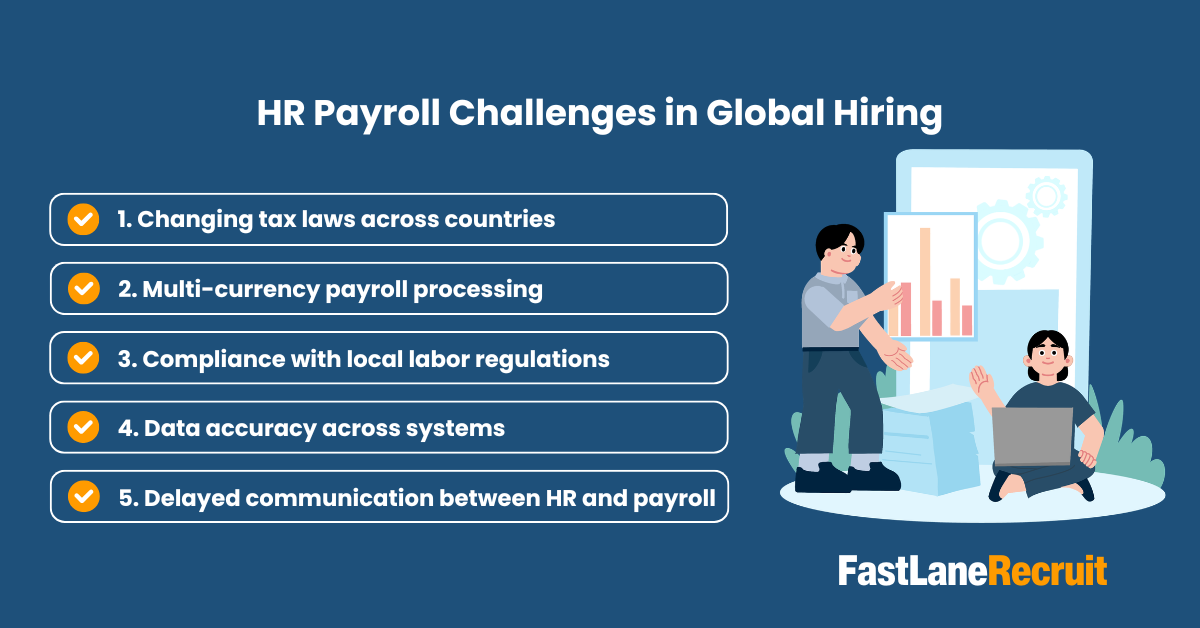
Managing hr payroll becomes significantly more complex when companies hire employees across different countries. Each country has its own labor laws, tax systems, currency rules, and compliance requirements. What works in one location may not apply in another.
Because of this, global businesses must carefully coordinate HR and payroll processes to avoid errors, delays, and compliance risks.
1. Changing tax laws across countries
Every country has different tax rules, reporting deadlines, and contribution systems. These rules can also change frequently.
Example:
An employee in Germany may have different tax deductions compared to an employee in Malaysia or the UK, even if their salary is the same.
This means payroll teams must constantly stay updated to avoid incorrect tax filings or penalties.
2. Multi-currency payroll processing
Global companies often pay employees in different currencies, which adds complexity to payroll calculations.
Example:
A company headquartered in Singapore may need to pay:
- Employees in Malaysia in MYR
- Employees in Europe in EUR
- Employees in the US in USD
Fluctuating exchange rates can also affect payroll budgeting and reporting accuracy.
3. Compliance with local labor regulations
Each country has its own employment laws covering working hours, overtime, leave entitlements, termination rules, and benefits.
Example:
In Malaysia, employers must comply with regulations such as:
- Employment Act 1955
- EPF (Employees Provident Fund) contributions
- SOCSO (social security protection)
- PCB (tax deductions for employees)
Failing to comply can lead to penalties or legal risks for the business.
4. Data accuracy across systems
HR and payroll systems often rely on shared employee data. If the data is inconsistent or outdated, payroll errors can occur.
Example:
If HR updates an employee’s promotion but payroll is not updated, the employee may continue receiving the old salary.
Even small data mismatches can lead to overpayments, underpayments, or compliance issues.
5. Delayed communication between HR and payroll
When HR and payroll teams are not aligned or working in separate systems, communication delays can cause payroll issues.
Example:
If HR does not inform payroll in time about a resignation, payroll may process an extra salary payment, leading to unnecessary corrections later.
How to Improve HR Payroll Efficiency
To overcome these challenges, businesses can optimize their hr payroll processes through better systems, clear communication, and automation.
1. Use integrated HR payroll systems
Using a single platform that connects HR and payroll reduces duplication and improves accuracy.
Benefits include:
- One source of employee data
- Automatic updates between HR and payroll
- Fewer manual errors
- Faster payroll processing
Example:
When HR updates a salary change, the payroll system automatically reflects the update in the next payment cycle.
2. Define clear responsibilities
Clearly assigning tasks between HR and payroll teams prevents confusion and delays.
Example:
- HR handles hiring, contracts, and employee updates
- Payroll handles salary processing, taxes, and deductions
When roles are clearly defined, there is less risk of missing or duplicated work.
3. Automate payroll processes
Automation reduces manual work and improves accuracy in calculations and compliance reporting.
Examples of automation benefits:
- Automatic tax calculations
- Real-time salary adjustments
- Automated payslip generation
- Scheduled payroll runs
This helps reduce human error, especially in large or global teams.
4. Standardize workflows across countries
Having consistent processes for hiring, promotions, leave, and exits helps maintain structure across global teams.
Example:
A standardized onboarding process ensures that every new employee, whether in Malaysia, Germany, or the UK, goes through the same HR payroll setup steps.
This improves consistency and reduces onboarding delays.
5. Align HR and payroll KPIs
When HR and payroll share performance goals, collaboration becomes more effective.
Common shared KPIs include:
- Payroll accuracy rate
- On-time salary payments
- Compliance error rate
- Employee satisfaction scores
Example:
If payroll accuracy is measured as a shared KPI, both HR and payroll teams are more motivated to ensure data is correct from the start.
Why This Matters for Global Businesses
For companies hiring internationally, strong HR payroll efficiency is not just an operational benefit, it is a business necessity.
When HR and payroll work smoothly together:
- Employees are paid correctly and on time
- Compliance risks are reduced
- HR operations become more scalable
- Global hiring becomes faster and more predictable
This is especially important for companies expanding into regions like Southeast Asia, where labor laws and payroll structures vary significantly between countries.
Also Read: Job Level Classification: How to Build a Fair, Consistent System Your Team Will Actually Use
Outsourcing HR Payroll for Global Expansion
Many companies outsource HR payroll functions to reduce complexity and improve compliance.
Benefits of outsourcing include:
- Lower administrative costs
- Access to local compliance expertise
- Faster global hiring
- Reduced legal risks
- Better focus on core business growth
For companies expanding into Southeast Asia, outsourcing is especially useful for navigating local employment regulations.
Example: Hiring in Malaysia Using HR Payroll Support
Instead of setting up a legal entity in Malaysia, companies can use an Employer of Record (EOR) model.
An EOR manages:
- HR compliance
- Payroll processing
- Tax contributions
- Employment contracts
This allows companies to hire Malaysian employees quickly and legally without a complex setup.
Conclusion
Understanding hr payroll is essential for any business managing employees, especially in a global environment. HR focuses on people and workplace development, while payroll ensures accurate and compliant compensation.
When both functions work together, or are integrated into a single system, businesses experience smoother operations, better compliance, and stronger employee satisfaction.
However, for companies expanding internationally, managing HR payroll in-house can become complex. This is where outsourcing solutions like Employer of Record (EOR) services become highly valuable.
Scale Your Global Hiring with FastLaneRecruit
FastLaneRecruit helps companies simplify HR payroll and hire talent in Malaysia without the need to set up a local entity.
With our Employer of Record (EOR) service, we handle:
- HR compliance and onboarding
- Payroll processing and tax filing
- Employment contracts
- Local labor law compliance
So you can focus on growing your team while we handle the complexity.