
As businesses expand globally, choosing the right external talent model becomes increasingly important. Two of the most commonly used options are freelancers and independent contractors, and while they may seem similar, they work differently in practice.
Understanding freelance vs contract arrangements helps companies hire the right talent, manage costs effectively, and stay compliant with local labour regulations. It also reduces the risk of misclassification, which can lead to legal and tax complications.
In this guide, we break down the differences in a simple, practical way so you can confidently decide which model fits your hiring needs, especially if you are building distributed teams or hiring talent in markets like Malaysia and beyond.
Content Outline
Key Summary
Understanding Work Models
Freelancers focus on short-term, task-based work, while contractors take on longer-term, role-based responsibilities within structured agreements.
Flexibility vs Structure
Freelancers enjoy high flexibility in choosing projects and schedules, whereas contractors usually follow more structured timelines and responsibilities.
Client Relationships
Freelancers often work with multiple clients at the same time, while contractors typically work with one primary client during a contract period.
Scope of Work
Freelancers handle specific deliverables such as design or content creation, while contractors manage broader functions like IT, finance, or operations support.
Engagement Duration
Freelancers are ideal for short-term projects or seasonal needs, while contractors are better suited for long-term engagements lasting several months or years.
Compliance and Risk Consideration
Misclassifying workers can create legal and tax risks, especially in global hiring. Businesses must carefully evaluate labour laws and engagement structures.
Global Hiring and EOR Relevance
For companies hiring across borders, especially in regions like Malaysia, Employer of Record (EOR) solutions help manage compliance, payroll, and workforce operations efficiently.
What is a Freelancer?
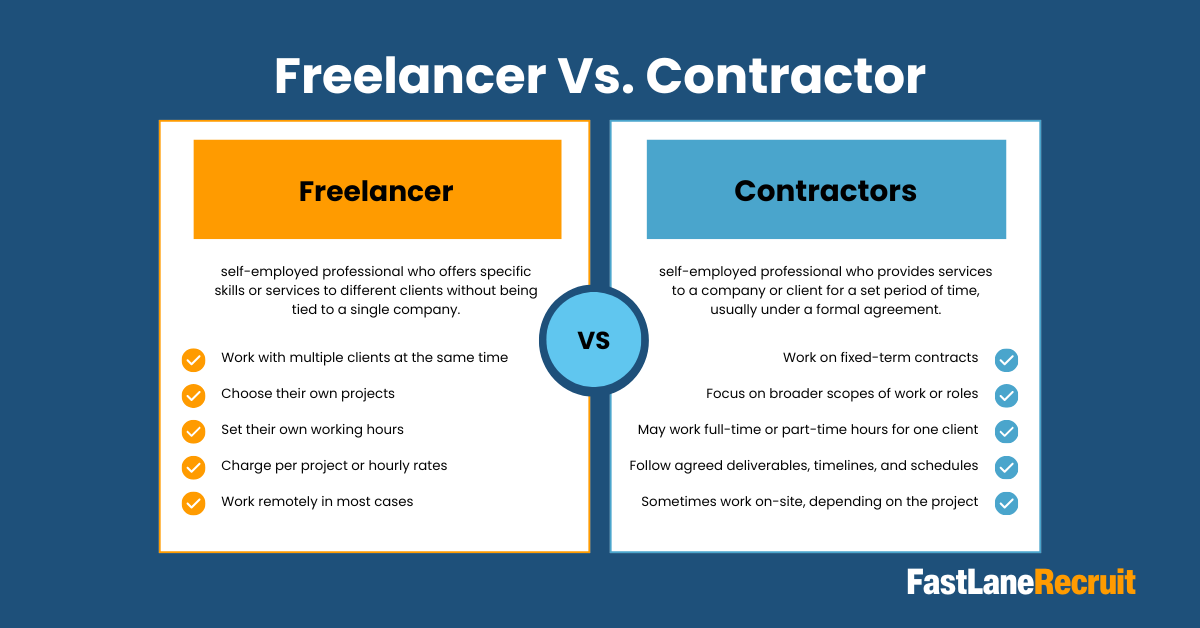
A freelancer is a self-employed professional who offers specific skills or services to different clients without being tied to a single company. Instead of working full-time for one employer, freelancers take on individual projects from multiple clients and manage their own workload.
Think of a freelancer as someone who runs their own small service business. They decide who to work with, what projects to accept, and how to organize their time. This makes freelancing a flexible way of working, especially for people who prefer variety in their projects.
How freelancers typically work
Freelancers usually work in a very independent way:
- Work with multiple clients at the same time
A freelancer might be designing a logo for one company while writing blog content for another. This helps them diversify their income and experience. - Choose their own projects
Instead of being assigned work, freelancers can decide which projects they want to take on based on their skills, interests, and availability. If a project doesn’t fit, they can politely decline. - Set their own working hours
Freelancers are not tied to fixed office hours. They can work early in the morning, late at night, or during flexible hours, what matters most is meeting deadlines. - Charge per project or hourly rates
Payment is usually agreed before the work starts. Some freelancers charge a fixed price for the whole project, while others charge based on the number of hours worked. - Work remotely in most cases
Many freelancers work from home, coworking spaces, or anywhere with an internet connection. Physical office presence is usually not required unless the project demands it.
Common freelance roles
Freelancers are widely used in industries that require specialized, project-based skills. Some of the most common freelance roles include:
- Content writers – creating blog posts, website content, and marketing copy
- Graphic designers – designing logos, branding materials, and social media visuals
- Web developers – building and maintaining websites or web applications
- Social media specialists – managing content, engagement, and online presence for brands
These roles are often hired based on specific needs rather than long-term employment.
When do companies hire freelancers?
Freelancers are usually hired when a company needs:
- Short-term support for a project
- Specialized expertise that is not needed full-time
- Extra manpower during busy periods
- Flexible talent without long-term hiring commitments
For example, a company may hire a freelance designer to create a new logo or a freelance writer to produce a set of articles for a campaign.
Simple summary
Freelancers are independent professionals who provide skills on a flexible, project-by-project basis. They work with different clients, manage their own time, and are typically brought in for specific tasks that require expertise without the need for a long-term employment arrangement.
Also Read: Job Level Classification: How to Build a Fair, Consistent System Your Team Will Actually Use
What is an Independent Contractor?
An independent contractor is a self-employed professional who provides services to a company or client for a set period of time, usually under a formal agreement. Unlike freelancers who often juggle many small projects, independent contractors typically work more closely with one main client for the duration of a contract.
You can think of an independent contractor as someone who temporarily “fills a role” within a company without becoming a permanent employee. They are still independent, but their work is usually more structured and longer-term compared to freelance work.
How independent contractors typically work
Independent contractors usually operate in a more organized and role-focused way:
- Work on fixed-term contracts (months to years)
Contractors are usually hired for a specific time period, such as 3 months, 6 months, or even 1–2 years. The contract clearly defines when the work starts and ends, although it may sometimes be extended. - Focus on broader scopes of work or roles
Instead of completing small tasks, contractors are often responsible for larger responsibilities. For example, they might manage an entire IT system, handle financial reporting, or support an ongoing marketing function. - May work full-time or part-time hours for one client
Many contractors dedicate most or all of their working hours to a single company during the contract period. This makes their work structure feel more like a traditional job, even though they are not employees. - Follow agreed deliverables, timelines, and schedules
Contractors usually work based on a clear plan set at the beginning of the contract. This includes deadlines, expected outcomes, and sometimes even fixed working hours depending on the project. - Sometimes work on-site, depending on the project
While many contractors work remotely today, some roles, especially in industries like healthcare, construction, or IT infrastructure, may require them to be physically present at the client’s location.
Examples of independent contractor roles
Independent contractors are commonly found in professional and specialized industries where companies need consistent expertise for a defined period:
- IT consultants – managing systems, infrastructure, or software projects
- Healthcare professionals – such as locum doctors or specialist medical consultants
- Legal advisors – providing legal support for specific cases or projects
- Finance specialists – handling accounting, audits, or financial planning tasks
These roles often require deeper involvement in a company’s operations compared to freelance assignments.
How independent contractors differ in nature of work
One of the simplest ways to understand contractors is this:
- Freelancers = task-based work
(e.g., design a logo, write a blog, create a website page) - Independent contractors = role-based work
(e.g., manage IT operations for 6 months, oversee financial reporting for a project cycle)
Contractors usually take on responsibilities that look and feel closer to an internal team member, but they still maintain independence and are not considered permanent employees.
Simple summary
An independent contractor is a self-employed professional who works under a structured, time-bound contract, usually for one main client. They take on broader responsibilities, often work longer engagements, and play a more “role-like” function compared to freelancers, who typically focus on smaller, project-specific tasks.
Freelance vs Contract: Key Differences
Understanding the difference between freelancers and independent contractors becomes much easier when you compare them side by side. While both are self-employed and work independently, the way they operate, the type of work they handle, and their level of commitment to a client can be quite different.
Below is a simplified breakdown to help you clearly see how freelance vs contract roles compare in real-world situations.
1. Work Scope
- Freelancer:
Freelancers usually handle specific tasks or deliverables. Their work is clearly defined and focused on a particular output such as designing a logo, writing a blog post, or creating a website page. - Independent Contractor:
Contractors are typically responsible for broader roles or ongoing responsibilities. Instead of one-off tasks, they may manage an entire function such as IT support, financial reporting, or marketing operations over a longer period.
In simple terms, freelancers focus on tasks, while contractors often manage broader responsibilities.
2. Engagement Length
- Freelancer:
Engagements are usually short-term or project-based. Work may last a few days, weeks, or for a specific campaign. - Independent Contractor:
Contractors are engaged for mid to long-term periods, often ranging from several months to a few years. Contracts have defined start and end dates, with possible extensions.
Contractors are more suitable when consistency over time is required.
3. Number of Clients
- Freelancer:
Freelancers often work with multiple clients at the same time, allowing them to take on varied projects. - Independent Contractor:
Contractors usually work with one primary client during the contract period, focusing more deeply on that engagement.
4. Schedule
- Freelancer:
Freelancers have full control over their working hours. They decide when to work as long as deadlines are met. - Independent Contractor:
Contractors may follow a more structured schedule. Some roles require fixed working hours or alignment with the client’s business operations.
5. Work Location
- Freelancer:
Most freelancers work remotely from any location, such as home or coworking spaces. - Independent Contractor:
Contractors may work remotely or on-site depending on project requirements and industry needs.
6. Payment Structure
- Freelancer:
Payment is usually per project or hourly. Freelancers set their own rates and invoice clients based on agreed deliverables. - Independent Contractor:
Contractors are typically paid hourly or through a fixed-term contract arrangement, with structured payment cycles over the engagement period.
7. Hiring Model
- Freelancer:
Freelancers are usually hired directly through platforms, referrals, or direct client outreach, often with a quick hiring process. - Independent Contractor:
Contractors may be hired directly or through agencies or Employer of Record (EOR) providers, especially for cross-border hiring where compliance is required.
8. Control Level
- Freelancer:
Freelancers have a high level of independence and control over how they complete their work. - Independent Contractor:
Contractors also work independently but follow more structured processes, reporting requirements, and client guidelines.
Summary Comparison
- Freelancers are flexible, task-focused, and often work with multiple clients on short-term projects.
- Independent contractors are more structured, role-focused, and typically engaged for longer-term assignments with one primary client.
Both models provide flexibility compared to traditional employment, but they serve different business needs depending on scope, duration, and level of responsibility.
Here is a simplified comparison to help you understand the differences clearly:
| Factor | Freelancer | Independent Contractor |
| Work Scope | Specific tasks or deliverables | Broader role or ongoing responsibilities |
| Engagement Length | Short-term or project-based | Mid to long-term contracts |
| Number of Clients | Multiple clients at once | Usually one primary client |
| Schedule | Fully flexible | May follow structured working hours |
| Work Location | Remote, flexible | Remote or on-site depending on contract |
| Payment Structure | Per project or hourly | Hourly or fixed-term contract |
| Hiring Model | Direct engagement | Direct or via agency/EOR |
| Control Level | High independence | Moderate structure and reporting |
Also Read: What Is Business Process Outsourcing (BPO) and How Does It Work?
Key Similarities Between Freelancers and Contractors
Although freelancers and independent contractors differ in how they work, they share several important characteristics. Both fall under the broader category of independent work, which means they operate outside of traditional full-time employment structures while still delivering professional services to businesses.
Understanding these similarities helps businesses set clear expectations and ensures proper classification when hiring external talent.
1. Self-Employment Status
Both freelancers and independent contractors are considered self-employed professionals. This means they are not employees of the companies they work with.
Instead, they:
- Run their own independent work setup
- Manage their own business activities
- Decide which clients and projects to take on
- Operate with a high level of autonomy
They are responsible for running their work like a small business, even if they are working alone.
2. Tax Responsibility
One of the most important similarities is tax responsibility. Unlike traditional employees, freelancers and contractors must manage their own taxes.
In the United States, clients typically issue a 1099-NEC form to report payments made to independent workers.
According to the IRS, independent contractors are responsible for reporting income and paying applicable self-employment taxes.
This includes:
- Income tax reporting
- Self-employment tax obligations
- Estimated quarterly tax payments (in many cases)
They do not have taxes automatically deducted from their payments like salaried employees.
3. No Standard Employee Benefits
Freelancers and contractors generally do not receive employee benefits from the companies they work with.
This typically means no access to:
- Paid annual or sick leave
- Health insurance coverage
- Retirement contributions such as pensions or 401(k) plans
- Paid public holidays
Because of this, independent professionals usually factor these costs into their rates and manage their own benefits independently.
4. Own Tools and Expenses
Both freelancers and contractors are usually responsible for providing their own tools and resources needed to complete their work.
This may include:
- Laptops or computers
- Software subscriptions
- Internet connection
- Workspaces or office setup
In many cases, they also cover their own business-related expenses such as:
- Training and skill development
- Travel costs (unless explicitly agreed otherwise)
- Office supplies and equipment
Some clients may provide access to internal systems or tools, but ownership and responsibility for core working tools usually remain with the independent professional.
5. Contract-Based Work
Freelancers and contractors both work under formal agreements that define the terms of engagement. These contracts help ensure clarity for both parties and reduce misunderstandings.
A typical agreement outlines:
- Scope of work – what tasks or responsibilities are included
- Payment terms – rates, billing cycles, and payment methods
- Timeline – project duration, deadlines, or contract period
- Deliverables – expected outcomes or results
These agreements also often include clauses related to confidentiality, intellectual property rights, and termination conditions.
Summary
While freelancers and independent contractors differ in how they structure their work, both share key similarities in independence, tax responsibility, lack of standard employee benefits, self-provided tools, and contract-based engagements.
These shared characteristics are what define them as independent professionals rather than traditional employees.
Also Read: Guide to PEO vs EOR
When to Choose Freelancers vs Contractors
Choosing between freelance vs contract arrangements depends on what your business is trying to achieve, how long you need support, and how broad the work scope is. Both options can be effective, but they serve different hiring needs and project types.
A clear understanding of when to use each model can help businesses improve efficiency, manage costs better, and build more flexible teams.
Choose Freelancers If:
Freelancers are best suited for work that is focused, flexible, and outcome-driven.
You should consider freelancers when:
- You need specialized skills for short-term tasks
Freelancers are ideal when you require a specific expertise for a defined task or short project. For example, writing a set of blog articles, designing a logo, or creating website visuals. - You want flexibility in scaling work up or down
If your workload changes frequently, freelancers allow you to quickly increase or reduce support without long-term commitments. - You need multiple small deliverables
Freelancers are useful when your business requires ongoing but segmented outputs, such as weekly social media posts, ad creatives, or content updates.
In general, freelancers work best when the scope is narrow, and the outcome is clearly defined.
Example use case:
A company hires a freelance designer to create monthly social media visuals, marketing banners, and campaign graphics as needed. The work is ongoing but broken into smaller, separate deliverables.
Choose Contractors If:
Independent contractors are better suited for structured, longer-term roles where continuity and deeper involvement are required.
You should consider contractors when:
- You need someone for a longer-term role
Contractors are ideal when the work spans several months or more and requires consistent involvement with your business operations. - The work requires broader responsibilities
Instead of focusing on one task, contractors often manage multiple functions or a complete workflow. For example, overseeing IT systems, managing financial reporting, or supporting HR operations. - You want continuity in project execution
Contractors help maintain stability in ongoing projects, ensuring processes remain consistent and aligned over time.
In short, contractors are better when you need role-based support rather than task-based execution.
Example use case:
A company hires a contractor to manage IT support for 6–12 months. The contractor handles system maintenance, troubleshooting, and ongoing technical support across the organization.
Simple Way to Remember the Difference
- Freelancers = short-term, task-focused, flexible support
- Contractors = long-term, role-based, structured involvement
Practical Tip for Businesses
Many companies make better hiring decisions by first defining:
- How long the work will last
- Whether the need is a skill or a role
- How much control and continuity is required
If the requirement is project-based and flexible, freelancers are often the right fit. If the need is ongoing and operational, contractors are usually more suitable.
For companies expanding globally, especially in regions like Malaysia, this decision also connects to compliance and workforce structuring. In such cases, solutions like Employer of Record (EOR) services can help ensure proper classification, payroll handling, and legal compliance while scaling teams efficiently.
Business Perspective: Why This Matters for Global Hiring
For companies expanding internationally, the difference between freelancers and independent contractors is more than just a hiring preference. It directly impacts compliance, payroll structure, tax obligations, and how a business legally engages talent across different countries.
This becomes especially important in regions like Southeast Asia, where countries such as Malaysia, Singapore, and Indonesia each have their own employment rules and worker classification standards. A structure that works in one country may not automatically apply in another.
Why worker classification is important in global hiring
When hiring across borders, businesses need to clearly define whether a worker is a freelancer, independent contractor, or employee-equivalent role. This is because each classification can affect:
- Tax reporting obligations
- Legal employment status
- Social security contributions
- Contract enforceability
- Eligibility for benefits or protections
Incorrect classification can unintentionally expose a company to compliance issues in both the home country and the country where the talent is based.
Misclassification risks in international hiring
One of the biggest challenges in global workforce management is worker misclassification. This happens when a worker is treated like an independent contractor or freelancer, but their working conditions resemble those of a full-time employee.
According to the U.S. Department of Labor, worker classification is assessed based on several key factors:
- Level of control – How much direction the company has over how, when, and where work is performed
- Financial independence – Whether the worker operates their own business and bears financial risk
- Nature of the working relationship – Whether the engagement resembles employment or independent service delivery
These criteria are used to evaluate whether a worker is truly independent or should be treated as an employee under labor laws.
Why this matters more in cross-border hiring
When hiring talent internationally, compliance becomes more complex because:
- Each country has different labor definitions and thresholds
- Tax systems vary significantly between jurisdictions
- Contractor rules in one country may not apply in another
- Remote work does not remove legal obligations
For example, a contractor arrangement that is acceptable in one market may be considered misclassification in another if the level of control or working structure resembles employment.
This is why global companies must carefully design their workforce strategy before hiring remote talent abroad.
Impact on business planning and operations
Understanding freelance vs contract structures helps businesses:
- Design compliant hiring models for each country
- Reduce legal and financial exposure
- Improve workforce scalability across regions
- Choose the right engagement model based on role needs
- Maintain consistency in global HR practices
It also helps companies avoid unexpected costs related to penalties, back taxes, or contract restructuring.
For global hiring, especially in regions like Southeast Asia, worker classification is not just an HR detail; it is a core part of legal and operational planning.
Freelancers and contractors offer flexibility, but businesses must ensure that the working relationship aligns with local labour regulations to stay compliant while scaling internationally.
Also Read: Global Employment Outsourcing: Complete Guide to Hiring International Teams
Tips for Choosing the Right Model
Choosing between freelance vs contract is not just about cost or availability. It is about matching the right type of talent arrangement with your business goals, project structure, and long-term hiring plans. A clear decision upfront helps reduce hiring friction and improves overall team efficiency.
Below are practical, real-world recommendations to help guide your decision.
1. Define the Work Scope Clearly
The first step is always understanding what kind of work you actually need.
- If the work is task-based, a freelancer is usually the better fit
This includes work like writing articles, designing visuals, building a landing page, or handling small digital tasks. - If the work is role-based, a contractor is more suitable
This applies when someone needs to manage ongoing responsibilities such as IT support, marketing operations, HR coordination, or financial reporting.
A clear scope prevents confusion later and ensures the right expectations are set from the beginning.
2. Estimate Duration Early
Timeframe is one of the strongest indicators when choosing between freelancers and contractors.
- Short-term needs → freelancers are ideal
For example, a one-time campaign, seasonal content creation, or short project deliverables. - Long-term needs → contractors are better suited
For example, a 6–12 month system implementation, ongoing business support, or continuous operational work.
Defining duration early also helps with budgeting and workforce planning.
3. Evaluate Compliance Needs
When hiring across borders, compliance becomes a key factor, not just a legal requirement but a business safeguard.
International hiring involves:
- Local labor laws
- Tax obligations
- Worker classification rules
- Contract enforceability standards
Misalignment in classification can lead to compliance risks, especially when companies scale remote teams globally. This is why many organizations take extra care when engaging freelancers or contractors in different jurisdictions.
4. Consider Operational Load
Different hiring models require different levels of management effort.
- Freelancers often require more coordination
Because they work on multiple clients and smaller tasks, businesses may need to manage:- Frequent onboarding for short tasks
- Multiple communication touchpoints
- Several individual deliverables at once
- Contractors usually offer more structured engagement
Since they work within defined roles and timelines, they typically require:- Fewer handovers
- More predictable reporting cycles
- Greater continuity in execution
If your team is already managing complex workflows, reducing coordination overhead can significantly improve productivity.
5. Think Scalability
If your business is planning to expand across regions or build distributed teams, scalability becomes a major consideration.
Freelancers are great for flexibility, but large-scale workforce expansion often requires more structured systems.
For companies scaling internationally, structured hiring approaches or Employer of Record (EOR) solutions can provide:
- Compliant hiring across multiple countries
- Centralized payroll and contract management
- Reduced administrative burden
- Consistency in workforce operations
This is especially useful when building teams in markets like Southeast Asia, where labor laws and employment structures differ from country to country.
Summary
- Freelancers are best for flexible, task-based, short-term needs
- Contractors are better for structured, role-based, longer-term engagement
- Global hiring requires additional attention to compliance and scalability
A well-planned approach ensures smoother operations, better talent alignment, and fewer legal risks as your business grows internationally.
Why Businesses Use EOR for Contractors and Global Talent
As companies grow beyond their home markets, hiring freelancers and independent contractors from different countries becomes more common. While this approach offers flexibility and access to global skills, it also introduces complexity in areas like compliance, payroll, contracts, and local labor laws.
This is where an Employer of Record (EOR) becomes a practical solution for many global businesses.
An EOR acts as a legal employer on behalf of a company in a foreign country, while the talent works directly for the business. This setup helps companies hire internationally without needing to set up a local legal entity.
How an EOR supports global hiring
An Employer of Record helps businesses manage cross-border hiring in a structured and compliant way by handling key employment functions, including:
- Hiring global talent legally
The EOR ensures that employment contracts follow local labor laws in the country where the employee is based. - Handling contracts and payroll
It manages employment agreements, salary payments, tax deductions, and statutory contributions according to local regulations. - Ensuring compliance with local employment laws
Each country has its own rules around employment classification, benefits, and taxation. The EOR helps ensure businesses stay aligned with these requirements. - Reducing administrative workload
Instead of managing multiple legal systems, HR teams can focus on hiring and performance while the EOR handles operational and compliance tasks.
Why this matters when hiring contractors and freelancers globally
When companies hire freelancers or contractors across borders, they must carefully manage how those relationships are structured. In some cases, long-term or structured contractor arrangements may begin to resemble employment under local laws.
This creates challenges such as:
- Varying legal definitions of “contractor” across countries
- Tax obligations in multiple jurisdictions
- Risk of misclassification
- Complex onboarding and documentation requirements
An EOR helps simplify this by creating a compliant employment structure that aligns with local legal frameworks while still giving companies access to global talent.
Also Read: Guide to Outsourcing Web Development
Hiring Talent in Malaysia: A Practical Example
Malaysia has become an increasingly attractive hub for global hiring due to its strong talent pool, multilingual workforce, and growing digital and professional services ecosystem. It also offers good regional connectivity within Southeast Asia, making it a strategic location for business expansion.
Companies hiring Malaysian talent often evaluate different engagement models depending on their needs:
- Freelancers for short-term digital projects
Ideal for content creation, design work, digital marketing campaigns, or one-off technical tasks. - Contractors for ongoing operational roles
Suitable for longer-term responsibilities such as IT support, finance operations, HR coordination, or project management. - EOR solutions for compliant hiring
Best suited for companies that want to hire full-time or long-term talent in Malaysia without setting up a local entity.
Why companies choose EOR in Malaysia
Instead of navigating local employment structures independently, many businesses use an EOR model to simplify operations and ensure compliance.
With an EOR, companies can:
- Hire Malaysian talent legally without establishing a local entity
- Manage payroll, taxes, and statutory contributions correctly
- Stay aligned with Malaysia’s employment regulations
- Reduce administrative and legal complexity
- Focus on building and scaling their core business operations
This approach is especially useful for companies testing new markets, expanding regional teams, or building distributed workforces across Southeast Asia.
Simple takeaway
Freelancers and contractors offer flexibility, but as businesses scale globally, managing compliance and employment structures becomes more complex.
An Employer of Record provides a practical way to:
- Hire international talent legally
- Reduce operational and compliance burden
- Scale teams efficiently across countries like Malaysia
This makes EOR a strategic option for companies looking to grow globally while staying compliant and operationally efficient.
Also Read: How to Manage Staffing Shortage
Build Your Global Team with FastLaneRecruit
Expanding your business internationally opens up access to highly skilled talent across different markets. However, managing cross-border hiring, employment compliance, payroll systems, and local labour regulations can quickly become complex, especially when building teams in multiple countries.
FastLaneRecruit’s Employer of Record (EOR) service is designed to simplify this process so you can focus on growing your business while we handle the operational and compliance side of global hiring.
Whether you are hiring in Malaysia or expanding into other global markets, an EOR model allows you to build your team efficiently without the need to set up a local entity in each country.
How FastLaneRecruit supports your global hiring strategy
We help businesses streamline international workforce expansion by providing end-to-end support across key areas:
- Hiring Malaysian talent compliantly
We ensure your hiring process aligns with Malaysian local employment laws and regulations, helping you engage talent legally and confidently across different regions. - Managing contracts and payroll
From employment agreements to monthly payroll processing, we handle the full employment lifecycle in accordance with local requirements, ensuring accuracy and compliance. - Streamlining cross-border workforce operations
We reduce the complexity of managing distributed teams by centralising employment administration, allowing your internal teams to focus on core business activities. - Supporting scalable international expansion
Whether you are hiring one specialist or building an entire regional team, our EOR solution is designed to scale with your business growth.
Conclusion
Understanding freelance vs contract roles helps businesses make smarter hiring decisions based on flexibility, cost, and long-term goals.
- Freelancers are ideal for short-term, specialized work
- Contractors are better suited for structured, longer-term roles
- Both offer flexibility compared to traditional employment models
However, as businesses expand globally, compliance and workforce management become just as important as hiring itself.
Start building your global team with confidence
If you are looking to hire or outsource talent in Malaysia, FastLaneRecruit’s Employer of Record (EOR) service provides a reliable and compliant way to scale your workforce internationally. We help you simplify hiring, reduce operational complexity, and build strong global teams with confidence.
FastLaneRecruit EOR Services – your trusted partner for compliant global hiring and scalable workforce expansion. Get Started Now!