
As businesses grow, one challenge quickly appears: titles start to mean different things across teams.
A “Manager” in one department may lead five people, while a “Manager” in another handles strategy across regions. A “Senior Executive” in one office may perform mid-level work elsewhere. Over time, this creates confusion in hiring, promotions, salary planning, and employee expectations.
That is where job levels become valuable.
A clear job level system helps companies define responsibilities, progression paths, compensation ranges, and hiring expectations in a fair and consistent way. It also helps employees understand where they stand and what it takes to move forward.
For companies hiring internationally or building remote teams, job levels become even more important. They create alignment across countries, departments, and functions.
In this guide, we will explain how job levels work, why they matter, and how to build a practical framework your team will actually use.
Content Outline
Key Summary
Clear Role Structure
Job levels organise roles based on responsibility, experience, and impact, creating clarity beyond job titles alone.
Fair Career Progression
Employees understand exactly what is required to move from one level to the next, making promotions more transparent and structured.
Improved Hiring Accuracy
Defined job levels help hiring teams align expectations, reduce mismatches, and hire candidates at the correct seniority.
Consistent Compensation
Salary bands linked to job levels ensure fair and structured pay decisions instead of relying on negotiation or inconsistent benchmarks.
Stronger Employee Retention
When career growth is visible and achievable, employees are more motivated to stay and grow within the organisation.
Global Hiring Alignment
Job levels create a standard framework across countries, reducing confusion caused by different job title meanings in different regions.
Scalable Workforce Planning
A structured leveling system helps companies plan headcount, define roles clearly, and scale teams more efficiently as they grow.
What Are Job Levels?
Job levels are a way for companies to clearly organise all roles into different stages based on how much responsibility, experience, and decision-making power each role has.
Instead of only looking at job titles like “Manager” or “Executive”, companies use job levels to understand what the role actually involves. This helps avoid confusion, because the same job title can mean very different things in different companies.
For example, one company’s “Manager” might lead a small team and focus on daily tasks, while another company’s “Manager” might be responsible for multiple teams, budgets, and strategy. Job levels help standardise this so everyone understands the real scope of the role.
In simple terms, job levels answer questions like:
- How complex is the work?
- How much experience is needed?
- How independent is the person expected to be?
- How big is the impact of this role on the business?
Simple Job Level Breakdown
Here is an easier way to understand how job levels typically work:
| Job Level | What It Means in Simple Terms |
| Level 1 (Entry Level) | This is usually a starting role. The employee is still learning, needs guidance, and works on basic tasks under supervision. |
| Level 2 (Junior / Independent Contributor) | The employee can handle daily tasks independently but still works within clear guidelines. They may occasionally need support for more complex tasks. |
| Level 3 (Senior / Experienced Specialist) | The employee has strong experience, works independently, and can take ownership of projects. They often help or guide junior team members. |
| Level 4 (Lead / Manager) | The employee leads a team or a specific function. They are responsible for planning work, managing people or processes, and ensuring goals are met. |
| Level 5 (Director / Executive) | The employee is responsible for high-level strategy and decision-making. They focus on business direction, growth, and long-term planning across departments or the entire organisation. |
Why This System Is More Reliable Than Job Titles Alone
Job titles can be misleading because they are often:
- Different across companies
- Influenced by company culture or size
- Not always linked to actual responsibility
Job levels solve this problem by focusing on what the person actually does, not just what their title says.
This makes it easier for companies to:
- Compare roles fairly across departments
- Set clear expectations for performance
- Create consistent promotion paths
- Align salaries with real responsibility
For employees, it also makes career growth clearer because they can see exactly what is needed to move from one level to the next.
In short, job levels create structure, fairness, and clarity for both employers and employees.
Why Job Levels Matter for Growing Companies
As companies grow, things naturally become more complex. More people join, new teams are created, and roles start to overlap. Without a clear structure in place, it becomes difficult to keep everything consistent, especially when it comes to hiring, promotions, and pay.
This is where job levels become important. They act as a shared framework that helps everyone in the organisation understand what each role means, how it fits into the bigger picture, and what progression looks like over time.
Without clear job levels, businesses often run into common problems such as:
- Inconsistent promotions – Different managers may promote employees using different standards, which creates confusion and a sense of unfairness.
- Salary disputes – Employees may feel they are underpaid compared to others in similar roles because there is no clear structure behind pay decisions.
- Title inflation – Job titles can become exaggerated over time without a real increase in responsibility, making it harder to compare roles accurately.
- Hiring mismatches – Teams may disagree on what level a role should be, leading to hiring the wrong seniority or skill level.
- Employee frustration – When expectations are unclear, employees may feel stuck or unsure about their performance.
- Unclear career progression – Without defined levels, employees cannot clearly see how to grow within the company.
- Difficult workforce planning – Leaders struggle to plan team structures, budgets, and future hiring needs effectively.
When job levels are clearly defined, these challenges become easier to manage. The organisation becomes more structured, decisions become more consistent, and employees gain a clearer understanding of their career path.
Key Benefits of Job Levels
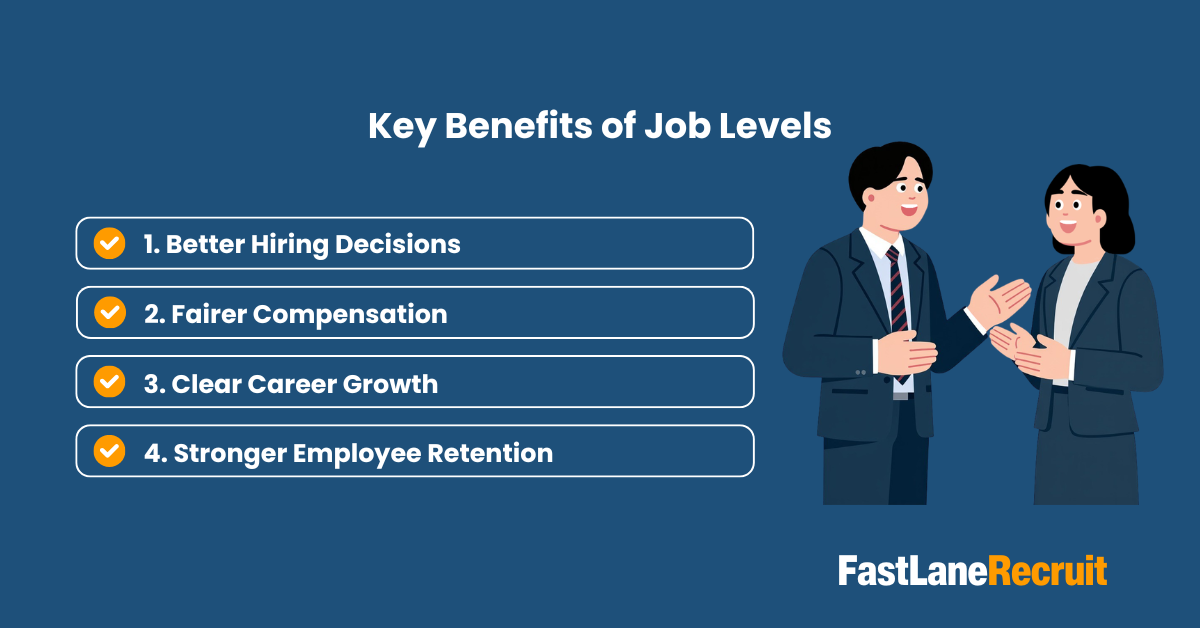
1. Better Hiring Decisions
With clear job levels, hiring becomes much more focused and efficient. Recruiters and hiring managers can agree upfront on:
- What skills are required
- What level of experience is needed
- What responsibilities the role will include
- What success looks like in the role
This reduces confusion during the hiring process and helps ensure that candidates are matched to the right level from the start. It also improves the quality of hires because expectations are clearly defined before interviews even begin.
2. Fairer Compensation
Job levels help create a more structured and transparent approach to pay.
Instead of negotiating salaries in isolation, companies can link compensation to:
- Role scope
- Level of responsibility
- Required experience
- Market benchmarks
This creates more consistency across the organisation and reduces situations where employees in similar roles are paid very differently without clear justification. It also supports long-term fairness and trust within the company.
3. Clear Career Growth
One of the biggest advantages of job levels is clarity in career progression.
Employees can clearly see:
- What level they are currently at
- What the next level looks like
- What skills or outcomes are required to progress
- What type of impact is expected at each stage
This makes career development more structured and less uncertain. Instead of guessing how to grow, employees have a defined pathway to follow, which helps them focus their development in the right direction.
4. Stronger Employee Retention
When employees understand how they can grow within a company, they are more likely to stay long-term.
A clear job level system gives employees confidence that:
- Their progress is visible
- Their contributions are measured fairly
- There is a real opportunity to advance
Research from LinkedIn shows that career development opportunities are one of the most important factors influencing employee retention. When people can see a future for themselves in the organisation, they are less likely to look elsewhere.
Also Read: Understanding the Recruitment Process: Strategies for Success
5. Easier Global Expansion
For companies hiring across multiple countries, job levels become even more important.
Different regions often have different:
- Job title conventions
- Salary expectations
- Experience definitions
- Role structures
A standard job level framework helps companies compare roles across countries in a consistent way. This makes it easier to:
- Hire international talent
- Set fair compensation across regions
- Align expectations across global teams
- Build scalable organisational structures
In short, job levels act as a common language for global hiring.
When implemented properly, job levels bring structure, fairness, and clarity to every stage of the employee lifecycle, from hiring and compensation to career growth and long-term workforce planning.
Job Levels vs Job Titles: What Is the Difference?
Many companies confuse job titles with job levels, but they are not the same thing. They may look similar on the surface, but they serve completely different purposes in how an organisation defines roles, responsibilities, and career progression.
Understanding the difference is important because it helps companies hire correctly, set fair salaries, and create clear career paths for employees.
Job Titles: What They Are
A job title is simply the name given to a role in a company. It is what you see on a business card, LinkedIn profile, or job posting.
Examples include:
- Marketing Manager
- Software Engineer
- Director of Operations
- Data Analyst
Job titles are often influenced by:
- Company culture
- Industry norms
- Internal preferences
- Marketing or branding choices
- Company size or structure
Because of this, job titles can vary widely between companies even when the actual work is similar.
Job Levels: What They Are
A job level is a structured way of measuring the seniority, responsibility, and impact of a role.
Instead of focusing on what the job is called, job levels focus on:
- How complex the work is
- How much responsibility the role carries
- How independent the employee is expected to be
- How much business impact the role has
- How decisions are made at that level
This makes job levels much more consistent and reliable across different teams and organisations.
Why Job Titles Can Be Misleading
The same job title can mean very different things depending on the company.
For example:
| Job Title | Job Level Interpretation |
| Marketing Manager | Could be Level 3 (managing campaigns) or Level 4 (leading a team and strategy) |
| Software Engineer | Could be Level 1 (junior), Level 2 (independent), or Level 3 (senior ownership) |
| Director | Could be a small team lead in one company or a senior executive role in another |
| Analyst | Could be entry-level or highly experienced depending on the organisation |
This variation creates confusion when comparing roles across companies or countries.
Job Titles vs Job Levels (Simple Comparison)
| Job Titles | Job Levels |
| Labels used for roles | Structured framework for seniority |
| Can vary widely between companies | More consistent across organisations |
| Focus on what the role is called | Focus on responsibility and impact |
| Used for branding and external communication | Used for internal structure and fairness |
Why Mature Companies Use Both
Modern and well-structured organisations use both job titles and job levels together because they serve different purposes.
- Job titles are useful for external communication, recruitment, and branding
- Job levels are essential for internal structure, fairness, and career progression
When combined, they help companies:
- Hire more accurately
- Avoid salary confusion
- Define clear promotion paths
- Improve internal fairness
- Standardise roles across departments and countries
In short:
Job titles describe the role.
Job levels define the meaning behind the role.
That is why companies with strong HR systems always separate the two.
Common Job Level Structure
Most organisations use a job level framework with around 5 to 7 levels. This structure helps standardise how roles progress from entry-level positions all the way up to executive leadership.
Instead of relying only on job titles, companies use this framework to clearly define:
- How much responsibility a role carries
- The level of experience required
- The amount of decision-making authority
- The overall impact on the business
This makes career progression clearer and more consistent across the organisation.
Typical Job Level Structure
| Level | Individual Contributor Path | Management Path |
| L1 | Coordinator / Junior Analyst | Not applicable |
| L2 | Specialist / Associate | Team Lead |
| L3 | Senior Specialist / Senior Engineer | Manager |
| L4 | Principal / Lead | Senior Manager / Head of Department |
| L5 | Expert / Distinguished Individual Contributor | Director |
| L6 | — | Vice President (VP) |
| L7 | — | C-Suite (CEO, CFO, CTO, etc.) |
Understanding the Two Career Paths
A key feature of modern job level systems is the dual-track model, which separates career growth into two clear paths:
1. Individual Contributor (IC) Path
This path is designed for employees who want to grow through deep expertise and technical or functional mastery, rather than managing people.
Examples include:
- Engineers
- Designers
- Analysts
- Recruiters
- Finance specialists
As they move up levels, their impact expands:
- From individual tasks (L1–L2)
- To owning projects (L3)
- To influencing multiple teams or systems (L4–L5)
2. Management Path
This path focuses on leading people, teams, and business functions.
Examples include:
- Team Leads
- Managers
- Senior Managers
- Directors
- Executives
As they progress, their responsibilities shift from:
- Managing small teams (L2–L3)
- To leading departments (L4–L5)
- To shaping company-wide strategy (L6–L7)
Why This Structure Works So Well
The biggest advantage of this model is that it prevents a common problem in many companies: forcing strong specialists into management roles just to grow their careers.
Without a dual-track system, employees often feel that the only way to progress is to become a manager, even if they are better suited as specialists. This can lead to poor leadership and disengaged employees.
With a structured job level system:
- Experts can continue growing without managing people
- Managers are chosen for leadership ability, not just tenure
- Career growth becomes more flexible and fair
- Employees stay longer because their strengths are recognised
In Simple Terms
- Job levels define how senior and impactful a role is
- Career paths define how someone can grow in that level system
- Titles describe the role name, but levels define the real meaning behind it
When both are used together, companies get a clear, scalable structure that supports growth, fairness, and better workforce planning.
Also Read: In-House Recruiter vs. Recruiting Agency
Why You Need Two Career Tracks
One of the most common mistakes companies make when they grow is assuming that the only way for a high performer to progress is by becoming a manager.
At first glance, this seems logical. Someone performs well, so they are promoted. But the problem is that great individual performance does not automatically translate into strong people management skills.
In reality, these are two very different skill sets:
- One is about doing the work exceptionally well
- The other is about leading others to do the work well
When companies ignore this difference, they often end up promoting strong specialists into management roles where they may struggle, feel frustrated, or lose engagement. At the same time, the organisation loses a highly valuable expert.
To avoid this, modern organisations use a dual career track system.
Example of Dual Career Tracks
A simple example in a recruitment function:
| Individual Contributor (IC) Path | Management Path |
| Senior Recruiter | Recruitment Manager |
| Lead Recruiter | Head of Talent Acquisition |
| Principal Recruiter | Director of Talent |
In this structure:
- The IC path focuses on becoming a highly skilled recruitment expert
- The management path focuses on leading hiring teams and shaping talent strategy
Both paths are equally valuable and can reach senior levels within the organisation.
Why This Model Is So Important
Without a dual-track system, companies often face several problems:
- Strong specialists are pushed into management roles they are not suited for
- Leadership quality becomes inconsistent
- Valuable technical or functional expertise is lost
- Employee frustration increases due to mismatched roles
- Senior roles become dependent on people management, not skill
Over time, this can weaken both performance and retention.
The Key Benefit: Retaining Top Talent
The biggest advantage of having two career tracks is simple: you keep your best people in the organisation longer.
Not everyone wants to manage people. Some employees are most motivated by:
- Solving complex problems
- Building deep expertise
- Working on high-impact projects
- Becoming recognised experts in their field
A dual-track system allows them to grow without changing their career direction.
At the same time, it ensures that people who are genuinely interested in leadership can step into management roles with the right skills and mindset.
In Simple Terms
- IC path = grow through expertise
- Management path = grow through leadership
Both paths are equal in value, just different in focus.
When companies design careers this way, they create a more balanced organisation where:
- Specialists feel valued
- Leaders are properly equipped
- Career growth is clearer
- And top talent is less likely to leave
This is why most mature organisations now build two career tracks into their job level systems from the very beginning.
How to Build a Job Levels Framework
Building a job levels framework is not just an HR exercise. It is the foundation that connects hiring, compensation, performance, and career growth into one consistent system.
When done well, it helps employees clearly understand their career path and helps companies make fair, structured decisions about hiring and promotions.
Below is a practical step-by-step approach to building a job levels framework that actually works in real organisations.
Step 1: Review Current Roles
The first step is to understand what people are actually doing day-to-day, not just what their job titles say on paper.
In many companies, job descriptions become outdated quickly. As a result, the real responsibilities of a role may no longer match its official title or level.
To build an accurate framework, review each role by looking at:
- Responsibilities – What tasks and outcomes is the person accountable for?
- Reporting lines – Who do they report to, and who reports to them (if anyone)?
- Decision-making authority – What decisions can they make independently?
- Skills required – What technical or functional skills are needed to perform well?
- Business impact – How does this role contribute to company goals and results?
At this stage, the goal is to understand reality, not assumptions.
A helpful reference for structured job analysis can be found through the U.S. Department of Labor, which provides guidance on role evaluation, classification, and workforce structuring principles.
Step 2: Group Roles into Job Families
Once you understand individual roles, the next step is to group them into job families.
A job family is a collection of roles that share similar skills, responsibilities, and career paths.
Common examples include:
- Sales
- Marketing
- Finance
- Human Resources
- Engineering
- Operations
- Customer Support
Each job family should have its own progression ladder, because the way someone grows in engineering will look very different from how someone grows in marketing or HR.
For example:
- In Engineering: Junior Developer → Senior Engineer → Tech Lead
- In HR: HR Assistant → HR Generalist → HR Business Partner
This structure ensures career progression feels logical and relevant within each function.
Step 3: Define Levels Clearly Using Measurable Criteria
This is the most important part of the framework. Job levels must be defined using clear and measurable criteria, not vague descriptions or job titles.
Instead of saying “Senior means more responsibility,” you need to define what “more responsibility” actually means.
You can use the following key dimensions:
| Criteria | Questions to Ask |
| Scope | How large is the responsibility? Is it individual tasks, a team, or multiple departments? |
| Complexity | How difficult or unpredictable is the work? Are problems routine or highly complex? |
| Independence | Does the role require supervision, or can the person work independently? |
| Leadership | Does the role guide, mentor, or manage others? |
| Impact | Does the work affect a team, department, or the entire organisation? |
By using these criteria consistently, companies can reduce bias and ensure that promotions are based on structured expectations rather than subjective opinions.
Step 4: Build Salary Bands
Once job levels are defined, the next step is to connect them to compensation ranges (salary bands).
Each level should have a defined pay range that reflects:
- Responsibility
- Skill level
- Market value
- Geographic location
Example structure:
| Level | Salary Band Description |
| L1 | Entry-level range for learners and early-career professionals |
| L2 | Developing professional range with growing independence |
| L3 | Experienced professional range with full ownership of work |
| L4 | Leadership range with team or functional responsibility |
| L5 | Executive range with strategic and organisational impact |
A well-designed system often includes overlap between levels, so employees can progress within a level before moving to the next stage.
It is also important to regularly benchmark salaries based on country-specific and market-specific data, especially for global teams.
Step 5: Communicate Internally
A job levels framework only works if people understand it.
Once defined, it must be clearly communicated across the organisation.
Employees should understand:
- What each job level means
- How promotions are decided
- How salary ranges are structured
- What skills or outcomes are needed to progress
Managers should also be trained to explain the system clearly during performance reviews and career discussions.
When employees understand how decisions are made, trust in the system increases significantly.
Transparency is not just helpful, it is essential for adoption.
Also Read: Bridging The Talent Gap in Australia’s Job Market: Hiring Trends In 2026
Step 6: Review Annually
A job levels framework is not a one-time project. It is a system that must evolve with the business.
Roles change over time due to:
- New technologies
- Market changes
- Company growth
- Organisational restructuring
- New business priorities
Because of this, companies should review their framework at least once a year or whenever major changes occur.
During the review, organisations should check:
- Are job descriptions still accurate?
- Have responsibilities shifted?
- Are salary bands still competitive?
- Do new roles need to be added?
Regular reviews help prevent level drift, where roles slowly become misaligned over time without anyone noticing.
In Summary
Building a job levels framework involves:
- Understanding real work being done
- Grouping roles into structured families
- Defining clear and measurable levels
- Connecting levels to salary bands
- Communicating the system clearly
- Reviewing and updating it regularly
When all these steps work together, companies create a structured system that supports fairness, clarity, and long-term growth for both employees and the organisation.
Job Levels Example: Recruitment Team
Recruitment is one of the fastest-growing functions in many organisations, especially as companies scale, expand into new markets, or build distributed teams. Because hiring needs can change quickly, having a clear job levels structure in recruitment is especially important.
Without defined levels, recruitment teams often face unclear expectations such as:
- Who owns which hiring roles
- What “senior recruiter” actually means
- When someone is ready to lead a team
- How career progression works in talent acquisition
A structured job levels framework solves this by clearly mapping responsibility, ownership, and progression across the recruitment function.
Recruitment Job Levels Breakdown
| Level | Recruitment Role | Typical Scope |
| L1 | Recruitment Coordinator | Handles scheduling, interview coordination, candidate communication, and administrative support |
| L2 | Recruiter | Manages full-cycle recruitment for standard or well-defined roles, from sourcing to offer stage |
| L3 | Senior Recruiter | Owns critical or hard-to-fill roles, works with hiring managers independently, and mentors junior recruiters |
| L4 | Talent Acquisition Manager | Leads a recruitment team, oversees hiring strategy for departments, and manages workforce planning |
| L5 | Director of Talent | Defines overall talent acquisition strategy, aligns hiring with business growth, and oversees regional or global recruitment functions |
What Each Level Really Means in Practice
L1: Recruitment Coordinator
At this stage, the focus is on support and execution of processes.
Typical responsibilities include:
- Scheduling interviews across multiple stakeholders
- Coordinating candidate communication
- Managing job postings and applicant tracking updates
- Supporting recruiters with administrative tasks
This role is essential for keeping the hiring process organised and efficient, especially in high-volume recruitment environments.
L2: Recruiter
This is where professionals begin to own the recruitment process end-to-end.
They typically:
- Handle sourcing, screening, and interviewing candidates
- Work on standard or recurring roles
- Collaborate with hiring managers on requirements
- Manage candidate pipelines independently
At this level, recruiters are expected to work with more autonomy while still following established hiring processes.
L3: Senior Recruiter
Senior Recruiters take on more complex and high-impact hiring needs.
Their responsibilities often include:
- Owning critical or specialised hiring roles
- Managing difficult-to-fill positions
- Advising hiring managers on talent strategies
- Mentoring junior recruiters or coordinators
- Improving recruitment processes and candidate experience
At this level, success is not just about filling roles, but about quality of hires and influence on hiring outcomes.
L4: Talent Acquisition Manager
This level shifts from individual hiring to team and strategy ownership.
Responsibilities typically include:
- Leading a team of recruiters and coordinators
- Managing hiring plans across departments
- Working closely with leadership on workforce planning
- Improving recruitment efficiency and performance metrics
- Ensuring alignment between hiring and business goals
At this stage, the focus moves from “hiring roles” to “building systems that enable hiring at scale.”
L5: Director of Talent
This is a strategic leadership role responsible for the overall talent acquisition direction of the organisation.
Key responsibilities include:
- Defining global or company-wide hiring strategy
- Aligning talent acquisition with business expansion plans
- Leading senior recruitment leaders and managers
- Driving employer branding and talent positioning
- Overseeing recruitment performance across regions or markets
At this level, the impact is organisational and long-term, not operational.
Why This Structure Matters
A clear recruitment job levels system helps organisations in several important ways:
- Clear career progression – employees understand what it takes to move from coordinator to director
- Better hiring decisions – roles are clearly defined, reducing mismatches in expectations
- Stronger performance management – expectations are tied to level, not subjective judgment
- Improved team structure – responsibilities are distributed logically across levels
- Better retention – recruiters see a long-term future in the organisation
Simple Takeaway
This structure ensures that recruitment teams grow in a logical way:
- Early levels focus on execution and coordination
- Mid levels focus on independent hiring ownership
- Senior levels focus on mentorship and complex hiring
- Leadership levels focus on strategy and organisational growth
When companies apply job levels correctly, recruitment becomes not just a function for filling roles, but a strategic driver of business growth.
Job Levels for Global Hiring
When companies start hiring across different countries, one of the first challenges they run into is inconsistency in job titles. A role that looks the same on paper can mean very different things depending on the country, industry, or even company culture.
This is where a job levels framework becomes especially important for global teams.
Instead of relying on job titles alone, companies use job levels to create a shared standard for understanding:
- Seniority
- Responsibility
- Decision-making authority
- Compensation alignment
- Career progression
Why Job Titles Break in Global Hiring
Job titles are not universal. They are often shaped by local hiring practices and market norms.
For example:
- The title “Executive” in some countries may refer to an entry-level or early-career role
- In other regions, “Executive” may refer to senior leadership or strategic roles
- The title “Manager” may mean team leadership in one company, but only operational coordination in another
- “Associate” may indicate a fresh graduate in one market, but a mid-level professional in another
This creates confusion when companies try to compare candidates across countries or build consistent global teams.
Also Read: Singapore Job Market: Hiring Trends In 2026
Why Job Levels Solve This Problem
A job level system removes ambiguity by focusing on structured criteria instead of job titles.
Instead of asking:
- “What does this title mean in this country?”
Companies ask:
- “What level of responsibility, impact, and independence does this role have?”
This allows organisations to:
- Compare roles fairly across regions
- Standardise hiring expectations globally
- Avoid salary inconsistencies
- Create a unified career structure across countries
- Improve internal fairness in promotions and mobility
Example: How Job Levels Create Global Consistency
A “Customer Support Executive” in one country might be:
- L1 (Entry-level support role with supervision)
While in another company or region, a similar title could actually perform at:
- L2 (Independent support handling customer issues)
- Or even L3 (senior escalation handling and mentoring others)
With job levels, the comparison becomes clearer:
| Job Title (varies globally) | Job Level (standardised meaning) |
| Executive | L1–L2 depending on scope |
| Associate | L1–L3 depending on responsibility |
| Manager | L3–L5 depending on leadership scope |
This removes confusion and ensures that compensation and responsibility are aligned correctly, no matter the country.
Why This Matters Even More in Malaysia-Based Regional Teams
This becomes especially important for companies building regional teams in markets like Malaysia, where organisations often manage multi-country or APAC-wide operations.
Many companies in Malaysia hire across functions such as:
- Finance
- Customer support
- IT and engineering
- Marketing and digital teams
- Shared services operations
- Recruitment and HR operations
In these environments, teams are often distributed across:
- Malaysia
- Singapore
- Indonesia
- Philippines
- Remote global locations
Without job levels, it becomes difficult to:
- Compare roles across countries
- Set fair salary benchmarks
- Decide promotion eligibility consistently
- Build unified HR structures across regions
How Job Levels Improve Fair Global Hiring
A structured job levels system helps companies:
1. Standardise Hiring Across Countries
Instead of interpreting job titles locally, recruiters can assess candidates based on level criteria such as scope and impact.
2. Improve Pay Fairness Across Regions
Job levels allow companies to set consistent salary bands while still adjusting for local market conditions.
This helps avoid:
- Underpaying senior talent in certain markets
- Overpaying junior roles due to title inflation
- Inconsistent compensation for similar responsibilities
3. Support Global Career Mobility
Employees can move between countries or teams more easily when levels are standardised.
For example:
- An L3 Marketing Specialist in Malaysia can transfer to a regional hub without role confusion
- A global promotion system becomes easier to manage
4. Reduce Misalignment in Remote Teams
As remote and hybrid teams grow, job titles alone are not enough to define expectations.
Job levels ensure:
- Clear performance expectations
- Consistent leadership structure
- Unified reporting structures across borders
In Simple Terms
- Job titles change from country to country
- Job levels stay consistent across the organisation
- Job levels make global hiring fair, structured, and comparable
Common Mistakes to Avoid
Even well-designed job level systems can fail if they are built or managed incorrectly. Most issues don’t come from the framework itself, but from how it is applied over time.
Here are the most common mistakes companies should avoid when building job levels.
1. Using Titles Only
One of the biggest mistakes is relying only on job titles to define seniority or responsibility.
Job titles can be misleading because:
- Different companies use the same title differently
- Titles often reflect branding rather than actual scope
- Seniority may not match responsibility
For example, a “Manager” in one company might lead a team of 10 people, while in another, it may simply mean handling coordination tasks without direct reports.
Without job levels, companies risk:
- Inconsistent hiring decisions
- Unfair salary comparisons
- Confusion in career progression
Job levels solve this by focusing on scope, impact, and responsibility instead of labels.
2. Promoting Based on Tenure Only
Another common mistake is promoting employees simply because they have been in the company for a long time.
While experience is valuable, years of service do not automatically equal higher-level capability or scope.
Promotions should be based on:
- Demonstrated impact
- Increased responsibility
- Leadership or technical contribution
- Ability to operate at the next level consistently
When promotions are based only on tenure, companies risk:
- Skill gaps at higher levels
- Reduced team performance
- Frustration among high-performing employees who are ready earlier
3. Ignoring Specialist Career Paths
Many companies unintentionally assume that career growth must lead to management.
This creates a major issue: not every high performer wants to become a manager.
Some employees prefer to grow as:
- Technical experts
- Functional specialists
- Domain authorities
- Individual contributors
If there is no clear path for them, companies risk losing top talent.
A strong job levels system includes both Individual Contributor (IC) and Management tracks, allowing employees to grow without being forced into leadership roles.
Also Read: High-Demand Jobs in Malaysia 2026
4. Never Updating the System
Job levels are not static. Roles evolve as:
- Technology changes
- Business needs shift
- New markets are added
- Companies scale or restructure
A framework that worked three years ago may no longer reflect today’s reality.
Without regular updates, companies face:
- Outdated role definitions
- Misaligned salary bands
- Confusion in promotions
- Inconsistent expectations across teams
A healthy system should be reviewed regularly to stay aligned with the business.
5. Lack of Communication
Even a well-designed job levels framework will fail if employees do not understand it.
If the system is unclear, employees may:
- Not trust promotion decisions
- Feel compensation is unfair
- Misunderstand expectations for growth
- Become disengaged over time
Clear communication should include:
- What each job level means
- How progression works
- How decisions are made
- What skills are required to move up
Transparency is key to building trust and long-term adoption.
Best Practices for Job Levels
To make a job levels framework effective and sustainable, companies should follow a set of proven best practices.
Keep It Simple
A common mistake is creating overly complex systems with too many layers or unnecessary detail.
A good job levels framework should be:
- Easy to understand
- Easy to apply consistently
- Simple enough for managers to use in daily decisions
If employees or managers struggle to understand the system, it will not be used effectively.
Be Consistent Across the Organisation
Job levels should be applied using the same logic across all departments.
This means:
- Similar criteria should apply to all roles
- Levels should reflect comparable scope across functions
- Promotions should follow consistent standards
Consistency ensures fairness and reduces internal confusion between teams.
Use Market Data
To remain competitive, companies should regularly benchmark their job levels against the external market.
This helps ensure:
- Salary ranges remain competitive
- Job expectations align with industry standards
- Talent can be attracted and retained effectively
Market data is especially important for global teams where compensation varies by region.
Train Managers
Managers play a critical role in how job levels are applied.
They should be trained to:
- Understand each job level clearly
- Explain progression paths to employees
- Apply criteria fairly and consistently
- Avoid subjective or biased decisions
Without proper training, even a strong framework can be applied incorrectly.
Document Everything Clearly
A job levels system should always be fully documented and stored in a central place.
This ensures:
- Everyone refers to the same definitions
- HR decisions are consistent
- Managers and employees have a single source of truth
- Onboarding becomes easier and faster
Clear documentation reduces confusion and improves alignment across the organisation.
Support Pay Equity
A well-structured job levels framework is one of the strongest tools for supporting fair and transparent compensation practices.
By linking roles to clearly defined levels, companies can reduce bias in:
- Salary decisions
- Promotions
- Performance evaluations
Global organisations are increasingly expected to demonstrate fairness and transparency in pay structures. International guidance from organisations such as the International Labour Organization reinforces the importance of equitable and transparent workplace systems.
Also Read: Talent Expectation Gap In Job Market Hong Kong Hiring Trend 2026
How Job Levels Improve Recruitment Performance
For hiring teams, job levels create immediate benefits:
| Challenge | How Job Levels Help |
| Slow hiring | Clearer candidate criteria |
| Salary mismatch | Better offer alignment |
| Wrong seniority hire | Defined scope expectations |
| Candidate confusion | Clear growth pathways |
| Multi-country hiring | Standardized role mapping |
This means faster and more accurate hiring decisions.
Your Solution for Hiring in Malaysia: FastLaneRecruit
As companies expand into new markets, one of the biggest challenges is hiring talent in a country where they do not have a legal entity. Setting up a local company can take time, require significant administrative effort, and involve complex compliance requirements.
This is where FastLaneRecruit supports businesses through its Employer of Record (EOR) service.
An EOR model allows companies to hire employees in a country like Malaysia quickly and compliantly, without needing to establish a local subsidiary. FastLaneRecruit becomes the legal employer on paper, while you retain full control over the employee’s day-to-day work and performance.
What You Can Do with FastLaneRecruit
Using FastLaneRecruit’s EOR solution, businesses can:
1. Hire Malaysian Employees Compliantly
FastLaneRecruit handles local employment contracts, statutory requirements, and regulatory obligations in Malaysia. This ensures that hiring is aligned with local labour laws and reduces compliance risks.
2. Manage Payroll and Local Employment Requirements
Payroll in each country can be complex due to different tax rules, statutory contributions, and benefits structures.
FastLaneRecruit manages:
- Monthly payroll processing
- Statutory contributions and deductions
- Employee benefits administration
- Local compliance reporting
This allows companies to focus more on team performance rather than administrative complexity.
3. Scale Teams Faster in New Markets
Instead of waiting months to set up a legal entity, companies can hire talent in Malaysia much more quickly through an EOR model.
This is especially useful for organisations that want to:
- Test new markets before full expansion
- Build regional teams in APAC
- Hire niche or specialised talent quickly
- Expand operations without heavy upfront setup costs
4. Reduce Administrative Complexity
Managing international hiring typically involves multiple systems, legal processes, and compliance frameworks.
FastLaneRecruit simplifies this by centralising:
- Employment contracts
- Payroll processing
- HR administration
- Compliance management
This reduces operational workload for internal HR and finance teams.
5. Build Structured Teams Using Clear Job Levels
Beyond hiring and compliance, FastLaneRecruit also supports companies in building structured and scalable workforce models.
By integrating clear job levels, organisations can:
- Define roles consistently across countries
- Align compensation with responsibility and impact
- Improve internal fairness in promotions and hiring decisions
- Create clear career progression paths for employees
This is especially important for global teams where consistency is key to maintaining fairness and operational clarity.
Why This Matters for Global Expansion
For companies entering Malaysia or expanding across the region, having a structured approach to hiring is critical. It ensures that teams are not only built quickly, but also built correctly.
With FastLaneRecruit, businesses gain:
- Speed in hiring
- Confidence in compliance
- Clarity in workforce structure
- Stability in long-term scaling
FastLaneRecruit helps companies:
- Hire in Malaysia without setting up a local entity
- Stay compliant with local employment laws
- Manage payroll and HR operations easily
- Scale teams faster
- Build organised teams using job levels
Conclusion
A strong job levels framework is more than an HR exercise. It is the foundation for fair hiring, consistent promotions, better compensation planning, and stronger retention.
When employees understand where they stand and how to grow, engagement improves. When hiring teams know what each level means, recruitment becomes faster and smarter.
Whether you are scaling locally or hiring globally, now is the right time to build a job level system your team will actually use.
And if you are planning to hire in Malaysia, FastLaneRecruit can help you do it compliantly through its EOR hiring solutions.
Start Building a Stronger Hiring Structure Today
Whether you are scaling a startup or expanding a global organisation, having the right job levels framework and hiring partner can make growth smoother and more predictable.