Hiring employees internationally can open access to new talent markets, but managing employment contracts, payroll, tax, benefits, and local labor requirements across multiple countries can quickly become complex.
An Employer of Record (EOR) can simplify this process by becoming the legal employer of your international employees while your company continues to manage their day-to-day work. The challenge is choosing an EOR provider that fits your countries, workforce, budget, compliance requirements, and growth plans.
This comparison examines Deel vs Rippling vs Remote vs Papaya Global across the factors that matter when evaluating an EOR: pricing, employment model, payroll, compliance, benefits, country coverage, integrations, support, and scalability.
The goal is not to identify one universal winner. It is to help businesses understand the differences and determine what they should verify before selecting an EOR partner.
Content Outline
Key Summary
All Four Providers Support Global Employment
Deel, Rippling, Remote, and Papaya Global provide EOR or global employment solutions that can help businesses hire internationally without establishing their own local entity in every market.
However, their product structures, infrastructure, pricing models, and broader workforce-management capabilities differ.
EOR Pricing Is Only One Part of the Total Cost
Salary, statutory employer costs, benefits, country-specific requirements, FX costs, and additional services can affect total cost.
Country Coverage Should Be Checked by Market
A provider may advertise broad global coverage, but businesses should verify whether a specific country is supported, how employment is delivered there, and which services are available.
Country coverage can also differ between EOR, global payroll, contractor management, and other workforce services.
The Right EOR Depends on Your Hiring Model
Before comparing providers, determine whether you need:
- EOR employment
- Global payroll for your own entities
- Contractor management
- Contractor of Record services
- Immigration and work permits
- Benefits administration
- Global HR management
- Multi-country workforce management
The best-fit solution depends on your workforce structure rather than simply the number of countries a provider advertises.
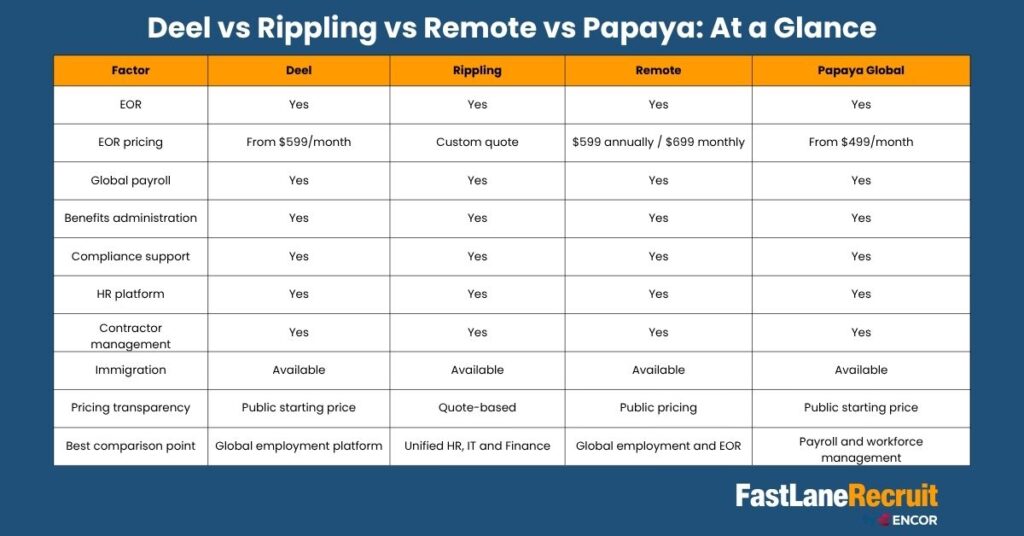
Deel vs Rippling vs Remote vs Papaya: At a Glance
| Factor | Deel | Rippling | Remote | Papaya Global |
| EOR | Yes | Yes | Yes | Yes |
| EOR pricing | From $599/month | Custom quote | $599 annually / $699 monthly | From $499/month |
| Global payroll | Yes | Yes | Yes | Yes |
| Benefits administration | Yes | Yes | Yes | Yes |
| Compliance support | Yes | Yes | Yes | Yes |
| HR platform | Yes | Yes | Yes | Yes |
| Contractor management | Yes | Yes | Yes | Yes |
| Immigration | Available | Available | Available | Available |
| Pricing transparency | Public starting price | Quote-based | Public pricing | Public starting price |
| Best comparison point | Global employment platform | Unified HR, IT and Finance | Global employment and EOR | Payroll and workforce management |
Provider features and pricing can change, and some services vary by country. Always verify the current commercial proposal and service scope for the countries where you plan to hire.
What Is an Employer of Record?
An Employer of Record (EOR) is a company that legally employs workers on behalf of another business.
The EOR generally manages employment administration such as:
- Employment contracts
- Payroll processing
- Tax withholding
- Statutory contributions
- Benefits administration
- Local employment compliance
- Leave administration
- Employee onboarding
- Termination and offboarding
Your business generally remains responsible for the employee’s daily work, responsibilities, performance, and team management.
An EOR can therefore provide an alternative to establishing a local subsidiary when a business wants to test a market, hire a small international team, or expand into a country without immediately creating its own legal entity.
Also Read: What Is an Employer of Record (EOR)?
Deel vs Rippling vs Remote vs Papaya: Key Differences
1. EOR Pricing and Total Cost
Price is often the first factor companies compare, but the monthly EOR fee is only one component of international employment cost.
Deel
Deel publicly lists EOR pricing starting at $599 per employee per month. Its EOR offering includes employment, payroll, benefits, compliance, and other global workforce capabilities.
Rippling
Rippling uses a custom pricing model for its platform and services. Its broader platform combines workforce management with HR, payroll, benefits, IT, and other functionality, while its EOR offering is part of the wider platform.
Remote
Remote currently lists EOR pricing at $599 per employee/month when paid annually or $699 when paid monthly on its EOR page.
Papaya Global
Papaya Global currently lists EOR pricing starting from $499 per employee/month, with the package including payroll, benefits, immigration, contracts, compliance, and other workforce services.
What to Check Beyond the Headline Price
Before comparing quotes, ask whether the price includes:
- Payroll processing
- Benefits administration
- Statutory contributions
- Onboarding
- Offboarding
- Local HR support
- Immigration
- Expense management
- Off-cycle payroll
- Currency conversion
- Additional employee services
A lower headline price does not necessarily mean a lower total employment cost.
2. Country Coverage
Country coverage is one of the most important EOR selection criteria.
However, “countries covered” should not be treated as a standalone metric.
Ask:
- Can the provider employ workers directly in the country?
- Does it use a local entity or another employment structure?
- Who handles local payroll?
- Who manages statutory compliance?
- Are local benefits available?
- Is immigration support available?
- What happens if the employee needs to be terminated?
- Are the same services available in every country?
For businesses expanding across Asia-Pacific, Europe, and the Middle East, country-specific capability can matter more than a provider’s headline global coverage.
3. Payroll and Global Payments
Payroll is a core EOR responsibility.
A suitable provider should be able to manage country-specific payroll requirements while helping ensure employees are paid accurately and on schedule.
Compare providers on:
- Payroll frequency
- Local currency payments
- Tax withholding
- Social security contributions
- Statutory deductions
- Expense reimbursements
- Payroll reporting
- Off-cycle payroll
- Payroll corrections
- Payment processing
- Currency conversion
Rippling emphasizes integrated payroll and workforce workflows, while Deel, Remote, and Papaya Global also position payroll as part of their global employment offerings.
4. Compliance and Legal Employment
International employment involves more than processing salaries.
Local requirements can affect:
- Employment contracts
- Minimum employment standards
- Working hours
- Paid leave
- Social insurance
- Tax obligations
- Benefits
- Probation
- Notice periods
- Severance
- Termination procedures
- Employee classification
A strong EOR should provide local employment expertise and maintain processes for regulatory changes.
When evaluating providers, ask who is responsible for compliance and how regulatory changes are communicated and implemented.
5. Employee Benefits
Benefits can vary significantly between countries.
Depending on the market, an EOR may manage statutory benefits such as:
- Social security
- Health insurance
- Pension contributions
- Paid leave
- Parental benefits
- Workers’ compensation
Some providers also offer supplementary benefits.
Businesses should compare not only whether benefits are available, but also:
- Which benefits are mandatory
- Which are optional
- What plans employees can access
- How much the employer pays
- Whether employees can choose plans
- How benefits are administered
6. HR, Automation, and Integrations
EOR platforms increasingly go beyond payroll.
Depending on the provider, businesses may find capabilities for:
- Employee onboarding
- Time off
- Expenses
- HR records
- Reporting
- Workflow automation
- HRIS integrations
- Accounting integrations
- IT management
- Contractor management
- Workforce analytics
Rippling particularly positions its EOR service within a broader HR, IT, and Finance platform, while Deel and other providers also offer broader workforce-management functionality.
For businesses already using an HRIS or accounting system, integration capability can be more important than having the largest feature list.
Deel vs Rippling vs Remote vs Papaya: Services Compared
| Service | Deel | Rippling | Remote | Papaya Global |
| Employer of Record | Yes | Yes | Yes | Yes |
| Global Payroll | Yes | Yes | Yes | Yes |
| Contractor Management | Yes | Yes | Yes | Yes |
| Benefits | Yes | Yes | Yes | Yes |
| Compliance | Yes | Yes | Yes | Yes |
| Immigration | Yes | Available | Available | Yes |
| HR Management | Yes | Yes | Yes | Yes |
| Workforce Reporting | Yes | Yes | Yes | Yes |
| Employee Self-Service | Yes | Yes | Yes | Yes |
The exact scope, availability, and pricing of individual services can vary by country and plan. Provider documentation should be checked before relying on a feature for a specific hiring market.
How to Choose Between Deel, Rippling, Remote, and Papaya
Instead of asking which EOR is universally best, start with your company’s requirements.
Choose Based on Your International Hiring Needs
If You Need Broad Global Employment Infrastructure
Compare:
- Country coverage
- Local employment infrastructure
- Compliance resources
- Payroll capabilities
- Immigration support
- Contractor services
If You Already Have an HR and IT Ecosystem
Prioritize:
- HRIS integrations
- IT management
- Workflow automation
- Workforce reporting
- Data synchronization
This can make a unified platform more valuable than adding another standalone system.
If Pricing Transparency Is Important
Compare:
- Published EOR fees
- Contract terms
- Additional fees
- Benefits costs
- FX charges
- Off-cycle payroll fees
- Onboarding and termination costs
A published starting price makes initial budgeting easier, but businesses should still request a country-specific quote.
If You Are Hiring Across Several Asian Markets
Look beyond global country counts.
Evaluate the provider’s:
- Local employment expertise
- Payroll capabilities
- Statutory compliance knowledge
- Benefits administration
- Employee support
- Country-specific onboarding process
Questions to Ask Before Choosing an EOR
A provider comparison should end with practical due diligence.
Legal and Compliance
- Who is the legal employer?
- Is the employment entity owned or operated through a partner?
- Who manages local tax and statutory obligations?
- How are regulatory changes communicated?
- Who handles employee disputes and termination procedures?
Pricing
- What is the monthly EOR fee?
- What is included?
- Are there setup fees?
- Are there off-cycle payroll fees?
- Are benefits charged separately?
- How are FX costs calculated?
- Are there minimum employee requirements?
Payroll
- Which payroll activities are managed directly?
- How quickly can payroll corrections be processed?
- Can employees receive payments in local currency?
- What payroll reports are available?
Employee Experience
- What benefits are available?
- How does employee onboarding work?
- Can employees access payslips and HR documents?
- What support is available to employees?
Business Expansion
- Can the same provider support future hiring countries?
- Can you transition from EOR to your own entity later?
- Can contractors and employees be managed through the same platform?
- Can the provider support payroll after you establish your own entity?
Also Read: 10 Best Employer of Record (EOR) Services To Consider in 2026
Why Businesses Choose FastLaneRecruit
Selecting an EOR is not only about comparing software features. It is also about finding a partner that understands the employment requirements of the countries where you plan to build your team.
FastLaneRecruit helps businesses hire and manage international employees through EOR and global employment solutions.
Our coverage includes: Malaysia, Singapore, Hong Kong, China, India, Philippines, Taiwan, Vietnam, Australia, United Kingdom, Switzerland, UAE, Saudi Arabia, Qatar
One EOR Partner for Multi-Country Expansion
FastLaneRecruit can help businesses manage international employment without requiring them to establish a separate local entity for every new market.
This can be useful when you are:
- Testing a new market
- Hiring your first employee overseas
- Building a small international team
- Expanding into multiple countries
- Managing remote employees
- Scaling without adding local HR administration
- Looking for support with payroll and employment compliance
Simplify International Employment
Our EOR services can support key parts of the employment lifecycle, including:
- Employee onboarding
- Employment contracts
- Payroll administration
- Statutory compliance
- Benefits administration
- Employee management
- Offboarding
- International workforce support
The exact services and requirements depend on the country and employment arrangement.
FastLaneRecruit vs Global EOR Platforms: What Should You Compare?
Large global platforms can offer extensive technology and workforce-management capabilities. A regional or multi-market EOR partner may provide a different type of value.
When comparing FastLaneRecruit with international EOR platforms, consider:
| Evaluation Factor | What to Look For |
| Country coverage | Does the provider support your target markets? |
| Local expertise | Does it understand local employment requirements? |
| Payroll | Can it manage country-specific payroll obligations? |
| Compliance | Who manages statutory employment requirements? |
| Benefits | What local benefits can employees receive? |
| Support | Who will assist when employment issues arise? |
| Scalability | Can the provider support additional countries? |
| Cost | What is the complete employment cost? |
| Flexibility | Can the solution fit your workforce model? |
The most useful comparison is therefore not simply which platform has more features, but which provider can reliably support your actual workforce requirements.
When Should You Use an EOR?
An EOR can make sense when your business:
Wants to Hire Without Establishing a Local Entity
You can hire through an EOR rather than immediately creating a subsidiary in a new market.
Needs to Hire Quickly
An EOR can remove some of the administrative work associated with setting up local employment infrastructure.
Is Testing a New Market
An EOR can allow a company to hire a small number of employees before deciding whether to establish a permanent local presence.
Is Expanding Across Multiple Countries
Using an EOR can centralize parts of employment administration rather than requiring separate processes in every market.
Wants Additional Local Employment Support
An EOR can help manage country-specific payroll, contracts, statutory requirements, and employment administration.
Get Expert Help With Your Global Hiring Strategy
Comparing EOR providers is easier when you know exactly what your business needs.
Instead of evaluating pricing and features in isolation, FastLaneRecruit can help you assess your target countries, employment requirements, payroll needs, compliance considerations, and workforce plans.
Ready to Hire Internationally?
Talk to FastLaneRecruit about your hiring requirements and explore an EOR solution for your target market.
Book a Free Consultation with an Expert
Get practical guidance on international employment, EOR, payroll, and global workforce expansion.
Deel vs Rippling vs Remote vs Papaya: Frequently Asked Questions
Which is better: Deel, Rippling, Remote, or Papaya Global?
There is no single EOR that fits every business. The appropriate choice depends on your hiring countries, workforce size, budget, existing HR technology, payroll requirements, compliance needs, and desired level of support.
How much does an EOR cost?
EOR pricing commonly uses a per-employee monthly fee, although pricing structures differ. Current published starting prices include $599/month for Deel, $599 annually or $699 monthly for Remote, and $499/month for Papaya Global. Rippling uses custom pricing. Salary, statutory employer costs, benefits, and additional services may be charged separately.
Is Deel more expensive than Remote?
Their published starting EOR prices are currently similar when comparing Deel’s $599/month starting price with Remote’s $599/month annual-payment price. However, the final cost depends on country, employment requirements, benefits, payment terms, and additional services.
Is Rippling an EOR?
Yes. Rippling offers Global Employer of Record services that allow businesses to hire employees internationally without establishing local entities, alongside its broader HR, payroll, IT, and Finance platform.
Is Papaya Global an EOR?
Yes. Papaya Global offers EOR services, with its current pricing page listing EOR from $499 per employee/month and services including payroll, benefits, immigration, contracts, and local compliance.
What does an EOR handle?
An EOR generally handles the legal employment relationship and associated administration, including employment contracts, payroll, tax obligations, statutory benefits, local compliance, and employee offboarding.
Can an EOR replace a local entity?
An EOR can provide an alternative to establishing a local entity for eligible employment arrangements. However, whether an EOR is appropriate depends on the company’s activities, hiring plans, tax position, permanent-establishment considerations, and local requirements.
What should I compare when choosing an EOR?
Compare:
- Country coverage
- Legal employment structure
- Pricing
- Payroll
- Compliance
- Benefits
- Employee support
- Integrations
- Immigration
- Contractor services
- Implementation
- Offboarding
- Total cost of employment
Can FastLaneRecruit help with international hiring?
Yes. FastLaneRecruit provides EOR and global employment support across Malaysia, Singapore, Hong Kong, China, India, the Philippines, Taiwan, Vietnam, Australia, the United Kingdom, Switzerland, UAE, Saudi Arabia, and Qatar.