

The traditional Monday-to-Friday schedule is no longer the only model businesses are considering. Companies around the world are experimenting with shorter working weeks to improve productivity, attract talent, strengthen employee wellbeing, and remain competitive in increasingly global labour markets.
But there is an important distinction: a country running a four-day workweek pilot is not necessarily a country that has legally adopted a four-day workweek. Some countries have tested a 32-hour week with no reduction in pay, while others allow employees to compress their existing hours into four longer days.
So, which are the leading four day work week countries, and what does this mean for companies hiring internationally?
Content Outline
Key Summary
No country has universally mandated a 32-hour, four-day workweek
As of 2026, no country has introduced a nationwide legal requirement for all employers to operate a four-day, approximately 32-hour workweek at full pay. However, numerous countries have introduced pilots, flexible working rights, compressed schedules, or government-supported initiatives.
Belgium has a legal four-day option, but it is not a shorter-hours model
Belgium allows eligible employees to request a four-day schedule by compressing their normal weekly hours into four longer working days. This means a four-day schedule does not necessarily mean a 32-hour week. The OECD describes the Belgian model as a 4/10 arrangement in which weekly hours can be compressed into four longer days.
Iceland is one of the strongest examples of reduced working hours
Iceland’s major trials helped establish shorter working hours across a significant part of the workforce. The model generally focused on reducing hours rather than simply squeezing the same number of hours into four days.
The UK, Portugal, Germany, Spain and Australia have been important testing grounds
These countries have participated in significant pilots or policy initiatives, although the design, scale and legal status differ considerably. The UK’s 2022 trial involved 61 companies and around 2,900 employees, while Portugal’s 2023 government-backed pilot involved 41 companies and more than 1,000 employees.
For international employers, working-time policy is only one part of the equation
If your company is introducing a four-day schedule while hiring employees in another country, you still need to consider employment contracts, payroll, statutory benefits, working-time rules, leave, overtime, tax and local employment compliance.
What Is a Four-Day Work Week?
A four-day workweek generally means employees work on four days rather than five. However, the number of hours worked and whether employees receive the same salary can vary significantly.
There are three major models.
1. Reduced-Hours Four-Day Workweek
Employees work fewer hours while maintaining their normal salary.
A common example is:
8 hours × 4 days = 32-hour workweek
This model is often associated with the “100-80-100” approach:
- 100% of salary
- 80% of previous working time
- 100% of expected productivity
The objective is not simply to remove one working day. It is to redesign work so that productivity can be maintained within fewer hours.
2. Compressed Four-Day Workweek
Employees work the same total number of weekly hours over four days.
For example:
10 hours × 4 days = 40 hours
Belgium is a notable example of this approach. Its legal framework allows employees to request a four-day schedule while generally maintaining their existing weekly hours.
3. Flexible or Rotating Four-Day Schedules
Some businesses maintain operational coverage throughout the week by rotating employees’ days off.
For example:
- Team A: Monday–Thursday
- Team B: Tuesday–Friday
- Team C: Wednesday–Saturday
This can be particularly relevant for customer service, technology support, healthcare, logistics and other businesses that cannot simply close for one additional day
Four Day Work Week Countries at a Glance
The following countries have introduced, tested, encouraged or otherwise experimented with four-day or reduced-hours working arrangements. Their approaches should not be interpreted as equivalent national mandates.
| Country | Current Position | Main Model | Key Point |
| Iceland | Strong reduced-hours adoption | Reduced hours | Major trials helped establish shorter working arrangements |
| Belgium | Legal option | Compressed 4-day week | Employees can request four longer working days |
| United Kingdom | Major pilots and employer adoption | Reduced hours | One of the world’s best-known four-day-week trials |
| Portugal | Government-backed pilot | Reduced hours | 41 companies participated in the 2023 pilot |
| Germany | Major trial activity | Reduced hours | 45 organisations participated in the 2024 pilot |
| Spain | Government policy discussions/pilots | Reduced hours | Four-day-week initiatives remain part of wider working-time reform |
| Australia | Trials and public-sector interest | Reduced hours | Four-day-week pilots have attracted employer and government interest |
| New Zealand | Employer-led adoption | Reduced hours | Private-sector organisations have tested and retained shorter weeks |
| Japan | Government encouragement | Various | Government has encouraged companies to consider shorter working weeks |
| Netherlands | Very short average workweek | Various | Short average hours do not mean a nationwide four-day week |
| Switzerland | Pilot activity | Reduced hours | Regional and company-level experimentation continues |
| Sweden | Pilot activity | Reduced hours | Four-day-week experiments have taken place |
| South Africa | Major pilot activity | Reduced hours | Participated in coordinated four-day-week trials |
| Ireland | Pilot activity | Reduced hours | Companies have participated in major trials |
| Canada | Pilot activity | Reduced hours | Employers have participated in four-day-week experiments |
| United States | Company/state pilots | Various | Adoption remains employer- and jurisdiction-dependent |
| Philippines | Government compressed-work arrangements | Compressed/flexible | Four-day arrangements can arise from public-sector or operational policies |
| UAE | 4.5-day federal workweek | 4.5-day | UAE should not be classified as a nationwide four-day workweek |
Current international trackers identify more than 20 countries with four-day-week initiatives or related shorter-working-week experiments. However, the exact classification varies because some countries are running pilots while others have shorter average working hours or compressed schedules.
Which Countries Have a 4-Day Work Week?
Iceland
Iceland is frequently cited as one of the world’s strongest examples of reduced working hours.
Large trials conducted between 2015 and 2019 involved approximately 2,500 public-sector workers. Working hours were reduced to around 35–36 hours in many participating arrangements without reducing pay.
The results helped drive broader adoption of shorter working hours in Iceland.
Why it matters: Iceland demonstrates the difference between a genuine reduction in working hours and simply compressing 40 hours into four days.
Belgium
Belgium is one of the most important countries to understand when researching countries with 4 day work weeks.
Under Belgium’s working-time reforms, eligible employees can request to work their normal weekly hours across four days rather than five. The arrangement therefore generally represents a compressed workweek, rather than a 32-hour week.
For employers, this distinction matters because longer daily schedules can create different workload, overtime and employee-wellbeing considerations.
Model: Four longer working days
Reduced hours: Generally no
Legal framework: Yes, subject to applicable conditions
United Kingdom
The UK has become one of the most prominent markets for four-day workweek experimentation.
The widely cited 2022 UK pilot involved 61 companies and around 2,900 employees. The trial was based around reducing working time while maintaining pay, and 4 Day Week Global reports that 92% of participating companies opted to continue with the four-day week after the trial.
The UK does not, however, have a statutory nationwide four-day workweek.
Model: Primarily reduced hours in major pilots
National mandate: No
Employer adoption: Growing
Portugal
Portugal conducted a government-backed four-day workweek pilot in 2023 involving 41 private-sector organisations and more than 1,000 employees.
Participating companies reduced working time while maintaining full pay. The pilot evaluated productivity, employee wellbeing and organisational performance.
This makes Portugal one of the more important European examples for employers considering a structured shorter-working-week experiment.
Germany
Germany has also become a significant testing ground.
A 2024 trial involved 45 organisations across sectors including professional services, manufacturing, healthcare, IT and utilities. The programme examined how companies could redesign work rather than simply eliminate one working day.
Germany’s debate also demonstrates why four-day-week policies cannot be evaluated solely on employee preference. Working-time reductions can affect productivity, labour costs, staffing and national economic output differently depending on the model used. A 2026 ifo Institute analysis, for example, modelled potential macroeconomic costs from a nationwide reduction in working time.
Spain
Spain has been another important European market for four-day-week experimentation.
The country has supported trials designed to explore whether businesses can reduce working time without sacrificing productivity. However, employers should distinguish between a pilot programme and a permanent national legal requirement.
As of 2026, Spain’s wider working-time reform remains an evolving policy area rather than a nationwide four-day, 32-hour mandate.
Australia and New Zealand
Both Australia and New Zealand have participated in major four-day-week experiments.
Australia has seen employer and public-sector interest in shorter working arrangements, while New Zealand’s four-day-week movement has been particularly associated with private-sector experimentation. For businesses expanding across the Asia-Pacific region, these markets are useful examples of how flexible work arrangements can be incorporated into broader talent and workforce strategies.
Japan
Japan has attracted international attention because of its productivity and workforce challenges.
The Japanese government has encouraged companies to consider more flexible working arrangements, including four-day workweeks. Individual companies have also experimented with shorter working schedules.
However, Japan should be viewed as a market where four-day workweek adoption is developing rather than as a country with a universal four-day working requirement.
Netherlands and the Nordic Countries
Countries such as the Netherlands, Denmark, Norway and Sweden often appear in lists of countries with four day work weeks because they have relatively short average working hours or have conducted shorter-week experiments.
However, a short average workweek is not automatically the same as a legal four-day workweek.
For example, the Netherlands is frequently cited for its very short average working week, while Denmark and Norway also have comparatively low average hours.
Important: Average working hours measure what people actually work on average. They do not prove that employees universally work only four days.
What About the UAE, Saudi Arabia, Qatar and Other Middle Eastern Markets?
The Middle East illustrates why country-by-country employment analysis is essential.
The UAE operates a 4.5-day federal government workweek, while Sharjah has adopted a four-day government workweek. The UAE therefore should not be described as having a nationwide four-day workweek across all employers.
Saudi Arabia and Qatar have also seen individual employers experiment with four-day schedules, but company-level adoption should not be confused with national policy.
For example, a Riyadh-based company introduced a four-day workweek in 2024, demonstrating that employer-level experimentation can exist even where no nationwide four-day policy applies.
For international employers, the practical question is therefore not simply:
“Does this country have a four-day workweek?”
It is:
“Can our employment model legally and operationally support a four-day schedule for employees in this country?”
Four-Day Work Week vs. Compressed Workweek
These terms are often used interchangeably, but they describe different employment models.
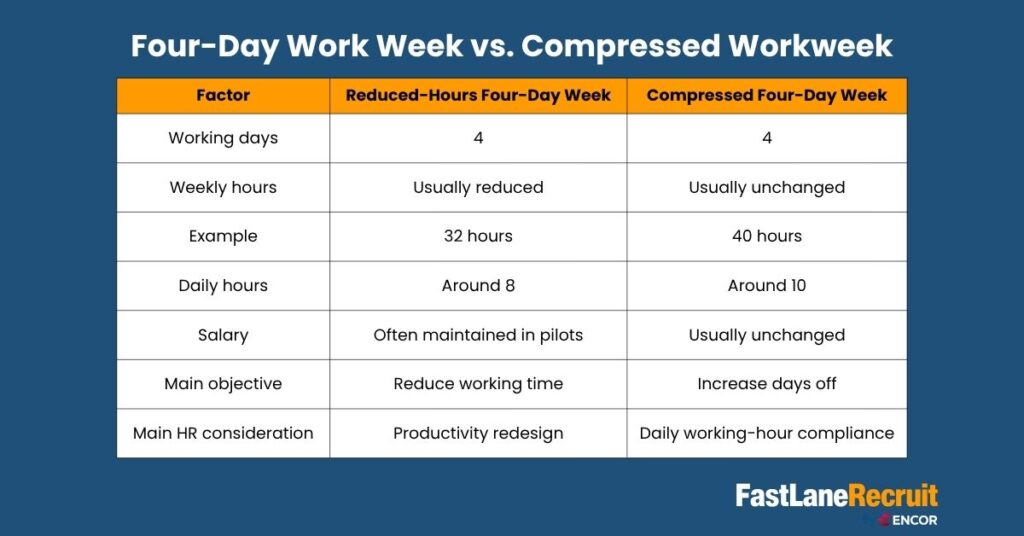
| Factor | Reduced-Hours Four-Day Week | Compressed Four-Day Week |
| Working days | 4 | 4 |
| Weekly hours | Usually reduced | Usually unchanged |
| Example | 32 hours | 40 hours |
| Daily hours | Around 8 | Around 10 |
| Salary | Often maintained in pilots | Usually unchanged |
| Main objective | Reduce working time | Increase days off |
| Main HR consideration | Productivity redesign | Daily working-hour compliance |
This distinction is critical when comparing four day work week countries.
A company considering a four-day week should first decide whether it wants to:
- reduce working hours;
- compress existing hours;
- introduce rotating days off; or
- create a role-specific flexible schedule.
The legal and payroll implications can differ significantly.
Why Are Companies Moving Toward Four-Day Workweeks?
1. Talent Attraction
A shorter working week can differentiate an employer in competitive recruitment markets.
Companies competing for skilled employees may use flexibility as part of their employee value proposition.
2. Employee Retention
A better work-life balance can support retention, particularly in knowledge-intensive roles.
3. Productivity
The strongest four-day-week experiments focus on eliminating low-value work, reducing unnecessary meetings and redesigning workflows rather than simply expecting employees to accomplish five days of work in four.
Research from 4 Day Week Global’s trials reports improvements in areas including stress, work ability and absenteeism, with 92% of companies in its UK trial choosing to continue with the model.
4. Employer Branding
Offering a flexible work schedule can strengthen an employer’s positioning when competing for international talent.
5. Global Workforce Flexibility
For distributed companies, shorter workweeks can form part of a broader workforce strategy involving remote work, offshore teams and flexible staffing.
What Are the Risks of a Four-Day Work Week?
A four-day schedule is not automatically better for every business.
Longer working days
A compressed model can create 10-hour working days, which may increase fatigue.
Customer coverage
Businesses operating five or seven days per week may need rotating schedules rather than simply closing one day.
Productivity pressure
If management removes one day but keeps the same workload, employees may experience work intensification rather than genuine flexibility.
Payroll and overtime
Changes to working hours can affect overtime calculations, payroll processing and employment contracts depending on the country.
Leave and benefits
Employers need to determine how annual leave, public holidays, sick leave and statutory benefits are calculated under the new schedule.
Local employment compliance
A global company cannot assume that a four-day policy used in one country can simply be copied into another.
What Should Employers Consider Before Introducing a Four-Day Work Week?
Before implementing a four-day schedule, employers should assess five areas.
1. Employment Law
Check:
- statutory working hours
- overtime requirements
- rest periods
- maximum daily hours
- employee consultation requirements
- collective agreements
- flexible-working rights
2. Payroll
Determine how the new schedule affects:
- monthly salaries
- hourly employees
- overtime
- public holidays
- leave entitlement
- statutory contributions
- payroll calculations
3. Employment Contracts
The employee’s working schedule, hours and applicable conditions should be properly documented.
4. Operational Coverage
Ask whether customers, suppliers and internal teams still receive the necessary coverage.
A rotating schedule may be more appropriate than giving everyone the same day off.
5. Productivity Measurement
A successful four-day week should be measured using outcomes rather than attendance alone.
Useful metrics include:
- revenue per employee
- output
- customer satisfaction
- employee retention
- absenteeism
- recruitment conversion
- project delivery
- overtime
Four-Day Work Weeks and Global Expansion: What Employers Need to Know
For companies hiring internationally, the four-day workweek discussion becomes more complex.
Imagine a company headquartered in the UK that wants to build a team in Malaysia.
The company may already operate a four-day schedule at headquarters. However, it cannot automatically assume that the same employment terms, working-hour rules, statutory benefits or payroll treatment apply to employees hired in Malaysia.
The same issue arises when expanding into:
- Singapore
- Hong Kong
- China
- India
- Philippines
- Taiwan
- Vietnam
- Australia
- United Kingdom
- Switzerland
- UAE
- Saudi Arabia
- Qatar
Local employment requirements must be assessed independently.
This is one reason companies expanding internationally use an Employer of Record (EOR).
How an EOR Can Help Companies Implement International Workforce Strategies
An Employer of Record can employ workers locally on behalf of a company while the client maintains day-to-day operational direction.
Depending on the market and service scope, an EOR can support:
Local employment contracts
Employees can be onboarded using locally compliant employment documentation.
Payroll administration
The EOR manages payroll processes and applicable statutory requirements.
HR administration
The provider can support employment administration throughout the employee lifecycle.
Compliance support
The company gains access to local employment expertise rather than attempting to replicate one country’s employment model across multiple jurisdictions.
Faster international expansion
Companies can test a new market or build an international team without immediately establishing their own local entity, subject to the applicable country’s EOR framework.
How FastLaneRecruit Supports Global Hiring and EOR
If your four-day workweek strategy is part of a broader international hiring or expansion plan, the employment structure matters just as much as the work schedule.
FastLaneRecruit provides EOR, recruitment, payroll and workforce solutions designed to help international companies build and manage teams across multiple markets.
Our EOR model can help companies manage local employment infrastructure while they retain operational control over their teams. FastLaneRecruit’s services include recruitment, onboarding, payroll and HR compliance support.
FastLaneRecruit’s EOR currently supports employers across markets including:
Malaysia, Singapore, Hong Kong, China, India, Philippines, Taiwan, Vietnam, Australia, United Kingdom, Switzerland, UAE, Saudi Arabia, Qatar
When should you consider an EOR?
An EOR can be particularly useful when you:
- want to hire internationally without immediately establishing a local entity;
- are testing a new market;
- need local payroll and employment administration;
- are building an offshore or remote team;
- want to expand quickly;
- need support navigating local employment requirements;
- are adapting global workforce policies to local regulations.
For a company introducing a four-day workweek across multiple countries, this local expertise can help identify where the intended schedule fits existing employment requirements and where the policy needs to be adapted.
Should Your Company Adopt a Four-Day Work Week?
There is no universal answer.
A four-day workweek can be attractive if your business:
- operates primarily on measurable outcomes;
- has strong digital workflows;
- can maintain customer coverage;
- has relatively flexible roles;
- can redesign processes around productivity;
- can comply with local working-time requirements.
It may require more planning if your company operates:
- customer-facing services;
- manufacturing;
- healthcare;
- logistics;
- retail;
- 24/7 operations;
- shift-based teams.
The best model is therefore not necessarily the one with the fewest working hours.
The best model is the one that balances employee experience, productivity, customer coverage and local employment compliance.
Ready to Build a Global Team Around a Flexible Work Model?
A four-day workweek can be an effective talent and productivity strategy, but international implementation requires more than changing Friday to a day off.
If you are hiring employees across multiple countries, you need a workforce structure that accounts for local employment contracts, payroll, statutory requirements, HR administration and compliance.
FastLaneRecruit can help you explore EOR and global expansion options across Asia-Pacific, Europe and the Middle East, including Malaysia, Singapore, Hong Kong, China, India, Philippines, Taiwan, Vietnam, Australia, the UK, Switzerland, UAE, Saudi Arabia and Qatar.
Talk to FastLaneRecruit about your global hiring plans and find out how an EOR structure can support your next international expansion.
Frequently Asked Questions About Four Day Work Week Countries
Which countries have a four-day work week?
Several countries have introduced, tested or encouraged four-day working arrangements, including Iceland, Belgium, the UK, Portugal, Germany, Spain, Australia, New Zealand, Japan, Ireland, Canada, the United States, Switzerland, Sweden and South Africa. However, their programmes differ significantly and most do not have a universal nationwide four-day workweek.
What countries have 4 day work weeks with no reduction in pay?
Several major pilots have tested reduced working hours while maintaining full pay. Iceland, the UK, Portugal and other participating markets provide important examples. However, the exact arrangement depends on the individual programme or employer.
Does Belgium have a four-day work week?
Belgium provides a legal framework allowing eligible employees to request a four-day schedule, but the standard model generally compresses existing weekly hours into four longer days rather than reducing the working week to 32 hours.
Is Iceland a four-day work week country?
Iceland is one of the strongest examples of widespread shorter working hours following major trials. However, it is more accurate to describe Iceland as having widespread reduced-hours arrangements rather than a universal statutory four-day, 32-hour workweek.
Does a four-day work week mean 32 hours?
Not necessarily. A four-day workweek can mean four eight-hour days, four ten-hour days, reduced weekly hours, or another flexible arrangement.
Is the UAE a four-day workweek country?
The UAE has a federal 4.5-day government workweek, while Sharjah has a four-day government schedule. This does not mean that all UAE employers operate a four-day workweek.
Are four-day workweeks legal everywhere?
No. Employers must assess the working-time, employment contract and labour-law requirements of each country before implementing the schedule.
Can an international company use the same four-day workweek policy in every country?
Not necessarily. A global policy may need country-specific adjustments to comply with local employment law, overtime rules, leave requirements, payroll practices and statutory benefits.
Can an EOR help with a four-day workweek?
An EOR can help with the local employment infrastructure surrounding an international workforce, including employment contracts, payroll, HR administration and compliance support. However, the actual four-day schedule must still be assessed against the applicable laws and employment requirements in each country.
How can I hire employees internationally without setting up a local entity?
An EOR can provide a local employment structure in supported markets, allowing companies to hire employees without immediately establishing their own local entity. FastLaneRecruit provides EOR and workforce solutions across multiple international markets.