
Managing cash flow is one of the most important functions of any business. While sales generate revenue, businesses only benefit when payments are collected on time. This is where an Accounts Receivable (AR) professional plays a critical role.
An effective accounts receivable specialist helps businesses maintain healthy cash flow, reduce overdue payments, improve customer relationships, and support financial stability. Whether you are a startup, SME, or multinational company, hiring the right AR professional can significantly impact your organization’s financial performance.
This guide explores everything employers need to know about accounts receivable job description, including responsibilities, skills, qualifications, KPIs, hiring challenges, and how to recruit top accounts receivable talent efficiently.
Content Outline
Key Summary
Accounts Receivable Professionals Directly Impact Cash Flow
Their primary responsibility is ensuring customers pay invoices accurately and on time, helping businesses maintain financial stability.
Technical Skills Alone Are Not Enough
The best AR professionals combine accounting expertise with communication, negotiation, and customer relationship management skills.
Modern AR Roles Are Becoming More Strategic
Today’s accounts receivable specialists leverage automation tools, financial analytics, and reporting systems to improve collections performance and reduce bad debt.
Hiring the Right AR Talent Reduces Financial Risk
A skilled AR professional can improve collection rates, lower Days Sales Outstanding (DSO), and enhance working capital management.
Recruitment Specialists Can Help You Find Better Candidates Faster
Working with a recruitment partner such as FastLaneRecruit can significantly reduce hiring time and improve candidate quality.
What Is an Accounts Receivable Professional?
An Accounts Receivable professional is responsible for managing money owed to a company by customers. Their role focuses on tracking invoices, processing incoming payments, following up on overdue accounts, reconciling balances, and ensuring accurate financial records.
Their primary objective is to ensure the business receives payments according to agreed credit terms while maintaining positive customer relationships.
Accounts receivable professionals typically work closely with:
- Finance teams
- Accounting departments
- Sales teams
- Customer service teams
- External customers
- Credit management teams
Depending on company size, job titles may include:
- Accounts Receivable Clerk
- Accounts Receivable Officer
- Accounts Receivable Specialist
- Accounts Receivable Executive
- Credit Control Officer
- AR Analyst
- Senior Accounts Receivable Accountant
Account Receivable Job Description Overview
An account receivable job description outlines the responsibilities, qualifications, skills, and performance expectations required to manage customer payments effectively.
A typical job description includes:
| Category | Details |
| Job Purpose | Manage customer invoicing and collections |
| Reporting Line | Finance Manager or Accounting Manager |
| Key Responsibilities | Billing, collections, reconciliation, reporting |
| Required Skills | Accounting, communication, problem-solving |
| Qualifications | Diploma or Degree in Accounting, Finance, or Business |
| Experience | AR, collections, bookkeeping, accounting |
| Performance Metrics | Collection rates, DSO, aging reports |
Key Responsibilities of an Accounts Receivable Professional
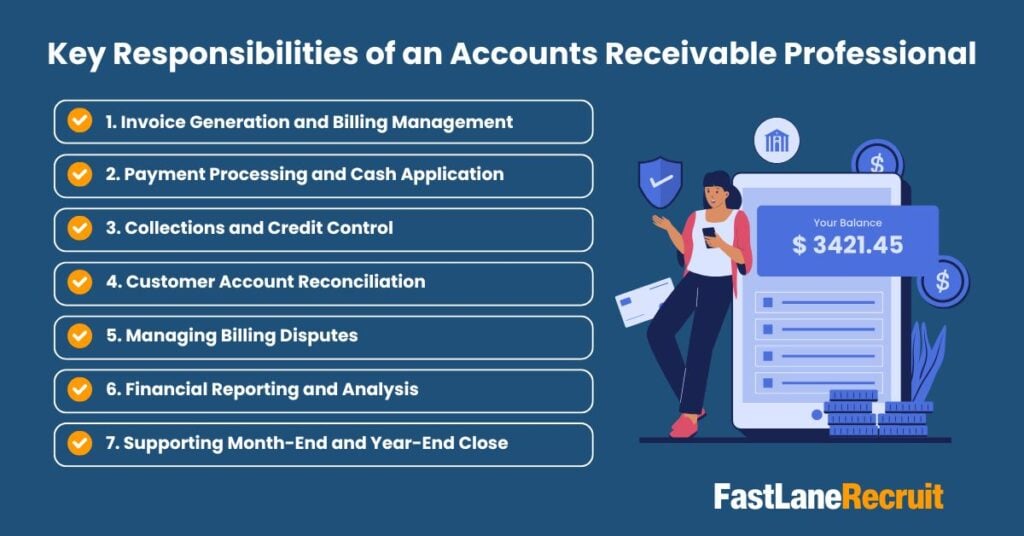
1. Invoice Generation and Billing Management
One of the most important responsibilities is ensuring invoices are generated accurately and sent promptly.
Tasks include:
- Preparing customer invoices
- Verifying billing information
- Reviewing contract terms
- Managing recurring invoices
- Processing credit notes
- Maintaining billing records
Errors in invoicing often lead to delayed payments, making accuracy essential.
2. Payment Processing and Cash Application
AR professionals record and allocate incoming customer payments.
Responsibilities include:
- Processing bank transfers
- Recording cheque payments
- Applying customer payments to invoices
- Reconciling payment records
- Identifying short payments or overpayments
Timely payment processing ensures financial records remain accurate.
3. Collections and Credit Control
Collections management is often considered the core responsibility of accounts receivable teams.
Tasks include:
- Monitoring outstanding balances
- Contacting customers regarding overdue invoices
- Sending payment reminders
- Negotiating payment arrangements
- Escalating delinquent accounts
Effective collections help businesses improve cash flow and reduce bad debt exposure.
4. Customer Account Reconciliation
Account reconciliation ensures customer balances are accurate.
Responsibilities include:
- Reviewing customer statements
- Resolving discrepancies
- Investigating missing payments
- Matching invoices with receipts
- Correcting accounting errors
Strong reconciliation skills reduce financial reporting inaccuracies.
5. Managing Billing Disputes
Customers may dispute invoices due to pricing discrepancies, delivery issues, or contract misunderstandings.
AR professionals must:
- Investigate disputes
- Coordinate with internal departments
- Resolve customer concerns
- Update records accurately
- Maintain customer relationships
The ability to balance collections with customer service is highly valuable.
6. Financial Reporting and Analysis
Modern AR professionals contribute valuable financial insights.
Reports commonly prepared include:
- Accounts receivable aging reports
- Collection performance reports
- Customer payment trends
- Bad debt analysis
- DSO reporting
These reports help management make informed financial decisions.
7. Supporting Month-End and Year-End Close
Accounts receivable teams play an important role during financial closing periods.
Responsibilities include:
- Reconciling AR balances
- Preparing supporting schedules
- Reviewing outstanding invoices
- Assisting auditors
- Supporting financial statement preparation
Essential Skills for an Accounts Receivable Professional
Accounting Knowledge
Successful AR professionals understand:
- Accounting principles
- Financial statements
- Double-entry bookkeeping
- Credit management
- Revenue recognition basics
This knowledge enables accurate recordkeeping and reporting.
Communication Skills
Since AR teams regularly interact with customers regarding payments, communication is critical.
Strong candidates can:
- Handle difficult conversations professionally
- Explain billing issues clearly
- Build positive customer relationships
- Negotiate payment terms effectively
Attention to Detail
Small errors can result in delayed payments or inaccurate records.
Employers should look for candidates who demonstrate:
- Accuracy
- Thoroughness
- Process discipline
- Data verification skills
Problem-Solving Ability
AR professionals frequently investigate:
- Missing payments
- Billing disputes
- Account discrepancies
- Collection challenges
Strong analytical thinking improves resolution speed.
Time Management
Managing hundreds of invoices simultaneously requires excellent organizational skills.
Top performers can:
- Prioritize collections activities
- Meet reporting deadlines
- Handle multiple customer accounts efficiently
Technology Proficiency
Modern AR departments rely heavily on technology.
Common systems include:
- Excel
- QuickBooks
- Xero
- SAP
- Oracle
- Microsoft Dynamics
- NetSuite
Experience with automation platforms is increasingly valuable.
Accounts Receivable Qualifications and Requirements
Most employers seek candidates with:
Educational Requirements
- Diploma in Accounting
- Degree in Accounting
- Degree in Finance
- Degree in Business Administration
Professional Certifications (Preferred)
Experience Requirements
Entry-Level:
- 1–2 years accounting experience
Mid-Level:
- 3–5 years AR experience
Senior-Level:
- 5+ years in collections, credit control, or finance operations
Sample Account Receivable Job Description
Job Title
Accounts Receivable Specialist
Job Summary
We are seeking a detail-oriented Accounts Receivable Specialist to manage customer invoicing, collections, account reconciliation, and payment processing. The successful candidate will help optimize cash flow while maintaining strong customer relationships.
Responsibilities
- Generate and issue invoices
- Monitor outstanding receivables
- Follow up on overdue accounts
- Process incoming payments
- Reconcile customer accounts
- Resolve billing disputes
- Prepare AR aging reports
- Support month-end close activities
Requirements
- Degree or Diploma in Accounting or Finance
- Minimum 2 years AR experience
- Strong Excel skills
- Experience with accounting software
- Excellent communication abilities
Key KPIs for Accounts Receivable Professionals
Employers should measure performance using objective metrics.
Days Sales Outstanding (DSO)
Measures how quickly customers pay invoices.
Lower DSO generally indicates stronger collections performance.
Collection Effectiveness Index (CEI)
Evaluates how efficiently receivables are collected.
Aging Report Performance
Tracks overdue balances across different age categories.
Bad Debt Percentage
Measures revenue lost due to uncollectible accounts.
Invoice Accuracy Rate
Tracks billing accuracy and operational efficiency.
Common Hiring Mistakes When Recruiting Accounts Receivable Staff
Focusing Only on Technical Skills
Candidates must also possess communication and negotiation skills.
Ignoring Industry Experience
Industry-specific billing practices can significantly impact performance.
Overlooking Technology Skills
Modern AR operations rely heavily on automation and ERP systems.
Hiring Too Slowly
Strong accounting candidates are often in high demand.
Lengthy recruitment processes can result in losing top talent.
Why Businesses Are Increasingly Hiring Accounts Receivable Professionals in Malaysia
Malaysia has become a leading destination for finance and accounting talent.
Companies benefit from:
- Competitive hiring costs
- Strong English proficiency
- Growing accounting talent pool
- International accounting standards familiarity
- Shared service center expertise
Many multinational companies now build finance teams in Malaysia to improve efficiency while controlling operational costs.
Why Use Recruitment Services Instead of Hiring Alone?
Recruiting finance professionals can be time-consuming and costly.
Challenges include:
- Screening technical competencies
- Assessing accounting knowledge
- Verifying experience
- Evaluating communication skills
- Managing interviews
Specialized recruitment firms reduce hiring risks and improve hiring outcomes.
Benefits include:
- Faster time-to-hire
- Access to pre-screened candidates
- Better candidate quality
- Reduced recruitment workload
- Improved retention rates
Get Expert Recruitment and Payroll Support from FastLaneRecruit
Finding a qualified accounts receivable professional requires more than reviewing resumes. Businesses need candidates who can manage collections effectively, communicate professionally with customers, and support long-term financial stability.
FastLaneRecruit helps businesses hire finance and accounting professionals across Malaysia through specialized recruitment solutions designed for growing companies and international organizations.
Our services include:
Recruitment Services
- Accounts Receivable Specialists
- Finance Executives
- Accountants
- Payroll Specialists
- Financial Analysts
- Shared Services Professionals
Payroll Services
- Payroll processing
- Statutory compliance
- Employee record management
- Payroll reporting
- HR administrative support
Whether you need a single AR specialist or an entire finance team, FastLaneRecruit can help you identify and hire qualified professionals faster and more efficiently.
Speak with FastLaneRecruit today to build a stronger finance team and improve your business’s financial operations.
Conclusion
A well-crafted account receivable job description is essential for attracting professionals who can strengthen cash flow, reduce payment delays, and improve financial performance. Beyond technical accounting expertise, the most successful AR professionals possess strong communication, analytical, and relationship management skills.
As finance functions become increasingly technology-driven, businesses must focus on hiring candidates who can combine traditional accounting knowledge with modern reporting, automation, and customer management capabilities.
If your organization is looking to hire qualified accounts receivable professionals in Malaysia, FastLaneRecruit can help you source, assess, and onboard top finance talent efficiently while supporting your broader payroll and workforce needs.
Frequently Asked Questions
What does an accounts receivable professional do?
An accounts receivable professional manages customer invoices, processes payments, follows up on overdue accounts, reconciles balances, and helps maintain healthy cash flow.
What skills are required for an accounts receivable job?
Key skills include accounting knowledge, communication, collections management, reconciliation, problem-solving, and proficiency in accounting software.
What qualifications do employers look for in accounts receivable candidates?
Most employers prefer a diploma or degree in accounting, finance, or business administration, along with relevant AR experience.
What is the difference between accounts receivable and accounts payable?
Accounts receivable manages money owed to the company, while accounts payable manages money the company owes to suppliers.
What KPIs should be used to measure accounts receivable performance?
Common KPIs include Days Sales Outstanding (DSO), Collection Effectiveness Index (CEI), aging report performance, invoice accuracy rate, and bad debt percentage.
How can a recruitment agency help hire accounts receivable professionals?
Recruitment agencies provide access to pre-screened candidates, reduce hiring time, improve candidate quality, and help businesses find professionals with the right technical and communication skills.