

Bringing a new vendor or supplier into your business is more than just signing a contract. It is a structured process that ensures compliance, smooth collaboration, and long-term success.
A well-designed vendor onboarding checklist helps businesses reduce risks, avoid delays, and create a consistent process when working with external partners. Whether you are hiring vendors locally or outsourcing talent globally, such as hiring employees in Malaysia through an Employer of Record (EOR) model, having a clear onboarding process is essential.
In this guide, we will break down everything you need to build a strong vendor onboarding checklist, including compliance steps, best practices, and real-world examples to help you scale confidently.
Content Outline
Key Summary
Structured Vendor Onboarding Ensures Consistency
A vendor onboarding checklist standardizes how businesses verify, approve, and integrate vendors, ensuring every supplier follows the same process.
Compliance Starts from Day One
Proper onboarding helps businesses collect legal, tax, and regulatory documents early, reducing compliance risks across different countries and industries.
Global Expansion Requires Stronger Processes
When working with international vendors, especially in regions like Southeast Asia, businesses must manage different laws, tax systems, and documentation requirements.
Clear Communication Reduces Misunderstanding
A structured onboarding process ensures vendors clearly understand expectations, responsibilities, reporting lines, and payment terms from the beginning.
Faster Vendor Activation Improves Business Speed
Standardized checklists reduce delays caused by missing documents or unclear approvals, helping vendors start work faster and more efficiently.
Better Financial Accuracy and Payment Control
Collecting correct banking details, invoice formats, and payment terms during onboarding helps avoid errors, delays, and duplicate records.
Strong Onboarding Builds Long-Term Vendor Relationships
A smooth onboarding experience creates trust, improves communication, and strengthens long-term partnerships with suppliers and global vendors.
What is a Vendor Onboarding Checklist?
A vendor onboarding checklist is a structured framework that helps businesses verify, approve, and integrate new vendors into their operations.
It ensures that every supplier meets your company’s standards before they begin work.
In simple terms, it helps you:
- Verify vendor identity and legitimacy
- Ensure legal and tax compliance
- Set clear expectations and contracts
- Integrate vendors into systems and workflows
- Reduce risk and payment issues
Why Vendor Onboarding Matters for Global Businesses
As companies expand into new markets, they naturally start working with more vendors, contractors, and service providers across different countries. This is especially common in fast-growing regions like Southeast Asia, where businesses often hire remote teams, outsource services, or work with local suppliers.
While this growth is exciting, it also makes operations more complex. Each country may have different tax rules, employment laws, documentation requirements, and payment processes. Without a clear onboarding structure, it becomes easy for things to get delayed, missed, or handled differently each time.
This is where a vendor onboarding checklist becomes important. It creates consistency and ensures every vendor goes through the same clear process before starting work.
What happens without a structured onboarding process?
When vendor onboarding is not standardized, companies often face:
- Delayed project starts due to missing documents
- Confusion between internal teams (HR, finance, procurement, legal)
- Inconsistent vendor information across systems
- Payment errors or approval delays
- Higher risk of non-compliance in different regions
These issues become more noticeable when managing cross-border vendors, where requirements can vary widely between countries.
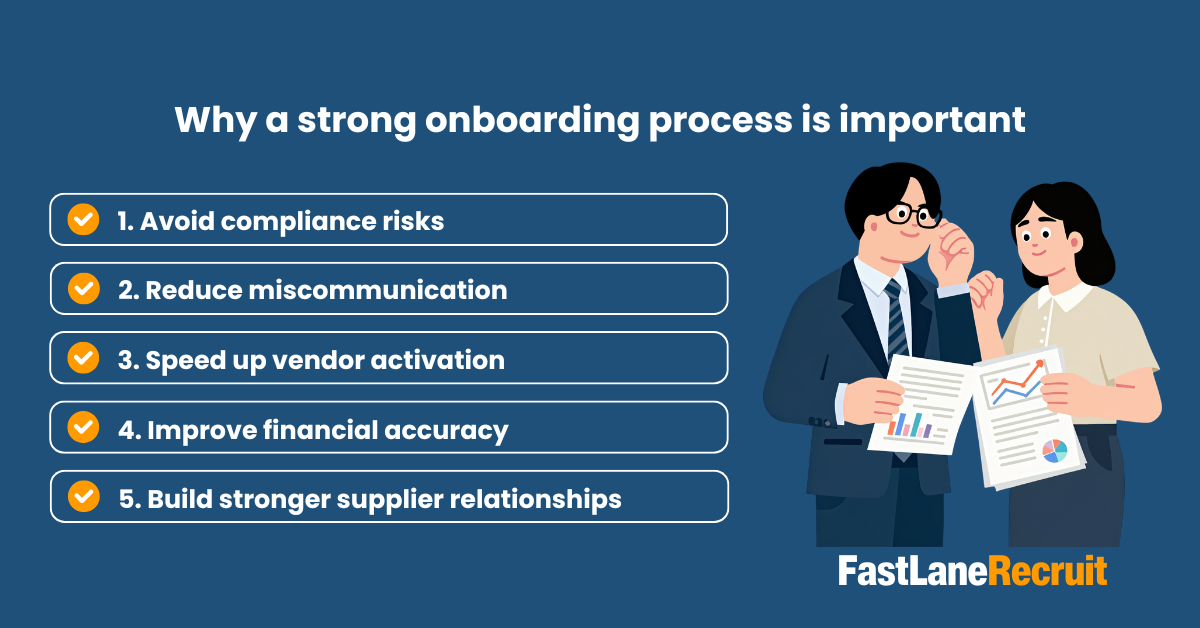
Why a strong onboarding process is important
A well-structured onboarding system helps global businesses stay organized, compliant, and efficient as they scale. Here’s how it makes a difference:
1. Avoid compliance risks
Different countries have different legal and tax requirements for vendors and contractors. If these are not properly checked during onboarding, businesses may face avoidable issues later.
A structured onboarding process ensures:
- Vendors submit correct legal and tax documents
- Industry or country-specific requirements are met
- Compliance checks are completed before work begins
This is especially important in international hiring and outsourcing scenarios, such as working with vendors in Malaysia, where employment and tax obligations must align with local regulations.
2. Reduce miscommunication
When onboarding is unclear or handled differently each time, vendors may not fully understand:
- What is expected of them
- Who they should report to
- How payments and approvals work
- What deadlines they need to follow
A standardized onboarding checklist ensures that every vendor receives the same clear instructions. This reduces confusion and helps both sides start the relationship on the same page.
3. Speed up vendor activation
Without a proper system, onboarding often involves back-and-forth emails, missing documents, and repeated approvals.
A structured process helps streamline everything by:
- Defining exactly what documents are required
- Assigning clear responsibilities to internal teams
- Reducing unnecessary delays in approval workflows
This means vendors can start working faster, which is especially important when projects are time-sensitive.
Also Read: Terminating an Independent Contractor: How to Do It Compliantly
4. Improve financial accuracy
Vendor onboarding is closely linked to finance and payments. If vendor details are incomplete or incorrect, it can lead to:
- Payment delays
- Invoice mismatches
- Incorrect tax handling
- Duplicate records in financial systems
A clear onboarding checklist ensures all financial details, such as bank information, payment terms, and tax documentation, are collected correctly from the start. This improves accuracy and reduces administrative issues later.
5. Build stronger supplier relationships
A smooth onboarding experience sets the tone for the entire vendor relationship.
When vendors experience a clear and professional process, they are more likely to:
- Trust your organization
- Communicate effectively
- Deliver work on time
- Build long-term partnerships
On the other hand, a confusing or delayed onboarding process can create frustration before the work even begins.
In summary
A strong vendor onboarding process is not just an administrative task; it is a foundation for scaling your business globally.
It helps you:
- Stay compliant across different countries
- Work more efficiently with international vendors
- Reduce operational mistakes
- Improve financial control
- Build long-term, reliable partnerships
As your business expands globally, having a consistent onboarding system becomes essential for sustainable growth.
Vendor Onboarding Checklist (Core Framework)
Below is a practical, structured vendor onboarding checklist you can use for global hiring and procurement.
1. Vendor Verification & Business Details
| Requirement | Purpose |
| Legal business name | Confirm legal identity |
| Tax registration number | Ensure tax compliance |
| Business address | Validate legitimacy |
| Contact details | Enable communication |
2. Compliance & Legal Documentation
This step ensures vendors meet legal and regulatory requirements.
- Business registration documents
- Tax forms (W-9 / W-8 or local equivalents)
- Insurance certificates
- Data protection compliance (GDPR if EU-related)
- Industry certifications (if applicable)
3. Contract & Agreement Setup
Clear agreements protect both parties.
- Master Service Agreement (MSA)
- Non-Disclosure Agreement (NDA)
- Scope of Work (SOW)
- Service Level Agreements (SLA)
Example SLA structure:
| Element | Description |
| Delivery timeline | Expected deadlines |
| KPIs | Performance benchmarks |
| Payment terms | Invoice schedule |
| Escalation process | Issue handling |
4. Financial & Payment Setup
Ensure smooth and transparent payments:
- Bank account details
- Currency preferences (important for global vendors)
- Payment terms (Net 30, Net 60, etc.)
- Invoice format standards
For outsourcing in Malaysia, businesses often prefer structured payroll or EOR-supported payments to ensure compliance and accuracy.
5. System Integration & Access
This ensures vendors can operate efficiently within your systems.
- ERP or procurement system setup
- Communication channel access
- Project management tool onboarding
- File sharing permissions
6. Performance & Communication Setup
Set expectations early to avoid misunderstandings.
- Assign vendor point of contact (POC)
- Define the reporting schedule
- Set response time expectations
- Establish an escalation process
- Agree on review cycles
Also Read: What is Employee Tenure?
Common Vendor Onboarding Challenges
Even though vendor onboarding is a critical business process, many companies still struggle to manage it smoothly. This usually happens not because the process is difficult on its own, but because multiple teams, systems, and requirements need to work together at the same time.
When onboarding is not properly structured, small gaps can quickly turn into delays, confusion, or compliance risks, especially when working with international vendors or remote contractors.
Below are the most common challenges businesses face during vendor onboarding, explained in a clearer and more practical way.
1. Missing compliance documents
One of the most frequent issues is incomplete or missing documentation from vendors.
This can include:
- Business registration certificates
- Tax forms or identification numbers
- Insurance documents
- Industry-specific licenses or certifications
When these documents are missing, the onboarding process often stops completely until everything is collected. This slows down project timelines and can create compliance risks if vendors are activated too early without proper checks.
This challenge becomes even more important in global hiring or outsourcing, where documentation requirements differ by country.
2. Slow approval workflows
Vendor onboarding usually involves multiple departments such as:
- Procurement
- Finance
- Legal
- HR or operations
Each team may need to review and approve different parts of the vendor setup. Without a clear workflow, approvals can become slow and unclear.
Common causes of delays include:
- Unclear approval responsibilities
- Manual email-based approvals
- Lack of visibility on pending tasks
- Missing escalation processes
As a result, vendors may wait days or even weeks before they can officially start working.
3. Lack of internal coordination
Vendor onboarding is rarely handled by just one team. It requires coordination across multiple departments.
However, without a structured system, teams may:
- Duplicate requests for the same documents
- Miss key onboarding steps
- Work in isolation without shared updates
- Delay responses due to unclear ownership
This lack of coordination often leads to confusion both internally and for the vendor, who may receive inconsistent instructions from different teams.
4. Inconsistent vendor records
When there is no standardized onboarding checklist, each vendor may be recorded differently in internal systems.
This can result in:
- Different naming formats for the same vendor
- Missing or outdated contact details
- Duplicate vendor entries
- Inconsistent financial or tax information
Over time, this creates confusion in reporting, auditing, and payment processing. It also makes it harder for businesses to track vendor performance accurately.
A structured onboarding process helps ensure all vendor data is collected and stored in a consistent format from the beginning.
5. Delayed payment setup
Payment setup is one of the most important final steps in vendor onboarding, but it is often delayed.
This can happen due to:
- Missing bank account details
- Incorrect invoice requirements
- Late finance approvals
- Lack of alignment on payment terms
When payment setup is not completed on time, vendors may experience delays in receiving payments, which can negatively affect trust and working relationships.
In global operations, this challenge can also be more complex due to currency differences, cross-border transfer requirements, and local banking systems.
Why these challenges increase in global vendor management
These onboarding issues often become more serious when working with:
- International vendors
- Remote contractors
- Outsourced teams across different countries
This is because businesses must manage:
- Different legal and tax systems
- Varying compliance standards
- Time zone differences between teams
- Currency and payment complexities
Without a structured vendor onboarding checklist, these small gaps can quickly multiply and slow down global operations.
In short
Vendor onboarding challenges usually come down to one thing: lack of structure.
When onboarding is not standardized, businesses face:
- Missing documents
- Slow approvals
- Poor coordination
- Inconsistent records
- Payment delays
A clear and consistent onboarding process helps eliminate these issues and ensures vendors can start work smoothly, no matter where they are located.
Also Read: Best Practices for Managing Remote Teams Effectively
Best Practices for a Strong Vendor Onboarding Process
1. Standardize Everything
Use a consistent vendor onboarding checklist across all departments to ensure no steps are missed.
2. Assign Clear Ownership
Each department should have defined responsibilities:
| Department | Role |
| HR | Compliance checks |
| Finance | Payment setup |
| Legal | Contracts |
| Procurement | Vendor selection |
3. Automate Where Possible
Automation reduces manual errors and speeds up onboarding:
- Auto document collection
- Approval workflows
- Payment scheduling
- Vendor tracking dashboards
4. Maintain Compliance from Day One
Depending on your industry, compliance may include:
- ISO certifications
- Data privacy laws (GDPR)
- Labor regulations (important for outsourcing in Malaysia)
- Financial reporting requirements
5. Use Vendor Performance Tracking
Track:
- Delivery timelines
- Quality standards
- Communication responsiveness
- Cost efficiency
Example: Vendor Onboarding for Hiring in Malaysia
When outsourcing employees in Malaysia, businesses often use an Employer of Record (EOR) model.
This helps manage:
- Local employment compliance
- Payroll and tax contributions
- EPF and SOCSO requirements
- Employment contracts
Instead of setting up a legal entity, companies can hire faster and stay compliant.
Why a Vendor Onboarding Checklist Improves Business Efficiency
A structured checklist helps you:
- Reduce onboarding time
- Improve compliance accuracy
- Ensure financial transparency
- Build stronger vendor relationships
- Scale global hiring operations easily
Also Read: Job Level Classification: How to Build a Fair, Consistent System Your Team Will Actually Use
Conclusion
A strong vendor onboarding checklist is not just an administrative tool, it is a foundation for scalable, compliant, and efficient business operations.
Whether you are managing local suppliers or hiring global talent, a structured onboarding system ensures consistency, reduces risk, and improves overall performance.
Scale Faster with FastLaneRecruit EOR Services
If you are planning to hire or outsource talent in Malaysia without setting up a local entity, FastLaneRecruit can help.
Through our Employer of Record (EOR) services, we handle:
- Local compliance and payroll
- Employment contracts
- Statutory contributions (EPF, SOCSO, etc.)
- Smooth onboarding of Malaysian employees
This allows your business to focus on growth while we handle the compliance and operational complexity. Contact us to learn more about FastLaneRecruit EOR solutions!