
Australian businesses have a wide choice of IT consulting companies, technology service providers and managed IT partners. Some firms focus on board-level digital transformation, some specialise in cloud, cybersecurity or data, while others support day-to-day IT operations for small and mid-sized companies.
That variety is useful, but it can also make the selection process difficult. Many online lists compare providers by company name, review score, city or service category. A stronger way to evaluate IT consulting firms in Australia is to first define the business outcome you need, then decide whether the right model is a consulting engagement, managed service provider, software delivery partner or dedicated offshore IT team.
This guide brings together the common coverage found across Australian IT consulting company lists, directory pages and city-specific roundups, then consolidates it into a practical buyer guide for employers. It also explains when Australian companies should consider building a Malaysia-based IT team instead of relying only on external project-based consulting.
Content Outline
What Do IT Consulting Companies in Australia Do?
IT consulting companies help organisations make better technology decisions and execute those decisions with less operational risk. Their work often starts with assessment and strategy, then extends into implementation, governance and support.
In practice, IT consulting firms Australia-wide may support IT strategy, cloud migration, cybersecurity, data analytics, application modernisation, enterprise software implementation, infrastructure planning, IT procurement and managed services. Larger consulting firms often combine technology advisory with business transformation, while specialist providers focus more deeply on areas such as Microsoft environments, cloud architecture, DevOps, software engineering, cyber risk or industry-specific platforms.
The important point is that IT consulting is not only about fixing technology problems. It is about aligning systems, processes, people and risk controls with the organisation’s commercial goals. For Australian companies planning growth, digital transformation or cross-border hiring, the right IT model can influence productivity, data security, service continuity and long-term scalability.
Main Types of IT Services Companies in Australia
IT strategy and digital transformation firms
These firms advise on technology roadmaps, operating models, enterprise architecture, digital platforms and transformation governance. They are often used by larger organisations that need structured change management, stakeholder alignment and clear investment cases before major technology decisions are made.
Managed IT services and infrastructure providers
Managed service providers support ongoing IT operations. Their services may include helpdesk support, network management, device management, cloud administration, backup and disaster recovery, cybersecurity monitoring and vendor management. They are often suitable for companies that need reliable day-to-day IT support without expanding their internal infrastructure team too quickly.
Software, cloud and data engineering partners
Some IT services companies in Australia focus on building or modernising technology products. They may support custom software development, mobile app development, application management, AI development, business intelligence, data engineering, cloud-native architecture, DevOps and quality assurance. These providers are useful when the outcome is a working product, platform or engineering capability rather than a strategy report.
Cybersecurity and compliance consultants
Cybersecurity-focused consultants help organisations assess risk, strengthen controls and respond to regulatory or industry requirements. Common work includes vulnerability assessment, security audits, cloud security reviews, penetration testing coordination, user awareness, incident response planning and compliance support. This category is especially relevant for finance, healthcare, professional services, education, government suppliers and businesses managing sensitive customer data.
Examples of IT Consulting Firms Australia Should Know
There is no single definitive ranking of the best IT consulting companies in Australia because each list uses different criteria. Directory sites typically rank by reviews, service focus, hourly rate, team size and location. Blog roundups often highlight brand recognition, city presence, service breadth or niche specialisation. For a more useful comparison, it helps to group the market into several categories.
Global consulting and enterprise technology firms
Commonly cited examples include Accenture, Deloitte, PwC, KPMG, EY, Capgemini, IBM, DXC Technology, Kyndryl, Cognizant, Infosys, Wipro, Tata Consultancy Services, HCLTech, Tech Mahindra, Thoughtworks, Publicis Sapient, Endava and Mantel Group. These firms are typically considered for complex transformation, enterprise systems, cyber risk, data, cloud, managed services, digital products and multi-country delivery.
For large organisations, global firms can provide structured methodologies, broad technical depth and experience across regulated industries. The trade-off is that engagement models may be more formal, project scopes may be larger and delivery may require careful governance from the client side.
Australian and city-focused IT service providers
City-specific articles often highlight local providers in Sydney, Melbourne and Perth. Examples from competitor coverage include iCare Cyber, itGenius, Sydney IT Solutions, Liberty IT, MSP Corporation, CICT Solutions, Trinity IT Consulting, Insight IT, Avenue Group Australia, Techbrain, Lindentech, Epic IT, Gartner, Dell Technologies, Ackama and Versent.
These providers may be a better fit for companies that value local relationships, hands-on support, specific platform expertise or faster communication with a team in the same city. For SMEs and mid-market businesses, local IT service providers can be easier to engage for infrastructure, Microsoft 365, cloud, cybersecurity, system upgrades and ongoing managed support.
Marketplace and directory-listed providers
Directories such as GoodFirms, Clutch and TechBehemoths surface a wider pool of IT services companies in Australia and companies serving Australian clients. These platforms usually let buyers filter by review rating, service category, project size, hourly rate, employee count, city and industry. They are useful for discovery, but they should not replace direct due diligence.
When using directory listings, review whether the provider has delivered similar work for companies of your size, whether the reviews are recent, whether the service mix matches your requirement and whether the team can support the level of governance your project needs.
Top 20 IT Consulting Companies in Australia
1. Data#3
Data#3 is one of Australia’s well-known ICT solutions and services providers, offering support across cloud, security, mobility, data and analytics, IT lifecycle management, and managed services. The company positions itself as an ASX200-listed ICT solutions provider and one of the largest onshore providers in Australia.
Data#3 is a strong option for larger organisations that require enterprise-grade IT infrastructure, cloud migration, cybersecurity, licensing, and managed technology services. Its managed security services include proactive detection and remediation support, which makes it relevant for companies looking to strengthen cyber resilience.
Best for: Cloud, managed services, cybersecurity, enterprise IT infrastructure.
2. Atturra
Atturra is an Australian advisory and technology services provider listed on the ASX. The company offers technology and advisory services designed to help organisations unlock value from data, technology, and people.
Its managed services cover areas such as cloud, networks, cybersecurity, workplace technology, infrastructure, backup, disaster recovery, and strategic IT consulting. This makes Atturra suitable for organisations seeking a local Australian IT consulting partner with capabilities across advisory, implementation, cloud, and managed services.
Best for: IT strategy, cloud, enterprise applications, data, managed services.
3. Deloitte Australia
Deloitte Australia is one of the Big Four professional services firms and provides technology consulting, digital transformation, risk advisory, data, cloud, cybersecurity, and enterprise transformation support.
Deloitte is typically suited to large-scale transformation projects where technology is closely connected to business strategy, operating model redesign, risk management, governance, and enterprise change. For corporations, government bodies, and regulated industries, Deloitte’s strength lies in combining technology consulting with broader business advisory capability.
Best for: Enterprise transformation, digital strategy, governance, technology advisory.
4. EY Australia
EY Australia provides consulting, strategy, assurance, tax, technology, data analytics, cybersecurity, risk, and transformation services. It is often considered by large organisations that need technology advisory combined with business, compliance, and organisational transformation support.
EY is especially relevant for companies that want technology transformation to be aligned with governance, risk, regulatory obligations, operating model design, and long-term business strategy.
Best for: Digital strategy, IT advisory, data analytics, cybersecurity, enterprise consulting.
5. KPMG Australia
KPMG Australia is another major professional services firm offering technology consulting, risk advisory, transformation, cybersecurity, data, analytics, and enterprise technology services.
KPMG is often suitable for enterprise clients that require technology implementation to be linked with governance, regulatory compliance, business process improvement, and operational transformation. It is a strong fit for organisations in financial services, government, infrastructure, healthcare, and other regulated sectors.
Best for: IT advisory, risk consulting, enterprise transformation, compliance-led technology projects.
6. Versent
Versent is an Australian technology consultancy focused on cloud-native applications, data streams, platforms, and services. The company describes itself as a leading technology consultancy that architects, builds, and operates cloud-native technology environments.
Versent is particularly strong for businesses looking for cloud transformation, AWS-based solutions, platform engineering, digital product development, and modern application architecture. Its case studies include cloud migration and digital transformation projects across major Australian enterprises.
Best for: Cloud-native consulting, AWS, digital transformation, data, platform engineering.
7. Kyndryl Australia
Kyndryl is a global IT infrastructure services provider with a presence in Australia. It is commonly associated with enterprise infrastructure, cloud, managed IT environments, mainframe modernisation, workplace services, and mission-critical technology operations.
Kyndryl is suitable for large companies with complex infrastructure environments, legacy systems, hybrid cloud needs, and long-term managed IT requirements. It is often a better fit for enterprise-scale infrastructure transformation than for small one-off digital projects.
Best for: Infrastructure, cloud, managed IT, enterprise modernisation.
8. Dell Technologies Australia
Dell Technologies Australia provides technology infrastructure, cloud, workplace, data centre, storage, security, and consulting-related services. For businesses modernising their IT environments, Dell can support infrastructure strategy, hybrid cloud architecture, endpoint management, and enterprise technology deployment.
Dell is especially relevant for organisations looking for a consulting partner connected to hardware, infrastructure, cloud, and enterprise technology ecosystems.
Best for: IT infrastructure, cloud computing, enterprise technology strategy.
9. Fusion5
Fusion5 is a business applications and technology consulting firm with capabilities across ERP, CRM, analytics, digital transformation, and business process improvement.
Fusion5 is a strong option for companies that need enterprise software implementation rather than general IT advisory. It is especially relevant for businesses looking to modernise finance, operations, customer relationship management, reporting, and business workflows through ERP and CRM platforms.
Best for: ERP, CRM, business applications, analytics, process transformation.
10. Velrada
Velrada is an Australian technology consulting firm known for Microsoft-based business transformation, including cloud, ERP, CRM, business intelligence, automation, and digital workplace solutions.
Velrada is particularly relevant for organisations already using or planning to adopt Microsoft technologies such as Dynamics 365, Power Platform, Azure, and Microsoft 365. It is a practical choice for companies that want to improve internal systems, automate processes, and connect business applications.
Best for: Microsoft cloud, ERP, CRM, BI, digital transformation.
11. Mantel Group
Mantel Group is an Australian technology consultancy focused on AI, data, cloud, digital, and cybersecurity. The company describes itself as having more than 900 specialists across AI, data, cloud, digital, and cyber security.
Mantel Group is suitable for organisations that need specialist digital and technical delivery rather than only high-level strategy. Its services span digital and design, data, cloud, and cybersecurity, with experience across banking, public sector, healthcare, and retail.
Best for: AI, data, cloud, digital products, cybersecurity.
12. Thoughtworks Australia
Thoughtworks is a global technology consultancy with an Australian presence. It is known for software engineering, digital product development, agile delivery, data, AI, and technology strategy.
Thoughtworks’ software engineering services focus on helping organisations modernise engineering functions and build high-quality digital systems. This makes it a strong fit for companies that want custom software, product engineering, platform modernisation, and stronger internal technology capability.
Best for: Custom software, digital product engineering, AI, data, technology strategy.
13. Endava Australia
Endava is a global digital transformation and technology services company with operations across Asia Pacific, including Australia. The company states that it helps organisations across Asia and Australia shape their future with technology and digital transformation.
Endava combines digital engineering, product development, AI-native delivery, data, automation, and industry expertise. It is a suitable choice for businesses that need scalable product development, platform transformation, and digital experience delivery.
Best for: Digital engineering, product development, platform transformation.
14. Infosys Australia
Infosys Australia and New Zealand is part of Infosys, a global leader in next-generation digital services and consulting. The company highlights its capabilities in digital services, consulting, AI, cloud, data, and enterprise transformation.
Infosys is suitable for large organisations that require scalable consulting and delivery capacity across cloud transformation, AI, automation, enterprise systems, application modernisation, and managed technology services. In 2025, Infosys and Telstra also announced a joint venture focused on accelerating AI-powered cloud and digital transformation for Australian enterprises.
Best for: Digital transformation, AI, cloud, enterprise IT, large-scale delivery.
15. Wipro Australia
Wipro Australia and New Zealand provides consulting-led, AI-powered technology services across consulting, design, engineering, operations, security, AI, sustainability, and digital transformation.
Wipro’s cloud services include advisory, migration, modernisation, infrastructure services, cloud security, AI, and industry cloud. This makes Wipro a strong option for large companies looking for a global technology partner with local ANZ capability.
Best for: Cloud, analytics, automation, AI, business process services.
16. HCLTech Australia
HCLTech is a global technology company with services covering digital, engineering, cloud, AI, cybersecurity, enterprise applications, infrastructure, and managed services.
In Australia, HCLTech is relevant for enterprises that require large-scale technology delivery, global resourcing, engineering support, application modernisation, and transformation across industries such as financial services, healthcare, manufacturing, telecom, retail, and the public sector.
Best for: Digital transformation, engineering, cloud, AI, enterprise IT.
17. Tech Mahindra Australia
Tech Mahindra is a global IT services and consulting company with services across digital transformation, AI, cybersecurity, telecom technology, cloud, automation, blockchain, and enterprise technology services.
For Australian businesses, Tech Mahindra is especially relevant in sectors where digital transformation overlaps with telecommunications, enterprise systems, customer experience, automation, and emerging technologies.
Best for: Digital transformation, AI, cybersecurity, 5G, blockchain.
18. NRI Australia
NRI Australia provides consulting, managed services, cloud, business intelligence, infrastructure, middleware, and core business application support.
It is suitable for businesses looking for a consulting partner that can combine strategic technology advice with practical implementation and ongoing managed services. NRI Australia may be especially relevant for companies that require long-term IT support, application management, cloud operations, and business systems consulting.
Best for: Consulting, managed services, cloud, business applications.
19. Ackama
Ackama is a Melbourne-based digital consulting firm focused on IT strategy, technology implementation, software delivery, and ongoing support.
Ackama is a good fit for organisations that need a more specialised digital consulting partner rather than a large global firm. It can support businesses with digital product development, system implementation, technology advisory, and long-term maintenance.
Best for: Digital consulting, IT strategy, implementation, ongoing support.
20. MSP Corporation
MSP Corporation is a managed IT and cybersecurity services provider serving businesses that need IT support, infrastructure management, cloud services, security, and consulting.
MSP Corporation is especially relevant for SMEs and mid-market businesses that may not need a large consulting firm but still require structured IT support, cybersecurity guidance, infrastructure management, and ongoing managed services.
Best for: Managed IT, cybersecurity, infrastructure, SME and mid-market IT consulting.
Comparison Table: Top IT Consulting Companies in Australia
| Rank | Company | Best Known For | Suitable For |
| 1 | Data#3 | Cloud, managed services, cybersecurity | Enterprise IT and infrastructure |
| 2 | Atturra | IT strategy, cloud, data, managed services | Australian businesses needing local transformation support |
| 3 | Deloitte Australia | Technology consulting, enterprise transformation | Large-scale transformation and governance |
| 4 | EY Australia | Digital strategy, IT advisory, cybersecurity | Enterprise consulting and risk-led transformation |
| 5 | KPMG Australia | IT advisory, risk, transformation | Regulated industries and governance-heavy projects |
| 6 | Versent | Cloud-native consulting, AWS, data | Cloud and platform modernisation |
| 7 | Kyndryl Australia | Infrastructure, cloud, managed IT | Enterprise infrastructure transformation |
| 8 | Dell Technologies Australia | Cloud, infrastructure, enterprise technology | IT infrastructure and hybrid cloud |
| 9 | Fusion5 | ERP, CRM, analytics | Business applications transformation |
| 10 | Velrada | Microsoft cloud, ERP, CRM, BI | Microsoft ecosystem transformation |
| 11 | Mantel Group | AI, data, cloud, digital, security | Specialist digital and technical delivery |
| 12 | Thoughtworks Australia | Software engineering, digital products | Custom software and product engineering |
| 13 | Endava Australia | Digital engineering, product development | Platform and product transformation |
| 14 | Infosys Australia | AI, cloud, digital transformation | Large-scale enterprise delivery |
| 15 | Wipro Australia | Cloud, analytics, automation | Global technology consulting and managed services |
| 16 | HCLTech Australia | Digital, engineering, cloud, AI | Enterprise IT and engineering transformation |
| 17 | Tech Mahindra Australia | AI, cybersecurity, 5G, blockchain | Telecom, digital transformation, emerging tech |
| 18 | NRI Australia | Managed services, cloud, business apps | Long-term IT operations and consulting |
| 19 | Ackama | Digital consulting, IT strategy | Digital implementation and support |
| 20 | MSP Corporation | Managed IT, cybersecurity | SME and mid-market IT support |
How to Choose Among IT Services Companies in Australia
1. Match the service model to the business objective
Start by clarifying the problem. If you need a technology roadmap, choose a strategy-led consulting firm. If you need reliable daily support, consider a managed IT services provider. If you need a software product built, compare engineering partners. If you need long-term internal capacity, it may be more effective to build a dedicated team rather than repeatedly buying project-based services.
2. Check industry and compliance experience
A provider that understands your industry can usually identify risk faster. This matters for healthcare, finance, education, legal, government, e-commerce and professional services where data security, audit trails, privacy and continuity are business-critical. Ask how the firm handles documentation, handover, access control, security review and incident response.
3. Compare technical depth, not only company size
Large firms may offer broad coverage, but specialist firms can be stronger in a specific platform or workflow. Compare certifications, case studies, delivery approach, project governance, support coverage and team structure. The question is not only whether the firm can advise, but whether it can deliver the specific outcome you need.
4. Review communication and ownership
Technology projects often fail when accountability is unclear. Before selecting a provider, confirm who owns the roadmap, who manages delivery, who communicates with internal stakeholders, what reporting cadence is used and how decisions are documented. Strong communication is often as important as technical capability.
5. Consider total capability after the project ends
An IT consulting engagement may solve a defined problem, but the company still needs ongoing capability after the consultant leaves. Consider whether your internal team can maintain the system, whether you need managed support, or whether it is time to build your own technology team.
IT Consulting Firm vs Managed Services vs Offshore IT Team
Choosing between an IT consulting firm, a managed services provider and an offshore IT team depends on the level of control, continuity and internal capability you want to build.
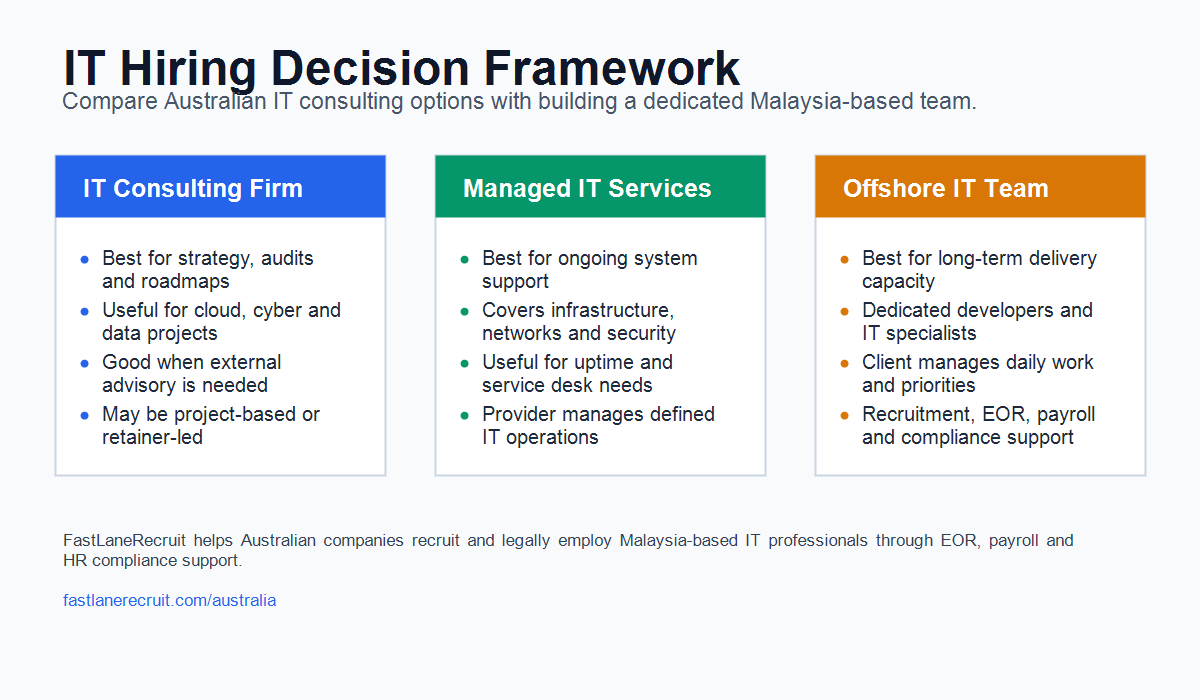
Figure 1: IT hiring decision framework for Australian companies comparing consulting, managed services and dedicated offshore IT teams.
When an IT consulting firm is the better fit
IT consulting is usually the right model when the business needs external assessment, specialist advice, independent governance or a defined implementation project. It works well for cloud migration planning, cybersecurity review, digital transformation strategy, ERP selection, infrastructure audits and complex integrations.
Use this route when:
The company needs independent advisory, a defined project scope, access to specialist knowledge, or a short-term implementation partner without adding permanent headcount.
When managed IT services are the better fit
Managed IT services are better suited to recurring operational needs. This can include service desk support, endpoint management, network monitoring, cloud administration, backup, procurement and security operations. For SMEs, a managed services provider can reduce internal workload and improve IT stability.
Use this route when:
The company needs dependable system support, predictable response times, defined service levels, and a provider that can manage day-to-day IT operations under a structured service agreement.
When an offshore IT team is the better fit
A dedicated offshore IT team is often the stronger model when the business needs long-term execution capacity, deeper integration with internal teams and clearer control over priorities. Instead of outsourcing the whole function to a vendor, the employer builds a remote team that works as part of its organisation.
Use this route when:
The company wants dedicated developers, cloud engineers, DevOps support, data specialists, cybersecurity analysts or IT support professionals who follow internal priorities, join internal meetings and build institutional knowledge over time.
Why Australian Companies Build IT Teams in Malaysia
For Australian employers, Malaysia is a practical location for building dedicated IT and technology teams. It offers a strong pool of English-speaking professionals, regional business familiarity, compatible working hours with Australia and a growing base of technology, finance, operations and professional services talent.
This is why many Australian companies compare local IT consulting with IT outsourcing in Malaysia and offshore team building. The goal is not simply to move tasks elsewhere. The more strategic model is to build a dedicated team that remains under the company’s direction while local employment, payroll and compliance are managed properly.
A Malaysia-based team can support software development, quality assurance, helpdesk, cloud administration, data analysis, technical project coordination and business systems work. For tech companies and digital businesses, this can provide continuity that project-based consulting may not deliver.
Common IT roles Australian employers hire in Malaysia
Common offshore IT roles include Software Developer, Full Stack Developer, Front-end Developer, Back-end Developer, App Developer, DevOps Engineer, Cloud Engineer, System Administrator, IT Support Specialist, Cybersecurity Analyst, Data Analyst, Data Engineer, QA Tester, AI Engineer and Technical Project Coordinator.
The best-fit roles depend on the employer’s operating model. A company with an internal CTO may build a delivery team around developers and QA. A company modernising infrastructure may start with cloud, DevOps or systems support. A company strengthening security may add cybersecurity or data governance capability.
How FastLaneRecruit Supports Australian Employers
FastLaneRecruit helps Australian companies recruit and legally employ Malaysia-based professionals through recruitment, Employer of Record in Malaysia, payroll services in Malaysia, onboarding, HR administration and compliance support.
FastLaneRecruit is not a BPO provider and does not run IT operations for clients. The client manages the employee’s day-to-day work, technical priorities and performance. FastLaneRecruit supports the hiring, employment, payroll, HR and statutory compliance framework so Australian employers can build a dedicated Malaysia-based team without setting up a local entity immediately.
Recruitment and EOR support in Malaysia
Through Talent Solutions, FastLaneRecruit helps employers define the role, source suitable Malaysian candidates, coordinate recruitment and support onboarding. Through EOR support, FastLaneRecruit can act as the legal employer in Malaysia while the client manages the employee’s work. This is especially useful for Australian companies testing the market, scaling gradually or hiring specialist roles before establishing a Malaysian entity.
Payroll, HR and compliance administration
Malaysia hiring requires proper employment contracts, payroll processing, statutory contributions and HR administration. FastLaneRecruit supports payroll, HR administration and compliance processes including EPF, SOCSO, EIS and PCB where applicable. This gives Australian employers a clearer path to compliant cross-border hiring while retaining operational control of their IT team.
Conclusion
The best IT consulting companies in Australia are not always the biggest names or the highest-ranked directory listings. The right choice depends on the outcome you need: strategy, implementation, managed support, cybersecurity, software delivery or long-term internal capability.
For short-term projects and specialist advisory, IT consulting firms remain valuable. For recurring IT operations, managed services may be the better fit. For companies that want more control, continuity and dedicated capacity, building an offshore IT team in Malaysia can be a strategic alternative.
Speak with FastLaneRecruit to explore how your company can recruit, employ and manage Malaysia-based IT professionals through recruitment, EOR, payroll and compliance support.
FAQs
What are the best IT consulting companies in Australia?
There is no single best provider for every business. Commonly cited IT consulting companies in Australia include global firms such as Accenture, Deloitte, PwC, KPMG, EY, Capgemini, DXC Technology, Kyndryl, Cognizant, Infosys, Wipro, Thoughtworks, Endava and Mantel Group, along with city-focused and specialist providers in Sydney, Melbourne, Perth, Brisbane and other Australian markets. The right choice depends on scope, budget, industry, technical requirements and desired support model.
What is the difference between an IT consulting firm and an IT services company?
An IT consulting firm usually focuses on advisory, strategy, assessment, project planning and transformation support. An IT services company may provide broader delivery and operational services such as software development, managed IT support, cloud administration, infrastructure management, cybersecurity and application support. Many providers offer both consulting and services, so buyers should compare the actual scope rather than relying only on the label.
How do I choose between local IT consulting and offshore IT hiring?
Use local IT consulting when you need external advice, local implementation support, audits, project governance or specialised short-term expertise. Consider offshore IT hiring when you need dedicated long-term capacity, internal team integration and more control over daily priorities. Many Australian companies use both models: consultants for roadmap or project design, and offshore teams for ongoing delivery.
Can Australian companies hire IT professionals in Malaysia without setting up a local entity?
Yes. Australian companies can hire Malaysia-based employees through an Employer of Record arrangement. Under this model, the EOR handles local employment, payroll, HR administration and compliance while the Australian company manages the employee’s day-to-day work. This can help employers build a Malaysia-based team before committing to a local entity.
Which IT roles are suitable for a Malaysia-based offshore team?
Suitable roles include software developers, full stack developers, front-end developers, back-end developers, app developers, DevOps engineers, cloud engineers, system administrators, IT support specialists, cybersecurity analysts, data analysts, data engineers, QA testers, AI engineers and technical project coordinators. The strongest setup depends on your internal leadership, delivery process and the level of technical ownership you want the offshore team to carry.