
Hiring international contractors has become increasingly common for businesses of all sizes. Companies today are building remote teams across different countries to access specialized skills, reduce operational costs, and scale faster.
However, global contractor hiring also comes with legal, tax, payment, and compliance responsibilities. Every country has different labour laws, contractor regulations, and tax requirements that businesses must follow carefully.
This is where a Contractor of Record (COR) becomes valuable.
A Contractor of Record helps businesses legally engage and manage independent contractors across borders while reducing compliance risks and simplifying administrative processes.
In this guide, we will explain what is a COR, how it works, its benefits, and why more companies are using COR services to support global hiring and outsourcing.
Content Outline
Key Summary
What a Contractor of Record (COR) Is
A Contractor of Record is a third-party service that manages contractor hiring, contracts, payments, and compliance for businesses working with global freelancers.
Simplifies Global Contractor Management
A COR centralizes complex tasks like onboarding, documentation, and payments, making it easier to manage contractors across multiple countries.
Reduces Legal and Compliance Risks
It helps businesses avoid contractor misclassification and ensures compliance with different labour and tax laws in each country.
Enables Faster International Hiring
Companies can hire global talent quickly without setting up local entities or dealing with lengthy legal registration processes.
Supports Flexible Workforce Scaling
Businesses can easily scale teams up or down by hiring contractors for short-term or project-based work.
Improves Payment and Administrative Efficiency
A COR streamlines international payments, invoice handling, and record keeping, reducing operational workload.
Ideal for Global and Remote-First Businesses
It is especially useful for companies hiring across multiple countries or managing remote freelancers regularly without internal HR complexity.
What Is a Contractor of Record (COR)?
A Contractor of Record (COR) is a third-party service provider that helps businesses legally hire, manage, and pay independent contractors while ensuring compliance with local labour and tax regulations.
As businesses increasingly hire remote contractors from different countries, managing contractor relationships has become more complex. Every country has its own rules regarding contractor agreements, worker classification, taxes, invoicing, and payment requirements. Trying to manage these responsibilities internally can take significant time and resources, especially for companies expanding globally.
This is where a Contractor of Record becomes valuable.
Instead of handling contractor administration manually, businesses can outsource these responsibilities to a COR provider. The COR acts as an intermediary between the company and the contractor, helping ensure that all contractor engagements are managed properly and compliantly.
A COR typically handles:
- Contractor onboarding
- Legally compliant contracts
- Worker classification assessments
- Tax and compliance documentation
- International contractor payments
- Invoice management
- Record keeping
- Contractor offboarding
This allows businesses to focus on daily operations and project management while the COR manages the administrative and compliance side of contractor hiring.
For example, imagine a company in the UK wants to hire:
- A software developer in Malaysia
- A designer in the Philippines
- A marketing consultant in Singapore
Without a COR, the company would need to manage:
- Different local contractor laws
- International payment systems
- Tax documentation requirements
- Compliance risks
- Contractor agreements for each country
A Contractor of Record simplifies this process by centralizing contractor management under one service provider.
Also Read: Terminating an Independent Contractor: How to Do It Compliantly
How a Contractor of Record Helps Businesses
One of the main reasons businesses use COR services is to reduce compliance risks associated with global contractor hiring.
Different countries have different rules that determine whether a worker qualifies as:
- An independent contractor, or
- A full-time employee
If a contractor is incorrectly classified, businesses may face:
- Financial penalties
- Tax liabilities
- Backdated employee benefits
- Legal disputes
- Regulatory investigations
A COR helps businesses reduce these risks by ensuring contractor relationships follow local labour laws and compliance requirements.
This is especially important for businesses hiring contractors across multiple countries where regulations can vary significantly.
Why COR Services Are Becoming More Popular
The rise of remote work and global hiring has increased the demand for COR services.
Today, many businesses prefer flexible workforce models that allow them to:
- Hire specialized talent quickly
- Scale teams efficiently
- Support international growth
- Reduce operational costs
Instead of setting up foreign subsidiaries or local legal entities, companies can work with contractors globally through a COR provider.
This makes international hiring:
- Faster
- More cost-efficient
- Easier to manage
- More compliant
For startups, SMEs, and fast-growing companies, a Contractor of Record can provide a practical solution for managing global contractors without building large internal HR and legal teams.
Why Businesses Are Hiring More Global Contractors
The way companies hire talent has changed significantly over the past few years. Businesses are no longer restricted to hiring employees only within their own country or city. Thanks to remote work technology and global connectivity, companies can now work with skilled contractors from almost anywhere in the world.
This shift has allowed businesses to become more flexible, cost-efficient, and competitive in a rapidly changing market.
Access to Global Talent
One of the biggest advantages of hiring global contractors is access to a much larger talent pool.
Instead of limiting recruitment to local candidates, businesses can hire experienced professionals from different countries based on skills, expertise, and project requirements. This makes it easier to find specialized talent that may not be available locally.
Companies today commonly hire international contractors such as:
- Software developers
- UI/UX designers
- Digital marketers
- Finance and accounting professionals
- Content writers
- Consultants
- Customer support teams
- Data analysts
- Video editors
For example, a startup in the UK may hire:
- A software developer from Malaysia
- A graphic designer from the Philippines
- A digital marketer from Singapore
- A finance consultant from India
This global hiring model gives businesses access to highly skilled professionals while building diverse and capable teams.
Faster Business Expansion
Hiring contractors also allows businesses to expand into new markets more quickly.
Traditionally, companies entering a new country needed to:
- Open a local entity
- Rent office space
- Set up payroll systems
- Understand local employment laws
- Build local HR processes
This process can be expensive and time-consuming.
By working with contractors instead, businesses can test new markets and launch projects faster without making large upfront investments.
For example, a company planning to expand into Southeast Asia may hire local contractors to support:
- Market research
- Customer service
- Sales outreach
- Digital marketing campaigns
- Business development
This allows businesses to build a local presence while maintaining operational flexibility.
Greater Workforce Flexibility
Modern businesses often experience changing workloads and project demands throughout the year.
Hiring contractors provides flexibility because companies can scale teams based on current business needs.
For example:
- A company launching a new website may temporarily hire freelance developers and designers.
- An eCommerce business may increase customer support contractors during peak shopping seasons.
- A marketing agency may hire additional content creators for large campaigns.
This flexibility allows businesses to:
- Respond quickly to market changes
- Fill skill gaps efficiently
- Manage short-term projects
- Reduce long-term staffing commitments
As a result, contractors have become an important part of modern workforce planning.
Reduced Operational Costs
Another major reason businesses hire global contractors is cost efficiency.
Hiring full-time employees often involves additional expenses such as:
- Employee benefits
- Insurance
- Office space
- Equipment
- Payroll taxes
- Training costs
- Long-term employment commitments
Contractors typically work on a project or service basis, which allows companies to control costs more effectively.
In many cases, contractors also:
- Use their own equipment
- Work remotely
- Manage their own schedules
- Handle their own tax obligations
This can help businesses reduce administrative and operational expenses while still accessing experienced professionals.
For startups and growing companies, this flexibility can be especially valuable when managing budgets and scaling operations carefully.
Also Read: What is Employee Tenure?
How Does a Contractor of Record Work?
A Contractor of Record manages the operational and compliance side of contractor engagement.
Below is a typical COR workflow:
| Process | How a COR Helps |
| Contractor onboarding | Prepares compliant contracts and collects required documentation |
| Classification assessment | Verifies contractor status based on local regulations |
| Compliance management | Ensures adherence to labour and tax laws |
| Contractor payments | Handles invoices and international payments |
| Tax administration | Manages tax forms and compliance records |
| Intellectual property protection | Helps secure ownership of contractor-created work |
| Offboarding | Handles final payments and documentation |
This allows businesses to focus on managing work performance while the COR manages administrative and compliance responsibilities.
Key Responsibilities of a Contractor of Record
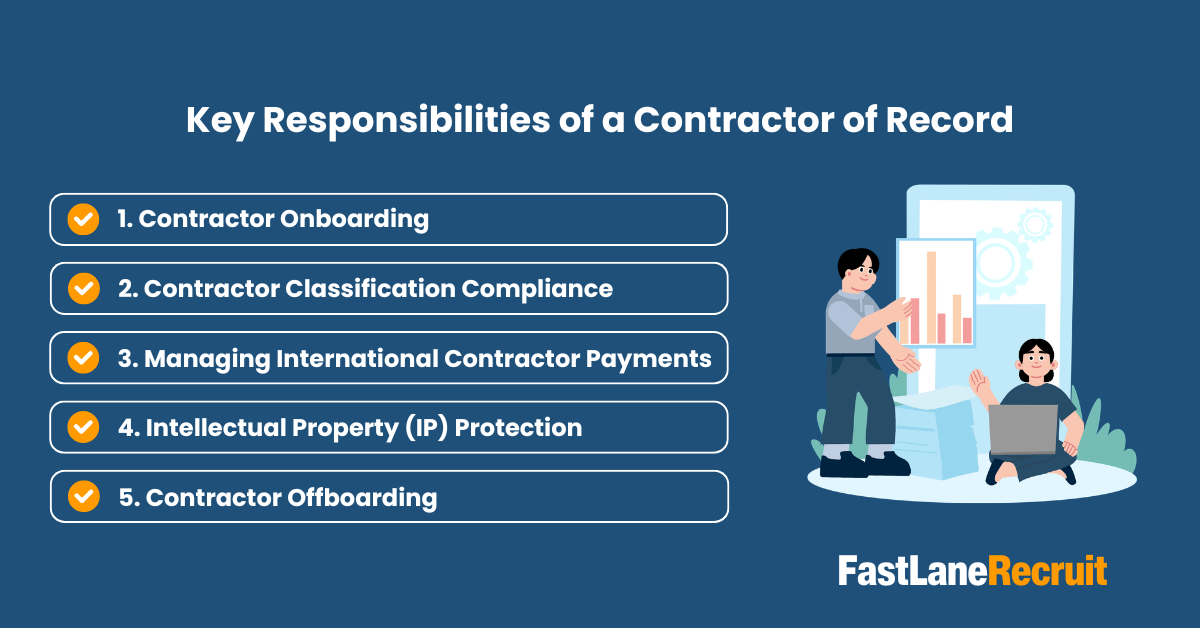
1. Contractor Onboarding
Preparing Legally Compliant Contracts
A COR creates contractor agreements that align with local laws and regulations.
These contracts may include:
- Scope of work
- Payment terms
- Confidentiality clauses
- Intellectual property protections
- Termination terms
Collecting Required Documentation
The COR gathers and stores important contractor records, including:
- Identification documents
- Tax forms
- Payment information
- Compliance records
2. Contractor Classification Compliance
Reducing Misclassification Risks
One of the biggest challenges in global contractor hiring is worker misclassification.
Misclassification occurs when a contractor is legally treated as an employee under local labour laws.
For example, a contractor may be considered an employee if they:
- Work fixed company hours
- Use company equipment
- Report directly like full-time staff
- Work exclusively for one employer long-term
3. Managing International Contractor Payments
Simplifying Global Payments
Paying contractors across different countries can become complicated due to:
- Currency conversion
- International bank transfer fees
- Invoice management
- Local payment regulations
A COR helps businesses:
- Process contractor payments efficiently
- Support multiple currencies
- Manage invoices
- Reduce payment delays
4. Intellectual Property (IP) Protection
Securing Ownership of Contractor Work
For businesses hiring contractors in areas such as:
- Software development
- Content creation
- Product design
- Marketing
protecting intellectual property is extremely important.
A COR helps ensure contracts clearly define ownership rights and IP transfer terms.
5. Contractor Offboarding
Managing Contractor Exits Properly
A COR also helps businesses handle contractor offboarding professionally by:
- Managing final payments
- Closing contracts properly
- Revoking system access
- Maintaining compliance records
Also Read: Best Practices for Managing Remote Teams Effectively
Benefits of Using a Contractor of Record
1. Faster Global Hiring
Businesses can hire contractors internationally without establishing local legal entities.
2. Reduced Compliance Risks
A COR helps reduce:
- Contractor misclassification risks
- Tax compliance issues
- Legal disputes
- Regulatory penalties
3. Simplified Administrative Work
Managing contractor contracts, payments, and tax records manually can become time-consuming.
A COR centralizes these processes into one streamlined system.
4. Better Contractor Experience
Reliable onboarding and timely payments help businesses build stronger relationships with contractors.
5. Easier International Expansion
A COR helps companies enter new markets faster while staying compliant with local regulations.
Contractor of Record (COR) vs Employer of Record (EOR)
Many businesses confuse COR and EOR services, but they serve different purposes.
| Feature | Contractor of Record (COR) | Employer of Record (EOR) |
| Worker Type | Independent contractors | Full-time employees |
| Employment Relationship | Contractor engagement | Official employment |
| Payroll & Benefits | Contractor payment management | Full payroll and employee benefits |
| Compliance Focus | Contractor compliance | Employment law compliance |
| Flexibility | High | Moderate |
| Best For | Freelancers and project-based work | Long-term international hiring |
If you want to hire employees in Malaysia without opening a local company, an EOR service may be a better solution.
COR vs Direct Contractor Hiring
| Aspect | Direct Contractor Hiring | Using a COR |
| Compliance Responsibility | Managed internally | Managed by COR |
| Worker Classification Risk | Higher | Lower |
| Contract Management | Manual | Streamlined |
| Global Payments | Complex | Simplified |
| Administrative Workload | High | Reduced |
Example: Outsourcing Talent to Malaysia
Why Malaysia Is a Popular Outsourcing Destination
Malaysia is becoming increasingly attractive for outsourcing due to:
- Strong English proficiency
- Competitive business costs
- Skilled digital workforce
- Growing technology sector
Companies commonly outsource:
- Software development
- Accounting support
- Customer service
- Digital marketing
- Administrative functions
When Should Businesses Use a Contractor of Record?
A Contractor of Record (COR) is especially useful for businesses that hire independent contractors regularly, particularly across different countries and regions.
As global hiring becomes more common, many businesses face challenges related to contractor compliance, international payments, tax documentation, and worker classification. A COR helps simplify these processes while reducing legal and operational risks.
Below are some common situations where businesses should consider using a Contractor of Record.
1. Businesses Hiring Contractors in Multiple Countries
Managing contractors in one country can already be complicated. Managing contractors across several countries becomes even more challenging because every country has different:
- Labour laws
- Tax regulations
- Contractor classification rules
- Payment requirements
- Documentation standards
For example, a company may hire:
- A software developer in Malaysia
- A content writer in the Philippines
- A designer in Indonesia
- A consultant in Singapore
Each country may require different contractor agreements and compliance processes.
A COR helps businesses centralize and manage these international contractor relationships more efficiently while ensuring local compliance requirements are followed properly.
2. Businesses That Want to Reduce Legal and Tax Risks
One of the biggest risks in contractor hiring is worker misclassification.
This happens when a contractor is treated like an employee under local labour laws. Misclassification can lead to:
- Financial penalties
- Backdated taxes
- Employee benefit liabilities
- Legal disputes
- Government investigations
Many countries are becoming stricter about contractor compliance and worker classification, especially for remote work arrangements.
A COR helps businesses reduce these risks by:
- Reviewing contractor relationships
- Preparing compliant agreements
- Managing proper documentation
- Monitoring local compliance requirements
This provides businesses with greater confidence when hiring contractors internationally.
Also Read: Job Level Classification: How to Build a Fair, Consistent System Your Team Will Actually Use
3. Businesses That Need Faster International Hiring
Setting up a legal entity in another country can take months and involve significant costs.
Businesses may need to:
- Register a company
- Open local bank accounts
- Set up payroll systems
- Understand local employment regulations
- Hire local legal and HR support
For businesses that need to hire quickly, this process may slow down expansion plans.
A COR helps companies onboard contractors faster without establishing a local entity. This allows businesses to:
- Enter new markets quickly
- Launch projects faster
- Hire specialized talent immediately
- Scale international operations efficiently
This flexibility is especially valuable for startups and growing companies.
4. Businesses That Work with Remote Freelancers Regularly
Many businesses today rely heavily on remote freelancers and project-based workers.
Examples include:
- Marketing agencies hiring freelance creatives
- Tech companies hiring remote developers
- eCommerce businesses outsourcing customer support
- Consulting firms engaging project specialists
As the number of contractors grows, managing:
- Contracts
- Invoices
- Payments
- Tax forms
- Compliance records
can become time-consuming and difficult to track manually.
A COR simplifies contractor administration by centralizing these tasks into one streamlined process.
5. Businesses That Want to Simplify Contractor Administration
Contractor management involves much more than simply paying invoices.
Businesses also need to manage:
- Contract renewals
- Payment schedules
- Compliance checks
- Tax documentation
- Contractor onboarding
- Offboarding procedures
- Record keeping
Without proper systems in place, administrative workloads can quickly increase.
A COR reduces this burden by handling many of these operational tasks on behalf of the business, allowing internal teams to focus on more strategic priorities.
6. Businesses That Do Not Want to Establish Foreign Legal Entities
Opening legal entities in multiple countries can be expensive, time-consuming, and administratively complex.
For many businesses, especially SMEs and startups, establishing local entities may not be practical during early expansion stages.
A COR provides an alternative solution by helping businesses legally engage contractors internationally without creating local subsidiaries.
This allows companies to:
- Test new markets
- Build international teams
- Support global operations
- Expand more flexibly
while avoiding the complexity of setting up foreign entities too early.
7. Businesses Expanding Through Outsourcing
Many companies use outsourcing to support business growth while maintaining flexibility and cost efficiency.
For example, businesses may outsource:
- IT and software development
- Finance and accounting support
- Administrative services
- Customer service operations
- Digital marketing functions
Countries like Malaysia have become increasingly popular outsourcing destinations due to their skilled workforce, strong English proficiency, and growing digital economy.
A COR can help businesses outsource talent more smoothly by managing:
- Contractor onboarding
- Local compliance
- International payments
- Contract administration
- Risk management
This makes outsourcing more efficient and scalable for global businesses.
Tips for Choosing the Right COR Provider
1. Check Global Coverage
Ensure the provider supports the countries where you hire contractors.
2. Evaluate Compliance Expertise
Choose a COR provider with strong legal and international compliance knowledge.
3. Review Payment Capabilities
Look for providers that support:
- Multiple currencies
- International bank transfers
- Flexible payment methods
4. Prioritize Data Security
Contractor information and company records should be securely protected.
5. Understand Pricing Clearly
Review onboarding fees, monthly charges, and termination costs carefully.
Common Challenges Without a COR
Businesses managing contractors internally may face:
| Challenge | Potential Risk |
| Worker misclassification | Legal penalties |
| Incorrect contracts | Compliance issues |
| Delayed payments | Contractor dissatisfaction |
| Missing tax records | Audit problems |
| Administrative overload | Reduced efficiency |
Using a COR helps businesses reduce these operational challenges significantly.
The Future of Global Contractor Management
The global workforce is continuing to evolve toward:
- Remote work
- Flexible hiring
- International outsourcing
- Project-based collaboration
At the same time, governments worldwide are increasing scrutiny around:
- Contractor classification
- Tax compliance
- Labour protections
- Cross-border hiring
As global contractor hiring grows, businesses will need stronger compliance processes and reliable contractor management solutions.
COR services are becoming an increasingly important part of modern workforce management.
How FastLaneRecruit Can Help
At FastLaneRecruit, we help businesses simplify international hiring and outsourcing across Malaysia and beyond.
Our solutions support businesses that need:
- Remote Malaysian talent
- International recruitment support
- Outsourcing solutions
- Employer of Record (EOR) services
- Scalable workforce solutions
If your business plans to hire or outsource Malaysian professionals without establishing a local company, FastLaneRecruit’s EOR service can help manage:
- Employment compliance
- Payroll administration
- Employee onboarding
- HR support
- Workforce management
Conclusion
Understanding what is a COR is essential for businesses managing international contractors in today’s global workforce.
A Contractor of Record helps businesses:
- Reduce contractor compliance risks
- Simplify international contractor payments
- Manage onboarding and contracts
- Support global expansion
- Improve contractor management efficiency
As global hiring continues to grow, COR services provide businesses with a safer and more efficient way to engage contractors across borders.
For companies expanding internationally, a Contractor of Record is becoming an important solution for compliant and scalable workforce management.
Ready to Hire and Outsource Talent in Malaysia?
Expanding your team internationally does not have to be complicated. Whether you are hiring remote contractors, building a distributed workforce, or outsourcing key business functions, FastLaneRecruit helps you manage the process efficiently and compliantly.
Our team supports businesses looking to:
- Hire skilled Malaysian professionals
- Expand into Malaysia without setting up a local entity
- Simplify international hiring and HR administration
- Reduce compliance and payroll complexities
- Scale remote and outsourced teams confidently
With FastLaneRecruit’s Employer of Record (EOR) and outsourcing solutions, you can focus on growing your business while we handle:
- Employment compliance
- Payroll processing
- Employee onboarding
- HR administration
- Workforce management support
If you are planning to build a remote team or outsource talent in Malaysia, FastLaneRecruit can help you hire faster, stay compliant, and scale with confidence.
Frequently Asked Questions (FAQs)
What is a Contractor of Record (COR)?
A Contractor of Record (COR) is a third-party provider that manages contractor compliance, onboarding, payments, and administrative responsibilities on behalf of businesses.
How does a Contractor of Record work?
A COR handles contractor agreements, compliance checks, payment processing, tax documentation, and contractor administration for businesses hiring independent contractors.
What is the difference between COR and EOR?
A COR manages independent contractors, while an EOR legally employs full-time employees on behalf of a business.
Why do businesses use COR services?
Businesses use COR services to reduce contractor misclassification risks, simplify global payments, and improve international contractor compliance.
Is a Contractor of Record suitable for global hiring?
Yes. A COR is particularly useful for businesses hiring contractors across multiple countries without establishing local legal entities.