Hiring employees in Malaysia comes with several statutory obligations that every employer should understand. Whether you are a local business, a global company expanding into Southeast Asia, or an employer outsourcing recruitment in Malaysia, managing contributions such as EPF, SOCSO, and EIS is essential for staying compliant and building a strong workforce.
Malaysia is widely recognised for its skilled multilingual talent, business-friendly environment, and growing digital economy. However, employers must also ensure that payroll and employee contributions are handled correctly from day one.
In this guide, we explain everything employers need to know about EPF, SOCSO, and EIS contributions in Malaysia for 2026, including contribution rates, employer responsibilities, deadlines, foreign worker rules, and compliance tips.
Content Outline
Key Summary
Payroll Outsourcing is aOverview of EPF, SOCSO & EIS in Malaysia Strategic Advantage
Employers must contribute to EPF, SOCSO, and EIS as part of Malaysia’s mandatory employee protection system covering retirement, social security, and unemployment support.
EPF Builds Long-Term Retirement Savings
EPF is a compulsory savings scheme where both employers and employees contribute monthly to support employees’ financial security after retirement.
SOCSO Protects Employees at Work
SOCSO provides financial and medical protection for employees in cases of workplace injuries, occupational diseases, disability, or death.
EIS Supports Job Loss Recovery
EIS offers temporary financial assistance, job placement support, and training programmes for employees who lose their jobs involuntarily.
Contribution Rates Depend on Employee Category
EPF, SOCSO, and EIS rates vary based on salary level, age, and employee type, including Malaysian citizens, permanent residents, and foreign workers.
Payroll Classification Impacts Compliance
Different types of payments such as salary, bonuses, allowances, and overtime may have different contribution rules that employers must classify correctly.
Timely Submission Prevents Penalties
All statutory contributions must be submitted by the 15th of each month to avoid late charges, penalties, and potential legal consequences.
What Are EPF, SOCSO, and EIS in Malaysia?
Malaysia requires employers to contribute to several statutory employee protection schemes:
| Contribution Type | Purpose | Managed By |
| EPF (Employees Provident Fund / KWSP) | Retirement savings scheme | Employees Provident Fund |
| SOCSO (PERKESO) | Social security and workplace injury protection | Social Security Organisation |
| EIS (Employment Insurance System) | Financial support for employees who lose employment | Social Security Organisation |
These contributions are mandatory for eligible employees under Malaysian employment laws.
What Is EPF in Malaysia?
The Employees Provident Fund (EPF), also known as KWSP (Kumpulan Wang Simpanan Pekerja), is Malaysia’s mandatory retirement savings scheme for private sector employees and non-pensionable public sector workers.
Established under the Employees Provident Fund Act 1991, EPF helps employees build long-term savings throughout their working years so they have financial support during retirement.
In simple terms, EPF works like a long-term savings fund. Every month, both the employer and employee contribute a percentage of the employee’s salary into the employee’s EPF account. These contributions are mandatory for eligible employees in Malaysia.
The savings are managed and invested by the Employees Provident Fund across different investment portfolios such as equities, bonds, real estate, and money market instruments. Based on the fund’s annual performance, EPF distributes dividends to members every year, helping the savings grow over time.
For many employees in Malaysia, EPF serves as one of the most important financial safety nets for retirement planning.
How EPF Contributions Work
Each month:
- Employers contribute a percentage of the employee’s monthly salary
- Employees also contribute a portion from their salary
- The total contribution is deposited into the employee’s EPF account
For example, if an employee earns RM5,000 monthly:
- The employer may contribute 12% or 13%
- The employee typically contributes 11%
These contribution rates may vary depending on:
- Age
- Salary level
- Citizenship or residency status
- Foreign worker category
Employers are responsible for deducting employee contributions and submitting both employer and employee portions to EPF before the monthly deadline.
Also Read: Job Level Classification: How to Build a Fair, Consistent System Your Team Will Actually Use
What Can EPF Savings Be Used For?
Although EPF is mainly designed for retirement savings, members may also use part of their funds for approved purposes before retirement age.
Common withdrawal purposes include:
- Purchasing or building a home
- Education expenses
- Medical treatment
- Retirement preparation after age 50
- Permanent departure from Malaysia (for eligible foreign workers)
This flexibility helps employees balance long-term retirement planning with important life needs.
Benefits of EPF Contributions
EPF provides long-term financial protection and supports employees in building a more secure future.
1. Retirement Savings Growth
EPF helps employees consistently build savings throughout their careers through automatic monthly contributions.
Because contributions are made regularly, employees gradually accumulate retirement funds without needing to manage the process manually.
2. Annual EPF Dividend Earnings
EPF savings earn annual dividends declared by the fund based on investment performance.
Historically, EPF dividend rates have generally remained above the statutory minimum guaranteed dividend rate of 2.5%, helping members grow their retirement savings over time.
3. Tax Relief Benefits
Employee EPF contributions may qualify for personal income tax relief in Malaysia, subject to annual limits set by the government.
This helps reduce taxable income while encouraging long-term savings habits.
4. Flexible Withdrawal Options
EPF members may partially withdraw savings for approved purposes such as:
- Housing
- Education
- Healthcare
- Retirement support
This provides additional financial flexibility during important life stages.
5. Financial Security for Employees
EPF creates a stronger sense of long-term financial stability for employees and their families, especially after retirement or during major life transitions.
For employers, offering proper EPF contributions also helps:
- Build employee trust
- Improve retention
- Support compliant hiring practices in Malaysia
Why EPF Matters for Employers
For employers hiring in Malaysia, EPF compliance is a key part of responsible workforce management.
Accurate EPF contributions demonstrate that a company:
- Follows Malaysian employment regulations
- Supports employee welfare
- Maintains proper payroll practices
- Builds credibility with local talent
This is especially important for international companies expanding into Malaysia or building remote teams with Malaysian employees.
What Is SOCSO in Malaysia?
SOCSO, also known as PERKESO (Pertubuhan Keselamatan Sosial), is Malaysia’s social security protection system established under the Employees’ Social Security Act 1969.
Managed by the Social Security Organisation, SOCSO is designed to provide financial protection and support to employees who experience work-related accidents, occupational illnesses, disabilities, or other situations that affect their ability to work.
In simple terms, SOCSO acts as a workplace safety net for employees and their families. If an employee becomes injured, disabled, or unable to work due to certain conditions, SOCSO may provide medical support, financial assistance, rehabilitation benefits, or compensation depending on the situation.
SOCSO is an important part of Malaysia’s employment protection system and helps create greater financial security for workers across different industries.
What Does SOCSO Cover?
SOCSO mainly protects employees against:
- Workplace accidents
- Occupational diseases
- Disability or invalidity
- Employment-related injuries
- Death benefits for dependents
- Medical and rehabilitation support
These protections help employees manage unexpected situations that may impact their income or ability to continue working.
For employers, SOCSO compliance is also an important legal responsibility when hiring employees in Malaysia.
The Two Main SOCSO Schemes
SOCSO protection is generally divided into two main schemes:
| Scheme | Coverage |
| Employment Injury Scheme | Protection against work-related accidents, injuries, or occupational diseases |
| Invalidity Scheme | Financial support for permanent disability, severe illness, or death unrelated to work |
1. Employment Injury Scheme
The Employment Injury Scheme protects employees if they suffer injuries or illnesses arising from their work duties.
This may include:
- Workplace accidents
- Injuries during work-related travel
- Occupational diseases caused by the work environment
- Temporary or permanent disability from work incidents
Depending on the case, employees may receive:
- Medical treatment coverage
- Temporary disability benefits
- Permanent disability compensation
- Dependants’ benefits in fatal cases
- Rehabilitation services
For example, if a warehouse employee is injured while operating equipment during work hours, SOCSO may help cover medical expenses and provide temporary financial assistance during recovery.
2. Invalidity Scheme
The Invalidity Scheme provides financial protection for employees who are unable to continue working due to serious health conditions or disabilities not directly related to their job.
This scheme may support employees facing:
- Permanent disability
- Chronic illness
- Severe medical conditions
- Death unrelated to workplace accidents
Eligible employees or their dependants may receive:
- Monthly invalidity pensions
- Survivors’ benefits
- Funeral benefits
- Constant attendance allowances in certain cases
This helps provide long-term financial support during difficult circumstances.
Are Foreign Workers Covered Under SOCSO?
Yes. Foreign workers in Malaysia are also covered under SOCSO protections.
Since 2019, employers are generally required to register eligible foreign workers under SOCSO’s Employment Injury Scheme.
This provides protection for foreign employees working in Malaysia if they experience workplace-related accidents or injuries.
For international companies hiring Malaysian and foreign employees, understanding SOCSO obligations is essential for maintaining compliance with local employment laws.
Employer Responsibilities for SOCSO
Employers in Malaysia are responsible for:
- Registering their business with SOCSO
- Registering eligible employees
- Submitting monthly SOCSO contributions
- Keeping employee records updated
- Reporting workplace accidents within required timelines
Failure to comply with SOCSO regulations may result in penalties, interest charges, or legal action.
Why SOCSO Matters for Employers and Employees
SOCSO plays an important role in supporting a stable and protected workforce in Malaysia.
For employees, SOCSO provides:
- Financial protection during emergencies
- Access to medical and rehabilitation support
- Greater peace of mind while working
For employers, proper SOCSO compliance helps:
- Build employee trust
- Improve workplace protection standards
- Support responsible hiring practices
- Reduce compliance risks
This is especially important for global companies expanding operations or hiring remote employees in Malaysia.
Also Read: What Is Business Process Outsourcing (BPO) and How Does It Work?
What Is EIS in Malaysia?
The Employment Insurance System (EIS) is Malaysia’s employment protection scheme designed to support employees who lose their jobs. It is administered by the Social Security Organisation (SOCSO/PERKESO) under the Employment Insurance System Act 2017.
In simple terms, EIS acts as a temporary financial safety net for employees during periods of unemployment. The system helps eligible employees manage their finances while they search for new job opportunities or improve their skills for future employment.
EIS is an important part of Malaysia’s workforce protection framework because it not only provides temporary income support but also helps employees return to work more quickly through career assistance and training programmes.
What Does EIS Cover?
EIS helps employees who lose their jobs by providing:
- Temporary financial assistance
- Job search support
- Career counselling
- Skills training programmes
- Employment placement assistance
The goal of EIS is to reduce the financial impact of unemployment while helping employees transition into new job opportunities more smoothly.
How EIS Works
Both employers and employees contribute monthly to the EIS fund as part of Malaysia’s statutory payroll requirements.
If an eligible employee loses their job under qualifying circumstances, they may apply for EIS benefits through SOCSO.
Depending on eligibility, employees may receive:
- Monthly financial support for a temporary period
- Assistance finding new employment
- Access to upskilling or reskilling programmes
- Career coaching and employability support
This helps employees maintain financial stability while actively seeking new work opportunities.
Who Is Covered Under EIS?
EIS generally covers employees:
- Aged between 18 and 60
- Working under a contract of service
- Contributing to EIS through payroll deductions
Both Malaysian citizens and permanent residents are generally covered if they meet the eligibility requirements.
However, certain categories of workers may not be covered, such as:
- Domestic workers
- Self-employed individuals
- Government employees
- Employees who have reached the statutory age limits under the scheme
Employers should always review the latest official SOCSO guidelines to confirm employee eligibility.
Situations Covered Under EIS
EIS is mainly intended for employees who lose employment involuntarily.
Examples may include:
- Company restructuring
- Workforce reduction
- Business closure
- Redundancy situations
However, employees who resign voluntarily or are dismissed due to misconduct may not qualify for EIS benefits.
Employer Responsibilities for EIS
In Malaysia, employers are responsible for:
- Registering eligible employees under SOCSO
- Deducting employee EIS contributions
- Submitting both employer and employee EIS contributions monthly
- Maintaining accurate payroll and employment records
EIS contributions are generally submitted together with SOCSO contributions.
Late payments or incorrect submissions may result in penalties or compliance issues.
Why EIS Matters for Employers and Employees
EIS plays an important role in supporting workforce stability and employee confidence in Malaysia.
For employees, EIS provides:
- Temporary income protection during unemployment
- Access to career support services
- Opportunities for skills development and retraining
For employers, EIS compliance helps:
- Maintain proper statutory payroll practices
- Support responsible employment standards
- Build stronger employer credibility
- Improve employee confidence and trust
This is especially important for international businesses hiring in Malaysia, where understanding local employment protections helps create a smoother and more compliant hiring process.
EPF Contribution Rates in Malaysia (2026)
EPF Employer and Employee Contribution Rates
| Employee Category | Employer Contribution | Employee Contribution |
| Malaysian below 60 years old (salary RM5,000 and below) | 13% | 11% |
| Malaysian below 60 years old (salary above RM5,000) | 12% | 11% |
| Malaysian age 60 and above | 4% | 0% |
| Permanent residents below 60 | 13% / 12% | 11% |
| Permanent residents age 60+ | 6.5% / 6% | 5.5% |
| Foreign workers (effective Oct 2025) | 2% | 2% |
Important Update for Foreign Workers
Starting October 2025, foreign workers with valid work permits are required to contribute to EPF in Malaysia.
This applies to:
- Employment Pass holders
- Professional Visit Pass holders
- Residence Pass holders
- Other eligible work permit holders
Foreign workers may withdraw EPF savings when permanently leaving Malaysia.
SOCSO Contribution Rates (2026)
SOCSO Employer and Employee Rates
| Employee Category | Employer Contribution | Employee Contribution |
| Malaysian & PR below 60 | 1.75% | 0.5% |
| Malaysian & PR age 60+ | 1.25% | 0% |
| Foreign workers | 1.25% | 0% |
Important update:
The SOCSO wage ceiling increased from RM4,000 to RM6,000 beginning October 2024.
This means employees earning between RM4,001 and RM6,000 now have higher contribution calculations.
EIS Contribution Rates (2026)
| Employee Category | Employer Contribution | Employee Contribution |
| Employees aged 18–60 | 0.2% | 0.2% |
Like SOCSO, EIS contributions are also capped at the RM6,000 wage ceiling.
One of the most important parts of payroll compliance in Malaysia is understanding which employee payments are subject to statutory contributions.
Not every payment made to an employee is treated the same way under EPF, SOCSO, and EIS regulations. Some payments require contributions, while others may be partially or fully exempt.
Understanding contribution eligibility helps employers:
- Avoid payroll calculation mistakes
- Reduce compliance risks
- Prevent underpayment or overpayment issues
- Ensure accurate statutory submissions
For global companies hiring in Malaysia, this is especially important because payroll structures may differ from other countries.
Common Payments Subject to Contributions
The table below outlines common payment types that are generally subject to EPF, SOCSO, and EIS contributions.
| Payment Type | EPF | SOCSO | EIS |
| Basic salary | Yes | Yes | Yes |
| Allowances | Mostly yes | Some | Some |
| Bonuses | Yes | No | No |
| Commissions | Yes | Yes | Yes |
| Overtime payments | No | Yes | Yes |
| Maternity leave wages | Yes | Yes | Yes |
Understanding Each Payment Type
1. Basic Salary
Basic salary is fully subject to EPF, SOCSO, and EIS contributions.
This includes the employee’s regular monthly salary stated in the employment contract.
Example:
- Monthly salary: RM5,000
- Contributions are calculated based on the applicable statutory rates and contribution tables.
2. Allowances
Allowances are generally subject to EPF contributions, but SOCSO and EIS treatment may vary depending on the type of allowance.
Common examples include:
- Housing allowance
- Meal allowance
- Shift allowance
- Attendance allowance
Some allowances may be treated differently if they are reimbursements rather than fixed wage components.
Example:
A fixed monthly transport allowance may sometimes be treated differently from actual travel reimbursements.
Because classifications can vary, employers should review official contribution guidelines carefully.
3. Bonuses
Bonuses are usually subject to EPF contributions but are generally exempt from SOCSO and EIS contributions.
Examples include:
- Annual performance bonuses
- Festival bonuses
- Incentive bonuses
Example:
If an employee receives a RM10,000 annual bonus:
- EPF contribution applies
- SOCSO and EIS generally do not apply
4. Commissions
Sales commissions and similar incentive payments are generally subject to all three contributions:
- EPF
- SOCSO
- EIS
This commonly applies to:
- Sales employees
- Recruitment consultants
- Business development staff
5. Overtime Payments
Overtime payments are generally:
- Exempt from EPF
- Subject to SOCSO and EIS
This includes:
- Overtime work
- Public holiday work
- Rest day work payments
Many employers accidentally apply EPF to overtime wages, so payroll teams should review calculations carefully.
6. Maternity Leave Wages
Wages paid during maternity leave are generally subject to:
- EPF
- SOCSO
- EIS
These payments are considered part of employment income under Malaysian payroll regulations.
Also Read: Guide to PEO vs EOR
Payments Usually Exempt From Contributions
Some payments are commonly exempt from statutory contributions.
| Payment Type | EPF | SOCSO/EIS |
| Travel allowance or reimbursements | Exempt | Exempt |
| Gratuity | Exempt | Exempt |
| Director fees | Exempt | Usually exempt |
| Termination benefits | Exempt | Exempt |
| Gifts and festive cash payments | Exempt | Exempt |
Understanding Common Exempt Payments
1. Travel Allowances and Reimbursements
Actual reimbursements for business-related travel expenses are generally exempt from contributions.
Examples include:
- Mileage claims
- Hotel reimbursements
- Flight reimbursements
- Client meeting travel expenses
However, fixed transport allowances may sometimes be treated differently from expense reimbursements.
2. Gratuity Payments
Gratuity payments made at the end of employment service are usually exempt from EPF, SOCSO, and EIS.
This often applies to:
- Long-service gratuity payments
- End-of-contract gratuity arrangements
3. Director Fees
Director fees are generally exempt from EPF and may also be exempt from SOCSO and EIS depending on the employment structure.
This typically applies to non-executive directors who are not employed under a standard contract of service.
4. Termination Benefits
Payments related to termination or retrenchment are generally exempt from statutory contributions.
Examples include:
- Retrenchment compensation
- Compensation in lieu of notice
- Separation benefits
5. Gifts and Festive Cash Payments
One-time festive gifts or goodwill payments are usually exempt.
Examples may include:
- Hari Raya gifts
- Christmas cash gifts
- Chinese New Year ang pow
- Company appreciation gifts
Why Accurate Payment Classification Matters
Incorrect contribution classifications can create serious payroll and compliance issues.
Common risks include:
- Underpayment penalties
- Employee disputes
- Payroll audit findings
- Delayed statutory submissions
- Incorrect tax reporting
For example:
- Applying EPF incorrectly to overtime wages may increase payroll costs unnecessarily
- Failing to contribute EPF on bonuses may result in compliance issues
This is why many companies use payroll specialists or local HR experts to manage Malaysian statutory calculations accurately.
Employer Responsibilities in Malaysia
When hiring employees in Malaysia, employers must:
EPF Responsibilities
- Register with EPF within 7 days of hiring the first employee
- Register employees as EPF members
- Submit monthly contributions on time
- Maintain payroll and salary records
SOCSO & EIS Responsibilities
- Register with SOCSO within 30 days
- Maintain employee contribution records
- Report workplace accidents within 48 hours
- Submit monthly SOCSO and EIS payments
Contribution Deadlines in Malaysia
| Contribution Type | Payment Deadline |
| EPF | By the 15th of the following month |
| SOCSO | By the 15th of the following month |
| EIS | Paid together with SOCSO |
Late submissions may result in penalties, interest charges, or legal action.
Penalties for Late Contributions
Employers in Malaysia are legally required to submit EPF, SOCSO, and EIS contributions on time every month. Missing deadlines or making incorrect submissions can lead to financial penalties, additional charges, and potential legal consequences.
For businesses hiring employees in Malaysia, understanding these penalties is important for maintaining smooth payroll operations and avoiding unnecessary compliance risks.
In most cases:
- Contributions must be paid by the 15th of the following month
- Employers are responsible for both employer and employee portions
- Late submissions may trigger automatic penalties and interest charges
For international companies expanding into Malaysia, timely statutory compliance is especially important because local authorities take payroll obligations seriously.
EPF Penalties
Late EPF payments may lead to:
- Dividend charges
- Additional late payment charges
- Fines
- Possible legal prosecution
SOCSO & EIS Penalties
Late SOCSO and EIS contributions may also result in penalties under Malaysian employment regulations.
Because EIS is administered together with SOCSO, contribution issues often affect both systems simultaneously.
- Interest charges
- Compliance penalties
- Additional enforcement action
For accurate compliance updates, employers should always refer to official government portals.
Why Timely Contributions Matter
Making statutory contributions on time is not only about compliance. It also helps:
- Protect employee benefits
- Maintain employee trust
- Support smooth payroll operations
- Reduce audit risks
- Avoid unnecessary financial penalties
For employees, delayed contributions may affect:
- Retirement savings growth
- Social protection coverage
- Access to employment-related benefits
This is why statutory payroll management is considered an important part of responsible employment practices in Malaysia.
Example: Hiring an Employee in Malaysia
Here is a simple example for a Malaysian employee earning RM5,000 monthly.
| Contribution | Employer Pays | Employee Pays |
| EPF | RM650 | RM550 |
| SOCSO | RM87.50 | RM25 |
| EIS | RM10 | RM10 |
This means employers should budget beyond base salary when planning recruitment in Malaysia.
Why Global Companies Choose Malaysia for Hiring
Malaysia continues to attract international employers because of its:
- Skilled English-speaking workforce
- Strong finance and tech talent pool
- Strategic Southeast Asian location
- Digital infrastructure
- Competitive regional operating environment
Many global businesses choose recruitment partners or payroll specialists to simplify compliance and onboarding.
For example, companies outsourcing software development, customer support, finance operations, or digital marketing to Malaysia often rely on local recruitment experts to manage hiring processes efficiently.
Tips for Managing EPF, SOCSO, and EIS Smoothly
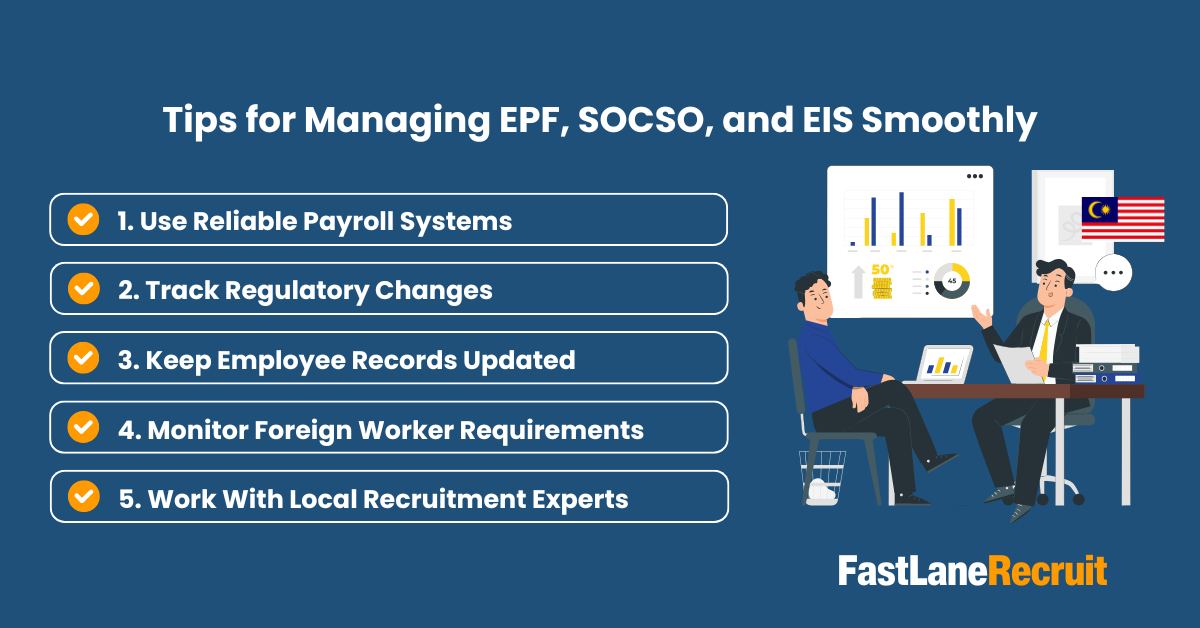
1. Use Reliable Payroll Systems
Automated payroll systems help reduce calculation errors and improve submission accuracy.
2. Track Regulatory Changes
Contribution rates and wage ceilings may change annually.
3. Keep Employee Records Updated
Incorrect employee details can delay submissions and create compliance issues.
4. Monitor Foreign Worker Requirements
Malaysia’s foreign worker EPF regulations changed significantly in 2025.
5. Work With Local Recruitment Experts
Local hiring specialists can help employers understand employment regulations, payroll obligations, and recruitment best practices.
Also Read: Global Employment Outsourcing: Complete Guide to Hiring International Teams
HRD Corp (HRDF): Another Important Employer Requirement in Malaysia
In addition to EPF, SOCSO, and EIS contributions, some employers in Malaysia may also need to register with HRD Corp, formerly known as the Human Resource Development Fund (HRDF).
HRD Corp plays an important role in supporting employee training, skills development, and workforce upskilling across Malaysia.
The organisation operates under the Pembangunan Sumber Manusia Berhad Act 2001 and is managed by Human Resource Development Corporation.
For businesses expanding into Malaysia, HRD Corp is another important compliance area that is sometimes overlooked during hiring and payroll planning.
What Is HRD Corp?
HRD Corp is a Malaysian government agency that helps employers improve workforce capabilities through training and professional development initiatives.
Eligible employers contribute a monthly training levy, which can later be used to claim training grants, employee development programmes, and upskilling support.
In simple terms:
- Employers contribute to the HRD Corp levy fund
- Companies can then use the fund to train and develop employees
- This helps businesses build a stronger and more competitive workforce
The programme supports Malaysia’s long-term goal of strengthening workforce productivity and professional skills across industries.
Which Companies Need to Register With HRD Corp?
Generally, companies may need to register if they:
- Operate in covered industries
- Employ 10 or more employees
- Reach the required registration threshold under HRD Corp regulations
Covered industries may include:
- Services
- Manufacturing
- Information technology
- Logistics
- Hospitality
- Mining and quarrying
- Selected professional services
Registration requirements may vary depending on:
- Industry classification
- Company size
- Number of employees
- Business activities
Because eligibility rules may change over time, employers should always confirm directly with HRD Corp.
What Is the HRD Corp Levy?
Eligible employers are required to contribute a monthly levy based on employee wages.
The levy rate commonly includes:
- 1% of monthly payroll for certain employers
- Reduced rates for some qualifying businesses or industries
The levy is calculated separately from:
- EPF
- SOCSO
- EIS
This means HRD Corp contributions should also be included when estimating total employment costs in Malaysia.
Why HRD Corp Matters for Employers
Although HRD Corp is an additional employer obligation, it also provides long-term benefits for workforce development.
Companies may use HRD Corp support for:
- Employee skills training
- Leadership development programmes
- Technical certifications
- Digital skills training
- Professional workshops
- Workforce upskilling initiatives
This can help employers improve:
- Employee productivity
- Staff retention
- Team performance
- Industry competitiveness
For fast-growing companies and international businesses hiring in Malaysia, investing in workforce development can be especially valuable.
Example: How HRD Corp Supports Business Growth
Imagine a technology company expanding its operations into Malaysia and hiring a local customer support and software development team.
Through HRD Corp-supported programmes, the company may be able to:
- Upskill employees in cybersecurity or cloud technologies
- Improve leadership and management capabilities
- Provide customer service training
- Develop language or communication skills
This creates opportunities for both employers and employees to grow together.
Learn More About HRD Corp Malaysia
For the latest registration requirements, covered industries, levy rates, and training programmes, employers should always refer to the official HRD Corp portal:
HRD Corp Malaysia Official Website
Staying informed about HRD Corp requirements helps employers maintain compliance while building stronger and more capable teams in Malaysia.
How FastLaneRecruit Helps Companies Hire in Malaysia
Hiring in Malaysia involves more than simply finding candidates. Employers also need to manage:
- EPF registration
- SOCSO and EIS compliance
- Employment documentation
- Payroll coordination
- Local hiring practices
FastLaneRecruit helps global companies simplify recruitment in Malaysia by connecting businesses with qualified Malaysian talent while supporting smooth hiring and onboarding processes.
Whether you are building a remote team, expanding operations into Southeast Asia, or hiring specialised professionals, FastLaneRecruit can help streamline your recruitment journey in Malaysia.
Learn more about FastLaneRecruit’s Recruitment Services for hiring Malaysian employees and building compliant local teams.
Conclusion
Understanding EPF, SOCSO, and EIS contributions is an essential part of hiring employees in Malaysia. These statutory contributions protect employee welfare while helping employers maintain compliance with Malaysian labour regulations.
As Malaysia continues attracting international investment and global hiring opportunities, businesses that understand local employment requirements can scale their workforce more confidently and efficiently.
By staying updated on contribution rates, deadlines, and foreign worker regulations, employers can create a smoother hiring experience while building trust with employees in Malaysia.
Hire and Manage Malaysian Talent With FastLaneRecruit
FastLaneRecruit helps businesses simplify hiring in Malaysia by connecting companies with qualified local talent while supporting a smoother and more efficient recruitment process.
Whether you are:
- Building a remote team
- Expanding operations into Malaysia
- Hiring tech, finance, customer support, or professional talent
- Scaling your Southeast Asia workforce
FastLaneRecruit can help you recruit confidently and efficiently.
Why Companies Choose FastLaneRecruit
- Access to qualified Malaysian professionals
- Faster hiring and screening processes
- Support for local hiring requirements
- Recruitment solutions tailored to business needs
- Better hiring efficiency for growing teams
Our team understands the Malaysian hiring landscape and helps employers navigate local workforce expectations while reducing recruitment complexity.
Build Your Team With Confidence
Connect with FastLaneRecruit today to find and hire top Malaysian talent while supporting a smoother hiring journey for your business.