Businesses today rely heavily on technology, remote teams, cloud systems, payroll platforms, cybersecurity tools, and global workforce management. However, managing all these operations internally can take significant time, resources, and expertise. This is where Managed Service Providers (MSPs) come in.
If you are wondering “what is MSP” and how businesses use managed services to improve operations, reduce administrative burden, and support global growth, this guide will help you understand everything in simple terms.
Whether you are a startup, SME, or multinational company, MSPs can help streamline operations while allowing your internal team to focus on business growth.
Content Outline
Key Summary
What Is an MSP
A Managed Service Provider (MSP) is an external partner that manages business operations like IT, HR, payroll, and cybersecurity so companies can focus on growth.
How MSPs Work
MSPs operate through a structured service agreement (SLA) and subscription model, offering ongoing monitoring, support, and optimization of business systems.
Wide Range of Services
Modern MSPs go beyond IT and include payroll processing, HR support, cloud management, compliance, cybersecurity, and workforce management.
In-House vs MSP Approach
Compared to in-house teams, MSPs provide faster scalability, broader expertise, and reduced operational burden without heavy internal hiring requirements.
Key Benefits for Businesses
MSPs help improve cost predictability, strengthen security, increase efficiency, and allow businesses to focus more on core growth activities.
Pricing Models and SLAs Matter
MSP pricing varies (per user, per device, tiered, or customized), and Service Level Agreements (SLAs) define performance, responsibilities, and service quality.
MSPs Enable Global Growth
MSPs support international expansion by simplifying operations, improving compliance, and enabling businesses to scale into markets like Malaysia more efficiently.
What Is MSP?
A Managed Service Provider (MSP) is a third-party company that helps businesses manage specific operations, services, or technology functions on an ongoing basis. Instead of handling everything internally, companies outsource certain tasks to an MSP so their internal teams can focus on more important business goals such as growth, customer service, and expansion.
In the past, MSPs were mainly known for providing IT support and maintaining company servers or networks. Today, however, MSP services have expanded far beyond traditional IT support. Many businesses now rely on MSPs to help manage daily operations, improve efficiency, strengthen cybersecurity, and support remote or international teams.
For example, a business may use an MSP to monitor its systems 24/7, manage employee payroll, handle cloud software maintenance, support recruitment operations, or provide cybersecurity protection against online threats.
Some of the most common MSP services include:
- IT infrastructure management
- Cybersecurity monitoring and protection
- Payroll processing
- HR administration support
- Cloud system management
- Recruitment and workforce support
- Data backup and disaster recovery
- Compliance and regulatory support
- Help desk and technical support services
In simple terms, MSPs act as external specialists that help businesses operate more smoothly and efficiently without needing to hire large in-house departments for every function.
For growing companies, startups, and businesses expanding internationally, MSPs can provide flexible support that is easier to scale as operational needs change.
Also Read: Job Level Classification: How to Build a Fair, Consistent System Your Team Will Actually Use
How Does an MSP Work?
An MSP usually works through a subscription-based service model. Businesses typically pay a fixed monthly fee or customized service fee depending on the type and level of support required.
Rather than waiting for problems to happen, many MSPs continuously monitor systems and operations to identify issues early and prevent disruptions before they affect the business.
The process of working with an MSP generally includes several key stages:
| Step | How It Works |
| Assessment | The MSP evaluates the company’s current systems, operational challenges, and business needs to understand where support is required |
| Service Agreement | Both parties agree on the services provided, pricing structure, response times, and responsibilities through a Service Level Agreement (SLA) |
| Onboarding | The MSP sets up systems, tools, workflows, communication channels, and support processes to begin service operations |
| Ongoing Management | The MSP continuously monitors, maintains, updates, and supports the agreed services on a daily basis |
| Reporting & Optimization | Regular performance reports, recommendations, and system improvements are provided to help the business operate more efficiently |
For example, if a company experiences a cybersecurity threat or server issue, the MSP can often detect and resolve the problem before it causes major downtime. Similarly, if a business expands into a new country or hires remote employees, the MSP can help scale operational support accordingly.
Many MSPs also provide proactive support, meaning they focus on preventing issues rather than simply fixing problems after they occur. This proactive approach helps businesses improve operational stability, reduce risks, and maintain smoother day-to-day performance.
Common Services Provided by MSPs
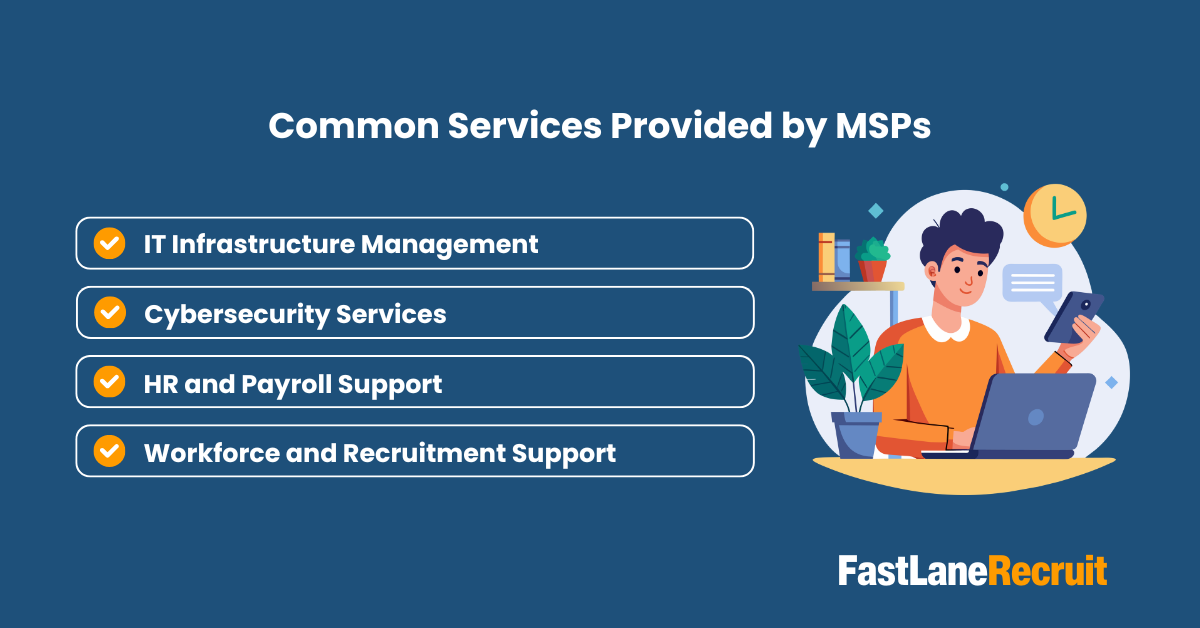
MSPs can support businesses in many different areas depending on industry needs and company size.
IT Infrastructure Management
This is the most common MSP service. It includes:
- Network monitoring
- Server maintenance
- Cloud support
- System updates
- Remote troubleshooting
- Data backup and disaster recovery
Cybersecurity Services
Cybersecurity has become a major concern for businesses worldwide. MSPs often provide:
- Threat monitoring
- Firewall management
- Security audits
- Employee cybersecurity training
- Endpoint protection
- Compliance support
For cybersecurity best practices, businesses can also refer to the official guidelines from National Institute of Standards and Technology and the CyberSecurity Malaysia.
HR and Payroll Support
Some MSPs support administrative HR tasks such as:
- Payroll processing
- Employee onboarding
- Benefits administration
- Attendance tracking
- HR documentation
Workforce and Recruitment Support
Modern MSP models can also support contingent workforce management, recruitment coordination, and outsourced staffing operations.
For companies expanding internationally, MSP services are often combined with Employer of Record (EOR) solutions to simplify global hiring and payroll management.
MSP vs In-House Team: What’s the Difference?
When businesses need support for IT operations, payroll management, cybersecurity, HR administration, or workforce management, they often face an important decision: should they build an in-house team or work with a Managed Service Provider (MSP)?
Both options can support business operations, but they differ significantly in terms of cost, expertise, scalability, and operational flexibility.
An in-house team means the company hires and manages employees internally to handle operational tasks. This approach gives businesses direct control over daily processes, but it also requires ongoing investment in hiring, training, salaries, software, infrastructure, and management.
An MSP, on the other hand, provides outsourced expertise and operational support through a service agreement. Instead of building a large internal department, businesses can access experienced specialists, technology tools, and ongoing support from an external provider.
Here is a simplified comparison between the two approaches:
| Area | In-House Team | MSP |
| Hiring Cost | Requires recruitment, onboarding, salaries, and employee training | Managed by an external provider, reducing hiring burden |
| Expertise | Limited to the experience of internal employees | Access to specialists with broader industry knowledge |
| Scalability | Expanding teams may take time and additional hiring | Services can often scale more quickly based on business needs |
| Technology Access | Requires internal investment in software and systems | Many tools and technologies are included within the service |
| Support Coverage | Support depends on internal staffing capacity | Many MSPs offer ongoing or 24/7 monitoring and support |
| Operational Flexibility | Internal resources may be limited during growth periods | Services can be adjusted more flexibly as operations change |
Example: In-House vs MSP for a Growing Company
Imagine a fast-growing company expanding into multiple countries. If the business chooses to build everything internally, it may need to:
- Hire IT specialists
- Recruit HR personnel
- Invest in cybersecurity systems
- Train payroll staff
- Purchase software and infrastructure
This process can take significant time and resources.
By working with an MSP, the company can quickly access specialized operational support without building large departments from scratch. The MSP can manage technical systems, monitor operations, support compliance processes, and help maintain business continuity while the company focuses on growth and expansion.
Why Many Businesses Choose MSPs
For startups, SMEs, and international businesses, MSPs offer a practical way to access professional support while maintaining operational efficiency.
Some key reasons businesses choose MSPs include:
- Faster access to specialized expertise
- Reduced administrative workload
- More predictable operational costs
- Easier scaling during business growth
- Improved system monitoring and security
- Better support for remote and global teams
This is especially useful for companies expanding into markets like Malaysia, where businesses may require support with payroll administration, compliance processes, remote workforce management, and local operational coordination.
While in-house teams still play an important role, MSPs can complement internal operations by handling specialized or time-consuming functions more efficiently.
For growing businesses, MSPs provide access to scalable support and operational expertise without significantly increasing internal complexity or management overhead.
Also Read: What Is Business Process Outsourcing (BPO) and How Does It Work?
Benefits of Using an MSP
1. Better Cost Predictability
Most MSPs use subscription-based pricing models, making operational costs easier to forecast and manage.
Businesses can reduce expenses related to:
- Hiring
- Training
- Software maintenance
- Infrastructure upgrades
- Internal support resources
2. Access to Specialized Expertise
MSPs often employ specialists with experience across multiple industries and technologies. This allows businesses to benefit from expert knowledge without building large internal departments.
3. Improved Business Focus
Outsourcing operational functions allows companies to focus on:
- Revenue growth
- Product development
- Customer service
- Market expansion
4. Enhanced Security and Compliance
MSPs help businesses stay updated with:
- Security best practices
- Software updates
- Industry regulations
- Data protection requirements
For example, businesses operating in Malaysia can refer to:
- Personal Data Protection Department for PDPA compliance
- Inland Revenue Board of Malaysia for payroll and tax compliance
5. Scalability for Growing Businesses
As businesses expand into new markets or hire international employees, MSPs can quickly adjust support levels without requiring large operational changes internally.
Types of MSP Pricing Models
Managed Service Providers (MSPs) use different pricing models depending on the size of the business, the complexity of services, and the level of support required. Understanding these pricing structures is important because it helps companies choose a model that matches their operational needs and budget expectations.
In most cases, MSP pricing is designed to be predictable and flexible, allowing businesses to pay for ongoing services rather than handling unpredictable repair or support costs.
Here are the most common MSP pricing models explained in a simple way:
| Pricing Model | Description |
| Per User | A fixed monthly fee is charged for each employee or user supported, regardless of how many devices they use |
| Per Device | Pricing is based on the number of devices managed, such as laptops, servers, or workstations |
| Tiered Pricing | Businesses choose from different service packages, each offering a different level of support and features |
| All-Inclusive | A single monthly fee covers a wide range of IT or operational services under one comprehensive plan |
| Monitoring-Only | Focuses mainly on system monitoring, alerts, and basic issue detection without full management services |
| Customized Pricing | Tailored pricing based on the company’s specific needs, industry requirements, and operational complexity |
Understanding Which Pricing Model Works Best
Each pricing model suits different types of businesses:
- Small teams often prefer per user pricing because it is simple and scalable as the company grows
- Companies with heavy infrastructure may prefer per device pricing for clearer cost tracking
- Growing businesses often choose tiered or all-inclusive models for better coverage and flexibility
- Organizations with unique workflows or compliance needs may benefit from customized pricing structures
Also Read: Guide to PEO vs EOR
Why the SLA (Service Level Agreement) Matters
Before signing an agreement with an MSP, businesses should always review the Service Level Agreement (SLA) carefully. The SLA is a key document that defines what services will be provided, how they will be delivered, and what level of performance is expected.
It acts as a clear agreement between the business and the MSP to avoid misunderstandings and ensure accountability.
Key areas to review in an SLA include:
1. Response Times
This defines how quickly the MSP will respond when an issue occurs. Faster response times are especially important for businesses that rely heavily on uninterrupted operations.
2. Service Coverage
This outlines exactly what services are included in the agreement, such as IT support, monitoring, cybersecurity, payroll processing, or HR administration.
3. Security Responsibilities
This explains how data protection, cybersecurity, and compliance responsibilities are shared between the MSP and the business.
4. Reporting Structure
This defines how often reports will be shared, what metrics will be tracked, and how performance will be measured over time.
5. Additional Service Fees
Some services may fall outside the standard package. The SLA should clearly explain any extra charges so businesses can avoid unexpected costs later.
Why This Matters for Growing Businesses
Choosing the right pricing model and understanding the SLA helps businesses:
- Plan budgets more effectively
- Avoid hidden operational costs
- Ensure clear expectations between both parties
- Scale services more easily as the business grows
- Maintain better control over service quality
For companies expanding into new markets or managing remote teams, having a clear MSP structure becomes even more important. It ensures operational stability while supporting business growth in a controlled and predictable way.
Challenges Businesses Should Consider
While Managed Service Providers (MSPs) can significantly improve efficiency, reduce operational workload, and provide access to specialized expertise, businesses should still evaluate a few important challenges before entering into a partnership.
Understanding these considerations early helps companies build a stronger, more transparent, and more effective working relationship with their MSP.
1. Communication and Coordination
One of the most important factors in a successful MSP partnership is clear and consistent communication. Since MSPs operate externally, businesses need well-defined communication processes to ensure smooth coordination between internal teams and the service provider.
Without proper communication, even small issues can lead to misunderstandings or delays in service delivery.
To avoid this, businesses should establish clear expectations from the beginning, including:
- Regular reporting schedules
Setting weekly or monthly updates helps businesses stay informed about system performance, ongoing issues, and improvements. - Clear escalation processes
Defining what happens when urgent issues arise ensures problems are handled quickly and by the right people. - Defined roles and responsibilities
Both the business and MSP should clearly understand who is responsible for each task to avoid overlap or confusion. - Communication channels
Agreeing on how communication will happen (e.g., email, ticketing systems, dashboards, or dedicated support lines) helps ensure faster response times and better organization.
A well-structured communication system builds trust and ensures that both sides stay aligned on business priorities.
2. Vendor Dependence
Another important consideration is vendor dependence, which happens when a business becomes highly reliant on a single MSP for critical operations.
While MSPs are designed to provide ongoing support and stability, over-reliance on one provider can create challenges if the relationship changes or service issues occur.
For example:
- Switching providers may require system migration
- Internal teams may have limited operational knowledge if outsourcing is too extensive
- Service delays could impact business operations if backup plans are not in place
To reduce this risk, businesses should:
- Choose an MSP with a strong reputation and proven track record
- Ensure contracts include clear Service Level Agreements (SLAs)
- Maintain some level of internal oversight or operational understanding
- Periodically review performance and service quality
A well-structured MSP partnership should support the business, not create dependency that limits flexibility.
3. Data Security and Compliance
Since MSPs often manage sensitive business operations such as IT systems, payroll data, employee records, or customer information, data security and compliance become extremely important.
Businesses must ensure that their MSP follows strong security practices and complies with relevant regulations.
Key areas to evaluate include:
- Data protection standards
How the MSP stores, processes, and protects sensitive information - Cybersecurity measures
Including encryption, firewall protection, access controls, and threat monitoring - Regulatory compliance
Ensuring the MSP follows industry and government regulations relevant to the business location and sector - Employee access control
Limiting access to sensitive data based on job roles and responsibilities
For companies operating internationally or managing remote teams, compliance becomes even more important. For example, businesses expanding into Malaysia should be mindful of local employment and data protection requirements guided by authorities such as the Personal Data Protection Department.
Why These Challenges Matter
Although MSPs offer strong benefits such as scalability, expertise, and operational efficiency, businesses that overlook these challenges may face:
- Communication gaps between internal teams and providers
- Over-reliance on external systems or vendors
- Increased risk if security practices are not properly evaluated
By addressing these challenges early, businesses can build a more stable and productive partnership with their MSP.
A successful MSP relationship is not just about outsourcing tasks, it is about building a structured, transparent, and secure partnership that supports long-term business growth.
When communication is clear, vendor risk is managed, and security standards are strong, MSPs become a powerful extension of the business rather than just an external service provider.
Also Read: Global Employment Outsourcing: Complete Guide to Hiring International Teams
How to Choose the Right MSP
Choosing the right Managed Service Provider (MSP) is an important decision because it can directly influence how smoothly your business operates, how secure your systems are, and how easily your company can scale in the future.
A good MSP becomes an extension of your business, while the wrong one can create operational delays, communication issues, or unnecessary costs. That’s why businesses should carefully evaluate multiple factors before making a decision.
Below are the key criteria to consider when selecting an MSP:
Key Criteria for Evaluating an MSP
| Criteria | What to Look For |
| Industry Experience | Experience working with businesses in your industry or similar operational environments |
| Service Scope | A clear list of services that match your business needs such as IT support, HR, payroll, cybersecurity, or workforce management |
| Security Standards | Strong cybersecurity measures, data protection policies, and compliance with industry regulations |
| Scalability | Ability to expand services as your business grows or enters new markets |
| Support Availability | Reliable support coverage with clear response times and escalation processes |
| Technology Stack | Use of modern, secure, and well-maintained systems and platforms |
| Client Reviews | Positive feedback, testimonials, and proven case studies from existing clients |
| Transparent Pricing | Clear and easy-to-understand pricing structure with no hidden charges |
What These Factors Really Mean in Practice
1. Industry Experience
An MSP that understands your industry will already be familiar with common challenges, workflows, and compliance requirements. This reduces onboarding time and improves service quality from the start.
For example, an MSP supporting a healthcare company will have different expertise compared to one supporting a manufacturing or tech startup.
2. Service Scope
Not all MSPs offer the same services. Some focus only on IT support, while others provide broader operational services such as payroll, HR, or cybersecurity.
It’s important to choose an MSP that aligns with your current needs, but also offers additional services that may become important as your business grows.
3. Security and Compliance Standards
Since MSPs often handle sensitive business data, security should be a top priority.
A reliable MSP should follow strong cybersecurity practices such as:
- Data encryption
- Secure access control
- Regular system monitoring
- Compliance with relevant laws and regulations
For companies operating internationally, this becomes even more critical, especially when handling employee or customer data across borders.
4. Scalability for Business Growth
As your company expands, your operational needs will also increase.
A good MSP should be able to scale services quickly, whether you are:
- Hiring more employees
- Expanding into new countries
- Increasing system usage
- Adding new departments or workflows
Scalability ensures your operations grow smoothly without disruption.
5. Support Availability
Business operations often run beyond standard office hours, especially for global teams.
That’s why it is important to check:
- Whether support is available 24/7 or during specific hours
- How quickly issues are resolved
- How urgent problems are escalated
Reliable support helps prevent downtime and keeps operations running smoothly.
6. Technology and Tools
Modern MSPs should use updated systems and platforms that support automation, monitoring, reporting, and security.
Outdated tools may limit efficiency and increase operational risks.
7. Client Reviews and Case Studies
Client feedback provides real-world insight into how the MSP performs.
Look for:
- Long-term client relationships
- Proven results in similar industries
- Clear case studies showing problem-solving ability
8. Transparent Pricing
Clear pricing helps businesses plan budgets more effectively and avoid unexpected costs.
A trustworthy MSP will always provide:
- Clear service breakdowns
- Defined pricing models
- No hidden fees or unclear charges
Additional Steps Before Choosing an MSP
Beyond comparing criteria, businesses should also take extra steps to better understand the MSP’s capabilities:
- Request service demonstrations
See how their systems and support processes actually work in real time. - Review case studies
Understand how they have helped other businesses solve similar challenges. - Ask for trial periods or pilot projects
Test their service quality before committing long-term. - Speak to client references
Gain direct feedback from existing customers about their experience.
Selecting the right MSP is not just about outsourcing tasks, it is about building a long-term operational partnership.
A well-chosen MSP can help businesses improve efficiency, strengthen security, support global expansion, and reduce operational complexity. Taking time to evaluate the right provider ensures better results and long-term business stability.
Also Read: Guide to Outsourcing Web Development
MSP Example: Expanding Operations into Malaysia
Imagine a technology company headquartered in Europe planning to expand into Malaysia.
Instead of building a large local HR and IT department immediately, the company may work with:
- An MSP for IT support and payroll administration
- An Employer of Record (EOR) provider for compliant employee hiring
This setup allows the business to:
- Enter the Malaysian market faster
- Simplify workforce management
- Maintain compliance with local labor regulations
- Reduce administrative complexity
- Support remote and hybrid employees efficiently
Malaysia continues to attract global businesses due to its skilled workforce, multilingual talent pool, and strong digital infrastructure.
For labor and employment guidance, companies can refer to the official portal of the Ministry of Human Resources Malaysia.
MSP vs EOR: What’s the Difference?
Although MSP and EOR services may sometimes overlap in workforce management, they serve different functions.
| MSP | EOR |
| Manages operational or IT-related services | Legally employs workers on behalf of companies |
| Focuses on system support and administration | Focuses on employment compliance and payroll |
| Supports infrastructure and business functions | Supports international hiring |
| Often technology-focused | Often HR and workforce-focused |
Many global businesses use both MSP and EOR solutions together when expanding internationally.
Why MSPs Are Becoming More Important Globally
The global shift toward:
- Remote work
- Cloud operations
- Distributed teams
- International hiring
- Cybersecurity protection
has significantly increased demand for managed services.
Businesses today need scalable support systems that allow them to operate efficiently across multiple regions and time zones.
MSPs help organizations stay agile while reducing operational burden and improving access to specialized expertise.
How FastLaneRecruit Supports Global Hiring and Workforce Expansion
For businesses expanding into Malaysia or building international teams, operational support goes beyond IT management alone.
FastLaneRecruit helps companies simplify:
- International hiring
- Payroll management
- HR administration
- Compliance support
- Employee onboarding
- Workforce expansion in Malaysia
Through Employer of Record (EOR) solution, businesses can hire Malaysian employees compliantly without setting up a local entity immediately.
This allows companies to scale faster while focusing on long-term business growth and workforce development.
Conclusion
Understanding what is MSP is important for businesses looking to improve operational efficiency, strengthen support systems, and scale more effectively.
A Managed Service Provider helps businesses outsource essential operational tasks such as IT management, cybersecurity, payroll support, and workforce administration. Instead of managing everything internally, companies can work with experienced specialists who provide ongoing support, monitoring, and optimization.
As global business operations become more digital and distributed, MSPs continue to play a major role in helping organizations stay flexible, secure, and growth-focused.
For companies planning to hire and outsource talent in Malaysia, combining MSP support with FastLaneRecruit’s EOR services can provide a more streamlined and compliant expansion strategy.
Ready to Expand Your Team in Malaysia?
If your business is planning to grow internationally, hiring and managing talent in a new market can quickly become complex. From employment compliance to payroll and HR administration, there are many moving parts that need the right structure in place.