Managing payroll sounds simple at first: pay employees accurately and on time. But as a business grows, payroll becomes more complex. You need to calculate salaries, handle taxes, track leave, manage benefits, stay compliant with local laws, and maintain accurate records.
That is where strong payroll management becomes essential.
Whether you hire one employee or build a global remote team, an efficient payroll system helps protect your business, improve employee trust, and save valuable time.
At FastLaneRecruit, we help companies hire and pay talent across markets, including Malaysia, through reliable Payroll and Employer of Record (EOR) solutions.
Content Outline
What Is Payroll Management?
Payroll management is the complete process a business uses to handle employee salaries, wages, and related payments. It is not only about transferring money to employees each month. It also includes making sure every payment is accurate, on time, properly recorded, and compliant with local employment and tax laws.
A well-managed payroll system helps businesses run smoothly, keeps employees satisfied, and reduces the risk of costly mistakes or penalties.
What Does Payroll Management Include?
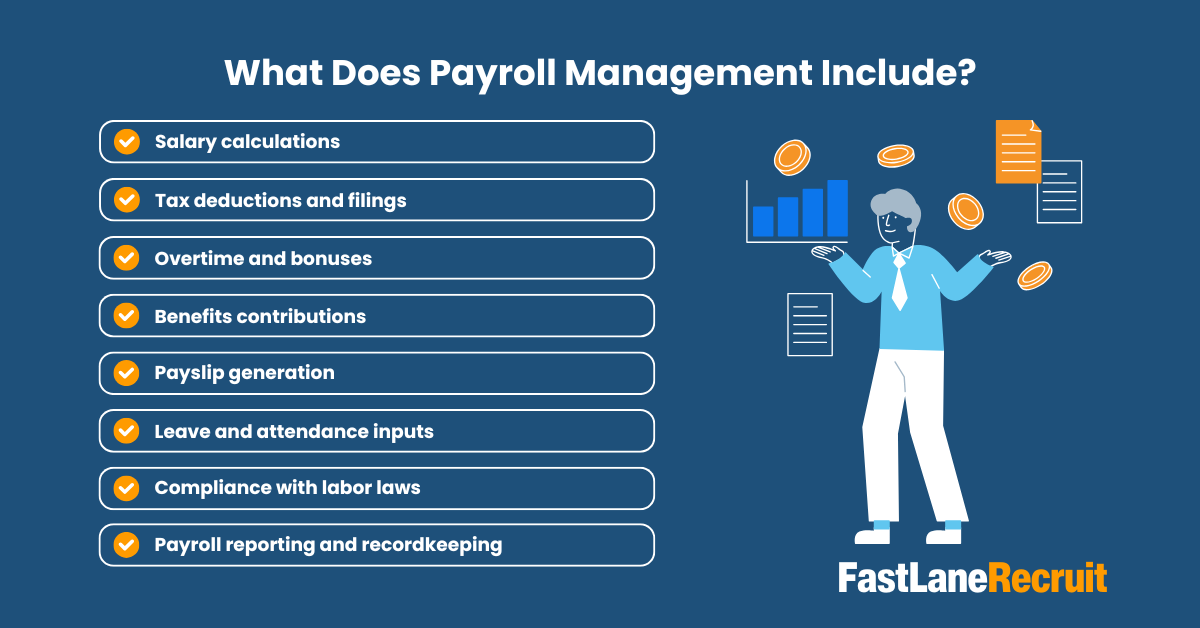
Payroll management usually covers the following areas:
- Salary calculations
Calculating monthly salary, hourly wages, commissions, or project-based payments based on the employee’s contract. - Tax deductions and filings
Withholding the correct amount of tax from employee salaries and submitting required reports to the relevant authorities. - Overtime and bonuses
Adding extra payments such as overtime hours, performance bonuses, incentives, or holiday pay. - Benefits contributions
Managing contributions for pensions, social security, insurance, or other employee benefits required by law or company policy. - Payslip generation
Providing employees with clear payslips that show earnings, deductions, and net pay. - Leave and attendance inputs
Taking into account unpaid leave, paid leave, sick leave, attendance records, or late arrivals when processing payroll. - Compliance with labor laws
Ensuring payroll follows local employment regulations, minimum wage laws, overtime rules, and statutory requirements. - Payroll reporting and recordkeeping
Keeping payroll records for audits, tax filings, budgeting, and internal financial planning.
Simple Example of Payroll Management
Imagine a company hires a Marketing Executive in Malaysia with a monthly salary of RM5,000.
During the month:
- The employee worked 10 hours of overtime
- Received a RM300 performance bonus
- Took 1 unpaid leave day
- Required statutory deductions apply
The payroll team or payroll system would need to:
- Start with the base salary of RM5,000
- Add overtime pay and bonus
- Deduct unpaid leave amount
- Calculate required statutory contributions and taxes
- Prepare a payslip
- Transfer the final net salary to the employee on payday
- Store the payroll record securely
This entire workflow is part of payroll management.
Why Payroll Management Matters
When payroll is managed properly:
- Employees are paid accurately and on time
- Businesses stay compliant with regulations
- HR and finance teams save time
- Errors and disputes are reduced
- Companies can scale hiring more confidently
In Simple Terms
Payroll management means making sure employees get paid the right amount, at the right time, with the right deductions, while following local laws.
Also Read: Best International Payroll Providers of 2026
Payroll Management vs Payroll Management Process
Many businesses use the terms payroll management and payroll management process as if they mean the same thing. In reality, they are closely connected but serve different purposes.
A simple way to understand it is this:
Payroll management is the full system and strategy, while the payroll management process is the day-to-day execution of that system.
Key Differences Explained
| Feature | Payroll Management | Payroll Management Process |
| Meaning | The overall payroll system, strategy, policies, tools, and compliance structure used by a business | The step-by-step actions taken each pay cycle to calculate and deliver employee salaries |
| Focus | Long-term planning, structure, and legal compliance across the organization | Short-term execution of payroll tasks every week, bi-weekly, or month |
| Includes | Payroll software setup, salary structure design, tax planning, benefits framework, compliance rules | Salary calculations, approval workflows, deductions, payment processing, payslip creation |
| Goal | Build a reliable and scalable payroll system that supports business growth | Ensure employees are paid accurately, on time, and without errors each cycle |
Simple Way to Understand the Difference
Think of it like running a restaurant:
- Payroll Management is like designing the restaurant system — deciding the menu, pricing, kitchen setup, hiring chefs, and defining food safety rules.
- Payroll Management Process is like the daily kitchen work — preparing meals, cooking orders, checking quality, and serving customers on time.
Both are essential, but they work at different levels.
Practical Example in a Business
Let’s say a company is expanding and hiring employees in Malaysia and other countries.
Payroll Management (System Level)
The company decides:
- Salary structure for different roles
- Which payroll software or provider to use
- Tax compliance approach for each country
- Benefits policy (insurance, bonuses, allowances)
- Rules for overtime and leave payments
This creates a structured payroll system that can scale as the company grows.
Payroll Management Process (Execution Level)
Every month, the HR or payroll team:
- Collects attendance and leave data
- Calculates salaries based on working days
- Adds overtime and bonuses
- Applies tax and statutory deductions
- Reviews payroll for accuracy
- Transfers salaries to employee accounts
- Generates payslips and stores records
This is the operational cycle that repeats every pay period.
Why Both Are Important
A strong payroll setup only works when both parts are aligned:
- Without payroll management (system) → payroll becomes disorganized, inconsistent, and risky
- Without payroll management process (execution) → even a good system fails in real operations
When both work together, businesses benefit from:
- Consistent and accurate payroll cycles
- Reduced compliance risks
- Better employee trust
- Easier scaling across countries
- Less manual workload for HR and finance teams
Payroll management builds the foundation. The payroll management process brings it to life every pay cycle.
A business needs both to ensure employees are paid correctly, compliance is maintained, and payroll operations run smoothly as the company grows.
Why Payroll Management Matters
Strong payroll management is more than an accounting function. It directly influences how employees feel about the company, how safely the business operates, and how easily it can grow.
When payroll is handled properly, it builds trust and stability across the organization. When it is not, it can lead to confusion, compliance risks, and operational delays.
Below are the key reasons why payroll management is so important for any business.
1. Accurate Salary Payments Build Trust
Employees rely on their salary to manage their daily lives, so accuracy and timing are critical.
Good payroll management ensures:
- Employees are paid the correct amount every cycle
- Overtime, bonuses, and deductions are calculated properly
- Salaries are processed on the agreed pay date
Even small mistakes such as missing overtime or incorrect deductions can affect employee confidence. Over time, repeated errors may lead to dissatisfaction and higher turnover.
A reliable payroll system helps employees feel secure and valued, which strengthens overall workplace trust.
2. Legal Compliance Reduces Business Risk
Every country has its own payroll-related laws. These often include:
- Income tax requirements
- Social security contributions
- Pension or retirement fund obligations
- Minimum wage rules
- Statutory leave and benefits
- Reporting and filing deadlines
For example, hiring employees in different countries means dealing with different authorities such as:
- Inland Revenue Board (LHDN) in Malaysia
- Inland Revenue Service (IRS) in the United States
- HM Revenue & Customs (HMRC) in the United Kingdom
Good payroll management ensures all of these requirements are handled correctly. This helps businesses avoid penalties, audits, and legal complications while staying compliant in every location they operate.
Also Read: Guide to Efficient Payroll Processing in Malaysia
3. Better Employee Experience and Satisfaction
Payroll is one of the most important touchpoints between a company and its employees.
A well-managed payroll system provides:
- Clear and easy-to-understand payslips
- Consistent salary payment dates
- Transparent breakdown of earnings and deductions
- Smooth onboarding for new hires
When employees understand how their pay is calculated and receive it on time, it builds confidence in the organization. This leads to stronger engagement, higher motivation, and better retention.
4. Time Savings and Operational Efficiency
Manual payroll work can be time-consuming, especially as a business grows.
Strong payroll management reduces workload by:
- Automating salary calculations
- Reducing manual data entry errors
- Streamlining approval processes
- Integrating attendance, HR, and finance systems
- Generating reports quickly for audits and planning
This allows HR and finance teams to focus on more strategic tasks such as workforce planning, talent development, and business growth instead of spending time on repetitive payroll calculations.
5. Business Growth and Expansion Readiness
As companies expand into new markets or hire remote teams, payroll becomes more complex.
Different countries mean:
- Different tax systems
- Different employment laws
- Different payment methods and currencies
- Different reporting requirements
A scalable payroll management system makes expansion easier by:
- Supporting multi-country payroll processing
- Ensuring compliance across different jurisdictions
- Standardizing reporting and documentation
- Reducing the need for setting up local entities immediately
This is especially important for companies hiring internationally or using an Employer of Record (EOR) model.
With the right payroll structure in place, businesses can grow faster without being slowed down by administrative or legal complexity.
Payroll management is not just about paying salaries. It is a core business function that supports trust, compliance, employee satisfaction, efficiency, and growth.
When done well, it becomes a strong foundation that allows a company to scale confidently across markets while maintaining a positive employee experience.
Step-by-Step Payroll Management Process
A payroll cycle follows a structured set of steps to ensure employees are paid correctly, on time, and in compliance with local regulations. While tools and systems may vary from company to company, the core payroll process usually remains the same.
Below is a clear breakdown of how the payroll management process typically works.
1. Collect Employee Information
The first step is to gather and maintain accurate employee data. This information forms the foundation of payroll calculations.
Common details include:
- Full legal name (as per official documents)
- Tax identification or national ID number
- Bank account details for salary transfer
- Employment contract terms (job role, salary, start date)
- Salary structure (fixed pay, allowances, incentives)
- Benefits enrollment (insurance, pension, or other benefits)
Why this matters:
Even a small error in employee data can lead to incorrect salary payments or compliance issues later in the process.
2. Track Attendance and Time Data
Next, the business collects work-related data that affects salary calculations.
This may include:
- Total working hours
- Overtime hours
- Paid leave (annual leave, sick leave, etc.)
- Unpaid leave
- Public holiday entitlement
- Shift-based allowances or night shifts
Why this matters:
Accurate attendance tracking ensures employees are paid fairly based on their actual work and agreed employment terms.
Also Read: Types of Payroll Deductions and How They Work
3. Calculate Gross Pay
Gross pay is the total earnings before any deductions are applied.
It typically includes:
- Base salary
- Overtime pay
- Performance bonuses
- Sales commission
- Allowances (transport, housing, meal, etc.)
Example:
If an employee earns a base salary of RM5,000 and receives RM500 in bonuses and RM300 in allowances, their gross pay becomes RM5,800.
Why this matters:
This step determines the total earnings an employee is entitled to before taxes and deductions.
4. Apply Deductions
Once gross pay is calculated, mandatory and optional deductions are applied based on local laws and company policies.
Common deductions include:
- Income tax
- Social security contributions
- Retirement or pension fund contributions
- Health or insurance contributions
- Loan repayments or salary advances
- Other approved deductions
Why this matters:
Correct deductions ensure legal compliance and protect both the employer and employee from regulatory issues.
5. Review and Approve Payroll
Before processing payments, payroll must be carefully reviewed.
This step usually involves HR, finance, or payroll teams checking:
- New hires and employee exits
- Salary changes or promotions
- Updated tax or benefit information
- Leave balances and attendance records
- Accuracy of calculations
Why this matters:
This is a critical quality control step that helps prevent payroll errors before money is transferred.
6. Process Salary Payments
Once payroll is approved, net salaries are transferred to employees.
This is done through:
- Bank transfers
- Direct deposit systems
- Approved payroll payment platforms
Net pay = Gross pay – Deductions
Why this matters:
Timely and accurate payments are essential for employee satisfaction and trust.
7. Issue Payslips
After payment, employees receive payslips that provide a full breakdown of their salary.
A typical payslip includes:
- Basic salary
- Allowances and bonuses
- Overtime earnings
- Tax deductions
- Social security contributions
- Net salary received
Why this matters:
Payslips provide transparency and help employees understand how their salary is calculated.
8. File Taxes and Maintain Records
The final step is ensuring all payroll data is properly documented and stored.
This includes:
- Payroll reports
- Tax filings submitted to authorities
- Employee payment records
- Compliance documents
- Audit history
Why this matters:
Accurate recordkeeping is essential for audits, legal compliance, financial reporting, and future reference.
Note
A well-structured payroll management process ensures that every step, from employee data collection to tax filing, is handled systematically. This reduces errors, improves compliance, and ensures employees are paid correctly and on time every cycle.
Common Payroll Challenges for Growing Companies
As companies grow, payroll becomes more complex. What starts as a simple monthly salary calculation can quickly turn into a multi-layered process involving compliance, multiple systems, and cross-border rules.
Even experienced businesses face payroll difficulties, especially when scaling teams or hiring internationally.
Below are the most common payroll challenges and what they mean in practice.
1. Manual Spreadsheets
Many businesses start with spreadsheets because they are simple and familiar. However, as headcount grows, this approach becomes risky.
Impact:
- Higher chance of calculation errors
- Formula mistakes affecting salary accuracy
- Version control issues (multiple files being used)
- Time-consuming updates every payroll cycle
Why it matters:
Even a small formula error can affect multiple employees’ salaries, leading to trust issues and correction work.
2. Late Payroll Inputs
Payroll depends on timely data from HR, operations, and managers.
Impact:
- Delayed salary processing
- Last-minute corrections
- Increased stress on payroll teams
- Risk of missed overtime or leave adjustments
Why it matters:
If attendance, bonuses, or employee changes are submitted late, payroll cannot be processed accurately or on time.
3. Multi-Country Hiring Complexity
Hiring across different countries introduces new rules and requirements.
Impact:
- Different tax systems and filing deadlines
- Varying labor laws and employment rules
- Currency conversion challenges
- Different statutory contributions per country
Example:
An employee in Malaysia, another in Singapore, and another in the UK all require different payroll calculations and compliance handling.
Why it matters:
Without local knowledge or systems, companies risk non-compliance and inconsistent payroll operations.
Also Read: Comprehensive Guide to Payroll Management in Malaysia
4. Data Security Concerns
Payroll data contains highly sensitive employee information.
Impact:
- Risk of unauthorized access
- Exposure of bank details or identity information
- Potential data breaches
- Compliance issues with data protection laws
Why it matters:
Payroll data must be handled with strict security controls to protect both employees and the business.
5. Frequent Law and Regulation Changes
Payroll rules are not static. Tax rates, labor laws, and statutory contributions change regularly.
Impact:
- Outdated payroll calculations
- Compliance risks and penalties
- Need for constant monitoring of legal updates
- Additional workload for HR and finance teams
Why it matters:
Businesses must continuously update payroll systems to stay compliant in each operating region.
6. Internal Workload and Resource Pressure
Payroll is time-sensitive and detail-heavy, especially during month-end cycles.
Impact:
- HR and finance teams become overloaded
- Reduced time for strategic work
- Higher risk of human error due to workload pressure
- Delays in approvals and processing
Why it matters:
As teams grow, payroll becomes a recurring operational burden if not supported by proper systems or automation.
Summary
These challenges show that payroll management becomes significantly more complex as a business scales. Issues often come not from one major problem, but from multiple small inefficiencies across systems, processes, and compliance requirements.
This is why many growing companies move toward structured payroll systems, automation tools, or outsourced payroll solutions to improve accuracy, compliance, and efficiency.
In-House Payroll vs Outsourced Payroll Services
As businesses grow, one of the most important decisions they face is how to manage payroll. There is no single “best” approach, each option depends on company size, hiring locations, internal resources, and compliance complexity.
Broadly, payroll can be handled in four main ways: in-house payroll, payroll software, outsourced payroll services, or global payroll partners.
Each model offers different levels of control, automation, and compliance support.
Payroll Options Compared
| Option | Best For | Key Benefit |
| In-House Payroll | Small local teams | Direct control over all payroll activities |
| Payroll Software | Growing companies | Automation, accuracy, and reporting efficiency |
| Outsourced Payroll Services | Busy teams needing support | Reduced administrative workload and expert handling |
| Global Payroll Partner | Multi-country employers | Cross-border compliance and centralized payroll management |
1. In-House Payroll
In-house payroll means your internal HR or finance team handles the entire payroll process using manual methods or basic tools.
Best suited for:
- Small businesses with local employees
- Companies with simple payroll structures
- Teams that prefer full internal control
Key advantages:
- Full visibility and control over payroll data
- Immediate access to payroll information
- Customizable processes based on company needs
Challenges:
- Requires significant time and expertise
- Higher risk of manual errors
- Difficult to scale as headcount increases
- Compliance responsibility stays fully in-house
2. Payroll Software
Payroll software helps businesses manage payroll internally but with automation and system support.
Best suited for:
- Growing companies with increasing employee numbers
- Businesses transitioning from spreadsheets
- Teams needing better accuracy and reporting
Key advantages:
- Automated salary calculations
- Reduced manual errors
- Built-in tax and compliance updates (depending on provider)
- Easy reporting and payroll tracking
Challenges:
- Still requires internal payroll management knowledge
- Software setup and maintenance needed
- Compliance responsibility may still remain with the company
Also Read: Guide to Employee Cost: How to Calculate the Cost of an Employee
3. Outsourced Payroll Services
Outsourced payroll means a third-party provider manages payroll operations on behalf of the business.
Best suited for:
- Companies with limited internal HR or finance resources
- Businesses that want to reduce administrative workload
- Organizations looking for expert payroll handling
Key advantages:
- Reduced workload for internal teams
- Access to payroll specialists
- Improved accuracy and consistency
- Faster payroll processing cycles
Challenges:
- Less direct control over day-to-day payroll tasks
- Dependence on external provider timelines
- Requires sharing sensitive employee data with third parties
4. Global Payroll Partner
A global payroll partner supports companies hiring across multiple countries. This is often combined with Employer of Record (EOR) services.
Best suited for:
- Companies hiring internationally
- Remote-first or distributed teams
- Businesses expanding into new markets without local entities
Key advantages:
- Handles multi-country tax and labor compliance
- Centralized payroll management across regions
- Reduces complexity of local employment laws
- Supports faster international hiring
Challenges:
- Requires trust in external compliance handling
- May involve more structured onboarding processes
- Cost varies depending on countries and services used
Why Outsourced or Global Payroll Solutions Work Better for International Hiring
As companies expand beyond one country, payroll becomes significantly more complex. Each country has its own:
- Tax rules
- Employment laws
- Statutory contributions
- Payment cycles
- Reporting requirements
Managing all of this internally can quickly become difficult and time-consuming.
That is why many growing companies choose outsourced payroll services or global payroll partners. These solutions help businesses:
- Stay compliant across multiple jurisdictions
- Reduce administrative burden on internal teams
- Ensure employees are paid correctly and on time
- Scale hiring faster without setting up local entities immediately
Final Insight
The right payroll model depends on your business stage and hiring strategy.
- Small teams often start with in-house payroll
- Growing companies move toward payroll software or outsourcing
- Global companies benefit most from international payroll partners or EOR solutions
Choosing the right structure early helps businesses reduce risk, improve efficiency, and support smoother long-term growth.
What Makes a Good Payroll Management System?
A strong payroll management system is not just a tool that calculates salaries. It is a complete setup that helps businesses manage employee payments accurately, stay compliant, reduce manual work, and support long-term growth.
Whether a company is handling payroll in one country or multiple regions, the right system can significantly reduce risk and improve efficiency.
Below are the key features to look for when selecting a payroll solution.
1. Automation
Automation is one of the most important features in a modern payroll system.
A good system should:
- Automatically calculate salaries, overtime, and deductions
- Reduce manual data entry
- Sync attendance, HR, and payroll data
- Speed up monthly payroll cycles
Why it matters:
Automation reduces human error and ensures payroll runs consistently, even as the team grows.
2. Accuracy Controls
Payroll errors can create serious issues for both employees and employers.
A strong payroll system includes:
- Built-in calculation checks
- Alerts for missing or inconsistent data
- Validation of employee records
- Error detection before payment is processed
Why it matters:
Even small mistakes in salary or tax calculations can lead to compliance issues or employee dissatisfaction.
Also Read: How to Process Payroll for Global Teams
3. Compliance Support
Payroll compliance is complex because laws differ across countries and change frequently.
A reliable system should help with:
- Tax updates and regulatory changes
- Statutory contributions (e.g., pension, social security)
- Local labor law requirements
- Filing and reporting obligations
Why it matters:
Compliance support helps businesses avoid penalties and ensures payroll aligns with legal requirements in every location.
4. Employee Self-Service Access
A modern payroll system should also improve the employee experience.
Employee self-service portals allow staff to:
- View and download payslips
- Check salary history
- Access tax documents
- Update personal details
- Track leave balances
Why it matters:
This reduces HR workload and gives employees more transparency and control over their payroll information.
5. Reporting Dashboard
Payroll is not only about paying employees, it is also an important part of financial planning.
A good reporting system provides:
- Monthly and annual payroll summaries
- Cost breakdown by department or location
- Tax and deduction reports
- Audit-ready payroll records
Why it matters:
These insights help businesses plan budgets, prepare audits, and make better financial decisions.
6. Multi-Country Capability
For companies hiring internationally, this feature becomes essential.
A global payroll system should support:
- Multiple currencies
- Different tax structures
- Country-specific compliance rules
- Centralized payroll management across regions
Why it matters:
Managing payroll across countries manually is complex and risky. A multi-country system simplifies global hiring and compliance.
Payroll Tips for Employers
Even with the right system in place, payroll success also depends on strong internal practices. Below are key tips to improve payroll accuracy and efficiency.
1. Use a Payroll Calendar
A payroll calendar helps structure the entire payroll cycle.
It should include:
- Attendance submission deadlines
- Payroll cut-off dates
- Approval timelines
- Payment dates
- Bonus or incentive schedules
Why it matters:
Clear timelines reduce last-minute delays and ensure smooth payroll processing every cycle.
2. Standardize Data Collection
Payroll depends heavily on accurate and consistent data.
Best practices include:
- Using a single HR or payroll system
- Standard templates for employee updates
- Centralized leave and attendance tracking
- Consistent approval workflows
Why it matters:
Standardization reduces confusion, improves accuracy, and prevents missing or duplicate data.
3. Review Compliance Regularly
Employment and tax laws are not static, they change frequently.
Businesses should:
- Monitor updates in tax regulations
- Review labor law changes periodically
- Update payroll systems accordingly
- Work with payroll experts when needed
Why it matters:
Regular reviews help avoid compliance gaps and unexpected penalties.
4. Protect Sensitive Payroll Data
Payroll data includes highly confidential information.
To protect it, businesses should:
- Use encrypted payroll systems
- Restrict access based on roles
- Enable secure login and authentication
- Store records in secure environments
Why it matters:
Data protection builds trust and reduces the risk of security breaches or misuse.
5. Plan for Growth Early
Payroll systems should not only solve today’s needs, they should support future expansion.
Companies should consider:
- Scalability for more employees
- Ability to support multiple countries
- Integration with HR and finance tools
- Flexibility for different employment models
Why it matters:
Planning early prevents costly system changes when the company expands into new markets.
Final Insight
A good payroll management system combines automation, compliance, accuracy, and scalability. When supported by strong internal practices, it helps businesses run payroll smoothly, reduce risks, and prepare for long-term growth, especially in multi-country hiring environments.
Also Read: 6 Reasons Why You Should Outsource Your Payroll
Payroll Management for Global Teams
When a business hires employees across different countries, payroll becomes significantly more complex than local payroll. Each country has its own employment laws, tax rules, and reporting requirements, which means payroll cannot be managed with a one-size-fits-all approach.
To operate smoothly across borders, companies need a structured and compliant payroll management approach that adapts to each location while still maintaining consistency across the organization.
Key Differences in Global Payroll Requirements
When managing international teams, businesses must handle different rules for each country, including:
1. Income Tax Regulations
Each country has its own tax system, rates, and filing requirements. Employers must calculate and withhold the correct income tax based on local laws.
2. Social Contributions
Most countries require employers and employees to contribute to social security systems such as healthcare, pensions, or insurance funds.
3. Leave Entitlements
Paid leave, sick leave, maternity leave, and public holiday rules vary widely depending on local labor laws.
4. Notice Periods and Termination Rules
Employment contracts and termination requirements differ across countries, including minimum notice periods and severance obligations.
5. Payslip Requirements
Some countries require detailed payslips with specific breakdowns of salary components, taxes, and deductions.
6. Currency and Payment Timing
Payroll must often be processed in local currency, and payment schedules may differ depending on regional banking systems and regulations.
Example: Payroll Complexity Across Countries
A company hiring in three locations, Malaysia, Singapore, and the United Kingdom, must manage three different payroll systems:
- Malaysia: EPF contributions, SOCSO, and EIS deductions
- Singapore: CPF contributions with specific employer-employee ratios
- United Kingdom: PAYE tax system, National Insurance contributions, and pension auto-enrollment
Even if employees have similar salaries, their net pay and deductions will differ significantly due to local regulations.
Challenges of Managing Global Payroll Internally
As companies expand, managing payroll in-house across multiple countries can become difficult due to:
- Different legal frameworks in each country
- Constant regulatory updates
- Currency conversion and banking delays
- Risk of compliance errors in unfamiliar markets
- Increased administrative workload for HR and finance teams
Without local expertise, even small mistakes can lead to compliance issues or delayed payments.
The Role of Employer of Record (EOR) in Global Payroll
To simplify international hiring, many companies use an Employer of Record (EOR) model.
An EOR becomes the legal employer of record in a specific country while the client company manages the employee’s day-to-day work.
This allows businesses to:
- Hire employees in other countries without setting up a legal entity
- Ensure compliance with local labor laws and tax regulations
- Manage payroll, benefits, and statutory contributions through a local expert
- Pay employees accurately in local currency and on time
Why Companies Choose EOR for Global Hiring
Using an EOR helps businesses:
- Expand into new markets faster
- Reduce legal and compliance risks
- Avoid the cost and complexity of establishing local entities
- Ensure consistent and compliant payroll processing across countries
- Focus on business growth instead of administrative complexity
Final Insight
Global payroll is not just an extension of local payroll; it is a more advanced system that requires local knowledge, compliance expertise, and structured processes.
For companies building international teams, especially across Asia and beyond, combining payroll management systems with EOR solutions creates a more efficient and compliant way to hire and manage global talent.
Also Read: How to Pay International Employees
Why Choose FastLaneRecruit for Payroll Management?
As businesses expand locally or internationally, managing payroll becomes more than just processing salaries. It involves compliance with local employment laws and tax obligations, and a consistent employee experience across regions.
FastLaneRecruit supports companies by simplifying payroll management and hiring through a combination of payroll services, Employer of Record (EOR) solutions, and recruitment expertise. This allows businesses to focus on growth while ensuring payroll and workforce operations are handled smoothly and compliantly.
End-to-End Payroll Services
FastLaneRecruit provides structured payroll support designed to reduce complexity and improve accuracy across the entire payroll cycle.
Our payroll services typically include:
- Monthly salary processing based on accurate employee data
- Payslip generation with clear breakdowns of earnings and deductions
- Payroll reporting for finance, budgeting, and audits
- Support for statutory compliance requirements
- Coordination with HR data such as attendance, leave, and employee updates
Why it matters:
This helps businesses reduce manual workload, avoid payroll errors, and ensure employees are paid correctly and on time every cycle.
Employer of Record (EOR) for Global Hiring
For companies expanding into new markets, hiring internationally often requires setting up a local legal entity, which can be time-consuming and complex.
With FastLaneRecruit’s Employer of Record (EOR) solution, businesses can:
- Hire employees in countries like Malaysia without establishing a local entity
- Ensure compliance with local employment laws and tax regulations
- Manage statutory contributions and benefits according to local requirements
- Process payroll in local currency with full legal alignment
- Onboard employees faster and more efficiently
Why it matters:
EOR makes international hiring more accessible, allowing companies to enter new markets quickly while staying fully compliant.
Recruitment Support for Better Hiring Outcomes
Payroll and hiring are closely connected. The quality of your workforce directly impacts payroll structure, costs, and long-term planning.
FastLaneRecruit provides recruitment support to help businesses:
- Identify and hire skilled talent faster
- Access local hiring expertise in key markets
- Reduce time-to-hire through streamlined processes
- Improve candidate matching for long-term roles
- Build strong, reliable teams across different functions
Why it matters:
Better hiring decisions lead to more stable payroll structures and improved workforce planning.
Malaysia Expansion Support
Malaysia is a growing hub for regional and remote teams, offering strong talent availability and business-friendly infrastructure.
FastLaneRecruit supports companies expanding into Malaysia by:
- Managing payroll and employment compliance requirements
- Assisting with onboarding and workforce setup
- Supporting statutory obligations such as EPF, SOCSO, and EIS
- Reducing administrative workload for HR and finance teams
- Helping businesses scale operations smoothly in the region
Why it matters:
Expanding into a new market requires local knowledge. Having structured support reduces risk and improves operational efficiency.
Flexible Support for Every Stage of Growth
Whether you are:
- Hiring your first international employee
- Building a remote team across multiple countries
- Expanding operations into Malaysia
- Or scaling a global workforce
FastLaneRecruit provides flexible solutions that adapt to your business stage and hiring strategy.
Final Insight
Payroll management becomes significantly more complex as companies grow, especially when hiring across borders. Having the right support system in place ensures accuracy, compliance, and efficiency.
FastLaneRecruit helps businesses simplify payroll management and hiring through integrated solutions that combine payroll services, EOR support, and recruitment expertise, making it easier to build and manage teams across markets.
Frequently Asked Questions
What is payroll management?
Payroll management is the system used to calculate salaries, process payments, manage deductions, maintain records, and stay compliant with employment laws.
What is the difference between payroll and payroll management?
Payroll usually refers to employee payments. Payroll management covers the full process, systems, controls, and compliance behind those payments.
Can small businesses outsource payroll?
Yes. Many small and growing businesses outsource payroll to save time, reduce errors, and access compliance support.
Is payroll software enough for global hiring?
Not always. Software helps with automation, but multi-country hiring may also require local compliance expertise or an EOR solution.
Why use an EOR in Malaysia?
An EOR can help you hire employees in Malaysia without creating a local entity, while managing employment compliance and payroll administration.
Conclusion
Payroll is more than paying salaries. It is a critical business function that affects compliance, employee trust, and growth.
Strong payroll management helps businesses stay organized, reduce risk, and create a better employee experience. For companies hiring internationally, expert support becomes even more valuable.
If you are expanding into Malaysia or building a remote team across Asia, FastLaneRecruit can help simplify payroll, hiring, and compliance through our Payroll and Employer of Record solutions.
Ready to Hire and Pay Talent in Malaysia?
Connect with FastLaneRecruit to streamline your payroll management, hire confidently, and grow your team with local expertise.