The way companies build teams has changed dramatically. Today, businesses are no longer limited by geography; they can hire the best talent from anywhere in the world. This shift has led to the rise of distributed teams, a model that allows organizations to operate across countries, time zones, and cultures.
For global companies, distributed teams offer more than flexibility. They unlock access to skilled professionals, improve business continuity, and support international expansion. However, managing teams across different locations also comes with challenges, from communication gaps to compliance complexities.
In this guide, we’ll break down what distributed teams are, how they differ from other work models, their benefits and challenges, and practical strategies to manage them effectively. We’ll also explore how businesses can hire and manage distributed teams compliantly, including in key markets like Malaysia.
Content Outline
Key Summary
What Distributed Teams Are
Distributed teams are global, location-independent groups of employees working from different countries and time zones without a central office, collaborating through digital tools and structured workflows.
How Work Models Differ
Distributed teams are fully global, remote teams are usually regionally based, and hybrid teams combine both office and remote work setups.
Why Distributed Teams Are Growing
Companies are adopting distributed teams to access global talent, increase flexibility, and meet evolving employee expectations in a digital-first world.
Key Business Benefits
Distributed teams support scalability, higher productivity, global hiring, reduced operational costs, and continuous 24/7 business operations across time zones.
Common Challenges to Manage
Key challenges include communication gaps, time zone differences, lack of visibility, and cultural diversity, all of which require structured systems to manage effectively.
Best Practices for Success
Successful distributed teams rely on clear communication rules, asynchronous workflows, strong documentation, simple tools, and performance measured by outcomes.
Importance of EOR for Global Hiring
Employer of Record (EOR) solutions like FastLaneRecruit enable companies to hire globally, such as in Malaysia, while ensuring compliance, payroll management, and smooth HR operations.
What Are Distributed Teams?
A distributed team is a group of employees who work together but are based in different locations instead of a single office. These locations can be in different cities, countries, or even continents, and team members often work across multiple time zones.
Unlike traditional office-based teams, distributed teams don’t rely on being physically present in the same place. Instead, they stay connected and get work done using digital tools, clear processes, and well-structured communication. Everything, from meetings and project updates to file sharing and collaboration, happens online.
To put it simply, a distributed team focuses on working together effectively, regardless of where each person is located.
What does this look like in practice?
A distributed team might include:
- A manager based in London
- A developer working from Malaysia
- A designer in Amsterdam
- A marketing specialist in the United States
Even though they are spread across the world, they function as one team by using tools like messaging platforms, video calls, and shared documents.
Where do distributed team members work from?
Team members in a distributed setup can work from:
- Different countries or regions
- Various time zones
- Home offices
- Co-working spaces
- Regional offices or hubs
Why are distributed teams different?
The biggest difference is that there is no central office where everyone gathers. Instead:
- Communication is more intentional
- Work is often documented and shared digitally
- Collaboration happens both in real-time and asynchronously (at different times)
The key idea
At its core, a distributed team is built on one simple concept:
Work is no longer tied to a single location; it can happen from anywhere.
This allows companies to build global teams, hire the best talent regardless of location, and operate more flexibly in today’s digital-first world.
Also Read: Job Level Classification: How to Build a Fair, Consistent System Your Team Will Actually Use
Distributed vs Remote vs Hybrid Teams
Understanding the differences between these three work models is important because each one affects how your team communicates, collaborates, and scales globally. While they may sound similar, they operate quite differently in practice.
Here’s a simple comparison:
| Work Model | Description | Key Characteristic |
| Distributed Teams | Employees work across different locations and time zones globally | Fully location-independent and global-first |
| Remote Teams | Employees work remotely but may be in the same region | No central office, but less geographic spread |
| Hybrid Teams | Mix of office-based and remote employees | Combines in-office and remote work |
Distributed Teams (Global-First Approach)
In a distributed team, employees are spread across multiple countries or regions, often working in different time zones. There is usually no central headquarters, and the company is designed to operate globally from the start.
This model is built around flexibility and access to global talent.
Example:
A company might have:
- A product team in Europe
- A support team in Malaysia
- A marketing team in the US
All teams collaborate digitally and keep work moving across time zones.
Best for:
- Companies expanding internationally
- Businesses looking to hire the best talent globally
- Organizations operating across multiple markets
Remote Teams (Location-Flexible, Regionally Focused)
A remote team works outside of a traditional office, but employees are often located within the same country or similar time zone.
There may not be a central office, but the team is not widely distributed globally.
Example:
A company based in the UK may have all employees working from home across different cities within the UK.
Best for:
- Companies offering work-from-home flexibility
- Teams that don’t require global coverage
- Organizations transitioning from office to remote work
Hybrid Teams (Mix of Office and Remote)
A hybrid team combines both in-office and remote employees. Some team members work from a physical office, while others work remotely, either full-time or part-time.
This is one of the most common models today.
Example:
- Employees come into the office 2–3 days a week
- Others work remotely full-time
- Some teams may be fully office-based
Best for:
- Companies that want flexibility but still maintain a physical presence
- Organizations easing into remote work
- Teams that benefit from in-person collaboration
Key Differences at a Glance
- Distributed teams are fully global and location-independent
- Remote teams are flexible but often geographically closer
- Hybrid teams blend office and remote work
Why This Matters for Your Business
Choosing the right model impacts:
- Hiring strategy
- Communication style
- Team productivity
- Expansion into new markets
For companies planning to scale internationally, distributed teams offer the most flexibility and access to global talent, making them a strong choice for long-term growth.
Why Distributed Teams Are Growing
The shift toward distributed teams isn’t happening by chance; it’s being driven by a combination of changing business needs and evolving employee expectations.
Organizations today are under pressure to move faster, hire smarter, and stay competitive globally. At the same time, employees are prioritizing flexibility, autonomy, and better work-life balance. Distributed teams sit right at the intersection of these needs.
According to McKinsey & Company, attracting and retaining top talent has become one of the biggest challenges for businesses. By removing geographic limitations, distributed teams allow companies to hire the right people, no matter where they are located.
At the same time, research from Gallup shows that flexible work models, including remote and distributed setups, can lead to higher employee engagement and satisfaction.
Key Drivers Behind the Growth of Distributed Teams
1. Demand for Flexible Work Arrangements
Employees today expect more control over where and how they work. Flexible working models are no longer a perk, they’re becoming a standard. Distributed teams allow companies to meet these expectations while maintaining productivity.
2. Access to Global Talent
Instead of being limited to a local hiring pool, businesses can tap into a worldwide network of skilled professionals. This is especially valuable for roles that require specialized expertise.
3. Advances in Digital Collaboration Tools
Tools like Slack, Zoom, and Notion have made it easier than ever for teams to communicate, collaborate, and manage projects from anywhere. Technology has removed many of the barriers that once made remote work difficult.
4. Need for Business Agility and Resilience
Distributed teams help companies stay adaptable. Whether it’s responding to market changes, expanding into new regions, or managing unexpected disruptions, a distributed workforce provides greater flexibility and continuity.
Benefits of Distributed Teams
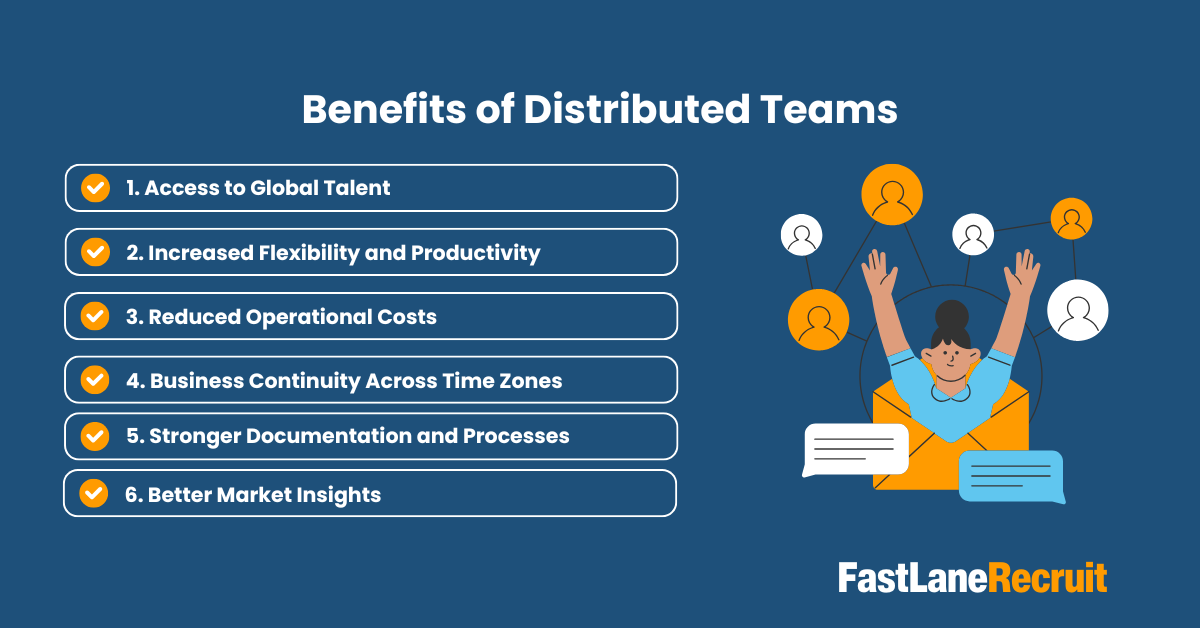
1. Access to Global Talent
One of the biggest advantages of distributed teams is the ability to hire from anywhere in the world. This means companies can:
- Find highly specialized skills
- Build diverse teams with different perspectives
- Improve overall team performance
For example, a company can hire developers from Southeast Asia, marketers from Europe, and customer support teams in different regions, all working together seamlessly.
Also Read: What Is Business Process Outsourcing (BPO) and How Does It Work?
2. Increased Flexibility and Productivity
Distributed teams allow employees to work during their most productive hours instead of following a strict 9-to-5 schedule.
This leads to:
- Better focus and efficiency
- Improved work-life balance
- Higher job satisfaction
When employees have more control over their schedules, they tend to produce better results.
3. Reduced Operational Costs
Without the need for a large physical office, companies can significantly reduce overhead costs such as:
- Rent and utilities
- Office maintenance
- Equipment and facilities
These savings can be reinvested into:
- Hiring better talent
- Improving employee benefits
- Expanding into new markets
4. Business Continuity Across Time Zones
With team members spread across different time zones, work doesn’t stop when one region logs off.
This enables:
- Faster project turnaround times
- 24/7 customer support
- Continuous progress on tasks
Often referred to as a “follow-the-sun” model, this approach gives businesses a strong operational advantage.
5. Stronger Documentation and Processes
In distributed teams, communication is often written and documented. This creates:
- Clear records of decisions
- Better knowledge sharing
- Easier onboarding for new employees
Over time, this leads to more structured workflows and fewer misunderstandings.
6. Better Market Insights
Having team members in different regions gives companies valuable local knowledge.
This helps with:
- Understanding customer behavior in different markets
- Adapting products or services to local needs
- Expanding into new regions more effectively
For example, hiring team members in Malaysia can help companies better understand Southeast Asian markets while supporting regional operations.
Overall, distributed teams provide a powerful combination of flexibility, efficiency, and global reach, making them an increasingly popular choice for modern businesses looking to scale.
Challenges of Distributed Teams
While distributed teams offer clear advantages, they also require more intentional planning and structure. Without the right systems in place, small issues can quickly turn into bigger problems that affect productivity, collaboration, and team morale.
The good news is that most challenges are predictable and manageable when you understand why they happen and how to address them.
Common Challenges and How to Solve Them
| Challenge | Why It Happens | Practical Solution |
| Communication gaps | Lack of face-to-face interaction and informal conversations | Set clear communication guidelines and document key updates |
| Time zone differences | Limited overlap in working hours across regions | Adopt asynchronous workflows and flexible schedules |
| Lack of visibility | No physical oversight of tasks and progress | Use project management tools and shared dashboards |
| Cultural differences | Diverse backgrounds, languages, and work styles | Promote cultural awareness and inclusive practices |
| Tool overload | Too many disconnected platforms and systems | Use a simplified, integrated tech stack |
1. Communication Gaps
In a traditional office, communication happens naturally, through quick chats, meetings, or even casual conversations. In distributed teams, these moments don’t exist, so important information can easily be missed.
What this looks like:
- Team members not having full context
- Misunderstandings about tasks or priorities
- Repeated questions or duplicated work
How to solve it:
- Define where communication should happen (e.g., chat vs documentation)
- Encourage written updates and summaries
- Document decisions so everyone can access the same information
2. Time Zone Differences
When team members work in different time zones, real-time collaboration becomes more difficult. Someone is always starting their day while someone else is ending it.
What this looks like:
- Delayed responses
- Difficulty scheduling meetings
- Slower decision-making
How to solve it:
- Use asynchronous communication (updates that don’t require immediate replies)
- Record meetings and share notes
- Set overlapping “core hours” when possible
3. Lack of Visibility and Accountability
Without a shared office, managers can’t easily see what everyone is working on. This can create uncertainty around progress and responsibilities.
What this looks like:
- Unclear task ownership
- Missed deadlines
- Managers constantly asking for updates
How to solve it:
- Use tools like task boards and dashboards
- Clearly assign ownership for every task
- Track progress through shared systems instead of relying on check-ins alone
4. Cultural Differences
Distributed teams often include people from different countries, cultures, and communication styles. While this diversity is a strength, it can sometimes lead to misunderstandings.
What this looks like:
- Different expectations around communication
- Misinterpretation of tone or feedback
- Conflicts due to cultural differences
How to solve it:
- Encourage open and respectful communication
- Provide basic cultural awareness training
- Create clear guidelines for collaboration and feedback
Also Read: Guide to PEO vs EOR
5. Tool Overload
It’s easy for distributed teams to rely on too many tools, one for messaging, another for tasks, another for documents, and so on. When tools aren’t well integrated, work becomes fragmented.
What this looks like:
- Wasted time switching between platforms
- Difficulty finding information
- Confusion about where work is stored
How to solve it:
- Keep your tech stack simple and focused
- Define one “source of truth” for key information
- Choose tools that integrate well with each other
Key Takeaway
Most challenges in distributed teams come down to lack of structure, not lack of effort.
By putting the right systems in place, clear communication, proper tools, and defined processes, companies can overcome these challenges and build distributed teams that are just as effective, if not more, than traditional office-based teams.
How to Manage Distributed Teams Effectively
Managing distributed teams successfully comes down to building the right systems, habits, and culture. Since your team isn’t in the same physical space, everything, from communication to collaboration, needs to be more intentional and structured.
Here are 10 practical strategies to help your distributed team stay aligned, productive, and engaged:
1. Establish Clear Communication Rules
In a distributed team, communication doesn’t happen naturally, you need to design it.
What to do:
- Define which tools to use for different purposes (e.g., chat for quick updates, documents for decisions)
- Set expectations for response times
- Create clear channels (e.g., project-specific or team-specific)
Why it matters:
When everyone knows where information lives and how to communicate, it reduces confusion and saves time.
2. Set Clear Goals and Expectations
Clarity is critical when teams are working across different locations.
What to do:
- Clearly define roles and responsibilities
- Document deadlines, KPIs, and deliverables
- Use shared dashboards or trackers
Why it matters:
This ensures everyone knows what they’re responsible for and avoids misalignment.
3. Embrace Asynchronous Work
Not everyone will be online at the same time—and that’s okay.
What to do:
- Encourage written updates instead of constant meetings
- Use shared documents and recorded updates
- Reduce reliance on real-time communication
Why it matters:
Asynchronous work allows teams to move forward without delays, even across time zones.
4. Build a Simple, Effective Tool Stack
Too many tools can slow your team down instead of helping.
What to do:
- Choose one main tool for communication, one for tasks, and one for documentation
- Ensure tools integrate well with each other
- Avoid unnecessary duplication
Why it matters:
A clean and simple system helps your team stay focused and organized.
5. Strengthen Onboarding Processes
Onboarding sets the foundation for long-term success, especially in a remote environment.
What to do:
- Provide structured onboarding plans
- Give access to tools, documents, and workflows from day one
- Assign a mentor or “go-to” person
Why it matters:
A strong onboarding experience helps new hires become productive faster and feel connected to the team.
6. Focus on Outcomes, Not Activity
In distributed teams, tracking hours is less effective than tracking results.
What to do:
- Set clear performance metrics
- Measure output and impact instead of time spent
- Avoid micromanagement
Why it matters:
Focusing on outcomes builds trust and encourages accountability.
7. Build a Strong Team Culture
Without an office, culture doesn’t happen by accident; you have to create it.
What to do:
- Schedule regular team check-ins
- Create informal communication channels (e.g., non-work chats)
- Organize virtual team activities
Why it matters:
A strong culture keeps employees engaged, motivated, and connected.
8. Document Everything
Documentation is the backbone of distributed teams.
What to do:
- Record decisions, processes, and workflows
- Maintain a central knowledge base
- Keep documentation updated and accessible
Why it matters:
It reduces confusion, supports onboarding, and ensures consistency across the team.
9. Respect Time Zones and Boundaries
Working across regions requires flexibility and understanding.
What to do:
- Avoid expecting instant replies
- Rotate meeting times when needed
- Encourage employees to maintain work-life balance
Why it matters:
Respecting boundaries helps prevent burnout and improves long-term productivity.
10. Hire the Right People
Not everyone thrives in a distributed work environment.
What to look for:
- Strong communication skills
- Self-discipline and accountability
- Ability to work independently and collaboratively
Why it matters:
The right people make distributed teams easier to manage and more effective overall.
Key Takeaway
Managing distributed teams isn’t about replicating the office experience; it’s about building better systems for how work gets done.
With clear communication, the right tools, and a strong culture, distributed teams can perform just as well, or even better, than traditional teams.
Also Read: Global Employment Outsourcing: Complete Guide to Hiring International Teams
Tools for Managing Distributed Teams
The right tools are the backbone of successful distributed teams. Since team members are working from different locations and time zones, these tools help create structure, improve communication, and keep work organized in one place.
Below is a simple breakdown of essential tool categories and how they support distributed team management.
Communication Tools
| Tools | Use Case |
| Slack, Microsoft Teams | Real-time messaging, team discussions, and asynchronous communication |
How they help:
Communication tools replace in-person conversations. They allow teams to quickly share updates, ask questions, and stay aligned without needing constant meetings.
Best practice:
Use separate channels for projects, teams, and announcements to keep conversations organized and easy to follow.
Project Management Tools
| Tools | Use Case |
| Asana, Trello, Jira | Task tracking, project planning, and workflow visibility |
How they help:
These tools give teams a clear view of what needs to be done, who is responsible, and the progress of each task.
Best practice:
Assign clear ownership for every task and regularly update progress to avoid confusion or duplicated work.
Documentation Tools
| Tools | Use Case |
| Notion, Confluence | Knowledge sharing, SOPs, internal documentation |
How they help:
Documentation tools act as a central knowledge hub where teams can store processes, decisions, and guidelines.
Best practice:
Treat documentation as a “single source of truth” so everyone works with the same updated information.
Scheduling Tools
| Tools | Use Case |
| Google Calendar, World Time Buddy | Time zone coordination and meeting scheduling |
How they help:
These tools make it easier to coordinate across different time zones and avoid scheduling conflicts.
Best practice:
Always check overlapping working hours before scheduling meetings to reduce disruption.
Performance & Feedback Tools
| Tools | Use Case |
| Lattice, 15Five | Employee feedback, performance tracking, and engagement |
How they help:
These platforms support regular check-ins, performance reviews, and continuous feedback, especially important when teams don’t work face-to-face.
Best practice:
Focus on ongoing feedback rather than only annual reviews to support continuous improvement.
Key Takeaway
Managing distributed teams effectively is not about using more tools, it’s about using the right tools in a simple, connected system.
When communication, tasks, documentation, and performance tracking are all aligned, distributed teams can work smoothly across any location or time zone without losing clarity or productivity.
Hiring Distributed Teams Globally: What to Consider
Building a distributed team across borders introduces new complexities:
- Employment laws vary by country
- Payroll and tax compliance requirements differ
- Contracts must meet local regulations
- Benefits and employee rights must be managed correctly
For guidance on international labour standards, businesses can refer to the International Labour Organization.
Example: Building a Distributed Team in Malaysia
Malaysia has become a popular destination for building distributed teams due to:
- Strong English proficiency
- Skilled talent in tech, finance, and digital roles
- Strategic time zone for Asia-Pacific operations
For example, a global company could:
- Hire a customer support team in Malaysia to serve APAC markets
- Build a regional marketing team with local insights
- Support 24/7 operations by complementing teams in Europe and the US
This approach helps companies scale efficiently while maintaining quality and responsiveness.
Also Read: Guide to Outsourcing Web Development
How FastLaneRecruit Supports Distributed Teams (EOR Solution)
As companies grow their distributed teams across different countries, things can quickly become more complex than just hiring talent. Each country has its own employment laws, tax rules, payroll systems, and compliance requirements. Managing all of this internally can slow down expansion and create unnecessary operational pressure.
This is where an Employer of Record (EOR) solution becomes especially valuable.
An EOR allows companies to legally hire and manage employees in another country without needing to set up a local entity. Instead, the EOR becomes the official employer on paper, while you still manage the employee’s day-to-day work and performance.
Why FastLaneRecruit’s EOR Service Matters for Distributed Teams
FastLaneRecruit helps global companies build and manage distributed teams in Malaysia with confidence and compliance. It removes the administrative and legal barriers that often come with international hiring.
Here’s how it supports your business:
1. Hire in Malaysia Without Setting Up a Local Entity
Expanding into a new country normally requires registering a company, which can take time and resources.
With FastLaneRecruit’s EOR service, companies can:
- Hire Malaysian talent quickly
- Avoid setting up a legal entity
- Start operations faster in the region
This makes it easier for businesses to test new markets or scale teams without heavy upfront setup.
2. Ensure Full Compliance with Local Employment Laws
Every country has different rules around contracts, working hours, employee benefits, and termination policies.
FastLaneRecruit helps ensure:
- Employment contracts meet Malaysian legal standards
- Hiring processes follow local regulations
- Companies stay compliant with labor requirements
This reduces legal risk and helps companies operate confidently in a new market.
3. Manage Payroll, Taxes, and Benefits Seamlessly
Handling payroll across borders can become complicated very quickly, especially when dealing with multiple currencies and tax systems.
With EOR support:
- Salaries are processed correctly and on time
- Tax contributions are handled properly
- Employee benefits are managed according to local standards
This ensures employees are paid accurately while reducing administrative workload for employers.
4. Simplify Onboarding and Employee Management
A smooth onboarding experience is essential for distributed teams, especially when employees are based in different countries.
FastLaneRecruit supports:
- Structured onboarding processes
- Clear documentation and contracts
- Local HR support for employees in Malaysia
This helps new hires integrate quickly into the team, no matter where they are located.
Why This Matters for Distributed Teams
Instead of spending time navigating:
- Local employment laws
- Payroll systems
- Legal entity setup
- Administrative processes
Companies can focus on what really matters, building and scaling high-performing distributed teams.
FastLaneRecruit acts as the operational backbone, handling the complexity behind the scenes so businesses can expand globally with confidence and efficiency.
Also Read: How to Manage Staffing Shortage
Conclusion
Distributed teams are no longer a trend; they are becoming a standard way of working for global organizations. By removing geographic limitations, companies can access top talent, improve flexibility, and scale faster across markets.
However, success depends on having the right systems in place. Clear communication, structured workflows, and strong management practices are essential to keep distributed teams aligned and productive.
For companies looking to expand internationally, combining distributed team strategies with the right hiring solution, such as an EOR, can make global growth faster, simpler, and fully compliant.
FAQs
What is a distributed team?
A distributed team is a group of employees working from different geographic locations, often across multiple time zones, without relying on a central office.
How is a distributed team different from a remote team?
Distributed teams are globally spread across regions and time zones, while remote teams may work remotely but within the same region.
What are the biggest challenges of distributed teams?
Common challenges include communication gaps, time zone differences, and maintaining team culture.
How can companies manage distributed teams effectively?
By using clear communication systems, structured workflows, proper tools, and strong leadership practices.
Build and Scale Distributed Teams with Confidence
Hiring globally shouldn’t slow your growth; it should accelerate it. With the right support, you can build distributed teams that are flexible, high-performing, and ready to scale across borders without getting stuck in legal or administrative complexity.
FastLaneRecruit’s Employer of Record (EOR) solution in Malaysia helps you hire, manage, and pay talent seamlessly while staying fully compliant with local employment regulations.
Ready to expand your distributed team?
Partner with FastLaneRecruit to:
- Hire top talent in Malaysia without setting up a local entity
- Stay fully compliant with local employment laws
- Simplify payroll, contracts, and HR administration
- Scale your global workforce with less operational friction