
Malaysia vs Global Markets
System Administrators are truly the unsung heroes of every IT setup. They’re the ones making sure servers stay healthy, networks stay connected, and systems stay secure, all so businesses can run smoothly in an increasingly digital world. With the rise of SaaS, fintech, and enterprise tech, the demand for skilled system administrators is getting stronger globally.
In 2026, system administrators in key markets such as Malaysia, the USA, Singapore, Hong Kong, and Australia typically earn between USD 30,000 and USD 100,000 annually, depending on region and seniority. Employers typically achieve around 50–55% payroll efficiency when hiring system administrators in Malaysia compared to Western markets.
This guide compares 2026 salary benchmarks across Malaysia, the USA, Singapore, Hong Kong, and Australia, helping employers make informed hiring and payroll decisions.
Content Outline
Key Summary
Malaysia Offers Cost-Effective System Admin Talent
System Administrators earn MYR 95,000–145,000 annually (USD 23,000–35,000), making Malaysia a high-value destination for offshore IT teams.
USA Pays Top Dollar
Senior System Administrators earn USD 90,000–100,000, especially in enterprise IT and cloud-heavy environments.
Singapore Offers Competitive Packages
Salaries range from SGD 85,000–125,000 (USD 63,000–92,000), driven by demand in fintech, SaaS, and government sectors.
Hong Kong Salaries Are Moderate
System Administrator roles pay HKD 340,000–480,000 (USD 44,000–62,000), with growing demand in finance and logistics.
Australia Rewards Experience
Salaries range from AUD 95,000–135,000+ (USD 63,000–90,000+), especially in government and enterprise IT.
Outsourcing to Malaysia Maximizes ROI
Employers can achieve around 50–55% payroll efficiency while gaining access to English-speaking, certified professionals.
System Administrator Specialist Salary Breakdown by Country (2026)
Malaysia
Malaysia’s system admin talent is known for strong English proficiency, Microsoft/Linux certifications, and expertise in cloud platforms like AWS and Azure.
| Level | Salary (MYR) | Salary (USD) |
| Entry (0–2 yrs) | 95,000–110,000 | 23,000–26,000 |
| Mid (3–5 yrs) | 120,000–135,000 | 28,000–32,000 |
| Senior (6+ yrs) | 140,000–145,000 | 33,000–35,000 |
Market Insight: Malaysia provides reliable, scalable IT talent with strong payroll efficiency compared to Western markets.
Also Read: Top 15 Business Consulting Firms in Australia
United States
| Level | Salary (USD) |
| Entry (0–2 yrs) | 60,000–70,000 |
| Mid (3–5 yrs) | 75,000–85,000 |
| Senior (6+ yrs) | 90,000–100,000 |
Market Insight: High salaries reflect demand for cloud integration, cybersecurity, and enterprise-scale infrastructure.
Singapore
| Level | Salary (SGD) | Salary (USD) |
| Entry (0–2 yrs) | 85,000–95,000 | 63,000–70,000 |
| Mid (3–5 yrs) | 100,000–115,000 | 74,000–85,000 |
| Senior (6+ yrs) | 120,000–125,000+ | 88,000–92,000+ |
Market Insight: Specialists with cloud, DevOps, and security skills command premium pay.
Hong Kong
| Level | Salary (HKD) | Salary (USD) |
| Entry (0–2 yrs) | 340,000–380,000 | 44,000–49,000 |
| Mid (3–5 yrs) | 400,000–440,000 | 52,000–57,000 |
| Senior (6+ yrs) | 450,000–480,000 | 58,000–62,000 |
Market Insight: System administrators gain exposure to compliance-heavy and multilingual environments.
Australia
| Level | Salary (AUD) | Salary (USD) |
| Entry (0–2 yrs) | 95,000–105,000 | 63,000–70,000 |
| Mid (3–5 yrs) | 115,000–125,000 | 76,000–83,000 |
| Senior (6+ yrs) | 130,000–135,000+ | 86,000–90,000+ |
Market Insight: Specialists with cloud, automation, and DevOps experience are in high demand.
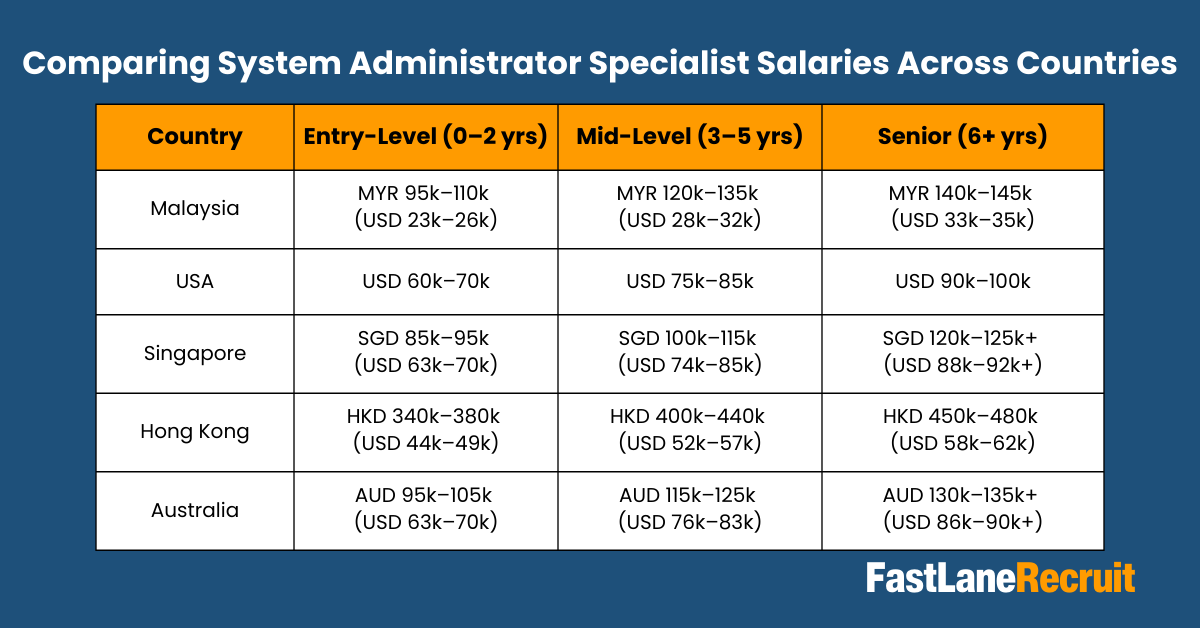
Comparing System Administrator Specialist Salaries Across Countries
| Country | Entry-Level (0–2 yrs) | Mid-Level (3–5 yrs) | Senior (6+ yrs) |
| Malaysia | MYR 95k–110k (USD 23k–26k) | MYR 120k–135k (USD 28k–32k) | MYR 140k–145k (USD 33k–35k) |
| USA | USD 60k–70k | USD 75k–85k | USD 90k–100k |
| Singapore | SGD 85k–95k (USD 63k–70k) | SGD 100k–115k (USD 74k–85k) | SGD 120k–125k+ (USD 88k–92k+) |
| Hong Kong | HKD 340k–380k (USD 44k–49k) | HKD 400k–440k (USD 52k–57k) | HKD 450k–480k (USD 58k–62k) |
| Australia | AUD 95k–105k (USD 63k–70k) | AUD 115k–125k (USD 76k–83k) | AUD 130k–135k+ (USD 86k–90k+) |
Why These Salaries Differ
System Administrator salaries vary widely across regions, and it’s not just about the job title. Compensation is shaped by several key factors: cost of living, industry demand, skill specialization, and remote work trends. Understanding these drivers helps employers set realistic payroll budgets and attract the right talent.
1. Cost of Living
Countries with higher living costs, such as the U.S., Singapore, and Australia, naturally offer higher salaries to offset expenses like housing, healthcare, and transportation. For example, a senior system administrator in San Francisco may earn USD 95,000 annually, but much of that income is absorbed by rent and living costs that can exceed USD 3,500 per month.
In contrast, Malaysia’s lower cost of living allows system administrators to enjoy strong purchasing power even at modest salary levels. A mid-level administrator earning USD 30,000 annually in Kuala Lumpur can maintain a comfortable lifestyle thanks to affordable housing, healthcare, and food costs.
Tip for Employers: Use location-adjusted salary frameworks to stay competitive while managing payroll budgets effectively.
2. Industry Demand
System administrators are essential in industries that rely on uptime, compliance, and secure infrastructure. Salaries rise in sectors where downtime or breaches carry heavy financial or regulatory consequences.
- SaaS & Fintech: High demand for cloud infrastructure, automation, and security validation drives premium pay.
- Healthcare & Government: Compliance and data protection requirements increase specialization and compensation.
- E-commerce & Logistics: Real-time monitoring and device compatibility are critical, pushing demand for skilled administrators.
Example: A system administrator at a fintech firm in Singapore may earn USD 85,000 due to the complexity of compliance and cloud frameworks, while a peer in retail earns closer to USD 60,000.
Tip for Employers: Prioritize domain-specific experience when hiring for regulated or high-uptime environments.
3. Skill Specialization
Not all system administrators earn the same. Salaries are closely tied to certifications and advanced expertise. Specialists with cloud, DevOps, and security skills often earn 25–30% more than those focused on traditional server maintenance.
High-value skills include:
- Certifications: Microsoft Certified Solutions Expert (MCSE)*, Red Hat Certified Engineer, AWS Certified SysOps, Azure Administrator Associate
*Note: MCSE has been retired; candidates now pursue Microsoft Certified: Azure or Modern Workplace certifications.
- Cloud Platforms: AWS, Azure, Google Cloud
- Security Expertise: Firewalls, penetration testing, vulnerability scanning
- DevOps Integration: CI/CD pipelines, Kubernetes, Docker
Example: A system administrator in Penang with AWS and Red Hat certifications may earn MYR 135,000 (USD 32,000), while a peer focused only on basic server management earns closer to MYR 95,000 (USD 23,000).
Tip for Employers: Use skill-based compensation models to attract and retain top-tier talent while encouraging certification and upskilling.
4. Remote Work & Global Hiring
The rise of remote-first hiring has reshaped IT recruitment. Employers now focus on responsiveness, automation coverage, and cloud expertise rather than physical location. This shift positions Malaysia as a prime destination for offshore system administration teams.
Global Trends:
- Hybrid Teams: Strategic oversight remains in high-cost markets, while execution is outsourced to Malaysia.
- Offshore Hiring: Companies achieve 50–55% payroll efficiency by hiring in Malaysia while maintaining strong technical standards.
Example: A U.K.-based SaaS company hired three system administrators in Kuala Lumpur for the cost of one London-based hire. This enabled 24/7 monitoring and reduced payroll costs by over 50%.
Tip for Employers: Partner with an Employer of Record (EOR) to hire globally without navigating complex labor laws.
Also Read: Top 15 HR SaaS Platforms in Australia
Why Outsource System Administrator Roles to Malaysia?
Outsourcing system administration to Malaysia is more than just a cost-saving measure, it’s a strategic decision that balances affordability, technical expertise, and operational resilience. With Malaysia’s strong IT education pipeline, government-backed digital initiatives, and a growing pool of certified professionals, global companies can build reliable infrastructure teams without the overhead of Western markets.
1. Lower Payroll Costs Without Sacrificing Quality
Hiring a system administrator in Malaysia typically provides 50–55% payroll efficiency compared to U.S. or Australian markets. Employers gain access to professionals trained in Microsoft, Linux, AWS, and Azure environments at a fraction of the cost.
Example:
A U.S.-based SaaS company built a four-person Malaysian infrastructure team for the cost of two U.S. hires, saving over USD 200,000 annually while maintaining enterprise-grade uptime.
2. Certified Talent with Global Tools
Malaysia produces thousands of IT graduates annually, many holding certifications such as MCSE, Red Hat, AWS, and Azure. These certifications ensure that Malaysian system administrators are ready to manage hybrid cloud environments and enterprise networks.
Example:
A Singaporean fintech firm outsourced its infrastructure management to a Malaysian team certified in AWS and Linux. The team reduced downtime by 30% and improved compliance reporting.
Also Read: Top 20 Collaboration Tools in Australia
3. Time Zone Overlap with APAC & Partial Europe
Malaysia’s GMT+8 time zone enables real-time collaboration across Asia-Pacific and partial overlap with Europe. This ensures faster incident response and smoother workflows for global teams.
Example:
A German logistics company set up a Malaysian system admin team. With overlapping hours, they resolved overnight server issues and delivered reports by the next European business day.
4. Strong English Proficiency and Global Collaboration
Malaysian system administrators are fluent in English and experienced in working with global clients via Jira, ServiceNow, GitHub, and Slack, ensuring seamless onboarding and communication.
Example:
A Hong Kong-based trading firm outsourced infrastructure monitoring to Malaysian professionals. Their fluency and familiarity with global tools enabled smooth integration into cross-border teams.
5. Simplified Payroll & Compliance with EOR
Hiring in Malaysia is streamlined with an Employer of Record (EOR), which manages contracts, payroll, and statutory contributions such as EPF, SOCSO, and EIS.
Example:
A Canadian healthcare company used FastLaneRecruit’s EOR service to hire three senior system administrators in Malaysia. Payroll and compliance were fully managed locally, eliminating the need to set up a subsidiary.
Use Case: Scaling IT Teams Cost-Effectively
A U.S.-based e-commerce platform was preparing for global expansion, requiring a dedicated IT team to manage servers, cloud environments, and security compliance. Hiring locally proved costly and slow.
To accelerate delivery and manage costs, the company partnered with FastLaneRecruit to build a six-person system administration team in Malaysia. The team included:
- Two mid-level administrators managing cloud infrastructure and monitoring tools
- Two junior administrators handling helpdesk support and routine server maintenance
- One senior administrator overseeing compliance, backups, and disaster recovery
- One team lead coordinating with the U.S. IT department
Outcome 1: Payroll Efficiency
Payroll costs achieved approximately 55% efficiency compared to U.S. hiring benchmarks, saving over USD 250,000 annually.
Outcome 2: Compliance Fully Managed
FastLaneRecruit’s EOR model handled all statutory contributions and tax deductions, including EPF, SOCSO, EIS, and PCB.
Outcome 3: Faster Incident Response
Thanks to Malaysia’s GMT+8 time zone, the offshore team provided real-time monitoring for APAC users and overnight coverage for U.S. operations.
Also Read: Top 20 Accounting BPO Providers in Australia
How to Hire System Administrators in Malaysia
Hiring system administrators in Malaysia is straightforward once you understand the local talent market, salary benchmarks, and compliance requirements.
1. Define Role Requirements
Start by clearly outlining the role to attract the right candidates and avoid mismatches.
Seniority Levels:
- Entry-level (0–2 years): Ideal for routine server maintenance and helpdesk support
- Mid-level (3–5 years): Suitable for cloud infrastructure, monitoring tools, and automation
- Senior (6+ years): Best for compliance, disaster recovery, and mentoring junior staff
Tech Stack & Tools:
- Microsoft Windows Server, Linux (Red Hat, Ubuntu)
- AWS, Azure, VMware
- Monitoring tools: Nagios, Zabbix, Splunk
- Certifications: MCSE, AWS Certified SysOps, Red Hat Certified Engineer
Business Objectives:
- Supporting hybrid cloud environments
- Managing compliance frameworks (ISO, SOC2, GDPR)
- Ensuring uptime and disaster recovery readiness
2. Choose a Hiring Model
| Hiring Model | Description | Best For |
| Direct Hire via Local Entity | Requires a Malaysian company setup. You manage payroll and compliance. | Businesses with existing Malaysian operations |
| Contract via Outsourcing Firm | Administrators hired as contractors. Limited control over retention. | Short-term projects, pilot teams |
| Employer of Record (EOR) | Third-party hires specialists on your behalf, handling contracts and payroll. | Global companies without a local entity |
3. Set Competitive Salary Benchmarks
System Administrator salaries in Malaysia vary by location, seniority, and specialization. Specialists in Kuala Lumpur and Penang often command higher pay due to demand from enterprise clients.
Tips:
- Benchmark against local hubs: Kuala Lumpur, Penang, Johor Bahru
- Adjust compensation for in-demand certifications like AWS or MCSE
- Offer training stipends or performance bonuses to attract top talent
4. Ensure Payroll Compliance
Malaysia has clear labor and tax regulations that employers must follow when hiring full-time system administrators. Ensuring compliance from day one helps avoid fines, misclassification risks, and employee dissatisfaction.
Key statutory requirements:
- EPF (Employees Provident Fund): Mandatory retirement savings contributions
- SOCSO (Social Security): Coverage for workplace injury and disability
- EIS (Employment Insurance System): Protection against job loss
- PCB (Potongan Cukai Bulanan): Monthly income tax deductions
Also Read: Top 20 EOR Services in Australia
FastLaneRecruit’s EOR Solution
For companies without a Malaysian entity, FastLaneRecruit’s Employer of Record (EOR) service offers a fast, compliant way to hire system administrators.
What FastLaneRecruit Covers:
- Compliant employment contracts
- Monthly payroll with EPF, SOCSO, EIS
- Income tax (PCB) deductions and filings
- Compliance with Malaysian labor laws
- Onboarding and local HR support
Benefits:
- Hire in days, not months
- Full compliance with Malaysian labor classifications, minimizing misclassification risks
- Transparent payroll reporting
- Seamless integration with global HR systems
Example:
A Singapore-based healthcare company used FastLaneRecruit’s EOR to hire three system administrators in Penang. Within two weeks, contracts were signed, payroll was active, and the team was fully operational without registering a Malaysian subsidiary.
Also Read: Top 15 Recruitment Agencies in Australia
Conclusion
System Administrators remain essential to maintaining IT resilience, uptime, and security. While markets like the U.S. and Singapore offer high compensation, Malaysia provides a strategic balance of capability, scalability, and cost efficiency. With certified professionals, strong English proficiency, and government-backed digital initiatives, Malaysia enables payroll savings of up to 55% while sustaining world-class IT standards.
Ready to Build a Smarter IT Team?
Hiring system administrators doesn’t have to be slow, expensive, or complicated. With Malaysia’s growing pool of certified, English-speaking talent, global companies can expand their IT capabilities while keeping payroll lean and compliant.
By partnering with FastLaneRecruit’s Employer of Record (EOR), you gain:
- Access to skilled system administrators trained in Microsoft, Linux, AWS, and Azure
- Payroll savings of up to 55% compared to hiring in the U.S. or Europe
- Seamless compliance with EPF, SOCSO, EIS, and PCB fully managed
- Faster hiring timelines, with teams operational in days, not months
- Transparent payroll reporting that integrates with global HR systems
Whether you’re a SaaS provider scaling infrastructure, a fintech firm optimizing costs, or an enterprise expanding into APAC, FastLaneRecruit makes offshore hiring simple, compliant, and scalable.
Let’s build a future-ready IT function: resilient, global, and built to last. Reach out to FastLaneRecruit today and start building your offshore system administration team with confidence.