
Hiring in the United Kingdom can give international businesses access to a large and highly skilled workforce across technology, financial services, professional services, engineering, life sciences, creative industries, healthcare, and other sectors.
However, hiring an employee in the UK is more complicated than simply finding a candidate and issuing an offer letter.
Businesses must consider employment contracts, payroll, PAYE, National Insurance, pensions, statutory leave, minimum wage requirements, right-to-work checks, employee benefits, employment rights, and ongoing HR administration.
For a company without an established UK entity, these requirements can create significant administrative and compliance responsibilities.
This is where an Employer of Record UK can help.
An Employer of Record, or EOR, is a third-party employment partner that legally employs workers on behalf of another company. The EOR becomes the formal employer for employment and payroll purposes while the client company retains responsibility for the employee’s day-to-day work.
Instead of establishing a UK entity before making the first hire, a company can use an EOR to create a compliant employment structure and begin building its UK team.
But how exactly does an EOR work in the UK? What does it handle? How much can it cost? And when is an EOR a better option than establishing a local entity or hiring contractors?
This guide explains how to use an Employer of Record in the UK, including the UK employment framework, payroll and benefits administration, hiring process, risks, provider selection criteria, and alternatives.
Content Outline
Key Summary
An EOR Is More Than Payroll
An Employer of Record is not simply a payroll provider. The EOR becomes the formal employer and manages important employment administration and compliance responsibilities.
The Client Still Manages the Employee
The EOR handles the formal employment relationship, while the client normally manages the employee’s day-to-day responsibilities, performance, and business objectives.
UK Compliance Requires Local Knowledge
PAYE, National Insurance, pensions, statutory leave, right-to-work requirements, employment rights, and evolving legislation all need to be considered.
EOR Can Be Valuable Before Entity Setup
Companies entering a new market or hiring a small initial team may find an EOR more practical than immediately establishing a local entity.
Cost Should Be Evaluated as Total Employment Cost
Do not compare EOR providers solely on their monthly service fee. Consider salary, employer taxes, benefits, pensions, onboarding, termination, FX costs, and other charges.
Provider Quality Matters
The EOR becomes closely connected to your employee’s formal employment experience. Compliance expertise, local infrastructure, HR support, security, and transparency should therefore be part of your evaluation.
What Is an Employer of Record in the UK?
An Employer of Record UK is a company that legally employs a worker on behalf of another business.
The EOR becomes the employee’s formal employer and typically handles employment administration, including:
- Employment contracts
- Payroll processing
- PAYE administration
- National Insurance contributions
- Statutory benefits
- Pension administration
- Leave administration
- Employment documentation
- HR administration
- Right-to-work processes where applicable
- Employee onboarding
- Offboarding and termination administration
- Local employment compliance
The client company remains responsible for the employee’s operational role.
For example, a US technology company wants to hire a software developer who lives in London but does not have a UK subsidiary.
Instead of immediately establishing a UK company, the business can engage an EOR.
The structure generally works like this:
International Company → EOR → UK Employee
The international company decides:
- What the employee does
- Who manages the employee
- What projects they work on
- Their performance objectives
- Their working relationship with the wider team
The EOR manages the formal employment relationship and associated administrative obligations.
EOR vs Client Company Responsibilities
| Responsibility | EOR | Client Company |
| Legal employment | Yes | No |
| Employment contract | Yes | Provides commercial terms |
| Payroll | Yes | Provides payroll information |
| PAYE administration | Yes | No |
| National Insurance administration | Yes | No |
| Statutory benefits | Yes | Determines additional benefits with provider |
| Pension administration | Yes | Provides agreed compensation information |
| Day-to-day management | No | Yes |
| Performance management | Usually shared/support | Yes |
| Job responsibilities | No | Yes |
| Business strategy | No | Yes |
| Employee termination process | Supports/manages formal process | Makes business decision with EOR guidance |
The exact division of responsibilities depends on the EOR agreement, so businesses should review the service scope before signing.
Why Are Companies Using EORs to Hire in the UK?
The UK can be an attractive hiring market, but establishing a legal employment infrastructure before making the first hire may not make commercial sense for every business.
An EOR can be useful when a company wants to:
- Hire one or a small number of employees
- Enter the UK market quickly
- Test demand before establishing a subsidiary
- Hire specialized UK talent
- Expand an international team
- Relocate or hire employees internationally
- Avoid creating an immediate local payroll infrastructure
- Reduce administrative work
- Access local employment expertise
An EOR is therefore particularly useful for companies where the hiring requirement is real but establishing a permanent UK operation is premature.
How to Use an Employer of Record in the UK
Using an EOR is not simply a matter of sending employee information to a provider.
The strongest EOR relationships involve clear responsibilities between the client, EOR, and employee.
Step 1: Determine Whether EOR Is Right for Your Business
Start by assessing:
- Number of employees you plan to hire
- Expected hiring timeline
- Length of the UK expansion
- Whether you already have a UK entity
- Planned investment in the UK
- Type of employees you need
- Required benefits
- Payroll complexity
- Long-term expansion plans
If you are hiring one employee to test a market, an EOR may be practical.
If you expect to build a large permanent UK operation with offices, significant headcount, and local revenue-generating activities, establishing your own entity may eventually make more sense.
Step 2: Define the Role and Compensation
Before onboarding the employee, establish:
- Job title
- Responsibilities
- Salary
- Working hours
- Work location
- Start date
- Probation terms
- Bonus or commission
- Equity arrangements
- Benefits
- Leave entitlement
- Notice requirements
These details provide the basis for the EOR’s employment documentation.
Step 3: Choose an EOR Provider
Evaluate providers based on more than price.
Consider:
- Whether the provider has its own employing entity in the UK
- UK employment-law expertise
- Payroll capabilities
- Benefits administration
- Employee support
- Data security
- Intellectual property protection
- Onboarding process
- Compliance infrastructure
- Contract flexibility
- Pricing transparency
- Customer support
- Offboarding support
A provider’s ability to administer employment locally is particularly important. A generic global platform relying heavily on third parties may provide a different experience from an EOR with direct local infrastructure.
Step 4: Submit Employee and Employment Information
The company provides the EOR with the information needed to create the employment arrangement.
This may include:
- Employee identity information
- Right-to-work information
- Job details
- Compensation
- Benefits
- Working location
- Start date
- Reporting structure
- Contract requirements
The EOR then prepares the appropriate employment documentation.
Step 5: Complete Compliance and Onboarding
The EOR helps ensure that the employment arrangement complies with applicable UK requirements.
Depending on the employee and circumstances, this can include:
- Right-to-work verification
- Employment documentation
- Payroll setup
- PAYE setup and administration
- Pension arrangements
- Benefits enrollment
- Employee records
- Required HR documentation
Step 6: Employee Starts Work
Once onboarding is complete, the employee joins the client company’s team.
The employee works under the client’s operational direction while the EOR manages the formal employment relationship.
This creates a useful separation:
Business management remains with the client.
Employment administration remains with the EOR.
Step 7: Manage Payroll and Employment Throughout the Relationship
During employment, the EOR can continue supporting:
- Monthly payroll
- Tax deductions
- National Insurance
- Pension contributions
- Leave administration
- Benefits
- Contract changes
- Salary adjustments
- HR documentation
- Employee queries
- Compliance updates
Step 8: Manage Offboarding Correctly
If employment ends, the EOR can support the formal process.
Depending on the circumstances, this may include:
- Notice requirements
- Final salary
- Unused holiday
- Statutory payments
- Benefits termination
- Payroll reporting
- Employment documentation
- Termination procedures
Because UK termination rules can be complex, businesses should involve their EOR early rather than treating termination as a simple administrative step.
UK-Specific EOR Insights: What Makes the UK Different?
The UK has a mature employment framework with extensive statutory protections.
International companies should not assume that employment practices used in another country can simply be transferred to the UK.
Key areas include:
PAYE
UK employers generally operate Pay As You Earn (PAYE), through which income tax and employee National Insurance are deducted from wages.
National Insurance
Employers and employees may have National Insurance obligations depending on the employee’s circumstances and earnings.
For the 2026/27 tax year, the standard employer Class 1 National Insurance rate is 15% above the applicable secondary threshold.
Workplace Pensions
Eligible employees generally need to be considered for workplace pension auto-enrolment requirements.
Minimum Wage
UK minimum wage rates vary according to age and other qualifying categories and were increased from April 2026.
Paid Holiday
Almost all workers are legally entitled to 5.6 weeks of paid holiday each year, subject to the applicable rules.
Right to Work
Employers must establish that employees have the right to work in the UK before employment begins.
Employment Rights
UK employment legislation covers areas such as:
- Discrimination
- Working time
- Leave
- Pay
- Dismissal
- Redundancy
- Family-related rights
- Employee consultation
- Workplace protections
For an international employer, keeping track of these requirements can be challenging. A knowledgeable EOR can provide local employment administration and help the client respond to regulatory changes.
UK Employment Compliance and Legal Framework
A UK EOR relationship should be designed around applicable UK employment law rather than treating compliance as an optional service.
Important areas include:
| Compliance area | What businesses should consider |
| Employment contracts | Written employment terms and required information |
| PAYE | Income tax and payroll deductions |
| National Insurance | Employer and employee contributions |
| Minimum wage | Applicable minimum wage based on employee circumstances |
| Annual leave | Statutory holiday entitlement and holiday pay |
| Sick leave | Statutory Sick Pay and related requirements |
| Pensions | Workplace pension obligations and auto-enrolment |
| Right to work | Verification before employment |
| Equality law | Protection against unlawful discrimination |
| Working time | Working hours, rest and holiday requirements |
| Termination | Notice, dismissal and final payments |
| Employers’ liability | Required insurance where applicable |
| Data protection | Appropriate handling of employee information |
| Worker classification | Correct classification of employees and contractors |
Businesses should obtain professional legal or tax advice where circumstances are complex.
An EOR reduces administrative complexity, but it does not eliminate the need for careful decision-making by the client company.
Also Read: Employee Benefits & Compensation Services United Kingdom
UK Payroll and Benefits Administration
Payroll is one of the most important reasons companies use an EOR.
A UK payroll arrangement can involve:
- Gross salary
- PAYE income tax
- Employee National Insurance
- Employer National Insurance
- Pension contributions
- Statutory payments
- Benefits
- Bonuses
- Commissions
- Holiday pay
- Expense administration
- Final payments
The EOR calculates and processes payroll based on the agreed employment terms.
Example UK Employment Cost Structure
| Cost component | Typically paid/managed by |
| Gross salary | Client funds; EOR processes |
| Employee income tax | Deducted through payroll |
| Employee National Insurance | Deducted through payroll |
| Employer National Insurance | Employer/EOR responsibility |
| Workplace pension | Employer and employee contributions as applicable |
| Statutory benefits | Employer/EOR administration |
| Additional employee benefits | Based on agreed package |
| EOR service fee | Client |
| Other approved employment costs | Client/EOR according to agreement |
The EOR service fee is only one part of the total cost of employment.
Companies should calculate the total employment cost, rather than comparing providers based only on their advertised monthly EOR fee.
UK Employee Benefits and Statutory Leave
A competitive benefits package can be important when attracting UK talent.
Depending on the employment arrangement, businesses may need to consider:
- Paid annual leave
- Public holidays
- Statutory Sick Pay
- Maternity-related benefits
- Paternity-related benefits
- Adoption-related benefits
- Shared parental leave
- Pension contributions
- Bereavement-related leave
- Additional company benefits
The statutory baseline should be treated as the starting point, not necessarily the entire compensation package.
For competitive positions, companies may supplement statutory requirements with:
- Private medical insurance
- Life insurance
- Enhanced parental leave
- Wellness benefits
- Additional paid leave
- Flexible working benefits
- Learning and development
- Employee assistance programs
An experienced EOR can help employers understand which benefits are legally required and which are commonly offered to remain competitive.
How Much Does an Employer of Record Cost in the UK?
There is no single universal EOR price.
Pricing can vary depending on:
- Provider
- Number of employees
- Contract duration
- Services included
- Benefits package
- Payroll complexity
- Currency
- Employee location
- Visa or immigration requirements
- Onboarding and termination services
- Additional HR support
The total cost normally consists of:
Employee salary + employer statutory costs + benefits + EOR service fee + other applicable employment costs
What to Ask About EOR Pricing
Before signing a contract, ask:
- Is the monthly EOR fee fixed?
- Are onboarding fees charged?
- Are termination fees charged?
- Are payroll processing fees included?
- Are benefits included?
- Are pension administration costs included?
- Are FX or currency conversion charges applied?
- Are immigration services additional?
- Are there minimum contract periods?
- Are there additional compliance or HR fees?
The cheapest EOR provider may not represent the lowest total cost if important services are excluded from the headline price.
EOR vs Setting Up a UK Entity
One of the most important decisions for international businesses is whether to use an EOR or establish their own UK company.
| Factor | Employer of Record | Own UK Entity |
| Local entity required by client | No | Yes |
| Initial setup | Generally faster | More setup required |
| Hiring one employee | Often practical | May be disproportionate |
| Payroll infrastructure | EOR manages | Company manages |
| Employment compliance | EOR supports/manages formal employment obligations | Company responsible |
| Corporate administration | Limited client-side setup | Company responsible |
| Long-term UK operations | Useful depending on scale | Often more suitable |
| Market testing | Strong fit | Less flexible |
| Control over employment entity | Limited | Full |
| Administrative burden | Lower | Higher |
| Scalability | Useful for distributed hiring | Useful for substantial local operations |
| Best suited for | International hiring and early expansion | Permanent local presence |
When Is an EOR Better?
An EOR may be more appropriate when:
- You need to hire quickly
- You have only a few employees
- You are testing the UK market
- You do not yet know how large the UK operation will become
- You want to reduce administrative complexity
- You already have an international business but no UK entity
When Should You Consider Your Own Entity?
A local entity may become more appropriate when:
- You have substantial UK headcount
- You plan long-term UK operations
- You need direct control over the employing entity
- You are establishing a significant physical presence
- You need local corporate infrastructure
- Your commercial activities require a UK entity
The right answer depends on your business model, headcount, tax position, operational plans, and long-term expansion strategy.
Also Read: 10 Best Employer of Record (EOR) Services To Consider in 2026
EOR vs Staffing Agency
An EOR and staffing agency solve different problems.
| Factor | EOR | Staffing Agency |
| Primary purpose | Employ workers on behalf of a company | Recruit/provide temporary or permanent talent |
| Legal employer | EOR | Depends on arrangement |
| Recruitment | May be included, but not always | Core service |
| Payroll | Yes | Often yes for temporary workers |
| Employment compliance | Core responsibility | Depends on model |
| Day-to-day management | Client | Usually client for assigned workers |
| Long-term employment | Strong fit | Depends on agency model |
| International expansion | Strong fit | Not necessarily |
An EOR is primarily an employment and compliance solution, while staffing agencies are primarily talent acquisition and workforce supply solutions.
Some providers offer both services, but businesses should understand which service they are actually purchasing.
EOR vs Independent Contractors in the UK
Hiring contractors can appear simpler than employing someone, but classification matters.
A contractor should not be used simply to avoid employment responsibilities when the underlying relationship resembles employment.
UK businesses also need to consider off-payroll working rules, including IR35 where applicable.
| Factor | EOR Employee | Contractor |
| Employment relationship | Formal employment | Independent engagement |
| Payroll | EOR-managed payroll | Contractor arrangement |
| Employee benefits | Applicable employment benefits | Usually different |
| Statutory leave | Employee rights apply | Different treatment |
| Classification risk | Reduced when correctly employed | Potentially higher |
| IR35 considerations | Generally not the same issue as engaging a contractor | May apply depending on circumstances |
| Long-term dedicated role | Often suitable | Depends on genuine contractor status |
If a worker is effectively functioning as an employee, businesses should obtain appropriate advice rather than assuming that labeling the person a contractor resolves the issue.
Why Use an EOR Instead of Setting Up an Entity?
The main advantage is speed and reduced administrative infrastructure.
Consider a company that wants to hire two UK employees.
Setting up a local operation may involve:
- Incorporation
- Corporate administration
- Banking
- Tax registrations
- Payroll setup
- Employment processes
- Pension administration
- Insurance
- Accounting
- Ongoing compliance
An EOR can provide an existing employment framework through which the company can hire employees without immediately building all of that infrastructure itself.
This can make an EOR especially useful for:
Market Testing
Test the UK market before committing to a permanent local structure.
Small Teams
Hire one or several employees without building an entire HR and payroll operation.
Fast Expansion
Add UK talent to an existing international team without waiting for entity setup.
Specialized Hiring
Hire a specialist employee even when there is not yet enough UK headcount to justify a subsidiary.
Temporary Expansion
Build a temporary team for a project, launch, or market-entry initiative.
Key Benefits of Using an Employer of Record UK
1. Hire Without an Immediate Local Entity
An EOR can provide a practical employment structure for companies that do not yet have their own UK entity.
2. Reduce Administrative Work
The EOR manages many employment-related administrative tasks.
3. Support Payroll Compliance
Payroll, PAYE, National Insurance, and statutory payments can be managed through the EOR.
4. Access Local Employment Expertise
Local knowledge can help international companies avoid applying inappropriate employment practices from their home country.
5. Improve Hiring Speed
Using an established employment infrastructure can remove some of the setup steps associated with creating a new local operation.
6. Simplify Employee Onboarding
Employment documentation, payroll setup, benefits, and other onboarding processes can be coordinated through one provider.
7. Support International Expansion
An EOR can allow companies to test new markets without immediately committing to permanent infrastructure.
8. Reduce Classification Risk
Where a company genuinely needs an employee relationship, an EOR can provide an employment model rather than forcing the business to rely on contractor arrangements.
9. Improve Employee Experience
A strong EOR can give employees a local HR contact, compliant payroll, appropriate benefits, and structured employment support.
UK Hiring Challenges for International Companies
International companies commonly face several challenges when hiring in the UK.
Understanding Local Employment Law
UK employment legislation contains detailed rules that may differ from the company’s home market.
Payroll Administration
PAYE, National Insurance, pensions, statutory payments, and payroll reporting create ongoing obligations.
Right-to-Work Compliance
Employers must complete appropriate checks before hiring workers.
Employee Benefits
International employers need to understand both statutory benefits and competitive market practices.
Contractor Classification
Using contractors incorrectly can create tax and employment risks.
Termination
Employment termination requires careful handling of contractual and statutory obligations.
Regulatory Changes
Employment legislation evolves, requiring employers to monitor changes rather than relying on outdated policies.
An EOR can help centralize these responsibilities.
Also Read: Hiring & Recruiting in the United Kingdom (UK)
UK Employment Changes Businesses Should Watch in 2026
The UK’s employment landscape is evolving, including changes associated with the Employment Rights Act 2025 and other regulatory developments.
Businesses hiring in 2026 should monitor changes affecting areas such as:
- Statutory Sick Pay
- Family-related employment rights
- Minimum wage
- Unfair dismissal
- Zero-hours and insecure work
- Workplace protections
- Employment enforcement
- Worker rights
This is an important reason to select an EOR with an active compliance function rather than a provider that simply processes payroll.
A good EOR should have processes for monitoring legislative changes and updating employment practices accordingly.
Industries That Benefit From an EOR in the UK
An EOR can be useful across industries, particularly where companies need specialized talent without immediately establishing a large local operation.
Technology and SaaS
Common roles include:
- Software engineers
- Product managers
- Data specialists
- Cybersecurity professionals
- UX/UI designers
Financial Services
Businesses may use EOR solutions when hiring:
- Analysts
- Financial specialists
- Compliance professionals
- Risk managers
- Technology teams
Life Sciences
International companies can hire:
- Researchers
- Regulatory specialists
- Clinical professionals
- Technical experts
Professional Services
EORs can support international hiring for:
- Consultants
- Project managers
- Analysts
- Marketing specialists
- Operations professionals
E-commerce
Companies expanding into the UK may use an EOR to build:
- Sales teams
- Customer support
- Marketing teams
- Operations teams
Creative and Media
International businesses can hire:
- Designers
- Content specialists
- Producers
- Creative directors
- Digital marketers
Common EOR Use Cases
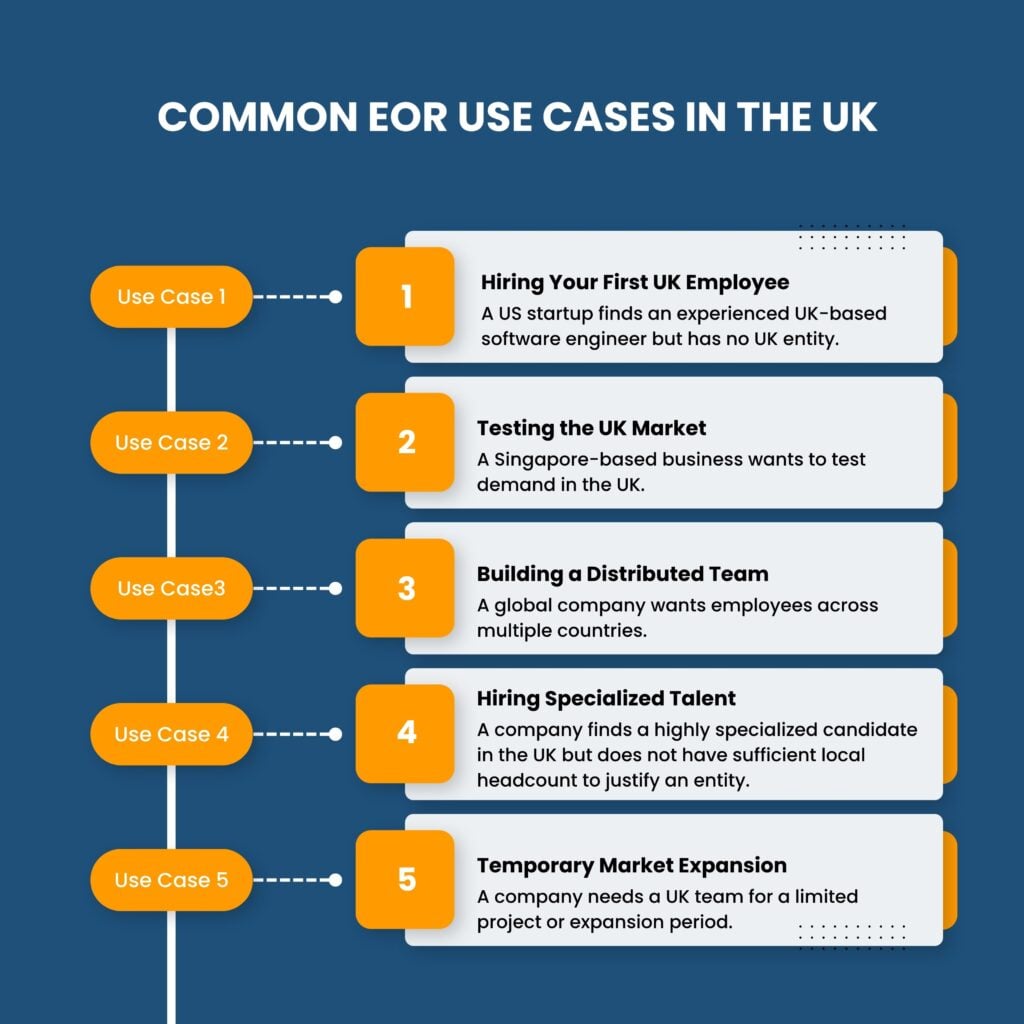
Use Case 1: Hiring Your First UK Employee
A US startup finds an experienced UK-based software engineer but has no UK entity.
Instead of establishing a subsidiary for one employee, it can evaluate an EOR.
Use Case 2: Testing the UK Market
A Singapore-based business wants to test demand in the UK.
The company can use an EOR to build an initial team while evaluating whether a permanent entity is justified.
Use Case 3: Building a Distributed Team
A global company wants employees across multiple countries.
An EOR can provide localized employment administration while the company maintains one operational management structure.
Use Case 4: Hiring Specialized Talent
A company finds a highly specialized candidate in the UK but does not have sufficient local headcount to justify an entity.
An EOR can provide the employment infrastructure.
Use Case 5: Temporary Market Expansion
A company needs a UK team for a limited project or expansion period.
An EOR can provide an alternative to immediately creating permanent corporate infrastructure.
Risks and Considerations When Using an EOR
An EOR reduces administrative complexity, but it does not remove every business risk.
Provider Dependency
Your employee’s formal employer is the EOR, so provider quality directly affects the employee experience.
Limited Direct Control
The client company does not own the EOR’s employing entity.
Cost
EOR fees are an additional expense on top of salary and employer costs.
Provider Quality
A provider with weak local infrastructure may create compliance or service problems.
Employee Experience
Poor payroll, benefits, or HR support can negatively affect employee retention.
Data and IP
Businesses should understand how employee information, confidential information, intellectual property, and inventions are protected.
Termination
The EOR should be involved before termination decisions are finalized to ensure the process is handled appropriately.
How to Reduce These Risks
Choose an EOR with:
- Strong local employment expertise
- Transparent contracts
- Clear service-level expectations
- Direct local infrastructure
- Strong data security
- Clear IP provisions
- Responsive HR support
- Transparent pricing
- Compliance expertise
- Good client references
EOR Provider Selection Checklist
Before choosing an Employer of Record UK provider, ask:
Legal and Compliance
- Does the provider have the appropriate UK employment infrastructure?
- Who is the legal employer?
- Who manages employment compliance?
- How does the provider monitor legislative changes?
- Does it support right-to-work processes?
- How are termination matters handled?
Payroll
- Does the provider process UK payroll directly?
- Does it handle PAYE?
- Does it manage National Insurance?
- Does it support pension administration?
- How are payroll errors corrected?
Employee Benefits
- What statutory benefits are included?
- What supplementary benefits are available?
- Can the client customize benefits?
- Are benefit costs included in the quoted fee?
Technology
- Is there an employee and employer portal?
- Can payroll information be accessed online?
- Can leave be managed digitally?
- Are payroll reports available?
Security
- How is employee data protected?
- Where is employee data stored?
- How is intellectual property protected?
- Does the provider have appropriate security controls?
Commercial Terms
- What is the monthly fee?
- Are there setup fees?
- Are there termination fees?
- Are there minimum commitments?
- Are currency conversion fees charged?
- Are benefits and statutory costs separate?
Employee Experience
- Who does the employee contact with HR questions?
- How quickly are employee queries answered?
- Is support available locally?
- How are grievances handled?
Key Benefits of Using an Employer of Record UK
1. Hire Without an Immediate Local Entity
An EOR can provide a practical employment structure for companies that do not yet have their own UK entity.
FastLaneRecruit can be approached by businesses evaluating an EOR model for international hiring and employment administration.
2. Reduce Administrative Work
The EOR manages many employment-related administrative tasks, allowing internal HR and finance teams to focus on core business priorities.
3. Support Payroll Compliance
Payroll, PAYE, National Insurance, and statutory payments can be managed through the EOR arrangement.
4. Access Local Employment Expertise
Local knowledge can help international companies avoid applying inappropriate employment practices from their home country.
5. Improve Hiring Speed
Using an established employment infrastructure can remove some of the setup steps associated with creating a new local operation.
6. Simplify Employee Onboarding
Employment documentation, payroll setup, benefits, and other onboarding processes can be coordinated through one provider.
7. Support International Expansion
An EOR can allow companies to test new markets without immediately committing to permanent infrastructure.
8. Reduce Classification Risk
Where a company genuinely needs an employee relationship, an EOR can provide an employment model rather than forcing the business to rely on contractor arrangements.
9. Improve Employee Experience
A strong EOR can give employees a local HR contact, compliant payroll, appropriate benefits, and structured employment support.
Expand Your Global Team With FastLaneRecruit
Hiring internationally becomes more manageable when you have an employment partner that understands the requirements of the market where your employees are based.
If your expansion strategy extends beyond the UK, FastLaneRecruit supports international hiring and Employer of Record requirements across selected markets, including Malaysia, Singapore, Hong Kong, China, India, Philippines, Vietnam, Australia, United Kingdom, Switzerland, UAE, Saudi Arabia, and Qatar.
Whether you are:
- Building a team in Asia Pacific
- Expanding into Europe
- Building a workforce in the Middle East
- Hiring UK-based employees
- Building offshore or distributed teams
an EOR model can provide a practical alternative to establishing a local entity immediately.
Instead of building separate employment, payroll, and HR infrastructure in every new market, businesses can use an EOR structure to employ and manage international talent while focusing on their core operations.
Why Talk to FastLaneRecruit?
FastLaneRecruit can help businesses explore:
- UK EOR hiring
- International employee onboarding
- Payroll and employment administration
- Recruitment and talent acquisition
- Offshore and distributed teams
- Multi-country workforce strategies
- EOR alternatives to immediate entity setup
Ready to explore your next hiring market? Speak with FastLaneRecruit about your international hiring and EOR requirements.
Build Your Next International Team
Expanding internationally does not have to mean establishing a new employment infrastructure in every market from day one.
For companies entering the UK, an Employer of Record can provide a structured way to employ local talent while reducing the administrative burden associated with international employment.
For companies expanding beyond the UK, FastLaneRecruit can also help explore international hiring and EOR solutions across selected markets.
Whether you need to hire your first international employee, build a distributed team, or develop a longer-term global workforce strategy, the right EOR structure can help you expand while maintaining operational control.
Talk to FastLaneRecruit about your hiring plans and discover whether an Employer of Record solution is right for your next market.
Frequently Asked Questions About Employer of Record UK
What is an Employer of Record UK?
An Employer of Record UK is a third-party organization that legally employs workers on behalf of another company. It typically manages employment contracts, payroll, statutory employment obligations, benefits administration, and other local HR responsibilities.
Can I hire an employee in the UK without having a UK company?
An EOR can provide a way for an international company to employ a UK-based worker without immediately establishing its own UK employing entity, subject to the specific circumstances and applicable laws.
How does an EOR work in the UK?
The EOR becomes the formal employer while the client company manages the employee’s day-to-day work. The EOR typically handles employment documentation, payroll, statutory deductions, benefits administration, and other employment obligations.
How much does an EOR cost in the UK?
EOR costs vary by provider and employee. The total cost generally includes the employee’s salary, employer statutory costs, benefits, and the EOR’s service fee. Additional costs may apply for benefits, immigration, onboarding, termination, or other services.
Is an EOR the same as a staffing agency?
No. A staffing agency primarily focuses on recruiting or supplying workers, while an EOR provides a legal employment structure and manages employment administration and compliance.
Is an EOR the same as a PEO?
The terminology varies by market and provider. In general, an EOR becomes the formal employer, while PEO arrangements typically involve a co-employment structure. Businesses should examine the legal structure rather than relying only on terminology.
Does an EOR handle UK payroll?
A UK EOR typically handles payroll administration, including applicable PAYE and National Insurance processes, along with other statutory payroll responsibilities.
Does an EOR provide employee benefits?
Many EOR providers administer statutory benefits and may offer additional benefits packages. The exact benefits available depend on the provider and employment arrangement.
Can an EOR hire contractors?
EOR and contractor management are different services. Some providers offer both, but businesses should correctly determine whether a worker should be employed or engaged as an independent contractor.
What are the main benefits of using an EOR?
The main benefits include reducing the need for immediate entity setup, simplifying employment administration, supporting local payroll and compliance, accelerating international hiring, and providing access to local employment expertise.
When should a company set up its own UK entity instead?
A company may consider establishing its own UK entity when it expects significant long-term operations, substantial headcount, a permanent local presence, or requires direct control over its own employing entity and corporate infrastructure.