

Malaysia vs Global Markets
Remote Assistants help businesses stay organized and productive. They support tasks such as email management, calendar coordination, research, document preparation, customer support, and routine administrative work. As remote and hybrid teams become the norm, understanding salary standards for Remote Assistants across countries helps employers stay competitive while managing payroll costs.
This guide compares 2026 salary ranges for Remote Assistants in Malaysia, the United States, Singapore, Hong Kong, and Australia to help you make smarter hiring and budgeting decisions.
Content Outline
Key Summary
Malaysia Offers Cost-Effective Remote Support
Strong communication, organizational skills, and tech adaptability at lower payroll cost.
U.S. Salaries Reflect Higher Labor Costs
Higher pay due to labor laws, minimum wage standards, and living costs.
Singapore’s Competitive Pay Structure
Stable pay, especially in regulated or multinational environments.
Hong Kong Shows Wide Salary Variability
Pay differs widely based on industry and complexity.
Australia Balances Pay and Professional Skills
Reflects demand for experienced, reliable assistants.
Access Reliable Remote Support Talent
Malaysia offers English-proficient assistants experienced with global tools.
Simplified Hiring via EOR
FastLaneRecruit handles payroll, compliance, and contracts while you retain operational control.
Remote Assistant Salary Breakdown by Country (2026)
Malaysia
| Level | Salary (MYR) | Salary (USD approx) |
| Entry (0–2 yrs) | 48,000–62,000 | 10,000–13,000 |
| Mid (3–5 yrs) | 62,000–82,000 | 13,000–17,500 |
| Senior (6+ yrs) | 82,000–105,000 | 17,500–22,500 |
Market Insight:
Malaysia is one of the most cost-efficient locations for Remote Assistants, offering quality communication and administrative support at competitive payroll rates.
United States
| Level | Salary (USD) |
| Entry (0–2 yrs) | 38,000–45,000 |
| Mid (3–5 yrs) | 45,000–55,000 |
| Senior (6+ yrs) | 55,000–65,000+ |
Market Insight:
U.S. salaries are higher due to labor regulations, living costs, and expectations for advanced administrative experience and independent remote work skills.
Singapore
| Level | Salary (SGD) | Salary (USD approx) |
| Entry (0–2 yrs) | 32,000–40,000 | 23,000–29,000 |
| Mid (3–5 yrs) | 40,000–50,000 | 29,000–36,000 |
| Senior (6+ yrs) | 50,000–62,000+ | 36,000–45,000+ |
Market Insight:
Singapore pays stable and competitive salaries for remote coordination and administrative roles, especially in regulated industries requiring cross-team collaboration.
Also Read: How to Build an Offshore Data Entry Team in Malaysia
Hong Kong
| Level | Salary (HKD) | Salary (USD approx) |
| Entry (0–2 yrs) | 210,000–270,000 | 27,000–35,000 |
| Mid (3–5 yrs) | 270,000–340,000 | 35,000–44,000 |
| Senior (6+ yrs) | 340,000–410,000+ | 44,000–53,000+ |
Market Insight:
Hong Kong shows wider salary ranges based on industry expectations, especially for multilingual assistants or those supporting high‑volume teams.
Australia
| Level | Salary (AUD) | Salary (USD approx) |
| Entry (0–2 yrs) | 58,000–68,000 | 38,000–45,000 |
| Mid (3–5 yrs) | 68,000–78,000 | 45,000–52,000 |
| Senior (6+ yrs) | 78,000–90,000+ | 52,000–60,000+ |
Market Insight:
Australia offers competitive wages reflecting demand for experienced, reliable remote professionals with strong organizational and digital skills.
Comparing Remote Assistant Salaries Across Countries
| Country | Entry (0–2 yrs) | Mid (3–5 yrs) | Senior (6+ yrs) |
| Malaysia | MYR 48k–62k (USD 10k–13k) | MYR 62k–82k (USD 13k–17.5k) | MYR 82k–105k (USD 17.5k–22.5k) |
| USA | USD 38k–45k | USD 45k–55k | USD 55k–65k+ |
| Singapore | SGD 32k–40k (USD 23k–29k) | SGD 40k–50k (USD 29k–36k) | SGD 50k–62k+ (USD 36k–45k+) |
| Hong Kong | HKD 210k–270k (USD 27k–35k) | HKD 270k–340k (USD 35k–44k) | HKD 340k–410k+ (USD 44k–53k+) |
| Australia | AUD 58k–68k (USD 38k–45k) | AUD 68k–78k (USD 45k–52k) | AUD 78k–90k+ (USD 52k–60k+) |
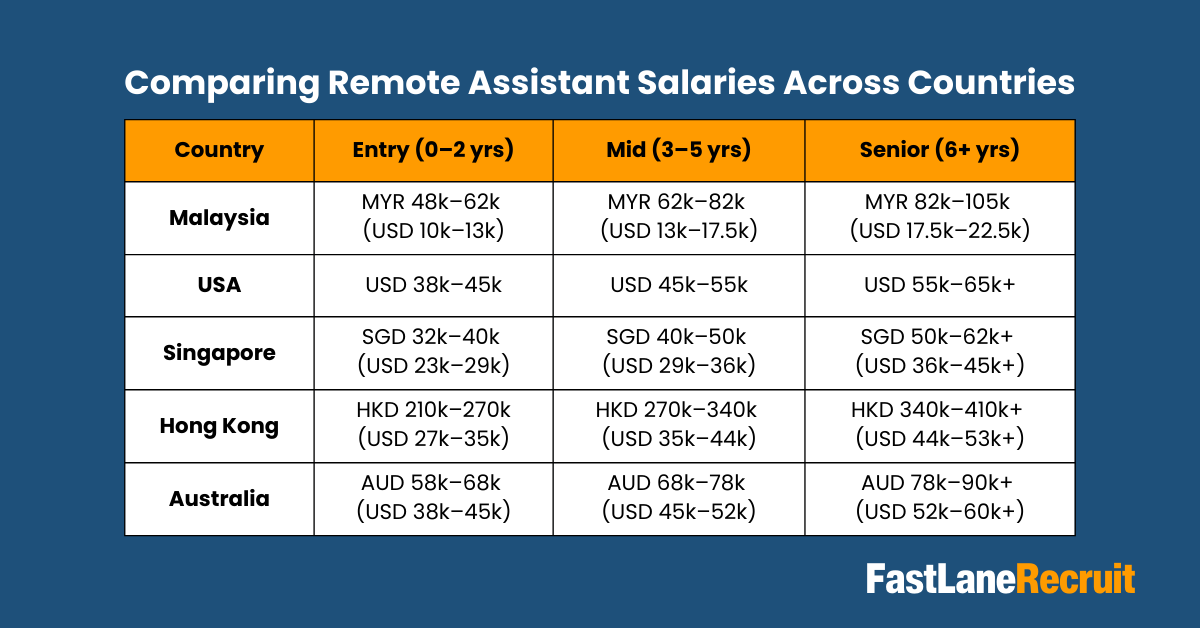
Key Insight:
Malaysia remains the most payroll‑efficient location for Remote Assistants while delivering consistent communication and operational support.
Also Read: Payroll and Statutory Compliance for Hiring Data Entry Clerks in Malaysia
Why These Salaries Differ
Remote Assistant salaries can vary significantly across countries, even if the job title and core responsibilities look similar. Several key factors influence these differences, from local economic conditions to job complexity, skills, and compliance requirements. Understanding these drivers helps companies set fair, competitive salaries while planning payroll budgets effectively.
1. Cost of Living & Local Expenses
One of the biggest reasons salaries differ is the local cost of living. This includes housing, food, transportation, healthcare, utilities, and general lifestyle expenses. Countries with higher living costs usually require higher salaries to ensure employees can maintain a reasonable standard of living.
Example:
A Remote Assistant earning USD 12,000 in Kuala Lumpur can enjoy a comfortable lifestyle with rent, groceries, and transport covered. In comparison, someone in Singapore would need around USD 35,000 to enjoy a similar standard of living because housing, transportation, and daily expenses are significantly higher.
Takeaway:
Even though the salary in Malaysia looks lower on paper, the purchasing power can be similar or even better than in higher-cost markets.
2. Industry Demand & Task Complexity
The type of industry and the complexity of tasks assigned to a Remote Assistant also affect pay. Roles in industries like technology, finance, human resources, and operations often involve higher responsibility, such as managing multiple executive schedules, coordinating international teams, tracking projects, preparing reports, or handling sensitive data. These tasks require more skills, accountability, and attention to detail.
Example:
A Remote Assistant managing executive calendars, client communication, and project coordination is more valuable than someone handling simple administrative tasks like sending reminders or basic scheduling. Higher responsibility and pressure lead to higher salaries.
Takeaway:
The more complex and critical the tasks, the higher the compensation required to attract qualified talent.
3. Digital Tools & Technical Skills
Remote Assistants today are expected to use a variety of digital tools efficiently. This includes project management software (Asana, Trello), collaboration tools (Slack, Notion), CRM platforms, and cloud-based document management systems. Employees who are proficient in these tools can work independently, reduce errors, and improve workflow efficiency, skills employers are willing to pay more for.
Example:
A Remote Assistant who can manage client data in a CRM, track projects across departments, and automate routine reporting saves time for the company and reduces the need for training. This expertise often translates to a higher salary.
Takeaway:
Technical skills and tool proficiency directly increase the market value of a Remote Assistant.
Also Read: Benefits of Outsourcing Data Entry Operations for Global Businesses
4. Remote Work & Global Hiring Trends
Remote work has changed the way companies hire. Businesses are no longer limited to their local labor market and can hire skilled talent in cost-efficient countries while maintaining high-quality output.
Example:
A European startup might hire a Remote Assistant based in Malaysia to support global teams across different time zones. The Malaysian hire provides the same level of professionalism and communication, but at a significantly lower payroll cost compared to hiring locally.
Takeaway:
Global hiring allows companies to optimize costs while accessing skilled Remote Assistants in countries like Malaysia.
5. Compliance & Work Standards
Countries with stricter labor laws, data protection regulations, and professional standards usually offer higher salaries. Employees handling sensitive information, like payroll data, HR records, or client information, must follow strict rules, which increases their responsibility and value.
Example:
A Remote Assistant managing employee payroll data or sensitive HR records in a regulated market may earn more because mistakes could lead to legal or financial penalties.
Takeaway:
Salaries reflect not just the work performed but also the responsibility, accountability, and compliance risk.
6. Retention & Career Growth
Experience and reliability matter. Companies are willing to pay more to retain Remote Assistants who have proven their ability to manage workflows efficiently, communicate clearly, and work independently. Replacing experienced remote staff can be expensive and disruptive.
Example:
A senior Remote Assistant with 7+ years’ experience supporting multiple departments and mastering company systems may receive salary increases, bonuses, or leadership responsibilities to retain their expertise.
Takeaway:
Long-term experience, institutional knowledge, and proven reliability justify higher pay and career growth opportunities.
Also Read: Why Malaysia Is a Top Choice for Offshore Data Entry Teams
Summary Insight:
Remote Assistant salaries are shaped by a mix of economic conditions, local living costs, task complexity, technical skills, global hiring trends, compliance requirements, and retention needs. Companies that understand these factors can set fair, competitive salaries while efficiently managing payroll budgets.
Why Outsource Remote Assistant Roles to Malaysia
Outsourcing Remote Assistant roles to Malaysia is about much more than cost savings. It’s a strategic decision that allows global companies to access skilled, reliable professionals while keeping payroll costs manageable and staying fully compliant with local regulations. Malaysia offers a combination of talent, infrastructure, and business-friendly policies that make it an attractive destination for offshore administrative and remote support roles.
1. Lower Operational Cost with Strong Output
Malaysia provides highly trained Remote Assistants at significantly lower payroll costs compared to Western countries, without compromising on quality. Malaysian professionals are known for their attention to detail, reliability, and adaptability with digital tools, making them capable of handling complex administrative tasks efficiently.
Example:
A company could hire two Malaysian Remote Assistants for the cost of one equivalent role in the U.S., effectively doubling productivity while maintaining accuracy and responsiveness.
Takeaway:
Outsourcing to Malaysia maximizes output while minimizing payroll expenses, giving businesses a strong return on investment.
2. Reduced Payroll & Compliance Risk
Hiring internationally introduces challenges related to employment laws, payroll processing, taxes, and statutory contributions. Malaysia has specific requirements, including EPF (retirement contributions), SOCSO (social security), EIS (unemployment insurance), and PCB (income tax).
FastLaneRecruit manages these entirely:
- Drafting legally compliant employment contracts under Malaysian law
- Processing monthly payroll and statutory contributions
- Monitoring ongoing compliance to avoid penalties or errors
Benefit:
Your internal HR or finance team can focus on operations, while FastLaneRecruit ensures all employment and payroll obligations are met accurately and on time.
3. Strategic Time Zone Alignment
Malaysia’s time zone (GMT+8) is ideal for supporting regional APAC operations and partially overlaps with European working hours. This allows companies to coordinate tasks, respond to queries, and manage workflows efficiently across multiple regions.
Example:
A European finance team sends tasks at the end of their workday, and the Malaysian Remote Assistant processes and returns updates the next morning, reducing turnaround time and keeping projects on schedule.
Takeaway:
Time zone alignment allows for near-continuous productivity and better collaboration between global teams.
Also Read: Benefits of Outsourcing Data Entry Operations for Global Businesses
4. EOR Simplifies Local Hiring
Setting up a legal entity in a new country can be expensive and time-consuming. FastLaneRecruit’s Employer of Record (EOR) service removes this barrier.
With EOR, FastLaneRecruit becomes the legal employer in Malaysia and handles:
- Employment contracts and onboarding
- Payroll, tax, and statutory contributions
- Compliance with local labor laws
Meanwhile, your company retains full operational control over workflows, daily tasks, and team management.
Takeaway:
You can hire Malaysian Remote Assistants quickly and compliantly without investing in a local legal entity or HR infrastructure.
5. English-Proficient Workforce
Malaysia has a strong English-speaking talent pool, making collaboration with global teams smooth and efficient. Remote Assistants are comfortable using international tools, systems, and documentation, which reduces miscommunication and rework.
Example:
Malaysian Remote Assistants can manage international customer queries, schedule meetings across time zones, handle documentation, and update global systems with minimal language barriers.
Takeaway:
A highly proficient English workforce ensures seamless communication and reduces training time for global companies.
6. Scalability for Growing Teams
Outsourcing to Malaysia allows companies to scale teams quickly according to business needs. Whether you start with one Remote Assistant or build a full offshore support team, Malaysia’s talent pool and FastLaneRecruit’s flexible hiring models make expansion simple and risk-free.
Example:
An e-commerce company starts with a single Malaysian Remote Assistant to handle customer support. As the business grows, the team expands to support operations, admin, and project coordination without disrupting workflow or compliance.
Takeaway:
Outsourcing provides flexibility, enabling companies to grow their support team rapidly during peak periods or business expansion without long-term hiring commitments.
Summary Insight:
Outsourcing Remote Assistant roles to Malaysia delivers a strategic combination of cost-efficiency, skilled talent, time zone advantages, compliance security, and scalability. With FastLaneRecruit’s EOR support, companies can hire quickly, stay compliant, and scale operations confidently, making Malaysia an ideal hub for global remote support.
How to Hire Remote Assistants in Malaysia
A clear hiring process and knowledge of local requirements help companies build dependable remote support teams.
1. Define Clear Responsibilities
Create a detailed job description that describes daily tasks, tools required, communication expectations, and performance standards. This attracts candidates who fit your needs and reduces onboarding time.
Example responsibilities:
- Email and schedule management
- Project coordination and task tracking
- Client communication support
- Research and documentation
- Routine reporting and follow-ups
Tip: Clear roles lead to better hiring outcomes and faster productivity.
2. Choose the Right Hiring Model
| Hiring Model | Best For | How FastLaneRecruit Helps |
| Direct Hire | Companies with a Malaysian entity | Payroll and compliance support |
| Contract Hire | Project or short‑term work | Compliant contracts and payments |
| Employer of Record (EOR) | No local entity | Full compliance, contracts, and payroll |
EOR is usually the fastest and safest option for global companies new to Malaysia.
3. Set Competitive Salaries
Offer market‑aligned salaries to attract capable Remote Assistants who can manage communication, tools, and workflows effectively. Consider experience, tech skills, and job complexity when setting pay.
Example: A mid‑level Remote Assistant with CRM and project tool experience may command higher salaries than someone handling basic admin tasks only.
4. Ensure Compliance from Day One
Malaysia has statutory requirements like EPF (retirement), SOCSO (social security), EIS (unemployment), and PCB (income tax). FastLaneRecruit manages these as part of payroll so your internal team stays focused on operations.
5. Support Onboarding & Growth
Effective onboarding helps new hires become productive quickly. Provide training in internal tools, workflow documentation, and performance goals. This boosts quality and reduces errors early on.
Also Read: Data Entry Clerk Salary Guide 2026
Conclusion
Remote Assistant salaries in 2026 vary widely by country. Malaysia stands out as a cost‑efficient destination offering skilled, English‑proficient remote professionals, while countries like the U.S., Singapore, and Australia command higher salaries due to living costs and labor standards.
Understanding these salary benchmarks helps companies plan payroll and hiring strategies more effectively.
Ready to Hire Remote Assistant Talent with Confidence?
FastLaneRecruit’s Employer of Record (EOR) service makes it easy to hire Malaysian Remote Assistants without setting up a local entity. We manage:
- Fully compliant employment contracts
- Payroll and statutory contributions
- Ongoing compliance management
- Fast onboarding and team scaling
You keep full operational control while we manage the administrative complexity.
Your remote support team in Malaysia is ready. Contact FastLaneRecruit today for a free consultation and start building your global remote assistant team with confidence.