Managing employees in Singapore requires more than processing salaries. Businesses must stay compliant with employment regulations, manage statutory contributions, maintain accurate employee records, and ensure payroll is processed correctly every month.
For growing companies, especially international businesses expanding across Southeast Asia, managing these responsibilities internally can become complex and resource-intensive. This is why many businesses compare PEO vs payroll solutions to determine the best way to manage their workforce.
Although both solutions help simplify employee administration, they serve different purposes. A Professional Employer Organization (PEO) provides broader HR outsourcing through a co-employment model, while payroll services focus on salary processing, statutory compliance, tax reporting, and payroll administration.
In Singapore, businesses must consider requirements such as CPF contributions, IRAS reporting obligations, and Employment Act compliance when managing payroll. Choosing the wrong solution may lead to unnecessary costs or operational challenges.
This guide explains the key differences between PEO vs payroll in Singapore, including their services, costs, benefits, and limitations. We will also explore when payroll outsourcing is a more practical option and how businesses expanding into Malaysia can benefit from working with a local payroll partner like FastLaneRecruit.
Content Outline
Key Summary
PEO And Payroll Services Solve Different Business Challenges
A PEO provides comprehensive HR outsourcing, including payroll, benefits administration, compliance support, and HR management through a co-employment model. Payroll services focus specifically on managing salary processing, statutory requirements, and payroll administration.
Payroll Outsourcing Can Be A More Practical Choice For SMEs
Many SMEs do not require full HR outsourcing. Payroll outsourcing provides a cost-effective way to manage employee payments, compliance requirements, and payroll operations without entering a co-employment arrangement.
Singapore Businesses Should Evaluate Their Expansion Goals
Companies should choose based on their operational needs. Businesses requiring complete HR support may consider a PEO, while those needing reliable payroll processing may benefit from payroll outsourcing.
Malaysia Is A Strategic Payroll Outsourcing Destination For Singapore Companies
Singapore businesses expanding into Malaysia can benefit from outsourcing payroll to a local provider. Malaysia offers competitive operating costs, skilled talent, and strong regional connectivity within ASEAN.
FastLaneRecruit Supports Malaysia Workforce Expansion
FastLaneRecruit provides payroll outsourcing and Employer of Record (EOR) services exclusively in Malaysia, helping Singapore and international companies hire, manage payroll, and remain compliant when expanding into the Malaysian market.
What is a PEO?
A Professional Employer Organization (PEO) is a third-party HR service provider that helps businesses manage employee-related responsibilities through a co-employment model. Under this arrangement, the PEO shares certain employer responsibilities with the company, allowing businesses to outsource complex HR functions while maintaining control over daily operations.
A PEO does not replace the business owner or manager. Instead, it acts as an HR partner that handles administrative tasks such as payroll processing, employee benefits, compliance support, and risk management. The company continues to manage employees’ day-to-day activities, including work assignments, performance management, and business decisions.
For Singapore companies expanding into new markets or managing a growing workforce, a PEO can provide access to HR expertise without requiring a large internal HR department.
How Does a PEO Work?
A PEO operates through a co-employment relationship between the business and the PEO provider.
Under this arrangement:
| Business Responsibilities | PEO Responsibilities |
| Manage daily employee operations | Process payroll and employee payments |
| Make hiring and termination decisions | Handle HR administration |
| Manage company culture and performance | Support employment compliance |
| Assign employee duties and responsibilities | Assist with employee benefits administration |
| Control business operations | Provide HR expertise and risk management support |
The PEO becomes the employer of record for specific administrative and compliance purposes, while the business remains responsible for managing its workforce.
For example, a company may hire employees in Malaysia but lack local HR knowledge. A PEO can help manage employment documentation, payroll compliance, statutory requirements, and employee administration while allowing the company to focus on business growth.
Also Read:
What Services Does A PEO Provide?
A PEO typically provides a broad range of HR outsourcing solutions, including:
Payroll Management
PEOs handle employee payroll processing, salary calculations, deductions, tax reporting, and compliance-related payroll tasks. This helps businesses reduce payroll errors and administrative workload.
Employee Benefits Administration
Many PEOs provide access to employee benefits programs, including health insurance, retirement plans, and other workplace benefits that may otherwise be difficult for smaller companies to manage.
HR Administration
A PEO supports various HR functions, such as:
- Employee onboarding and offboarding
- Maintaining employee records
- HR policy development
- Leave and attendance management
- Employment documentation
Employment Compliance Support
Employment regulations vary across countries and regions. A PEO helps businesses navigate local labour laws, statutory obligations, and employment requirements to reduce compliance risks.
Risk Management
PEOs may assist with workplace safety policies, employee relations, and compliance procedures to help businesses manage employment-related risks.
Benefits Of Using A PEO
A PEO can be beneficial for businesses that need comprehensive HR support without building a large internal HR team.
1. Access To Professional HR Expertise
Small and medium-sized businesses may not have dedicated HR specialists. A PEO provides access to experienced HR professionals who can support employee management, compliance, and workplace policies.
2. Simplified Expansion Into New Markets
For companies entering unfamiliar markets, understanding local employment regulations can be challenging. A PEO helps businesses hire and manage employees while reducing administrative barriers.
3. Improved Compliance Management
Employment laws, payroll regulations, and statutory requirements can change frequently. A PEO helps businesses stay updated and reduce the risk of compliance issues.
4. Better Employee Benefits Options
PEOs often work with multiple businesses, allowing smaller companies to access competitive employee benefits packages that may otherwise be difficult to obtain independently.
Potential Limitations Of A PEO
While a PEO provides extensive HR support, it may not be the ideal solution for every business.
Higher Costs Compared To Payroll Services
Because PEOs provide a wider range of HR services, they are generally more expensive than traditional payroll outsourcing solutions. Businesses paying only for payroll management may find a PEO unnecessary.
Less Flexibility Over Certain HR Processes
Some companies prefer complete control over HR policies, employee benefits, and administrative processes. A PEO arrangement requires collaboration with an external provider.
Co-Employment Structure May Not Suit Every Business
The co-employment model involves sharing certain employer responsibilities with the PEO. Businesses should understand the agreement structure before choosing this option.
When Should A Business Choose A PEO?
A PEO may be the right choice for businesses that:
- Need full HR support beyond payroll processing
- Lack internal HR expertise
- Want assistance managing employee benefits
- Are expanding into new countries or regions
- Need support with employment compliance and risk management
- Have a growing workforce requiring structured HR operations
However, businesses that mainly need help with salary processing, tax calculations, and statutory compliance may find payroll outsourcing to be a more practical and cost-effective solution.
Also Read: Guide to PEO vs EOR
What Is Payroll?
Payroll refers to the process of calculating and distributing employee salaries while managing all related financial and compliance responsibilities. This includes salary calculations, tax deductions, statutory contributions, payslip generation, and payroll reporting.
Unlike a Professional Employer Organization (PEO), payroll services do not involve a co-employment relationship. The business remains the sole employer and retains full control over hiring decisions, employee management, company policies, and workplace operations.
Many businesses outsource payroll because managing payroll internally can become complicated as they grow. Different countries have different employment regulations, tax requirements, and statutory obligations, making payroll accuracy and compliance a critical business responsibility.
For companies operating in Singapore, payroll management requires understanding requirements such as Central Provident Fund (CPF) contributions, IRAS tax reporting obligations, Skills Development Levy (SDL), and Employment Act requirements.
What Are Payroll Services?
Payroll services are outsourced solutions where a third-party payroll provider manages payroll administration on behalf of a business. The provider ensures employees are paid accurately and on time while helping companies maintain compliance with payroll-related obligations.
A payroll provider typically manages:
Salary Calculation And Payroll Processing
Payroll providers calculate employee salaries based on:
- Basic salary
- Allowances
- Overtime payments
- Bonuses and incentives
- Deductions
- Leave adjustments
- Attendance records
This reduces manual calculations and minimizes payroll errors.
Tax And Statutory Compliance
Payroll compliance is one of the biggest challenges for businesses, especially those operating in foreign markets. Payroll service providers help manage:
- Employee tax deductions
- Government reporting requirements
- Statutory contribution calculations
- Payroll documentation
- Compliance deadlines
By outsourcing these tasks, businesses can reduce administrative risks and avoid potential penalties caused by incorrect payroll processing.
Payslip Generation And Employee Records
Payroll providers maintain accurate payroll records and generate employee payslips, helping businesses provide employees with transparent salary information.
Services may include:
- Digital payslip management
- Payroll reports
- Employee payroll history
- Salary summaries
- Payroll documentation
Payroll Reporting And Data Management
Businesses require accurate payroll data for financial planning and workforce management. Payroll providers can provide reports covering:
- Payroll expenses
- Employee costs
- Tax obligations
- Salary trends
- Workforce changes
These insights help business leaders make better decisions about hiring, budgeting, and operational planning.
Also Read: Top 10 Best Outsourced Payroll Companies for Growing Business in 2026
How Does Payroll Outsourcing Work?
Payroll outsourcing allows businesses to transfer payroll administration responsibilities to an external payroll specialist while keeping complete ownership of their employees.
The typical process includes:
Step 1: Payroll Data Collection
The business provides employee information, including:
- Employee details
- Salary information
- Attendance records
- Leave records
- Allowances and deductions
Step 2: Payroll Calculation
The payroll provider calculates salaries, statutory deductions, taxes, and other payroll components based on local regulations.
Step 3: Compliance Review
The provider verifies payroll calculations to ensure they meet employment and tax requirements.
Step 4: Salary Processing And Reporting
After approval, salaries are processed, payslips are generated, and payroll reports are provided to the business.
Benefits Of Payroll Outsourcing
Payroll outsourcing has become increasingly popular among SMEs and international companies because it provides a balance between cost efficiency, compliance, and operational flexibility.
1. Reduce Administrative Workload
Payroll management requires significant time and attention. Outsourcing allows business owners and HR teams to focus on strategic activities instead of spending hours on repetitive payroll tasks.
2. Improve Payroll Accuracy
Payroll mistakes can affect employee trust and create compliance problems. Professional payroll providers use established processes and expertise to ensure accurate salary calculations and reporting.
3. Maintain Compliance With Local Regulations
Employment laws and payroll requirements vary by country. A local payroll partner helps businesses stay compliant with changing regulations and statutory obligations.
This is especially valuable for foreign companies hiring employees in Malaysia without an established local HR team.
4. Reduce Operational Costs
Building an internal payroll function requires investment in:
- Payroll software
- HR employees
- Training
- Compliance monitoring
- Administrative resources
For businesses operating in Singapore, payroll outsourcing can help reduce administrative pressure related to CPF calculations, tax reporting, employee leave management, and statutory compliance.
5. Scale Easily As Your Business Grows
As companies hire more employees, payroll complexity increases. Outsourced payroll services can scale with business needs, whether managing a small team or a growing workforce.
Payroll Services Vs Payroll Software: What Is The Difference?
Many businesses confuse payroll software with payroll outsourcing.
| Payroll Software | Payroll Outsourcing |
| Business manages payroll internally | External experts manage payroll processes |
| Requires HR knowledge and payroll expertise | Provider handles compliance requirements |
| Business is responsible for updates and errors | Provider manages payroll accuracy |
| Suitable for companies with HR resources | Suitable for businesses seeking operational support |
For example, platforms such as accounting or payroll software can automate calculations, but businesses still need internal knowledge to ensure compliance. A payroll outsourcing provider offers both technology and professional payroll expertise.
When Should A Business Choose Payroll Outsourcing?
Payroll outsourcing is suitable for businesses that:
- Need accurate payroll processing without hiring additional HR staff
- Want to reduce administrative workload
- Need support with Singapore payroll compliance or regional workforce expansion
- Want predictable payroll management costs
- Prefer to maintain full control over employees
For many SMEs, payroll outsourcing provides the essential HR support they need without the additional cost and complexity of a PEO arrangement.
PEO Vs Payroll: The Key Difference
The simplest way to understand the difference is:
A PEO manages broader HR responsibilities through a co-employment relationship, while payroll services focus specifically on managing salary processing, payroll compliance, and administrative tasks.
Choosing between the two depends on whether your business needs complete HR outsourcing or simply requires professional payroll support.
PEO Vs Payroll: Key Differences Comparison
When comparing PEO vs payroll, the biggest difference is the scope of support they provide. A PEO offers a broader HR outsourcing solution through a co-employment relationship, while payroll services focus specifically on managing payroll administration, salary processing, and compliance requirements.
Choosing the right option depends on your business size, HR requirements, expansion plans, and the level of support you need.
| Comparison Factor | PEO (Professional Employer Organization) | Payroll Services |
| Main Purpose | Provides comprehensive HR outsourcing and employer support | Manages payroll processing and payroll compliance |
| Employer Relationship | Uses a co-employment model where responsibilities are shared between the business and PEO | Business remains the sole employer |
| Payroll Management | Handles payroll as part of a wider HR solution | Focuses specifically on salary calculations, deductions, payslips, and payroll reporting |
| HR Support | Includes HR administration, employee relations, policies, and workforce support | Usually limited to payroll-related administration |
| Employee Benefits | May provide access to benefits programs and benefits administration | Typically does not manage employee benefit programs |
| Compliance Support | Supports broader employment compliance, HR regulations, and risk management | Focuses on payroll compliance, tax requirements, and statutory obligations |
| Hiring & Termination Support | May assist with HR processes but does not control business decisions | Usually does not provide recruitment or employee management support |
| Cost | Generally higher due to wider HR services and co-employment support | More affordable because services focus on payroll functions |
| Business Control | Business manages daily operations but shares certain employer responsibilities | Business maintains complete control over employees |
| Best For | Companies needing full HR support or entering unfamiliar markets | SMEs needing reliable payroll processing and compliance support |
PEO Vs Payroll: Which Is More Cost-Effective?
Cost is one of the most important factors when businesses compare PEO vs payroll services.
A PEO typically charges higher fees because it provides a wider range of services, including HR management, employee benefits support, compliance assistance, and risk management. For businesses without an internal HR team, this additional support can provide significant value.
However, not every company requires full HR outsourcing.
Many SMEs primarily need help with:
- Monthly payroll processing
- Employee salary calculations
- Tax deductions
- Statutory contributions
- Payroll reporting
- Compliance management
For these businesses, payroll outsourcing is often a more cost-effective solution because they only pay for the services they actually need.
Example:
A growing company with 20 employees in Malaysia may not require a full PEO arrangement. Instead, outsourcing payroll allows the company to maintain control over employees while receiving professional support with salary processing and local compliance requirements.
PEO Vs Payroll: Which One Is Better For Small Businesses?
There is no universal answer when choosing between a PEO and payroll services. The right option depends on your operational needs.
Choose A PEO If Your Business Needs:
Comprehensive HR Support
A PEO is suitable if you need assistance beyond payroll, including:
- HR policies
- Employee benefits management
- Workplace compliance
- Employee relations support
- Risk management
Support Entering A New Market
Companies expanding internationally may choose a PEO to simplify hiring and employment administration in unfamiliar locations.
A Complete HR Solution Without Building An Internal Team
A PEO can be valuable for companies that want access to HR specialists without hiring a large HR department.
Choose Payroll Outsourcing If Your Business Needs:
Reliable Payroll Processing
If your main challenge is managing salaries, deductions, and payroll reporting, payroll outsourcing provides focused support.
Local Compliance Expertise
Businesses operating in Malaysia can benefit from a payroll partner that understands local employment requirements and statutory obligations.
Lower Operational Costs
Payroll outsourcing provides professional payroll management without the additional cost of comprehensive HR outsourcing.
More Control Over Employees
Unlike a PEO, payroll outsourcing allows businesses to remain the direct employer while outsourcing administrative tasks.
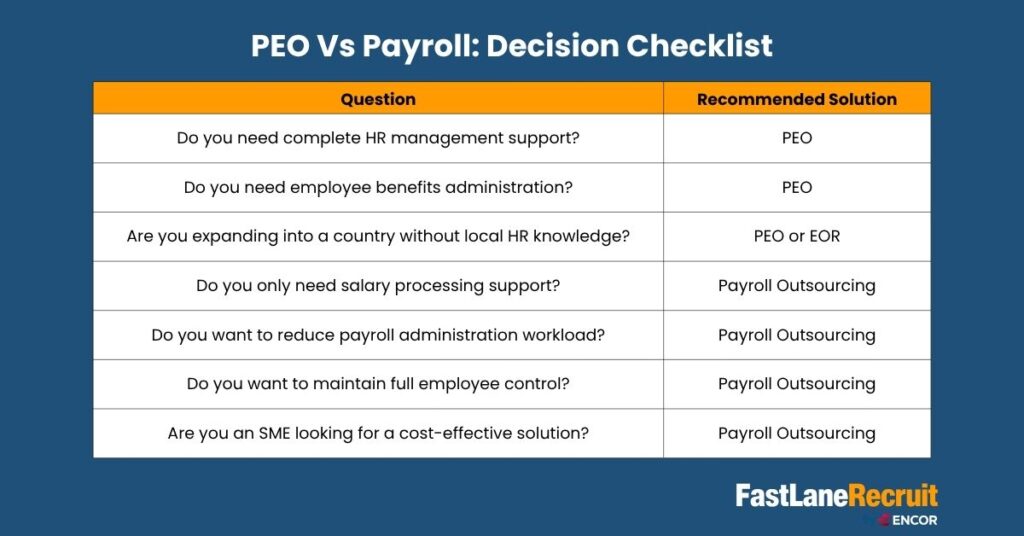
PEO Vs Payroll: Decision Checklist
Use the checklist below to identify which solution matches your business needs:
| Question | Recommended Solution |
|---|---|
| Do you need complete HR management support? | PEO |
| Do you need employee benefits administration? | PEO |
| Are you expanding into a country without local HR knowledge? | PEO or EOR |
| Do you only need salary processing support? | Payroll Outsourcing |
| Do you want to reduce payroll administration workload? | Payroll Outsourcing |
| Do you want to maintain full employee control? | Payroll Outsourcing |
| Are you an SME looking for a cost-effective solution? | Payroll Outsourcing |
PEO Vs Payroll Vs Employer Of Record (EOR): Understanding The Difference
Businesses expanding internationally often compare PEO vs payroll vs Employer of Record (EOR) because all three solutions support workforce management.
| Solution | Best For | Employer Relationship | Main Function |
| PEO | Companies needing HR outsourcing | Co-employment model | HR support, benefits, compliance, payroll |
| Payroll Outsourcing | Companies managing their own employees | Business remains employer | Payroll processing and compliance |
| EOR | Companies hiring employees without a local entity | Provider becomes legal employer | Hiring, payroll, compliance, and employment management |
For companies entering Malaysia without an established local entity, an Employer of Record service can be an effective solution because it enables businesses to hire employees legally while managing employment compliance through a local partner.
Why Many Businesses Choose Payroll Outsourcing Instead Of A PEO
For many SMEs, payroll is the biggest administrative challenge — not HR management.
A dedicated payroll outsourcing provider allows businesses to:
- Reduce manual payroll work
- Improve payroll accuracy
- Maintain compliance with Malaysian regulations
- Save internal HR resources
- Avoid investing in expensive payroll systems
- Focus on business growth
This makes payroll outsourcing a practical solution for companies that want professional payroll support without paying for unnecessary HR services.
Why Singapore Businesses Choose Malaysia For Payroll Outsourcing
Singapore is one of Asia’s leading business hubs, but many companies expanding regionally look to Malaysia for cost-effective workforce solutions. Due to geographic proximity, strong infrastructure, and a skilled workforce, Malaysia has become a preferred destination for Singapore businesses looking to optimize operational costs while maintaining quality.
As businesses expand across Southeast Asia, Malaysia has become an attractive destination for companies seeking reliable and cost-efficient workforce solutions. With a strong business ecosystem, skilled talent pool, competitive operating costs, and established employment regulations, Malaysia provides an ideal environment for companies looking to outsource payroll management.
For international companies, managing payroll in Malaysia can be challenging without local expertise. Businesses must understand employment regulations, statutory contributions, tax obligations, and reporting requirements to ensure accurate and compliant payroll processing.
Partnering with a professional payroll outsourcing provider in Malaysia allows companies to access local expertise while reducing administrative complexity.
1. Access To Local Payroll And Compliance Expertise
Payroll regulations vary significantly between countries. Companies entering Malaysia need to understand local employment requirements, including:
- Employee income tax deductions
- Employees Provident Fund (EPF) contributions
- Social Security Organization (SOCSO) requirements
- Employment Insurance System (EIS) contributions
- Payroll reporting obligations
A local payroll partner helps businesses manage these requirements accurately and avoid compliance risks.
For foreign companies without an established HR team in Malaysia, outsourcing payroll ensures employees are paid correctly while meeting local regulatory obligations.
2. Cost-Effective Alternative To Building An Internal Payroll Team
Managing payroll internally requires investment in:
- Payroll specialists
- HR administration resources
- Payroll software
- Compliance training
- Regular regulatory updates
For SMEs and growing businesses, these costs can become a significant operational burden.
Payroll outsourcing provides access to experienced payroll professionals without the expense of expanding an internal team. Businesses can receive professional payroll management while maintaining better control over operating costs.
3. Malaysia Offers A Strong Business Environment In Southeast Asia
Malaysia is widely recognized as a strategic location for regional business operations due to its:
- Growing economy
- Skilled multilingual workforce
- Competitive business costs
- Infrastructure and digital capabilities
- Strategic location within ASEAN
Companies choosing Malaysia as an operational hub can benefit from outsourcing partners who understand local business practices and employment requirements.
4. Simplify Expansion Into The Malaysian Market
Expanding into a new country involves more than hiring employees. Businesses must also manage:
- Employment contracts
- Payroll setup
- Statutory registrations
- Employee documentation
- Tax compliance
- Ongoing payroll administration
Payroll outsourcing helps companies establish compliant payroll processes faster, allowing them to focus on recruitment, operations, and business growth.
Payroll Outsourcing Vs Managing Payroll Internally In Malaysia
| Factor | In-House Payroll Management | Payroll Outsourcing In Malaysia |
| Payroll Expertise | Requires internal payroll knowledge | Access to experienced payroll specialists |
| Compliance Updates | Business monitors regulatory changes | Provider manages compliance requirements |
| Operating Costs | Higher costs for staff and systems | Lower and predictable service costs |
| Accuracy | Higher risk of manual errors | Professional payroll processes |
| Scalability | Requires additional resources as employees grow | Easily scales with workforce growth |
| Time Investment | HR teams spend time on administration | Businesses focus on strategic activities |
Why Choose FastLaneRecruit For Payroll Outsourcing In Malaysia?
For Singapore businesses expanding into Malaysia, managing payroll locally can create administrative challenges. FastLaneRecruit provides Malaysia-focused payroll outsourcing and Employer of Record services to help companies manage employment compliance without building a local HR infrastructure.
Managing payroll accurately requires more than software, it requires local knowledge, compliance expertise, and reliable processes.
FastLaneRecruit specializes in helping businesses simplify employment operations in Malaysia through professional workforce solutions. As a Malaysia-focused provider, FastLaneRecruit helps companies manage payroll requirements while reducing administrative challenges.
With payroll outsourcing support, businesses can benefit from:
Accurate Payroll Processing
FastLaneRecruit helps businesses manage payroll services, employee salary processing, deductions, and reporting to ensure employees are paid accurately and on time.
Local Compliance Support
Understanding Malaysian payroll regulations can be complex, especially for international companies. FastLaneRecruit provides local expertise to help businesses manage statutory requirements and payroll obligations.
Reduced HR Administration
Outsourcing payroll allows companies to reduce repetitive administrative work and allow internal teams to focus on higher-value business activities.
Flexible Support For Growing Businesses
Whether you are expanding your Malaysian workforce or establishing operations in the country, FastLaneRecruit provides scalable workforce solutions designed around your business needs.
Build Your Malaysia Team and Expand Globally With FastLaneRecruit
Payroll management is only one part of building a successful workforce. Businesses expanding into Malaysia also need the right talent, compliant employment solutions, and reliable HR support to manage teams effectively.
FastLaneRecruit helps companies simplify workforce expansion through Malaysia-focused payroll outsourcing and Employer of Record (EOR) services. Beyond managing payroll requirements, we support businesses with hiring, employment compliance, onboarding, and ongoing HR administration to help them build strong and scalable teams.
As businesses grow beyond Malaysia, FastLaneRecruit also provides EOR solutions across key markets in Asia including
Malaysia, Hong Kong, Singapore, China, Taiwan, and the United Arab Emirates (UAE). Our local expertise enables companies to hire employees without establishing a local legal entity while ensuring compliance with employment regulations, payroll requirements, tax obligations, and statutory responsibilities.
From managing employment contracts and employee onboarding to payroll administration and workforce compliance, FastLaneRecruit provides end-to-end support that reduces the complexity of international hiring. Whether you are expanding into Malaysia or building a regional workforce, our team helps you access talent, streamline operations, and grow with confidence.
Ready to build your team in Malaysia or expand across Asia and the UAE? Contact FastLaneRecruit today to discover how our payroll outsourcing and Employer of Record solutions can support your global growth.
Conclusion: Choosing Between PEO Vs Payroll
Choosing between PEO vs payroll services depends on what your business actually needs.
A PEO is suitable for companies looking for comprehensive HR outsourcing, employee benefits support, and workforce management solutions. However, businesses that mainly need payroll processing, compliance support, and administrative efficiency may benefit more from payroll outsourcing.
For companies operating or expanding in Malaysia, partnering with a local payroll specialist can simplify payroll management while ensuring compliance with local requirements.
FastLaneRecruit helps businesses streamline workforce operations in Malaysia through professional payroll outsourcing and Employer of Record services. Whether you need support managing payroll or want to hire employees in Malaysia without establishing a local entity, our team provides reliable solutions designed for business growth.
Frequently Asked Questions About PEO Vs Payroll
How Does Payroll Outsourcing Work In Singapore?
Payroll outsourcing allows businesses to transfer payroll administration to an external provider. The provider manages tasks such as salary calculations, CPF contributions, tax reporting, payslips, and payroll compliance while the company remains responsible for employee management.
What Are The Benefits Of Outsourcing Payroll For Singapore SMEs?
Payroll outsourcing helps Singapore SMEs reduce administrative workload, improve payroll accuracy, maintain compliance with local regulations, and save costs compared to managing payroll in-house.
Does Payroll Outsourcing Handle CPF Contributions In Singapore?
Yes. A payroll outsourcing provider can help manage CPF calculations, contribution submissions, payroll records, and other statutory requirements to ensure compliance with Singapore regulations.
Can Singapore Companies Outsource Payroll When Expanding To Malaysia?
Yes. Singapore companies expanding into Malaysia can outsource payroll to a local provider to manage Malaysian payroll requirements, statutory obligations, and employment compliance without building an internal HR team.
What Is The Difference Between A PEO And Payroll Services?
A PEO (Professional Employer Organization) provides broader HR outsourcing through a co-employment model, including payroll, employee benefits, HR administration, and compliance support. Payroll services focus mainly on salary processing, tax deductions, statutory contributions, payslips, and payroll reporting while the business remains the direct employer.
What Is The Downside Of A PEO?
A PEO can provide valuable HR support, but it may not be suitable for every business. The main disadvantages are higher costs, a shared employer relationship, and less flexibility for companies that only need payroll management. For many SMEs, payroll outsourcing can be a simpler and more cost-effective solution.
How Does A PEO Work For Payroll?
A PEO manages payroll as part of a wider HR outsourcing service. It typically handles salary processing, payroll taxes, employee records, benefits administration, and compliance support while the business continues managing daily employee operations.
Is QuickBooks Payroll A PEO?
No. QuickBooks Payroll is not a PEO. It is payroll software designed to automate payroll tasks such as salary calculations and tax payments. A PEO provides additional HR services, including employee benefits, compliance support, and HR administration.
Is ADP Payroll A PEO?
No. Standard ADP Payroll is not a PEO. ADP provides both payroll solutions and PEO services, but payroll focuses on payment processing and tax management, while PEO services provide broader HR outsourcing support.
Is Payroll Outsourcing Cheaper Than A PEO?
Generally, payroll outsourcing is more affordable because it focuses specifically on payroll management instead of providing full HR outsourcing. Businesses that only need payroll processing and compliance support often find outsourcing a more cost-effective option.
Can A Payroll Provider Handle Employee Tax And Compliance Requirements?
Yes. A payroll provider can help businesses manage salary calculations, tax deductions, statutory contributions, payroll reporting, and compliance requirements. Working with a local payroll partner in Malaysia helps ensure processes follow local employment regulations.
Can A PEO Replace An Internal HR Department?
A PEO can reduce HR workload but does not fully replace internal management. It supports areas such as payroll, HR administration, benefits, and compliance, while businesses continue managing employees, operations, and company decisions.
What Is The Difference Between A PEO And An Employer Of Record (EOR)?
A PEO uses a co-employment model where employer responsibilities are shared, while an Employer of Record (EOR) becomes the legal employer of workers on behalf of a company. EOR services are commonly used by international businesses hiring employees in Malaysia without setting up a local entity.
Should Small Businesses Choose A PEO Or Payroll Outsourcing?
Small businesses should choose based on their needs. Companies requiring complete HR support may benefit from a PEO, while businesses that mainly need accurate payroll processing, compliance support, and administrative assistance may find payroll outsourcing more suitable.
Why Should Businesses Outsource Payroll In Malaysia?
Payroll outsourcing in Malaysia helps businesses reduce administrative workload, improve payroll accuracy, and manage local compliance requirements. A local payroll partner provides expertise in Malaysian employment regulations without requiring businesses to build an internal payroll team.