Managing accounting operations has become increasingly complex as businesses expand across borders, navigate evolving tax regulations, and strive to control operating costs. At the same time, many companies face a growing shortage of qualified accounting professionals, making it more difficult to build and retain an in-house finance team.
This is why many organizations choose to outsource accounting to Philippines. With a large pool of English-speaking accountants, internationally recognized qualifications, and competitive labor costs, the Philippines has become one of the world’s leading destinations for accounting outsourcing. From bookkeeping and payroll administration to financial reporting and tax preparation, businesses can access skilled professionals without the overhead of traditional hiring.
However, cost savings alone should never drive your outsourcing strategy. Poor communication, inconsistent quality, weak data security, and compliance risks can outweigh the financial benefits if you partner with the wrong provider or lack a structured outsourcing process.
The key to successful accounting outsourcing lies in balancing affordability with expertise, operational control, and regulatory compliance. Whether you’re a startup, an SME, or a multinational company, choosing the right outsourcing model can help improve financial accuracy, increase efficiency, and support long-term business growth.
In this guide, you’ll learn:
- What it means to outsource accounting to the Philippines
- Why businesses choose the Philippines for accounting outsourcing
- Which accounting functions can be outsourced
- The biggest quality and compliance risks to avoid
- How to choose the right outsourcing partner
- When Malaysia may be a better strategic hiring destination for long-term business expansion
By the end of this article, you’ll have a clear framework for evaluating your options and making an informed outsourcing decision that aligns with your business goals.
Content Outline
Key Summary
Outsourcing Accounting Goes Beyond Cost Savings
Successful accounting outsourcing improves operational efficiency, provides access to experienced finance professionals, and allows your internal team to focus on strategic business growth.
Quality and Compliance Should Always Come First
Protecting sensitive financial data, maintaining accurate reporting, and complying with local and international regulations are essential when outsourcing accounting functions.
Choose an Outsourcing Model That Matches Your Business
Businesses can outsource bookkeeping, payroll, accounts payable, tax support, financial reporting, and other accounting functions depending on their operational needs and growth plans.
The Right Partner Makes a Significant Difference
An experienced recruitment or outsourcing partner helps businesses hire qualified accounting professionals, streamline onboarding, and reduce recruitment risks while ensuring a better cultural and operational fit.
Malaysia May Be a Better Long-Term Solution for Regional Expansion
While the Philippines remains a popular outsourcing destination, businesses planning to establish dedicated teams in Southeast Asia may benefit from Malaysia’s strategic location, multilingual workforce, and business-friendly ecosystem.
What Does It Mean to Outsource Accounting to the Philippines?
Outsourcing accounting to the Philippines means partnering with an external provider or hiring dedicated accounting professionals based in the Philippines to manage part or all of your finance and accounting operations. Instead of building a fully in-house accounting department, businesses can leverage experienced offshore talent to perform routine and specialized accounting tasks while maintaining oversight of financial performance.
This approach has become increasingly popular among startups, SMEs, and multinational companies looking to reduce operational costs, address accounting talent shortages, and scale their finance functions more efficiently. With a large pool of qualified accountants, strong English proficiency, and familiarity with international accounting standards, the Philippines has established itself as one of the leading destinations for accounting outsourcing.
However, successful outsourcing is about more than reducing expenses. Businesses need to ensure their offshore accounting team can consistently deliver accurate financial reporting, protect confidential data, and comply with relevant accounting and tax regulations. Choosing the right outsourcing model and partner is essential to achieving these goals.
Why Do Businesses Outsource Accounting to the Philippines?
Many organizations outsource accounting to the Philippines to access skilled professionals without the costs associated with recruiting, training, and retaining an in-house finance team. As businesses grow, accounting workloads become more complex, making outsourcing an effective way to increase capacity while maintaining operational efficiency.
Common business drivers include:
- Reducing payroll and recruitment costs
- Accessing experienced accounting professionals
- Scaling accounting operations more quickly
- Improving productivity through dedicated offshore teams
- Allowing internal finance leaders to focus on strategic initiatives
- Supporting business growth without significant overhead
For companies experiencing rapid expansion, outsourcing can provide the flexibility to adjust team size as business needs change, without the long-term commitments of traditional hiring.
What Accounting Functions Can Be Outsourced?
Modern accounting outsourcing extends well beyond bookkeeping. Depending on your business requirements, an offshore accounting team can support a wide range of financial functions.
| Accounting Function | Typical Responsibilities |
| Bookkeeping | Recording daily financial transactions, maintaining general ledgers, reconciling accounts |
| Accounts Payable | Processing supplier invoices, managing payment schedules, expense verification |
| Accounts Receivable | Invoice generation, payment tracking, collections, customer account reconciliation |
| Payroll Processing | Employee payroll calculations, statutory deductions, payroll reporting |
| Bank Reconciliation | Matching bank statements with accounting records and resolving discrepancies |
| Financial Reporting | Preparing monthly, quarterly, and annual financial statements |
| Tax Preparation Support | Organizing financial records, assisting with tax filings, maintaining documentation |
| Budgeting & Forecasting | Supporting financial planning, cash flow forecasting, variance analysis |
| Management Reporting | Creating dashboards and reports to support business decision-making |
By outsourcing selected functions or entire accounting processes, businesses can build a finance operation that aligns with their current needs while remaining flexible enough to support future growth.
Outsourcing vs. Offshoring vs. Staff Augmentation
These terms are often used interchangeably, but they represent different approaches to building an accounting team.
| Model | How It Works | Best For |
| Accounting Outsourcing | A third-party provider manages accounting processes and delivers agreed outcomes. | Businesses seeking a fully managed accounting solution. |
| Offshore Accounting Team | Dedicated accounting professionals work exclusively for your business while remaining employed in another country. | Companies wanting greater operational control and long-term team integration. |
| Staff Augmentation | Additional accounting professionals are added to your existing finance team to fill skill or capacity gaps. | Businesses with seasonal workloads or rapid growth. |
Understanding these models helps businesses choose the right solution based on their operational goals, desired level of control, and internal resources.
Is Outsourcing Accounting Right for Every Business?
Outsourcing accounting is not a one-size-fits-all solution. It works best when businesses have clearly defined accounting processes, reliable communication channels, and robust systems for data security and compliance.
You may benefit from outsourcing if your business:
- Is spending excessive time on routine accounting tasks
- Struggles to recruit or retain qualified accounting professionals
- Experiences seasonal fluctuations in accounting workload
- Needs specialized expertise without hiring full-time employees
- Wants to scale operations while controlling overhead costs
- Requires access to accounting talent across different time zones
On the other hand, businesses handling highly sensitive financial information or operating in heavily regulated industries should carefully evaluate outsourcing partners, security measures, and compliance frameworks before transferring critical accounting responsibilities.
By understanding what accounting outsourcing involves and selecting the right operating model, businesses can improve efficiency while maintaining the financial accuracy and compliance needed for sustainable growth.
Why Businesses Choose to Outsource Accounting to the Philippines
The Philippines has become one of the world’s most preferred destinations for accounting outsourcing because it combines a large pool of skilled finance professionals, strong English communication capabilities, competitive operating costs, and experience supporting international businesses.
For companies looking to outsource accounting to the Philippines, the decision is not only about reducing expenses. The biggest advantage comes from gaining access to qualified accounting talent that can support daily financial operations while maintaining accuracy, efficiency, and compliance.
However, businesses should evaluate outsourcing partners carefully. The success of an offshore accounting team depends on factors such as professional expertise, communication processes, data protection standards, and the ability to integrate with your existing workflows.
1. Access To A Large Pool Of Skilled Accounting Professionals
One of the biggest reasons companies choose accounting outsourcing in the Philippines is access to a strong talent pool. The country produces thousands of accounting and finance graduates every year, including professionals with experience in international business environments.
Many Filipino accountants have experience supporting companies from markets such as:
- United States
- United Kingdom
- Australia
- Singapore
- Canada
- Hong Kong
This international exposure allows many offshore accounting professionals to become familiar with global accounting practices, financial reporting requirements, and commonly used accounting software.
Businesses can hire professionals with expertise in areas such as:
- General accounting
- Bookkeeping
- Accounts payable and receivable
- Payroll processing
- Financial analysis
- Tax support
- Audit preparation
- Management reporting
Instead of spending months searching for local accounting talent, companies can quickly access experienced professionals who can support their finance operations.
2. Cost Efficiency Without Compromising Accounting Quality
Cost reduction remains one of the main motivations behind outsourcing accounting functions. Hiring an in-house accounting team involves more than salary expenses. Businesses also need to consider:
- Recruitment costs
- Employee benefits
- Office space
- Equipment and software
- Training expenses
- Administrative costs
By outsourcing accounting to the Philippines, companies can reduce operational expenses while still accessing qualified professionals.
However, successful businesses do not view outsourcing as simply a cheaper alternative. The objective is to achieve better value through access to specialized talent and improved operational efficiency.
A well-managed offshore accounting team can help businesses:
- Reduce administrative workload
- Improve financial reporting speed
- Minimize accounting errors
- Increase productivity
- Allow internal teams to focus on strategic decisions
The focus should always be on finding the right balance between affordability, expertise, and reliability.
3. Strong English Communication And Cultural Compatibility
Communication is one of the biggest concerns when companies build offshore teams. Accounting involves sensitive financial information, detailed reporting, and frequent collaboration, making clear communication essential.
The Philippines is recognized as one of Asia’s leading English-speaking countries. Many Filipino accounting professionals are comfortable communicating in English and collaborating with international teams.
This provides advantages such as:
- Easier daily communication
- Better understanding of business requirements
- Smoother reporting processes
- Reduced misunderstanding between teams
- Improved collaboration with overseas managers
Cultural familiarity with Western business practices is another reason many global companies choose the Philippines for outsourcing.
4. Experience With International Accounting Software And Technology
Modern accounting requires more than traditional bookkeeping skills. Businesses increasingly rely on cloud-based platforms, automation tools, and integrated financial systems to improve efficiency.
Many outsourced accounting professionals in the Philippines have experience using widely adopted accounting technologies, including:
- Xero
- QuickBooks Online
- NetSuite
- SAP
- Oracle NetSuite
Technology-enabled accounting outsourcing allows businesses to improve:
- Real-time financial visibility
- Reporting accuracy
- Workflow automation
- Data accessibility
- Collaboration between local and offshore teams
When evaluating outsourcing partners, companies should look beyond accounting qualifications and assess whether candidates have experience with the systems their business already uses.
5. Flexible Scaling For Growing Businesses
Business needs change over time. During periods of growth, companies may need additional accounting support for:
- New market expansion
- Increased transaction volumes
- Financial reporting requirements
- Month-end closing
- Tax preparation periods
- Business restructuring
Hiring locally for every temporary need can be expensive and time-consuming.
An offshore accounting team provides flexibility by allowing businesses to:
- Add accounting specialists when needed
- Increase support during peak periods
- Expand finance operations gradually
- Build dedicated teams over time
This flexibility is especially valuable for startups and SMEs that need professional financial support but may not be ready to establish a large internal finance department.
6. Philippines Accounting Outsourcing Supports Multiple Business Models
Accounting outsourcing in the Philippines can support different types of organizations, including:
| Business Type | How Accounting Outsourcing Helps |
| Startups | Provides accounting expertise without building a full finance department |
| SMEs | Reduces operational costs while improving financial management |
| E-commerce Businesses | Supports transaction tracking, reconciliation, and reporting |
| Professional Service Firms | Handles billing, payroll, and financial administration |
| International Companies | Provides offshore accounting support across different markets |
Whether a company needs a single offshore accountant or an entire finance support team, the Philippines offers flexible solutions that can adapt to different business requirements.
7. The Importance Of Choosing The Right Outsourcing Partner
While the Philippines offers significant advantages, the quality of your outsourcing experience depends heavily on the partner you choose.
A reliable outsourcing or recruitment partner should help businesses:
- Identify qualified accounting professionals
- Verify technical skills and experience
- Ensure cultural and communication fit
- Support onboarding processes
- Maintain compliance standards
- Build long-term offshore teams
The right partner transforms outsourcing from a cost-saving decision into a strategic advantage.
For businesses exploring offshore talent solutions, working with an experienced recruitment partner can provide greater confidence when building accounting teams across Southeast Asia.
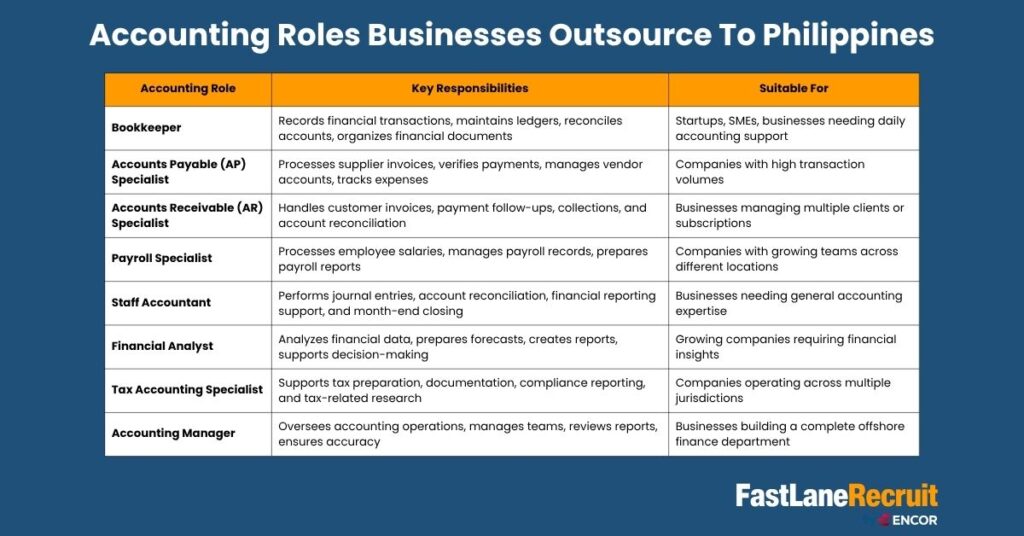
What Accounting Roles Can You Hire When You Outsource To The Philippines?
When businesses decide to outsource accounting to the Philippines, they are not limited to basic bookkeeping support. Companies can build a complete offshore finance team by hiring professionals across different accounting functions, depending on their operational requirements, industry, and growth stage.
From handling daily financial transactions to supporting strategic financial analysis, Filipino accounting professionals can take on various responsibilities while working alongside internal finance teams.
The right hiring approach depends on your business goals. Some companies outsource specific tasks such as invoice processing or reconciliation, while others build dedicated offshore accounting teams that operate as an extension of their internal department.
Common Accounting Roles Businesses Outsource To Philippines
| Accounting Role | Key Responsibilities | Suitable For |
|---|---|---|
| Bookkeeper | Records financial transactions, maintains ledgers, reconciles accounts, organizes financial documents | Startups, SMEs, businesses needing daily accounting support |
| Accounts Payable (AP) Specialist | Processes supplier invoices, verifies payments, manages vendor accounts, tracks expenses | Companies with high transaction volumes |
| Accounts Receivable (AR) Specialist | Handles customer invoices, payment follow-ups, collections, and account reconciliation | Businesses managing multiple clients or subscriptions |
| Payroll Specialist | Processes employee salaries, manages payroll records, prepares payroll reports | Companies with growing teams across different locations |
| Staff Accountant | Performs journal entries, account reconciliation, financial reporting support, and month-end closing | Businesses needing general accounting expertise |
| Financial Analyst | Analyzes financial data, prepares forecasts, creates reports, supports decision-making | Growing companies requiring financial insights |
| Tax Accounting Specialist | Supports tax preparation, documentation, compliance reporting, and tax-related research | Companies operating across multiple jurisdictions |
| Accounting Manager | Oversees accounting operations, manages teams, reviews reports, ensures accuracy | Businesses building a complete offshore finance department |
1. Offshore Bookkeepers
Bookkeeping is one of the most commonly outsourced accounting functions because it involves recurring financial tasks that require accuracy and consistency.
An offshore bookkeeper in the Philippines can support:
- Recording income and expenses
- Updating accounting systems
- Bank reconciliation
- Managing general ledger entries
- Organizing financial documents
- Preparing bookkeeping reports
Outsourcing bookkeeping allows business owners and finance managers to spend less time on administrative tasks and more time focusing on growth strategies.
For companies using cloud accounting platforms, offshore bookkeepers can work remotely while maintaining access to real-time financial information.
2. Accounts Payable And Accounts Receivable Specialists
Managing cash flow is essential for every business. Accounts payable and accounts receivable specialists help companies maintain accurate records and improve financial control.
Accounts Payable Responsibilities:
- Reviewing supplier invoices
- Processing payments
- Managing vendor records
- Tracking outstanding expenses
- Supporting expense management
Accounts Receivable Responsibilities:
- Preparing customer invoices
- Monitoring incoming payments
- Following up on overdue accounts
- Reconciling customer balances
- Supporting cash flow reporting
These roles are particularly valuable for businesses experiencing rapid growth or managing high transaction volumes.
3. Offshore Payroll Specialists
Payroll management requires accuracy, confidentiality, and strong knowledge of employment regulations.
Businesses outsourcing payroll support may hire professionals who assist with:
- Payroll calculations
- Employee payment records
- Payroll reporting
- Benefits administration support
- Payroll documentation
For international companies, payroll specialists can help coordinate processes between headquarters and offshore teams while ensuring accurate record management.
4. Staff Accountants
A staff accountant provides broader accounting support compared with specialized roles. They can manage multiple financial activities and work closely with internal finance teams.
Typical responsibilities include:
- Preparing journal entries
- Performing account reconciliations
- Supporting month-end closing
- Maintaining financial records
- Preparing financial statements
- Assisting with audits
For SMEs looking to build an offshore accounting department, hiring a staff accountant is often a practical first step.
5. Financial Analysts
As businesses grow, accounting teams need to provide more than historical reporting. Companies increasingly require financial insights that support strategic decision-making.
Offshore financial analysts can help with:
- Budget preparation
- Financial forecasting
- Performance analysis
- Revenue tracking
- Cost analysis
- Management reporting
Hiring offshore financial analysts allows businesses to access analytical expertise without significantly increasing local operating costs.
6. Accounting Managers And Finance Leaders
For companies with larger accounting requirements, outsourcing can extend beyond junior accounting roles.
Experienced offshore accounting managers can support:
- Managing accounting teams
- Reviewing financial reports
- Improving accounting processes
- Coordinating month-end closing
- Ensuring reporting accuracy
- Communicating with leadership teams
This approach allows businesses to build a complete offshore finance function rather than outsourcing individual tasks.
How To Choose The Right Accounting Role To Outsource?
Before hiring offshore accounting professionals, businesses should evaluate their current challenges and objectives.
Consider these questions:
Are You Looking To Reduce Administrative Work?
Start with:
- Bookkeepers
- AP specialists
- AR specialists
These roles help remove repetitive accounting workloads.
Do You Need Better Financial Visibility?
Consider hiring:
- Staff accountants
- Financial analysts
- Accounting managers
These professionals provide deeper financial insights and reporting support.
Are You Expanding Internationally?
Consider building a broader offshore finance team with:
- Accounting specialists
- Payroll professionals
- Compliance support staff
Dedicated Offshore Accountant Vs Outsourced Accounting Service
Businesses often choose between hiring a dedicated offshore accountant and using a fully managed accounting outsourcing service.
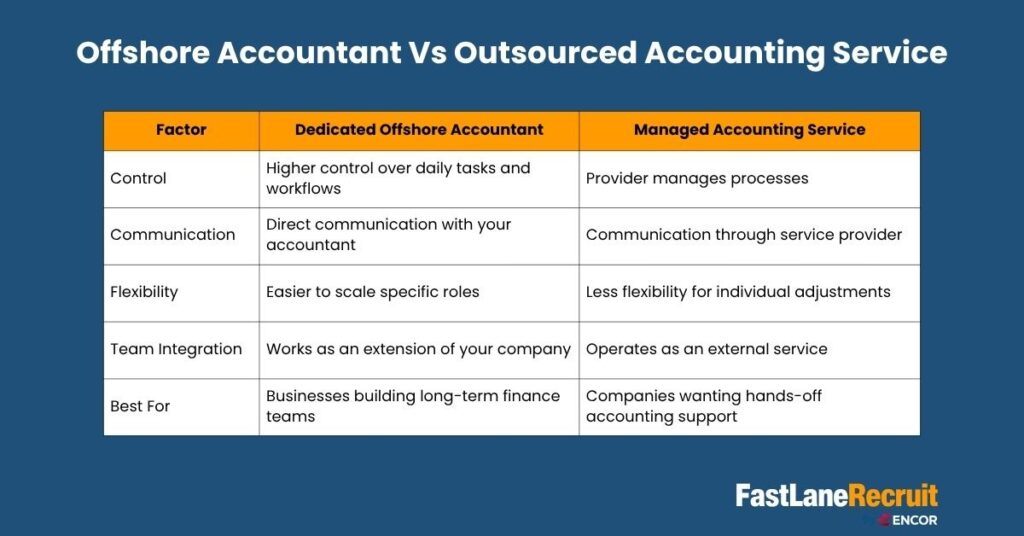
For companies that want greater control, cultural alignment, and long-term team development, hiring dedicated offshore accounting professionals can be a more strategic option.
Building A High-Quality Offshore Accounting Team
Hiring the right accounting professional requires more than reviewing resumes. Businesses should evaluate:
- Accounting qualifications
- Industry experience
- Software knowledge
- Communication skills
- Understanding of compliance requirements
- Ability to work with international teams
A professional recruitment partner can help businesses identify suitable candidates, conduct screening, and create a smoother onboarding process.
This is especially valuable for companies that want to hire accountants in the Philippines or explore offshore talent solutions without managing the entire recruitment process alone.
Benefits Of Outsourcing Accounting To The Philippines For Growing Businesses
For many growing businesses, accounting is essential but resource-intensive. Managing financial records, processing transactions, preparing reports, and maintaining compliance require time, expertise, and consistent attention.
By choosing to outsource accounting to the Philippines, companies can access experienced accounting professionals while improving operational efficiency and controlling costs. However, the biggest advantage of outsourcing is not simply reducing expenses, it is creating a more flexible and scalable finance function that supports long-term business growth.
A successful offshore accounting strategy allows businesses to combine global talent, modern technology, and structured processes to improve financial accuracy while allowing internal teams to focus on higher-value activities.
1. Reduce Accounting Costs Without Reducing Quality
One of the primary reasons businesses outsource accounting is to achieve cost efficiency. Building an internal accounting team requires significant investment beyond employee salaries.
Companies must consider expenses such as:
- Recruitment and hiring costs
- Employee benefits
- Office infrastructure
- Accounting software licenses
- Training and development
- Administrative expenses
Outsourcing accounting functions to the Philippines allows businesses to access qualified professionals with lower operational costs compared with hiring locally in many developed markets.
However, effective outsourcing is not about choosing the cheapest option. Businesses should focus on cost optimization, which means achieving reliable accounting support, improved efficiency, and professional expertise at a sustainable cost.
Cost Comparison: In-House Accounting vs Offshore Accounting
| Factor | In-House Accounting Team | Offshore Accounting Team |
| Recruitment | Requires local hiring process | Access to wider international talent pool |
| Operating Costs | Higher salary and infrastructure expenses | Lower operational overhead |
| Scalability | Slower to increase team size | Easier to add or adjust resources |
| Talent Access | Limited by local availability | Access to global accounting professionals |
| Management | Direct internal management required | Flexible engagement models available |
2. Access To Skilled Accounting Talent
Finding qualified accounting professionals has become increasingly challenging for businesses worldwide. Many companies struggle with:
- Accounting talent shortages
- Increasing salary expectations
- Difficulty retaining experienced professionals
- Limited access to specialized skills
The Philippines offers a large workforce of accounting professionals with experience in international business environments.
Businesses can access professionals skilled in:
- Bookkeeping
- Financial reporting
- Accounts payable and receivable
- Payroll processing
- Tax support
- Audit preparation
- Accounting software management
Instead of spending months searching for the right candidates, companies can build offshore accounting teams faster through established recruitment and outsourcing channels.
3. Improve Business Productivity And Operational Efficiency
Accounting outsourcing allows internal teams to focus on activities that directly contribute to business growth.
When routine financial tasks are handled by dedicated offshore professionals, business owners and managers can spend more time on:
- Strategic planning
- Customer acquisition
- Product development
- Market expansion
- Revenue growth initiatives
An experienced offshore accounting team can also improve operational efficiency by establishing consistent workflows for:
- Invoice processing
- Financial reconciliation
- Reporting schedules
- Documentation management
- Month-end closing
This creates a more organized finance operation with fewer delays and improved visibility.
4. Scale Your Finance Team Faster
Business requirements change over time. A company may need additional accounting support during:
- Business expansion
- Seasonal periods
- New market entry
- Financial reporting cycles
- Mergers and acquisitions
Traditional hiring methods can make scaling difficult because recruiting, onboarding, and training employees takes time.
Outsourcing provides flexibility by allowing businesses to:
- Add accounting specialists when needed
- Build teams gradually
- Increase support during busy periods
- Access specific skills without permanent hiring commitments
This makes offshore accounting particularly valuable for startups and SMEs that need professional support while managing growth costs.
5. Gain Access To Advanced Accounting Technology
Modern accounting requires businesses to use digital tools to improve accuracy and efficiency.
Many offshore accounting professionals in the Philippines have experience with:
- Cloud accounting platforms
- Enterprise resource planning systems
- Automated reporting tools
- Digital payment platforms
- Financial management software
Technology-enabled outsourcing helps businesses achieve:
- Faster reporting
- Better financial visibility
- Improved collaboration
- Reduced manual errors
- More efficient workflows
A capable offshore accounting team should be able to integrate with your existing systems rather than creating additional complexity.
6. Maintain Business Continuity And Flexible Support
Accounting operations cannot stop. Delayed reporting, missed payments, or inaccurate records can affect business decisions and financial performance.
An offshore accounting team can provide additional operational support by:
- Maintaining consistent accounting processes
- Supporting different time zones
- Reducing dependency on individual employees
- Creating documented workflows
For international businesses, offshore teams can provide extended operational coverage and help maintain financial processes even during busy periods.
7. Focus Internal Teams On Strategic Finance Activities
Many finance teams spend significant time managing repetitive administrative responsibilities.
Outsourcing routine accounting tasks allows internal finance professionals to focus on more strategic responsibilities, including:
- Financial planning
- Business forecasting
- Performance analysis
- Investment decisions
- Risk management
Instead of spending valuable resources maintaining records, businesses can use accounting insights to make better decisions.
8. Improve Access To Global Accounting Expertise
Outsourcing allows businesses to hire based on skills rather than geographic limitations.
Companies can find professionals with experience in:
- International accounting standards
- Industry-specific requirements
- Cross-border transactions
- Financial compliance
- Global reporting practices
This is particularly beneficial for businesses operating across multiple countries that need accounting support familiar with international operations.
9. Build A Long-Term Offshore Finance Partnership
The most successful outsourcing relationships are built around collaboration, not simply task completion.
A strong offshore accounting partnership should include:
- Clear communication processes
- Defined responsibilities
- Regular performance reviews
- Secure technology systems
- Continuous process improvement
Businesses that treat offshore accountants as an extension of their team often achieve better results than companies that view outsourcing as a simple cost-cutting measure.
Key Benefits At A Glance
| Benefit | Business Impact |
| Lower operational costs | Reduce expenses while accessing skilled professionals |
| Skilled accounting talent | Overcome local hiring challenges |
| Greater efficiency | Improve accounting workflows and productivity |
| Flexible scaling | Adjust finance resources as business needs change |
| Better financial insights | Support stronger business decisions |
| Technology adoption | Improve reporting and automation |
| Strategic focus | Allow internal teams to prioritize growth |
Potential Risks Of Outsourcing Accounting To The Philippines And How To Avoid Them
While many businesses successfully outsource accounting to the Philippines, outsourcing financial operations requires careful planning. Accounting involves highly sensitive information, including revenue data, payroll records, customer information, tax documents, and financial reports. Without proper processes and partner selection, businesses may face challenges related to quality, communication, security, and compliance.
The goal is not to avoid outsourcing risks entirely, but to understand them and create safeguards that protect your business.
A well-structured outsourcing strategy should combine qualified accounting professionals, secure technology systems, clear communication processes, and strong compliance practices.
1. Data Security And Confidentiality Risks
Accounting teams handle some of the most sensitive business information, making data protection one of the biggest concerns when outsourcing finance functions.
Potential risks include:
- Unauthorized access to financial records
- Poor data handling practices
- Weak cybersecurity measures
- Inadequate access controls
- Accidental disclosure of confidential information
Businesses should evaluate an outsourcing partner’s security practices before sharing financial data.
How To Reduce Data Security Risks
Companies should consider:
- Using secure cloud accounting platforms
- Implementing multi-factor authentication
- Limiting access based on employee roles
- Signing confidentiality agreements
- Establishing clear data protection policies
- Conducting regular security reviews
A reliable offshore accounting partner should prioritize information security as part of their operational framework.
2. Maintaining Accounting Quality And Accuracy
Accuracy is critical in accounting. Even small errors in financial records can affect decision-making, tax reporting, cash flow management, and compliance.
Common quality concerns include:
- Incorrect data entry
- Incomplete financial records
- Missed reporting deadlines
- Poor understanding of accounting processes
- Lack of industry knowledge
These issues usually occur when businesses focus only on cost savings instead of selecting professionals with the right qualifications and experience.
How To Maintain Quality Standards
Businesses can improve accounting quality by:
- Defining clear job responsibilities
- Establishing performance expectations
- Creating standard operating procedures (SOPs)
- Setting regular reporting schedules
- Reviewing financial outputs consistently
- Hiring professionals with relevant accounting experience
A successful offshore accounting team should operate with the same standards expected from an internal finance department.
3. Communication And Time Zone Challenges
Communication is one of the most common concerns when building an offshore accounting team.
Challenges may include:
- Different working hours
- Delayed responses
- Misunderstanding business requirements
- Lack of regular updates
However, these challenges can usually be managed with proper communication structures.
Best Practices For Effective Collaboration
Businesses should establish:
- Regular team meetings
- Clear communication channels
- Defined escalation procedures
- Shared project management tools
- Documented workflows
Many businesses successfully work with offshore accounting professionals by treating them as an extension of their internal team rather than an external service.
4. Compliance And Regulatory Concerns
Accounting compliance requirements vary depending on the country where your business operates.
When outsourcing accounting functions, companies must ensure their offshore team understands:
- Applicable accounting standards
- Tax reporting requirements
- Financial documentation requirements
- Industry-specific regulations
- Data privacy obligations
For example, a company operating in the United States may require knowledge of US GAAP, while businesses in other markets may follow different reporting standards.
How To Improve Compliance When Outsourcing
Businesses should:
- Clearly define compliance responsibilities
- Provide relevant training
- Work with experienced accounting professionals
- Maintain proper documentation
- Regularly review accounting processes
The right outsourcing partner should help businesses maintain consistency and compliance rather than create additional risks.
5. Lack Of Business Understanding
Accounting is not only about numbers. A good accounting professional should understand how your business operates, your industry requirements, and your financial objectives.
A common outsourcing mistake is hiring someone who can complete tasks but does not understand the broader business context.
This can result in:
- Limited financial insights
- Poor prioritization
- Inefficient processes
- Communication gaps
How To Build Stronger Offshore Accounting Relationships
Businesses should invest time in:
- Providing company background information
- Explaining business goals
- Sharing accounting procedures
- Creating onboarding plans
- Maintaining regular feedback
The more an offshore accountant understands your business, the more value they can provide.
6. Choosing The Wrong Outsourcing Model
Not every business needs the same outsourcing arrangement.
Choosing the wrong model can create problems.
For example:
- A startup may only need bookkeeping support.
- A growing SME may need a dedicated offshore accountant.
- A multinational company may require a complete finance team.
Businesses should consider whether they need:
| Outsourcing Model | Best For |
| Managed Accounting Service | Companies wanting a provider to handle complete accounting processes |
| Dedicated Offshore Accountant | Businesses wanting direct control and long-term team integration |
| Staff Augmentation | Companies needing additional accounting support quickly |
| Offshore Finance Team | Businesses building a scalable international finance department |
Selecting the right model helps ensure outsourcing supports long-term business objectives.
Outsourcing Accounting Risk Checklist
Before hiring an offshore accounting partner, ask:
| Question | Why It Matters |
| Does the team have relevant accounting experience? | Ensures technical capability |
| What security measures are in place? | Protects financial information |
| How is communication managed? | Prevents workflow delays |
| Are processes documented? | Improves consistency |
| Can the team scale with business growth? | Supports future expansion |
| Is there ongoing quality monitoring? | Maintains performance standards |
Accounting Outsourcing Compliance Checklist: How To Protect Your Business
When you outsource accounting to the Philippines or build an offshore finance team, maintaining compliance should be a top priority. Accounting teams handle sensitive financial information, including revenue reports, employee payroll data, customer records, invoices, and tax documents.
A successful outsourcing strategy requires more than finding skilled accountants. Businesses must ensure that their offshore accounting operations follow appropriate security measures, documentation standards, and compliance practices.
Whether you work with an outsourced accounting provider, hire dedicated offshore accountants, or build a remote finance team, a strong compliance framework helps reduce risks and protect your business.
1. Establish Clear Data Security And Privacy Policies
Financial data is among the most valuable information within any organization. Before providing access to accounting systems or financial records, businesses should establish clear data protection procedures.
Important security measures include:
- Role-based access controls
- Secure file-sharing systems
- Multi-factor authentication
- Encrypted communication channels
- Regular password management practices
- Restricted access to sensitive financial information
Businesses should follow the principle of least privilege, meaning each team member only receives access to the information required to complete their responsibilities.
For example:
- A bookkeeping specialist may only need transaction records.
- A payroll specialist may require employee compensation data.
- A financial analyst may need reporting access but not payment authorization.
This reduces unnecessary exposure of confidential information.
2. Use Confidentiality Agreements And Clear Contracts
A professional outsourcing arrangement should include clear agreements that define responsibilities, expectations, and data protection requirements.
Important contract elements may include:
| Contract Element | Purpose |
| Confidentiality Agreement (NDA) | Protects sensitive business information |
| Service Agreement | Defines responsibilities and deliverables |
| Data Protection Terms | Establishes security obligations |
| Performance Expectations | Sets quality and reporting standards |
| Termination Conditions | Defines procedures for ending the partnership |
Clear agreements help both parties understand their responsibilities and reduce potential misunderstandings.
3. Ensure Compliance With Accounting Standards
Outsourced accounting professionals should understand the accounting standards relevant to your business.
Depending on your market, this may include:
- Generally Accepted Accounting Principles (GAAP)
- International Financial Reporting Standards (IFRS)
- Local tax reporting requirements
- Industry-specific accounting practices
Before hiring an offshore accounting professional, businesses should evaluate:
- Previous accounting experience
- Familiarity with relevant standards
- Industry knowledge
- Software proficiency
- Reporting experience
A qualified accountant should not only record transactions but understand how financial information supports business decisions.
4. Protect Access To Accounting Software And Systems
Modern accounting relies heavily on cloud-based platforms. While these systems improve collaboration, they also require careful access management.
Common accounting platforms include:
- Xero
- QuickBooks
- NetSuite
- SAP
- Oracle-based financial systems
Businesses should implement:
User Access Management
Review who has access to:
- Accounting systems
- Banking platforms
- Payroll software
- Financial documents
Regular Access Reviews
Conduct periodic checks to:
- Remove inactive users
- Update permissions
- Monitor unusual activity
Secure Authentication
Use:
- Multi-factor authentication
- Strong passwords
- Secure devices
Technology should enable collaboration while maintaining strong financial controls.
5. Define Roles And Responsibilities Clearly
Many outsourcing challenges occur because businesses do not clearly define who is responsible for each accounting activity.
Before starting an outsourcing relationship, create a responsibility framework covering:
| Accounting Activity | Responsible Party |
| Transaction recording | Offshore accounting team |
| Financial approval | Internal management team |
| Tax decisions | Business owner or qualified advisor |
| Financial review | Finance manager or controller |
| System administration | Assigned internal administrator |
Clear ownership prevents delays, duplicate work, and accountability issues.
6. Maintain Regular Financial Reviews
Outsourcing does not mean removing oversight. Businesses should maintain regular reviews to ensure accuracy and alignment.
Recommended practices include:
- Monthly financial reviews
- Regular performance discussions
- Accounting quality checks
- Reconciliation reviews
- Process improvement meetings
These reviews help identify issues early and maintain consistent accounting standards.
7. Consider Employment Compliance When Hiring Offshore Talent
Businesses choosing a dedicated offshore accountant must consider how the employment relationship is structured.
Key considerations include:
- Employment contracts
- Payroll responsibilities
- Local labor regulations
- Employee benefits
- Tax obligations
For companies hiring internationally without establishing a local entity, an Employer of Record (EOR) solution can simplify employment compliance.
An EOR partner can manage:
- Local employment documentation
- Payroll administration
- Statutory requirements
- Employee benefits
- HR compliance
This allows businesses to hire international talent while reducing administrative complexity.
8. Create A Business Continuity Plan
Accounting operations are critical to daily business management. Companies should prepare for unexpected situations such as:
- Employee turnover
- System interruptions
- Increased workload
- Operational changes
A strong outsourcing strategy includes:
- Documented accounting procedures
- Backup access arrangements
- Knowledge sharing processes
- Clear transition plans
This ensures financial operations continue smoothly even when changes occur.
Why Businesses Choose The Philippines For Accounting Outsourcing
The Philippines continues to be a leading destination for offshore accounting because it offers several advantages:
1. Large Accounting And Finance Talent Pool
The Philippines has a mature outsourcing ecosystem with professionals experienced in:
- Bookkeeping
- Payroll support
- Accounts payable and receivable
- Financial reporting
- Tax support
- Audit assistance
Many Filipino accounting professionals have worked with international companies and are familiar with global business requirements.
2. Cost-Effective Offshore Support
Businesses can reduce operating expenses by accessing skilled accounting professionals without the higher costs associated with hiring in some developed markets.
This makes the Philippines attractive for:
- Startups
- Small and medium-sized businesses
- Companies scaling operations
- Businesses seeking operational efficiency
3. Established Outsourcing Infrastructure
The Philippines has decades of experience supporting global outsourcing operations.
Companies benefit from:
- Experienced outsourcing providers
- Established remote working practices
- Strong BPO infrastructure
- Familiarity with international clients
Why Businesses Should Consider Malaysia For Accounting Talent
While the Philippines is a strong outsourcing destination, Malaysia provides advantages for companies that need closer regional integration and long-term team development.
1. Malaysia Offers A Strategic ASEAN Business Location
Malaysia is strategically positioned in Southeast Asia, making it an attractive location for businesses expanding across regional markets.
Companies choosing Malaysia benefit from:
- Access to ASEAN markets
- Modern business infrastructure
- Strong digital connectivity
- Stable commercial environment
For companies planning regional growth, Malaysia can serve as more than a hiring destination — it can become a foundation for Southeast Asian operations.
2. Access To A Multilingual Professional Workforce
Malaysia has a diverse workforce with professionals who commonly operate in multiple languages, including:
- English
- Malay
- Mandarin
- Other regional languages
This multilingual capability can be valuable for companies serving customers or operating across different Asian markets.
For accounting and finance roles, strong communication skills are especially important when professionals need to collaborate with headquarters, suppliers, customers, and regional teams.
3. Malaysia Supports Dedicated Team Building
Businesses increasingly prefer building dedicated offshore teams rather than simply outsourcing tasks.
A dedicated team model allows companies to:
- Directly manage daily workflows
- Build stronger team relationships
- Maintain better operational control
- Develop long-term employee capability
Malaysia is well suited for companies that want professionals who operate as an extension of their internal organization.
4. Employer Of Record (EOR) Solutions Simplify Hiring In Malaysia
For companies that want to hire accounting professionals in Malaysia without immediately establishing a local entity, an Employer of Record (EOR) solution can simplify the process.
An EOR provider can support:
- Local employment compliance
- Payroll administration
- Employee benefits management
- Employment documentation
- HR administration
This allows businesses to hire Malaysian talent while reducing administrative complexity.
An EOR model is especially useful for companies that want to:
- Test the Malaysian market
- Hire their first regional employee
- Build a small finance team
- Expand before setting up a legal entity
Philippines Vs Malaysia: Which Is Better For Outsourcing Accounting Talent?
When businesses explore offshore accounting solutions, the Philippines is often one of the first destinations considered due to its established outsourcing industry, large English-speaking workforce, and competitive operating costs.
However, companies expanding across Southeast Asia should also evaluate Malaysia as a strategic alternative. While the Philippines remains a strong choice for outsourcing accounting tasks, Malaysia offers unique advantages for businesses that want to build dedicated teams, establish a regional presence, or hire professionals through compliant employment structures.
The right choice depends on your business objectives, operational requirements, and long-term expansion plans.
Philippines Vs Malaysia For Accounting Outsourcing: Key Differences
| Factor | Philippines | Malaysia |
| Primary Advantage | Large outsourcing talent pool and cost efficiency | Strategic regional hub with strong business infrastructure |
| Best For | Outsourcing accounting processes and offshore support teams | Companies building dedicated teams and Southeast Asia operations |
| Talent Pool | Large number of accounting and BPO professionals | Skilled multilingual workforce with regional business exposure |
| Language Capability | Strong English proficiency | English, Malay, Mandarin, and other multilingual capabilities |
| Business Environment | Mature outsourcing destination | Business-friendly hub connecting ASEAN markets |
| Employment Model | Outsourcing providers and offshore teams | Direct hiring, recruitment support, and Employer of Record (EOR) solutions |
| Regional Expansion | Strong offshore support location | Strong base for ASEAN market expansion |
When Should You Choose The Philippines Vs Malaysia?
The best option depends on your business needs.
Choose The Philippines If You Need:
- Cost-effective accounting outsourcing
- High-volume bookkeeping support
- A large offshore accounting talent pool
- Managed accounting services
- Flexible outsourced finance operations
Choose Malaysia If You Need:
- A dedicated accounting team in Southeast Asia
- Long-term employee relationships
- Regional market expansion support
- Employer of Record solutions
- Multilingual finance professionals
- A strategic ASEAN operating base
How To Choose The Right Accounting Outsourcing Partner
Choosing the right partner is one of the most important decisions when you outsource accounting to the Philippines or build an offshore finance team in another market. The quality of your accounting operations depends not only on the professionals you hire but also on the recruitment process, onboarding support, communication structure, and compliance practices behind your offshore team.
A low-cost provider may appear attractive initially, but poor-quality accounting work, communication issues, and compliance problems can create additional costs in the long term.
The right outsourcing partner should help you find qualified professionals, establish efficient workflows, and build a reliable finance function that supports your business objectives.
1. Evaluate Accounting Expertise And Industry Experience
Accounting requires technical knowledge, attention to detail, and familiarity with financial processes. Before selecting an outsourcing partner, evaluate whether they can provide professionals with the right expertise for your business.
Consider:
- Accounting qualifications
- Years of professional experience
- Industry background
- Knowledge of international accounting practices
- Experience with your accounting software
- Understanding of your market requirements
For example, a company requiring financial reporting support may need candidates with stronger analytical skills, while a business handling large transaction volumes may prioritize accounts payable and reconciliation experience.
2. Understand The Hiring And Screening Process
A reliable outsourcing partner should have a structured process for identifying and evaluating accounting professionals.
Ask about:
- How candidates are sourced
- Whether technical skills are assessed
- How experience is verified
- Whether interviews are conducted
- How communication skills are evaluated
A strong screening process helps ensure that the professionals you hire are not only technically capable but also able to collaborate effectively with your internal team.
3. Check Technology And Security Standards
Since accounting teams handle confidential financial information, security should be a priority.
Before partnering with an outsourcing provider, ask about:
- Data protection policies
- Access control procedures
- Secure communication tools
- Confidentiality agreements
- Cybersecurity practices
- Document management processes
A professional offshore accounting setup should protect sensitive information while allowing teams to collaborate efficiently.
4. Assess Communication And Collaboration Methods
Successful offshore teams depend on clear communication.
Before hiring, establish:
- Preferred communication channels
- Meeting schedules
- Reporting procedures
- Response expectations
- Escalation processes
A good partner should help create a communication framework that keeps both teams aligned.
Examples of useful collaboration tools include:
- Video conferencing platforms
- Project management systems
- Accounting software platforms
- Shared documentation systems
5. Review Compliance Knowledge
Accounting outsourcing involves more than completing financial tasks. Professionals must understand the importance of accuracy, documentation, and regulatory requirements.
A suitable outsourcing partner should demonstrate knowledge of:
- Accounting standards
- Financial reporting requirements
- Data privacy regulations
- Employment compliance
- Industry-specific requirements
For businesses hiring internationally, compliance support becomes even more important when building teams across borders.
6. Compare Different Outsourcing Models
Different businesses require different levels of support. Before selecting a provider, determine which model best fits your needs.
| Model | Description | Best For |
| Fully Managed Accounting Outsourcing | Provider manages accounting processes from start to finish | Businesses wanting minimal involvement |
| Dedicated Offshore Accountant | A professional works exclusively with your business | Companies wanting control and long-term collaboration |
| Offshore Finance Team | Multiple accounting professionals support different functions | Growing businesses scaling finance operations |
| Recruitment Support | Partner helps identify and hire suitable professionals | Companies wanting direct employee relationships |
Understanding these options helps businesses avoid choosing a model that does not match their goals.
7. Ask The Right Questions Before Hiring
Before signing an agreement, businesses should ask potential partners:
About Talent
- What accounting roles can you help us hire?
- How do you evaluate candidate skills?
- Can you provide professionals with international experience?
About Operations
- How will communication be managed?
- What onboarding support is provided?
- How are performance expectations established?
About Security
- How is financial data protected?
- What security measures are in place?
- Are confidentiality agreements included?
About Scalability
- Can we increase or reduce team size?
- Can we hire additional accounting specialists later?
- How quickly can new team members be recruited?
These questions help businesses choose a partner that can support long-term growth.
8. Build A Strong Onboarding Process
Even experienced accounting professionals need proper onboarding to understand your business.
A successful onboarding process should include:
Business Introduction
Provide:
- Company background
- Industry information
- Business objectives
- Internal team structure
Accounting Process Training
Explain:
- Existing workflows
- Reporting requirements
- Approval processes
- Accounting procedures
System Access Setup
Ensure:
- Software access is configured
- Security permissions are established
- Communication channels are ready
A structured onboarding process improves productivity and helps offshore accountants integrate faster.
Outsource Accounting To The Philippines Or Hire In Malaysia: Making The Right Decision
Choosing the right location for your accounting team depends on your business objectives, operational requirements, and long-term expansion plans.
For many companies, outsourcing accounting to Philippines is an effective way to access skilled finance professionals, reduce operating costs, and increase accounting capacity. The Philippines has built a strong reputation as a global outsourcing destination, particularly for businesses looking for offshore accounting support.
However, companies that want more control over their teams, stronger regional presence, or a long-term Southeast Asia expansion strategy may find Malaysia to be a more suitable option.
The decision should not only focus on short-term cost savings. Businesses should consider factors such as team ownership, compliance requirements, scalability, communication, and future growth plans.
Also Read: Outsourcing in Malaysia: Why It Leads Southeast Asia in 2026 and How Businesses Benefit
Why FastLane Recruit Can Help You Build Accounting Teams In Malaysia
Finding the right accounting professionals is one of the biggest challenges when expanding internationally.
FastLane Recruit supports businesses looking to hire talent in Malaysia by helping them identify qualified professionals who match their operational requirements.
Businesses can benefit from:
Access To Qualified Accounting And Finance Talent
FastLane Recruit helps companies connect with professionals who have experience in areas such as:
- Accounting operations
- Finance administration
- Bookkeeping
- Payroll support
- Financial reporting
Recruitment Expertise For International Businesses
Hiring across borders involves more than finding candidates. Companies need support understanding:
- Talent availability
- Hiring expectations
- Employment processes
- Local market conditions
FastLane Recruit helps simplify the recruitment journey.
Build A Scalable Southeast Asia Team
Whether you need one accounting professional or a growing finance team, FastLane Recruit helps businesses create a hiring strategy that supports long-term growth.
Making The Right Choice For Your Business
There is no universal answer when deciding between the Philippines and Malaysia.
The Philippines remains a strong choice for companies seeking established accounting outsourcing solutions, cost efficiency, and flexible offshore support.
Malaysia may be a better strategic choice for companies that want dedicated employees, stronger operational control, and a foundation for Southeast Asian expansion.
The right decision depends on where your business is heading — not only where you can reduce costs today.
How FastLane Recruit Helps Businesses Build High-Quality Accounting Teams
Finding the right accounting professionals is one of the most important steps when building an offshore finance team. While many companies understand the benefits of accessing international talent, the recruitment process can become challenging without local market knowledge, candidate networks, and a structured hiring approach.
FastLane Recruit helps businesses simplify the process of finding qualified professionals in Asia by connecting companies with skilled talent that matches their operational needs.
Rather than focusing only on filling vacancies, FastLane Recruit helps businesses build sustainable teams that can support long-term growth, improve operational efficiency, and integrate smoothly with existing business operations.
How FastLaneRecruit Supports Global Hiring Across Asia and the UAE
FastLaneRecruit helps businesses expand their global workforce through Employer of Record (EOR) services across Malaysia, Hong Kong, Singapore, China, Taiwan, and the United Arab Emirates (UAE). By acting as the legal employer on your behalf, we simplify international hiring while allowing you to manage your employees’ daily operations and performance.
With FastLaneRecruit, businesses can:
- Hire employees in new markets without establishing a local legal entity
- Ensure compliance with local employment laws, payroll regulations, tax obligations, and statutory requirements
- Manage employment contracts, payroll processing, employee benefits, and HR administration through one trusted partner
- Reduce the risks and complexities associated with international workforce expansion
- Access local market expertise and streamlined support across multiple countries
- Scale regional teams faster with flexible and compliant hiring solutions
Whether you are expanding into Malaysia or building a distributed workforce across Asia and the UAE, FastLaneRecruit provides end-to-end EOR support to help you enter new markets confidently while maintaining full compliance.
Access Qualified Accounting And Finance Professionals In Asia
Hiring the right accounting talent requires more than reviewing resumes. Businesses need professionals with the right combination of:
- Technical accounting knowledge
- Relevant industry experience
- Software proficiency
- Communication skills
- Problem-solving ability
- Cultural compatibility
FastLaneRecruit helps businesses identify suitable candidates for roles such as:
- Accountants
- Senior Accountants
- Finance Executives
- Bookkeepers
- Accounts Payable Specialists
- Accounts Receivable Specialists
- Payroll Specialists
- Finance Analysts
- Accounting Managers
By understanding your business requirements, FastLaneRecruit helps connect you with professionals who can contribute effectively from the beginning.
A Structured Recruitment Process Designed For Business Needs
Hiring internationally can involve multiple challenges, including identifying suitable candidates, assessing skills, and ensuring a good long-term fit.
FastLaneRecruit supports businesses throughout the recruitment journey.
1. Understand Your Hiring Requirements
The process begins by understanding:
- Your business goals
- Required accounting functions
- Technical requirements
- Industry background
- Team structure
- Preferred hiring model
This ensures candidates are selected based on your actual operational needs rather than general qualifications.
2. Source Suitable Accounting Candidates
FastLaneRecruit leverages recruitment expertise to identify professionals with relevant backgrounds.
Candidate evaluation may consider:
- Accounting qualifications
- Previous work experience
- Industry exposure
- Software knowledge
- Communication ability
- Career goals
This helps businesses access a more targeted talent pool.
3. Candidate Screening And Shortlisting
A strong recruitment process helps reduce hiring risks.
Candidates can be evaluated based on:
- Technical accounting skills
- Experience level
- Professional background
- Communication skills
- Role suitability
This allows businesses to focus their time on interviewing candidates who are more aligned with their requirements.
4. Support During Hiring And Onboarding
Hiring is only the beginning of building a successful accounting team.
A smooth onboarding process helps new employees understand:
- Business operations
- Accounting workflows
- Reporting expectations
- Internal communication processes
- Company culture
FastLane Recruit helps businesses create a more efficient transition from recruitment to employment.
Ready To Build Your Offshore Accounting Team?
Finding the right accounting professionals can help your business improve efficiency, control costs, and prepare for future growth.
If you are exploring offshore accounting talent, recruitment solutions, or Employer of Record support, FastLane Recruit can help you identify the right approach for your business.
Contact FastLaneRecruit today to discuss your hiring requirements and discover how you can build a reliable accounting team.
Conclusion
Outsourcing accounting can help businesses reduce costs, access global talent, and improve operational efficiency. However, achieving long-term success requires more than choosing a low-cost destination.
The right strategy combines:
- Qualified accounting professionals
- Strong compliance practices
- Secure systems
- Effective communication
- A suitable hiring model
Whether you choose to outsource accounting to the Philippines or build a dedicated finance team in Malaysia or other options in Asia, making the right hiring decision can create a stronger foundation for business growth.
Frequently Asked Questions
Is It Safe To Outsource Accounting To The Philippines?
Yes. Businesses can outsource accounting safely by working with reliable partners, using secure accounting systems, signing confidentiality agreements, and implementing proper data protection processes.
How Much Does It Cost To Outsource Accounting To The Philippines?
Costs depend on the role, experience level, workload, and outsourcing model. Bookkeeping support typically costs less than hiring senior accountants or finance specialists.
What Accounting Tasks Can Be Outsourced?
Common outsourced accounting functions include:
- Bookkeeping
- Accounts payable and receivable
- Payroll processing
- Bank reconciliation
- Financial reporting
- Tax preparation support
Why Choose The Philippines For Accounting Outsourcing?
The Philippines is popular because it offers:
- Skilled accounting professionals
- Strong English communication
- Experience with international businesses
- Competitive operating costs
Should I Outsource Accounting Or Hire A Dedicated Accountant?
Outsourcing works well for businesses wanting managed support. Hiring a dedicated offshore accountant is better for companies that need direct control and long-term team integration.
How Can Businesses Maintain Accounting Quality?
Maintain quality by hiring experienced professionals, setting clear processes, using reliable accounting software, and conducting regular performance reviews.
Is Malaysia A Good Alternative For Offshore Accounting Teams?
Yes. Malaysia can be a strong option for businesses looking to build dedicated teams, expand in Southeast Asia, or hire through compliant solutions such as Employer of Record (EOR).
How Can FastLane Recruit Help?
FastLane Recruit helps businesses find qualified accounting and finance professionals in Malaysia through recruitment solutions designed for building reliable offshore teams.