
Managing accurate financial records is essential for every growing business, but bookkeeping can quickly become time-consuming as operations expand. From recording daily transactions and reconciling accounts to preparing financial reports, businesses often find themselves spending valuable resources on administrative tasks instead of focusing on growth.
For many companies, building a full in-house finance team is not always practical. Hiring qualified bookkeepers requires recruitment costs, employee benefits, training investment, and ongoing management. This is where outsourced bookkeeping provides a flexible solution by allowing businesses to access experienced bookkeeping professionals without increasing internal overhead.
With the rise of remote work, cloud accounting technology, and global talent networks, businesses can now work with skilled bookkeeping specialists from trusted outsourcing destinations such as Malaysia. Companies can maintain accurate financial records, improve efficiency, and gain access to professional expertise while keeping costs under control.
This guide explains what outsourced bookkeeping is, its benefits, costs, best practices, and how businesses can find the right bookkeeping professionals to support long-term success.
Content Outline
Key Summary
What Is Outsourced Bookkeeping?
Understand how businesses delegate bookkeeping tasks to external professionals to improve efficiency and financial management.
Why Businesses Outsource Bookkeeping
Discover how outsourcing reduces operational costs, provides access to skilled professionals, and supports business growth.
How Much Does Outsourced Bookkeeping Cost?
Learn the factors that influence bookkeeping outsourcing costs and how businesses can optimize their investment.
Why Malaysia Is A Preferred Outsourcing Destination
Explore why Malaysia offers skilled finance professionals, competitive costs, strong English proficiency, and reliable business support.
How To Find The Right Bookkeeping Professionals
Learn what to consider when selecting an outsourced bookkeeping partner, from expertise to communication and data security.
What Is Outsourced Bookkeeping?
Outsourced bookkeeping is the process of hiring an external professional or specialized service provider to manage a company’s bookkeeping activities instead of handling these tasks internally.
An outsourced bookkeeper works as an extension of your business team and helps maintain accurate financial records, organize transactions, and support financial reporting requirements.
Depending on business needs, outsourced bookkeeping services may include:
- Recording income and expenses
- Managing accounts payable and receivable
- Bank reconciliation
- Processing invoices
- Maintaining general ledgers
- Preparing financial statements
- Monitoring cash flow records
- Managing accounting software systems
- Supporting month-end and year-end closing activities
Unlike traditional accounting outsourcing, bookkeeping focuses mainly on maintaining accurate financial data and ensuring business transactions are properly recorded.
For small and medium-sized businesses, startups, and growing companies, outsourced bookkeeping provides access to professional financial support without the commitment of hiring a full-time employee.
Why Are More Businesses Choosing Outsourced Bookkeeping?
The modern business environment requires companies to operate efficiently while controlling costs. Many organizations are rethinking traditional hiring approaches and exploring outsourcing as a way to access specialized skills.
Several factors are driving the growth of outsourced bookkeeping:
Rising Cost Of Hiring In-House Bookkeepers
Hiring an internal bookkeeping employee involves more than salary expenses. Businesses must also consider:
- Recruitment costs
- Employee benefits
- Training expenses
- Payroll taxes
- Office equipment
- Software subscriptions
- Management time
For smaller businesses, these additional expenses can make maintaining an internal bookkeeping team expensive.
Outsourced bookkeeping allows companies to pay only for the services they need while gaining access to experienced professionals.
Growing Need For Specialized Finance Skills
Bookkeeping requires accuracy, attention to detail, and knowledge of accounting systems. Errors in financial records can affect:
- Tax preparation
- Cash flow management
- Business decisions
- Financial reporting accuracy
By outsourcing bookkeeping tasks, businesses can work with professionals who have experience managing financial records across different industries.
Increasing Adoption Of Remote And Cloud-Based Work
Modern accounting tools make it easier for businesses and outsourced professionals to collaborate remotely.
Popular accounting platforms allow teams to:
- Share financial data securely
- Review reports in real time
- Automate repetitive tasks
- Communicate efficiently across locations
This has made outsourced bookkeeping a practical option for companies operating across different countries and regions.
Benefits Of Outsourced Bookkeeping For Businesses
Choosing outsourced bookkeeping is not only about reducing administrative workload. For many businesses, it is a strategic decision that improves financial accuracy, increases operational flexibility, and provides access to experienced professionals without the limitations of traditional hiring.
Whether you are a startup managing rapid growth, an SME looking to control expenses, or an established company seeking additional finance support, outsourced bookkeeping can provide measurable business advantages.
1. Reduce Operational Costs Without Sacrificing Quality
One of the biggest advantages of outsourced bookkeeping is cost efficiency.
Maintaining an internal bookkeeping team requires significant investment beyond employee salaries. Businesses need to consider recruitment expenses, benefits, office resources, software costs, and ongoing training.
With outsourced bookkeeping, companies can access qualified professionals through a more flexible cost structure.
Instead of paying for a full-time employee, businesses can choose support based on their actual requirements, such as:
- Part-time bookkeeping assistance
- Dedicated remote bookkeeping professionals
- Monthly bookkeeping support
- Project-based financial administration
This approach allows businesses to allocate resources more effectively while maintaining professional bookkeeping standards.
For growing companies, outsourcing provides the financial flexibility needed to invest more resources into core activities such as sales, marketing, product development, and customer growth.
2. Access Experienced Bookkeeping Professionals
Finding skilled bookkeeping professionals can be challenging, especially in competitive job markets. Businesses may spend weeks or months searching for candidates with the right combination of accounting knowledge, software experience, and industry understanding.
Outsourced bookkeeping provides direct access to professionals who already have relevant skills and experience.
A qualified outsourced bookkeeper can help businesses with:
- Accurate transaction recording
- Financial data organization
- Account reconciliation
- Reporting preparation
- Accounting system management
- Compliance support
Working with experienced professionals also reduces the risk of bookkeeping errors that may affect financial decision-making.
Instead of spending time training entry-level employees, businesses can immediately benefit from specialists who understand professional bookkeeping processes.
3. Improve Financial Accuracy And Business Visibility
Accurate bookkeeping is the foundation of effective financial management.
Incomplete or outdated financial records can create challenges such as:
- Poor cash flow visibility
- Incorrect financial decisions
- Delayed reporting
- Difficulty preparing for tax obligations
Outsourced bookkeeping professionals help maintain consistent financial records, allowing business owners and managers to understand their financial position more clearly.
With accurate bookkeeping data, companies can make better decisions regarding:
- Budget planning
- Business expansion
- Cost management
- Hiring decisions
- Investment opportunities
Reliable financial information allows leaders to focus less on administrative tasks and more on strategic growth.
4. Scale Finance Support According To Business Needs
Business requirements change over time. A startup may only need basic bookkeeping support initially, while a growing company may require more advanced financial assistance as transactions increase.
One advantage of outsourced bookkeeping is flexibility.
Businesses can adjust their level of support based on:
- Transaction volume
- Business growth stage
- Reporting requirements
- Seasonal demands
- Expansion plans
For example:
A startup may outsource monthly bookkeeping to maintain financial records while focusing on growth.
A growing SME may require dedicated bookkeeping professionals to manage increasing transactions and reporting responsibilities.
An international company entering a new market may need local finance support without immediately establishing a full internal team.
This scalability makes outsourced bookkeeping suitable for businesses at different stages of development.
5. Focus Internal Teams On Core Business Activities
Bookkeeping is essential, but it is not always the best use of business owners’ or senior employees’ time.
When internal teams spend excessive hours managing financial administration, they have less time available for:
- Business development
- Customer relationships
- Strategic planning
- Innovation
- Revenue growth
Outsourcing bookkeeping allows companies to delegate repetitive financial tasks to specialists while internal teams focus on higher-value responsibilities.
This creates a more efficient operating model where every team member can focus on their strongest area of expertise.
6. Gain Access To Advanced Accounting Tools And Processes
Professional outsourced bookkeeping providers often have experience working with modern accounting platforms and digital workflows.
Depending on business requirements, outsourced professionals may support systems such as:
- Cloud accounting software
- Financial reporting platforms
- Expense management tools
- Payroll systems
- Business management software
Their familiarity with accounting technology helps businesses improve efficiency through:
- Better financial organization
- Faster reporting processes
- Reduced manual work
- Improved collaboration
For companies transitioning from traditional bookkeeping methods, outsourced professionals can also provide guidance on improving accounting workflows.
7. Reduce Recruitment Challenges And Talent Shortages
Recruiting skilled finance professionals can be difficult, especially for businesses that need specific bookkeeping expertise.
Common recruitment challenges include:
- Limited availability of qualified candidates
- High salary expectations
- Lengthy hiring processes
- Employee turnover risks
Outsourced bookkeeping provides businesses with an alternative approach by connecting them with qualified professionals without requiring a lengthy recruitment cycle.
Through a trusted talent partner, companies can access bookkeeping specialists who are matched according to their business requirements, industry needs, and operational expectations.
Why Malaysia Is A Strategic Choice For Outsourced Bookkeeping
Malaysia has become an attractive outsourcing destination for businesses looking for reliable finance and administrative professionals.
The country offers a strong combination of skilled talent, competitive operating costs, business-friendly infrastructure, and international work standards.
Skilled And Educated Finance Talent
Malaysia has a growing pool of professionals with backgrounds in:
- Accounting
- Finance
- Business administration
- Bookkeeping
- Financial operations
Many Malaysian professionals are experienced with international accounting practices and commonly used accounting software platforms.
Strong English Communication Skills
Effective communication is essential when outsourcing financial responsibilities.
Malaysia is recognized as one of Southeast Asia’s leading destinations for English-speaking business professionals, making collaboration easier between international companies and outsourced teams.
Clear communication helps ensure:
- Accurate financial reporting
- Smooth workflow coordination
- Faster issue resolution
- Better team integration
Competitive Costs With Professional Quality
Malaysia provides businesses with access to skilled professionals at a more cost-effective rate compared with hiring in many developed markets.
Companies can reduce operational expenses while maintaining professional standards through carefully selected outsourced bookkeeping talent.
This makes Malaysia an ideal option for businesses seeking a balance between affordability and expertise.
Reliable Business Environment
Malaysia has established itself as a leading outsourcing hub in Southeast Asia due to:
- Strong digital infrastructure
- Growing professional workforce
- International business experience
- Supportive outsourcing ecosystem
For companies looking to expand finance operations efficiently, Malaysia provides a reliable location for accessing outsourced bookkeeping professionals.
Outsourced Bookkeeping Costs: How Much Does It Cost And What Factors Affect Pricing?
Understanding the cost of outsourced bookkeeping is one of the most important considerations for businesses evaluating whether outsourcing is the right solution.
While outsourcing is generally more cost-effective than hiring a full-time in-house bookkeeper, pricing can vary depending on business size, transaction volume, service requirements, and the level of expertise needed.
Rather than focusing only on the lowest cost option, businesses should evaluate the overall value they receive, including accuracy, reliability, communication, and access to skilled professionals.
Factors That Influence Outsourced Bookkeeping Costs
There is no fixed price for outsourced bookkeeping because every business has different financial requirements. The total cost depends on several key factors.
1. Business Size And Transaction Volume
The number of financial transactions your business handles directly affects bookkeeping workload.
A small business with limited monthly transactions may only require basic bookkeeping support, while a growing company with multiple revenue streams may need more comprehensive assistance.
Factors that influence workload include:
- Number of monthly transactions
- Number of bank accounts
- Sales channels
- Customer invoices
- Supplier payments
- Payroll activities
- Financial reporting requirements
Businesses with higher transaction volumes usually require more dedicated bookkeeping support.
2. Scope Of Bookkeeping Services Required
The services included in an outsourced bookkeeping arrangement will influence pricing.
Basic bookkeeping support may include:
- Recording transactions
- Categorizing expenses
- Bank reconciliation
- Maintaining financial records
More advanced support may include:
- Monthly financial reporting
- Accounts payable management
- Accounts receivable management
- Cash flow tracking
- Payroll support
- Accounting system management
Before choosing an outsourcing partner, businesses should clearly define which bookkeeping tasks they need assistance with.
3. Experience Level Of Bookkeeping Professionals
The expertise level of the assigned bookkeeping professional can also impact costs.
Entry-level bookkeeping support may be suitable for businesses with straightforward financial activities.
However, companies with complex operations may benefit from experienced professionals who can:
- Manage larger transaction volumes
- Handle advanced accounting software
- Support financial reporting
- Identify potential bookkeeping issues
- Improve accounting workflows
Investing in experienced professionals can reduce costly errors and improve long-term financial efficiency.
4. Accounting Software And Technology Requirements
Businesses using different accounting systems may require professionals with specific software knowledge.
Common accounting platforms include:
- Xero
- QuickBooks Online
- Sage Accounting
A bookkeeping professional familiar with your preferred software can reduce onboarding time and ensure smoother operations.
Outsourced Bookkeeping Cost Compared With Hiring In-House
When deciding between outsourcing and internal hiring, businesses should consider the complete employment cost rather than salary alone.
| Cost Factor | Outsourced Bookkeeping | In-House Bookkeeper |
|---|---|---|
| Salary commitment | Flexible service cost | Fixed monthly salary |
| Recruitment expenses | Usually reduced | Required |
| Employee benefits | Not required | Required |
| Training investment | Lower | Business responsibility |
| Software and equipment | May be included | Additional expense |
| Scalability | Easily adjustable | Limited by employee capacity |
| Access to expertise | Multiple professionals available | Depends on individual employee |
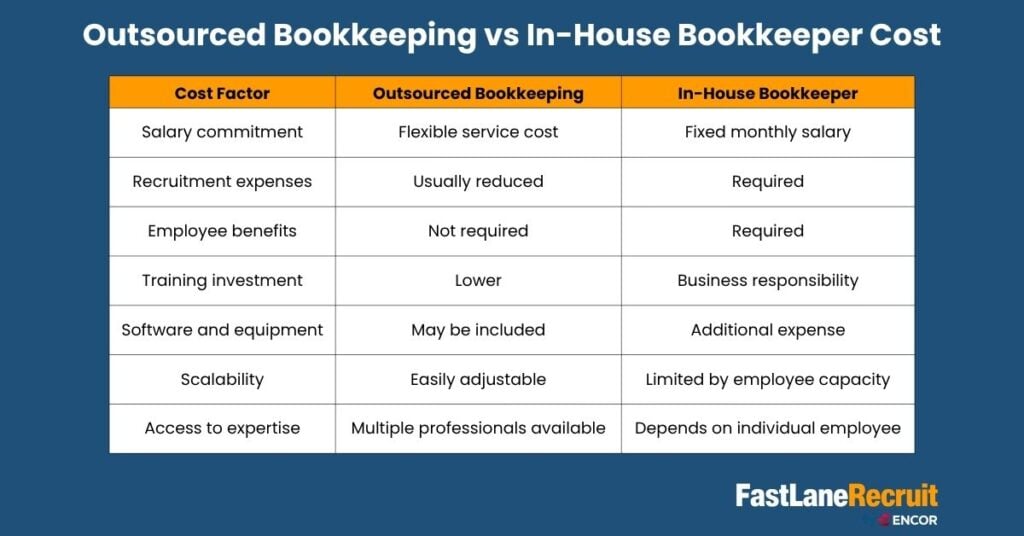
For many SMEs, outsourcing provides a more flexible approach because they can access professional bookkeeping support without taking on the long-term costs associated with full-time employment.
How To Choose The Right Outsourced Bookkeeping Solution
The cheapest option is not always the best option. Businesses should evaluate outsourcing partners based on quality, expertise, and reliability.
Before selecting an outsourced bookkeeping provider or recruitment partner, consider the following factors.
Look For Relevant Bookkeeping Experience
A reliable bookkeeping professional should understand:
- Accounting principles
- Financial record management
- Industry-specific requirements
- Accounting software systems
- Reporting expectations
Experience helps ensure accurate financial records and reduces the risk of errors.
Evaluate Communication And Collaboration Processes
Effective communication is critical when working with remote bookkeeping professionals.
A strong outsourcing partner should provide:
- Clear communication channels
- Regular updates
- Defined workflows
- Transparent reporting processes
Good collaboration ensures outsourced professionals become a seamless extension of your internal team.
Check Data Security And Confidentiality Practices
Bookkeeping involves sensitive business information, including:
- Revenue data
- Expenses
- Payroll information
- Customer details
- Financial reports
Businesses should choose partners that prioritize:
- Secure systems
- Confidentiality agreements
- Access controls
- Professional data handling procedures
Trust and security are essential when outsourcing financial responsibilities.
Outsourced Bookkeeping Vs Hiring An In-House Bookkeeper: Which Is Better?
The right choice depends on your business goals, budget, and operational requirements.
Choose In-House Bookkeeping If:
An internal bookkeeper may be suitable if:
- Your business requires daily physical collaboration
- You have consistent high-volume accounting needs
- You want complete internal control over finance operations
- You have the budget for long-term employment costs
However, hiring internally requires more commitment in terms of recruitment, management, and employee retention.
Choose Outsourced Bookkeeping If:
Outsourcing may be the better option if your business wants:
- Lower operational costs
- Faster access to skilled professionals
- Flexible finance support
- Remote collaboration
- Reduced recruitment challenges
- Ability to scale quickly
For many SMEs and growing companies, outsourced bookkeeping provides the right balance between cost efficiency and professional expertise.
How FastLaneRecruit Helps Businesses Find Outsourced Bookkeeping Professionals In Malaysia
Finding the right bookkeeping talent is one of the biggest challenges businesses face when outsourcing finance operations.
FastLaneRecruit helps companies connect with qualified professionals in Malaysia who can support bookkeeping and finance-related roles based on specific business needs.
Through a structured recruitment approach, FastLaneRecruit helps businesses access professionals with relevant skills, experience, and operational compatibility.
Businesses can benefit from:
Access To Malaysia-Based Finance Talent
FastLaneRecruit specializes in connecting businesses with professionals located in Malaysia, helping companies build reliable remote and outsourced teams.
Candidate Screening And Talent Matching
Instead of spending significant time reviewing applications and conducting recruitment processes, businesses can work with recruitment specialists who understand finance talent requirements.
FastLaneRecruit helps identify candidates based on:
- Bookkeeping experience
- Accounting knowledge
- Software familiarity
- Communication skills
- Business requirements
Flexible Outsourcing Support For Growing Businesses
Every company has different operational needs. Whether you require bookkeeping assistance for ongoing operations or additional finance support during growth periods, accessing the right talent can help your business operate more efficiently.
Best Practices For Successfully Managing Outsourced Bookkeeping
Outsourcing bookkeeping can deliver significant benefits, but successful results depend on choosing the right professionals and establishing an effective working process.
Businesses that treat outsourced bookkeeping professionals as an extension of their internal team are more likely to achieve better accuracy, communication, and long-term value.
Below are key practices to ensure a successful outsourced bookkeeping partnership.
1. Clearly Define Your Bookkeeping Requirements
Before outsourcing bookkeeping tasks, businesses should identify exactly what support they need.
A clear scope helps ensure the right professional is selected and prevents misunderstandings during collaboration.
Start by defining:
- Which bookkeeping tasks need support
- Required accounting software knowledge
- Reporting expectations
- Communication frequency
- Required working hours or availability
- Business-specific financial processes
For example, a small business may only require monthly transaction management and reconciliation, while a growing company may need ongoing bookkeeping support, financial reporting, and accounts management.
Having clear expectations from the beginning helps businesses find bookkeeping professionals who match their operational needs.
2. Choose Professionals With The Right Skills And Experience
Bookkeeping accuracy directly impacts business decisions. A reliable outsourced bookkeeper should have the technical knowledge and practical experience required to manage financial records effectively.
When evaluating bookkeeping professionals, consider:
Accounting Knowledge
Professionals should understand fundamental bookkeeping principles, including:
- Double-entry bookkeeping
- Account reconciliation
- Financial reporting
- Expense categorization
- Transaction management
Software Experience
Experience with commonly used accounting platforms can improve efficiency and reduce onboarding time.
Relevant skills may include:
- Cloud accounting software
- Financial management platforms
- Spreadsheet tools
- Payroll systems
Industry Experience
Some businesses may require professionals who understand specific industry requirements, such as:
- E-commerce transactions
- Professional services
- Retail operations
- International businesses
Selecting professionals with relevant experience improves accuracy and workflow efficiency.
3. Establish Clear Communication Processes
Communication is one of the most important factors in successful outsourced bookkeeping.
Because outsourced professionals may work remotely, businesses should establish structured communication processes from the beginning.
Effective practices include:
- Setting regular progress updates
- Defining reporting schedules
- Creating clear approval processes
- Using shared communication platforms
- Assigning key points of contact
Strong communication ensures that bookkeeping tasks remain aligned with business priorities and financial deadlines.
4. Use Secure Systems And Maintain Data Protection
Financial information is among the most sensitive data a business manages.
When working with outsourced bookkeeping professionals, businesses should prioritize security practices.
Important measures include:
- Using secure accounting platforms
- Managing user access permissions
- Protecting financial documents
- Establishing confidentiality agreements
- Reviewing security procedures regularly
A trusted outsourcing partner should understand the importance of protecting confidential business information.
5. Monitor Performance And Review Results Regularly
Outsourced bookkeeping should be treated as an ongoing business partnership rather than a one-time service.
Regular performance reviews help businesses ensure that bookkeeping support continues to meet expectations.
Key areas to evaluate include:
- Accuracy of financial records
- Timeliness of reporting
- Communication effectiveness
- Task completion quality
- Process improvements
Regular feedback also allows businesses and bookkeeping professionals to improve workflows over time.
Common Mistakes Businesses Should Avoid When Outsourcing Bookkeeping
While outsourced bookkeeping provides many advantages, businesses should avoid several common mistakes that may affect results.
Choosing Based Only On Low Cost
Lower pricing does not always mean better value.
A bookkeeping professional with limited experience may create additional costs through:
- Incorrect financial records
- Delayed reporting
- Poor documentation
- Compliance issues
Businesses should focus on expertise, reliability, and overall value rather than choosing the cheapest option.
Failing To Provide Proper Business Information
Outsourced bookkeeping professionals need access to accurate business information to perform effectively.
Businesses should provide:
- Existing financial records
- Accounting procedures
- Software access
- Reporting requirements
- Internal processes
Proper onboarding helps outsourced professionals understand the business and deliver better results.
Treating Outsourced Professionals As External Vendors Only
The most successful outsourcing relationships are built through collaboration.
Businesses should integrate outsourced bookkeeping professionals into their workflow by:
- Sharing relevant updates
- Providing feedback
- Including them in necessary discussions
- Building professional trust
When outsourced professionals understand business goals, they can provide more valuable support.
Why Businesses Should Choose Malaysia For Outsourced Bookkeeping Professionals
As businesses continue looking for efficient ways to access global talent, Malaysia has become a preferred destination for finance and business process outsourcing.
The country offers a strong combination of professional capability, communication advantages, and operational value.
Malaysia Provides Access To Skilled Finance Professionals
Malaysia has a growing workforce with experience in:
- Accounting operations
- Finance administration
- Bookkeeping
- Payroll support
- Business services
Many professionals have experience supporting international companies and understand global business requirements.
This allows businesses to access capable bookkeeping professionals without limiting themselves to local hiring markets.
Malaysia Offers Strong English Communication For Global Collaboration
Communication is essential when managing financial responsibilities remotely.
Malaysia’s multilingual workforce, including strong English capability in professional environments, allows international businesses to collaborate effectively with outsourced teams.
This supports:
- Clear financial discussions
- Accurate reporting
- Efficient problem-solving
- Smooth daily operations
Malaysia Provides A Cost-Effective Talent Solution
Hiring finance professionals in major business markets can be expensive due to:
- High salary expectations
- Employee benefits
- Recruitment competition
- Operational expenses
Malaysia allows businesses to access skilled bookkeeping professionals while maintaining better cost efficiency.
This makes it an attractive option for companies seeking professional outsourcing solutions without compromising quality.
Also Read: Malaysia Salary Guide 2026
Malaysia Supports Long-Term Business Growth
Outsourced bookkeeping is not only a short-term cost-saving strategy. It can become part of a company’s long-term operational model.
By accessing Malaysia-based bookkeeping professionals, businesses can:
- Build scalable finance operations
- Support international expansion
- Improve workflow efficiency
- Reduce administrative burden
The right outsourcing partner can help businesses create a sustainable finance support structure.
Also Read: Outsourcing in Malaysia: Why It Leads Southeast Asia in 2026 and How Businesses Benefit
Find Reliable Outsourced Bookkeeping Professionals With FastLaneRecruit
Managing bookkeeping internally can become challenging as businesses grow. Recruiting skilled professionals, maintaining accuracy, and controlling operational costs require significant time and resources.
FastLaneRecruit helps businesses access qualified bookkeeping and finance professionals in Malaysia through tailored recruitment solutions.
With expertise in connecting businesses with suitable talent, FastLaneRecruit supports companies looking to build reliable outsourced teams that align with their operational requirements.
Whether you need additional bookkeeping support, remote finance professionals, or scalable talent solutions, FastLaneRecruit can help you find the right professionals for your business.
How FastLaneRecruit Enables Global Hiring Across Asia and the UAE
FastLaneRecruit supports businesses in building and managing international teams through reliable Employer of Record (EOR) solutions across Malaysia, Hong Kong, Singapore, China, Taiwan, and the United Arab Emirates (UAE). Our EOR services allow companies to hire overseas employees without setting up a local entity while ensuring every aspect of employment is handled in line with local regulations.
With FastLaneRecruit, businesses can:
- Expand into new markets and hire local talent without incorporating a foreign entity
- Maintain compliance with country-specific employment laws, payroll requirements, tax regulations, and statutory obligations
- Simplify employee onboarding, contract management, payroll processing, and HR administration
- Minimize the legal and operational challenges of managing an international workforce
- Benefit from local expertise and dedicated support across multiple Asian and Middle Eastern markets
- Build and scale global teams through a single, trusted EOR partner
From hiring employees in Malaysia to expanding across Asia and the UAE, FastLaneRecruit provides the expertise, infrastructure, and workforce solutions needed to support seamless international growth.
Ready to expand your global workforce? Contact FastLaneRecruit today to explore how our Employer of Record services can help you hire faster, stay compliant, and grow with confidence.
Conclusion: Build A More Efficient Finance Team With Outsourced Bookkeeping
Accurate bookkeeping is essential for making informed business decisions, but managing financial tasks internally can become challenging as companies grow.
Outsourced bookkeeping provides businesses with a practical way to access skilled professionals, reduce operational costs, improve financial accuracy, and create a more flexible workforce structure.
By choosing the right bookkeeping professionals, businesses can gain reliable financial support without the complexity of traditional hiring.
Malaysia has become an increasingly attractive destination for outsourced bookkeeping because of its skilled workforce, strong communication capabilities, and cost-effective talent solutions.
For businesses looking to expand their finance capabilities, working with a trusted recruitment partner can make the process faster and more effective.
Frequently Asked Questions About Outsourced Bookkeeping
What Is Outsourced Bookkeeping?
Outsourced bookkeeping is when businesses hire external professionals to manage financial record-keeping tasks such as transaction management, reconciliation, and financial reporting support.
Why Should Businesses Outsource Bookkeeping?
Businesses outsource bookkeeping to reduce costs, access skilled professionals, improve accuracy, and save time for core business activities.
How Much Does Outsourced Bookkeeping Cost?
Costs vary depending on transaction volume, required services, software needs, and the experience level of the bookkeeping professional.
What Bookkeeping Tasks Can Be Outsourced?
Common outsourced bookkeeping tasks include:
- Recording transactions
- Bank reconciliation
- Invoice management
- Accounts payable and receivable support
- Financial reporting preparation
Why Choose Malaysia For Outsourced Bookkeeping?
Malaysia offers skilled finance professionals, strong English communication, competitive costs, and a reliable outsourcing environment for businesses.
How Can FastLaneRecruit Help With Outsourced Bookkeeping?
FastLaneRecruit connects businesses with qualified bookkeeping and finance professionals in Malaysia, helping companies build efficient and scalable outsourced teams.