Reliable IT infrastructure keeps businesses alive, but many organizations struggle to manage the increasing demands of system maintenance, cloud operations, security oversight, and continuous support.
As a result, more global businesses are outsourcing system administration, either to offshore teams or managed service providers. Outsourcing allows companies to tap into specialized expertise at a more efficient cost while maintaining security, reliability, and compliance.
In this guide, we will help you understand the benefits, use cases, risks, and best practices of outsourcing system administrator roles, plus why locations like Malaysia have become strategic hubs for IT outsourcing.
Content Outline
Key Summary
Outsourcing System Administration Strengthens IT Operations
Outsourcing allows businesses to access experienced system administrators for network monitoring, security patching, cloud management, troubleshooting, backups, and access control, ensuring IT environments remain secure, efficient, and resilient.
Significant Cost Savings and Flexible Staffing
Hiring in-house IT staff can be costly. Outsourcing to Malaysia or other offshore hubs reduces labour, overhead, and training costs, while offering scalable staffing solutions.
Access to Skilled Global Talent
Outsourced system administrators often hold top certifications (e.g., AWS, Azure, Cisco, CompTIA) and gain experience across diverse systems, networks, and cloud platforms, enabling faster problem resolution and stronger security.
24/7 Coverage and Faster Response Times
By outsourcing to different time zones like Malaysia, businesses can achieve follow-the-sun support, minimizing downtime and ensuring continuous IT operations.
Reduced Business Risks
Outsourced IT teams proactively manage cybersecurity, system updates, backup, and compliance, helping reduce the risks of downtime, data loss, and regulatory breaches.
Malaysia as a Strategic Outsourcing Hub
Malaysia offers a skilled, English-speaking workforce, competitive labour costs, strong digital infrastructure, mature cybersecurity frameworks, and a stable business environment, making it ideal for outsourcing system administration.
EOR Solutions for Direct Control of Talent
FastLaneRecruit’s Employer of Record (EOR) services allow companies to hire Malaysian system administrators legally without setting up a local entity, managing payroll, compliance, contracts, statutory contributions, and onboarding while retaining day-to-day supervision.
Best Practices for Successful Outsourcing
Define measurable goals, choose certified providers, maintain transparent communication, ensure compliance with global standards, and consider starting with a pilot period to evaluate performance before scaling.
Why Companies Outsource System Administration
Every modern business relies on technology whether it’s cloud applications, internal servers, customer databases, or the network that connects employees. A system administrator is the person responsible for keeping all of these systems secure, stable, and running efficiently.
Their day-to-day responsibilities typically include:
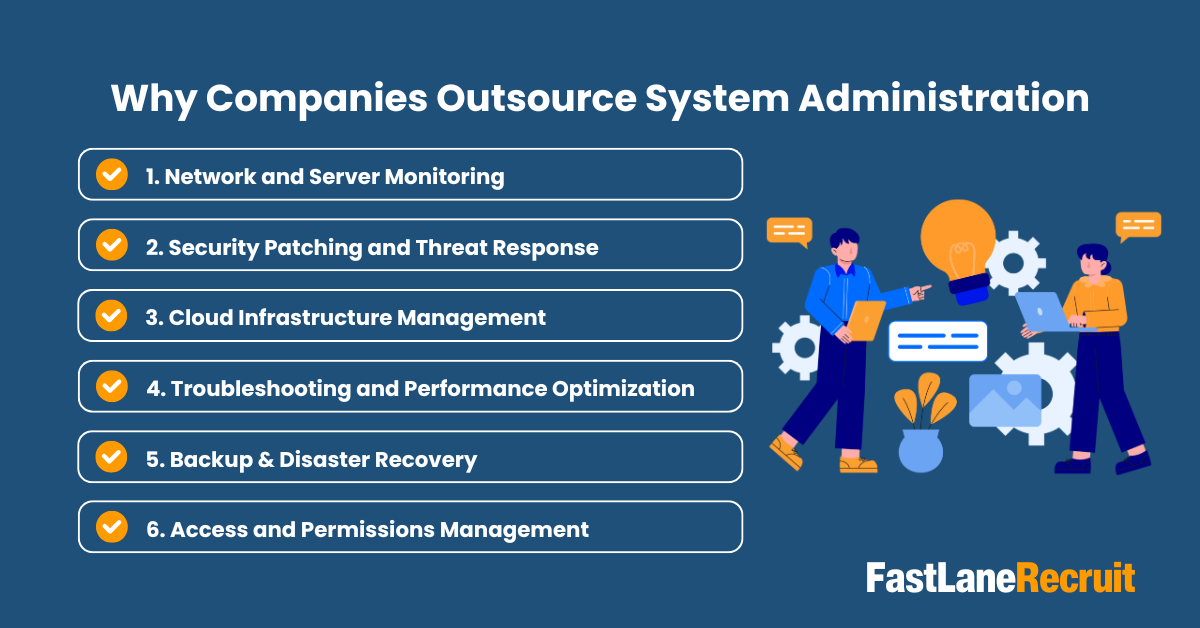
1. Network and Server Monitoring
They continuously monitor servers, networks, and connected devices to catch issues before they turn into major outages. This includes checking system health, performance, and availability.
2. Security Patching and Threat Response
System administrators install security patches, update software, and react quickly to suspicious activity. This helps strengthen the business’s defenses against cyberattacks, ransomware, and data breaches.
Also Read: Top 15 Business Consulting Firms in Australia
3. Cloud Infrastructure Management
Most companies now use cloud platforms like AWS, Azure, or Google Cloud. System administrators handle configuration, deployment, scaling, and ongoing maintenance for these environments.
4. Troubleshooting and Performance Optimization
When systems slow down or stop working, the system administrator diagnoses the root cause and applies solutions. They also optimize systems so applications run smoothly without delays.
5. Backup & Disaster Recovery
They ensure data is backed up properly and create recovery plans so the business can continue operating even after hardware failures, cyber incidents, or accidental data loss.
6. Access and Permissions Management
System administrators control who can access different systems and data. This prevents unauthorized access and keeps sensitive information protected.
Why Outsourcing Makes Sense
When a company doesn’t have strong system administration support, it becomes vulnerable to:
- Unplanned downtime
- Cybersecurity threats
- Poor performance across IT systems
- Data loss or corruption
- Slow user experiences for employees and customers
However, hiring an in-house system administrator can be costly and time-consuming especially for small to mid-sized businesses or companies expanding into new markets.
Outsourcing system administration solves this problem by giving companies access to experienced professionals without the high overhead. Instead of recruiting, training, and managing a full-time employee, businesses can work with a trusted outsourcing partner who provides:
- On-demand technical expertise
- 24/7 system monitoring
- Lower labour and operational costs
- Scalable support as the business grows
- Specialised skill sets in cloud, security, networks, and more
In short, outsourcing system administration allows companies to strengthen their IT infrastructure, reduce risks, and maintain high performance while staying cost-efficient and agile.
Key Benefits of Outsourcing System Administration
1. Significant Cost Savings
Hiring and training full-time IT staff is expensive, especially in high-cost markets. When you outsource to Malaysia or other offshore hubs, you tap into:
- Lower labour costs
- Reduced overhead (equipment, utilities, workspace)
- Flexible staffing models
- No long-term employment obligations
According to the U.S. Small Business Administration (sba.gov), outsourcing helps businesses convert fixed labour expenses into variable costs, improving cash flow and investment capacity.
Also Read: Top 15 HR SaaS Platforms in Australia
Example cost comparison:
| Cost Component | In-House (US/UK) | Offshore (Malaysia) |
| Monthly salary (System Administrator) | USD 5,000–7,500 | USD 1,800–3,000 |
| Benefits & insurance | High | Low |
| Office & equipment | Required | Included in outsourcing |
| Training & upskilling | Continuous | Often supported by the provider |
Outsourcing frees up capital you can reinvest into product development, cybersecurity, or customer-facing improvements.
2. Access to Global Expert Talent
Top outsourced system administrators typically hold certifications such as:
- CompTIA Network+ / Security+
- Microsoft Azure Administrator
- AWS SysOps Administrator
- Cisco CCNA / CCNP
Because outsourcing teams serve multiple clients, they maintain updated skills across:
- LAN/WAN/VPN topologies
- Cloud & hybrid configurations
- Windows, macOS, Linux ecosystems
- Wired, wireless, and SaaS environments
This broad exposure leads to well-rounded troubleshooting skills, faster issue resolution, and stronger security posture.
Also Read: Top 20 Collaboration Tools in Australia
3. 24/7 Coverage and Faster Response Times
Many offshore outsourcing hubs operate in different time zones, enabling true follow-the-sun IT support. This means:
- Critical issues are not left unattended overnight
- Global teams receive consistent coverage
- Downtime is minimized
- Customers experience smoother operations
For example, if your main team is in Europe, outsourcing system administrators in Malaysia or the Philippines allows issues to be handled while your local staff are offline.
4. Reduced Business Risk
IT environments face growing threats: cyberattacks, system failures, ransomware, and compliance violations. Outsourced system admin teams:
- Monitor systems continuously
- Apply security patches promptly
- Enforce backup and recovery processes
- Track regulatory compliance changes
For verification, see cybersecurity guidelines from Cybersecurity & Infrastructure Security Agency (CISA.gov).
By relying on specialised providers, companies avoid the risks of relying on one overstretched internal IT employee.
5. Better Focus for Your Core Team
Managers and internal staff often wear too many hats, from troubleshooting network issues to handling user support.
Outsourcing removes the noise by delegating:
- Routine system maintenance
- Helpdesk workloads
- Cloud configuration
- Performance tuning
- Update and patch cycles
This allows your in-house team to focus on high-value tasks like innovation, customer experience, and product development.
What You Can Outsource to a System Administrator
Here is a clear breakdown of the common tasks you can delegate:
| Area | Tasks You Can Outsource |
| Server Management | Configuration, updates, backups, hardware troubleshooting |
| Network Administration | Router/firewall management, network security, bandwidth optimization |
| Database Management | Database setup, backup, performance monitoring |
| Cloud Infrastructure | AWS/Azure/GCP deployment, scaling, configuration |
| Help Desk Support | L1/L2 technical support, ticket triaging |
| Security Operations | Vulnerability scanning, log monitoring, access control |
This flexibility allows companies to choose full outsourcing or hybrid support models.
Also Read: Top 20 Accounting BPO Providers in Australia
Why Malaysia Is Emerging as a Top Destination for System Administration Outsourcing
Malaysia has rapidly positioned itself as one of Asia’s most reliable and strategic hubs for outsourcing system administration and broader IT functions. Companies across the US, Europe, Australia, and the Middle East increasingly choose to outsource system administration to Malaysia because the country combines strong technical talent, a stable business climate, and cost-effective operations.
Below is a deeper look at why Malaysia stands out:
1. Skilled, English-Speaking IT Workforce
Malaysia consistently produces a large pool of qualified technology graduates each year.
According to the Malaysia Digital Economy Corporation (MDEC), the country generates over 50,000 ICT and engineering graduates annually (source: mdec.my).
This creates a strong talent pipeline of system administrators with expertise in:
- Network management
- Server administration
- Cloud platforms (AWS, Azure, Google Cloud)
- Cybersecurity
- IT support and monitoring
English proficiency is also high, making communication seamless for global teams.
2. Competitive Salary and Operating Costs
One of the biggest reasons companies outsource to Malaysia for system administration roles is the strong cost advantage. Businesses can often achieve significant savings on:
- Salaries
- Office space
- IT equipment
- Benefits
- HR and administrative costs
Compared to hiring in countries like Australia, Singapore, the UK, or the US, the financial savings are substantial while still maintaining a high level of technical expertise.
3. Strong Digital Infrastructure
Malaysia has invested heavily in digital innovation and national tech readiness.
Government-led initiatives such as MyDIGITAL and support from the Ministry of Communications (KKD.gov.my) focus on:
- Expanding high-speed internet
- Enhancing cloud adoption
- Strengthening data governance
- Promoting digital transformation for businesses
This robust infrastructure ensures system administrators working remotely or in outsourced teams can operate efficiently and reliably.
Also Read: Top 20 EOR Services in Australia
4. Mature Cybersecurity Framework
Cybersecurity is a major concern when outsourcing system administration, but Malaysia has built a strong foundation in this area.
Malaysia consistently performs well on global cybersecurity rankings and has been recognized in the International Telecommunication Union’s (ITU) Global Cybersecurity Index (source: itu.int).
The country has established:
- National cybersecurity policies
- Dedicated cyber incident response teams
- Data protection standards
- Mandatory reporting for major breaches
This makes Malaysia a secure and compliant destination for managing sensitive IT operations.
5. Stable, Outsourcing-Friendly Business Environment
Malaysia offers a safe, predictable environment for long-term outsourcing partnerships thanks to:
- Political stability
- Business-friendly tax policies
- A large multinational presence (e.g., Intel, HP, Microsoft, Huawei)
- Outsourcing-friendly laws and digital regulations
As a result, companies do not only outsource system administrator roles for cost efficiency, they choose Malaysia for reliability, scalability, and long-term value.
Tips for Successfully Outsourcing System Administration
To maximize results, consider these best practices:
1. Define measurable goals
Clarify uptime expectations, security requirements, ticket response times, and reporting formats.
2. Choose providers with proven certifications
Ask for cloud certifications, network credentials, or security qualifications.
3. Maintain transparent communication
Weekly check-ins, dashboards, and performance metrics help avoid misunderstandings.
4. Ensure compliance with global standards
Check if the provider adheres to ISO 27001, GDPR, PCI-DSS, or local data protection laws.
5. Start with a pilot period
Begin with a 30–90 day trial to evaluate performance before fully scaling.
Also Read: Top 15 Recruitment Agencies in Australia
Why Consider an EOR for Hiring Malaysian Talent
While outsourcing system administration offers flexibility and cost savings, some companies prefer direct control over their IT staff, especially when specific expertise, day-to-day supervision, or company culture alignment is critical. This is where an Employer of Record (EOR) service can provide the perfect balance.
FastLaneRecruit’s EOR services allow businesses to hire Malaysian system administrators legally and efficiently without the need to establish a local entity. Essentially, you get the benefits of a full local hire while we handle the administrative, legal, and compliance responsibilities on your behalf.
How an EOR Works
When you use FastLaneRecruit as your EOR:
- Payroll Management: We take care of salaries, benefits, and timely payments according to Malaysian labor laws.
- Compliance Assurance: Your employees are fully compliant with local employment regulations, avoiding legal risks.
- Local Contracts: We manage all employment contracts, ensuring they meet Malaysian labor standards.
- Statutory Contributions: Social security, taxes, and other statutory requirements are handled automatically.
- Employee Onboarding: From equipment setup to orientation, we ensure a smooth onboarding experience.
Why an EOR Is Ideal
- You maintain direct control over work assignments, priorities, and daily supervision.
- You avoid the time, cost, and complexity of registering a company in Malaysia.
- You gain legal and HR support, reducing risks associated with hiring in a foreign market.
- It’s scalable: hire one system administrator or build a full IT team without operational headaches.
In short, FastLaneRecruit’s EOR service provides a safe, compliant, and cost-efficient way to hire and manage Malaysian system administration talent while maintaining full control over their work.
Conclusion
Outsourcing system administration provides global businesses with access to expert talent, stronger security, lower costs, and reliable 24/7 coverage. Whether you want to outsource system administrator tasks entirely or hire dedicated Malaysian professionals through an EOR solution, outsourcing remains one of the most strategic ways to scale efficiently and securely.
By partnering with trusted outsourcing locations like Malaysia and leveraging modern models such as FastLaneRecruit’s EOR, you can ensure your IT infrastructure remains secure, optimized, and ready to support long-term business growth.
Ready to Strengthen Your IT Operations?
FastLaneRecruit helps global companies find and manage skilled system administrators, whether through outsourcing or direct hiring via our Malaysia EOR service.
Contact us to build your offshore IT team or hire Malaysian system administration talent, fast, compliant, and cost-efficient.