Managing finances is one of the most important responsibilities for any business. From recording daily transactions to preparing financial reports and staying compliant with tax regulations, accounting and bookkeeping require accuracy, time, and expertise.
For many companies, especially startups, SMEs, and fast-growing organizations, maintaining an in-house accounting team can become complex and expensive. This is why businesses around the world are increasingly choosing to outsource accounting and bookkeeping services to experienced professionals.
But one key question always comes up:
How much does it cost to outsource accounting and bookkeeping?
The cost can vary depending on your business size, the complexity of your finances, and the level of support required. In this guide, we’ll break down the typical cost ranges, pricing models, and key factors that influence outsourcing costs. We’ll also explore how businesses can reduce operational costs while gaining access to expert financial support, particularly when outsourcing to regions such as Malaysia.
Content Outline
Key Summary
Cost Savings
Outsourcing accounting reduces overhead costs like salaries, benefits, software, and office expenses, offering 40–60% savings compared to in-house teams.
Flexible Pricing Models
Businesses can choose hourly billing, monthly retainers, tiered packages, transaction-based, or value-based pricing depending on their needs.
Range of Services
Common services include bookkeeping, payroll, financial reporting, tax preparation, accounts payable/receivable, cash flow management, and strategic financial planning.
Scalability for Growth
Outsourced accounting services can scale with your business, from basic bookkeeping for startups to comprehensive CFO-level advisory for larger enterprises.
Financial Accuracy and Visibility
Professional providers use advanced tools and reporting systems to deliver accurate financial data, helping owners make informed strategic decisions.
Hidden Costs Awareness
Onboarding fees, custom reports, software licenses, and data migration costs may arise. Reviewing contracts ensures predictable pricing.
Employer of Record (EOR) Advantage
Hiring Malaysian accountants via an EOR gives businesses dedicated staff without establishing a local entity, ensuring compliance, cost efficiency, and seamless integration.
What Is Outsourced Accounting and Bookkeeping?
Outsourced accounting refers to delegating financial management tasks to an external accounting provider rather than handling them internally. Instead of hiring and managing a full accounting department, businesses work with specialists who manage financial processes remotely.
Common outsourced accounting services include:
- Bookkeeping and transaction recording
- Accounts payable and accounts receivable management
- Payroll processing
- Financial reporting and statements
- Cash flow forecasting
- Tax reporting and compliance
- Budget planning and financial analysis
Outsourcing allows businesses to access experienced accountants and modern financial tools without the overhead of building an in-house team.
Also Read: Offshore Vs Local: Accountants 2025 Salary Benchmark Report (Australia Vs Malaysia Edition)
Why Businesses Outsource Accounting and Bookkeeping
Many organizations choose to outsource their accounting and bookkeeping functions not only to manage costs but also to improve efficiency, accuracy, and access to professional expertise. Financial management plays a crucial role in every business, and outsourcing allows companies to maintain high standards without building a large internal team.
Below are some of the key reasons why businesses around the world decide to outsource their accounting and bookkeeping operations.
1. Reduce Operational Costs
Maintaining an in-house accounting team involves more than just paying a salary. Businesses must also consider additional costs such as employee benefits, payroll taxes, office space, accounting software subscriptions, and ongoing training. These expenses can quickly add up, especially for small and growing companies.
By outsourcing accounting and bookkeeping services, businesses can significantly reduce these overhead costs. Instead of hiring full-time employees, companies pay only for the services they need. This allows organizations to manage their finances more efficiently while keeping operational expenses under control.
2. Access to Experienced Professionals
Accounting requires specialized knowledge, attention to detail, and familiarity with financial regulations. Outsourced accounting providers typically have teams of experienced professionals, including accountants, bookkeepers, and financial analysts, who manage financial operations for multiple businesses across different industries.
Working with these experts allows companies to benefit from professional-level financial management without going through the lengthy process of recruiting, hiring, and training internal staff. These professionals also stay updated with changing regulations, accounting standards, and financial best practices, helping businesses maintain accurate and compliant financial records.
3. Scalability as Your Business Grows
Business needs often change over time. A startup may only need basic bookkeeping support, while a growing company might require payroll management, tax planning, and financial forecasting.
Outsourced accounting services are flexible and scalable. Businesses can start with essential services and gradually expand their support as operations grow. This flexibility makes outsourcing particularly valuable for companies experiencing rapid growth or seasonal fluctuations in workload.
4. Better Financial Visibility
Clear financial insights are essential for making informed business decisions. Professional accounting providers use modern accounting software and reporting systems to deliver accurate financial data, including balance sheets, profit and loss statements, and cash flow reports.
These reports help business owners and executives understand their financial performance, identify opportunities for improvement, and plan future investments with confidence. Improved financial visibility also supports better budgeting, forecasting, and long-term strategic planning.
5. More Time for Core Business Activities
Accounting tasks such as reconciling accounts, processing payroll, managing invoices, and preparing financial reports can consume a significant amount of time. For business owners and leadership teams, handling these tasks internally can distract from more important responsibilities.
By outsourcing accounting and bookkeeping, businesses free up valuable time and resources. This allows leadership teams to focus on activities that drive growth, such as developing new products, improving customer experiences, expanding into new markets, and building stronger business strategies.
Overall, outsourcing accounting and bookkeeping enables businesses to maintain reliable financial management while gaining the flexibility, expertise, and efficiency needed to support long-term growth.
Also Read: Building a High-Performing Offshore Accounting Team in Malaysia (Singapore Edition)
Average Cost of Outsourced Accounting and Bookkeeping
The cost of outsourcing accounting and bookkeeping can vary depending on the size of your business, the complexity of your financial operations, and the level of services required. Some companies only need basic bookkeeping support, while others require a full accounting solution that includes payroll management, tax preparation, and financial planning.
In general, the more comprehensive the service package, the higher the monthly cost. However, many businesses find that outsourcing still provides significant value compared to maintaining an internal accounting department.
Below is a general overview of typical monthly pricing ranges for outsourced accounting services.
Typical Monthly Cost Ranges
| Service Level | Typical Monthly Cost | What It Includes |
| Basic bookkeeping | $500 – $2,500 | Transaction recording, bank reconciliations, basic financial reports |
| Standard accounting services | $2,000 – $5,000 | Bookkeeping, payroll processing, tax preparation, financial reporting |
| Comprehensive accounting support | $5,000 – $10,000+ | Full accounting department support, financial analysis, and CFO-level advisory |
Basic Bookkeeping Services
Basic bookkeeping services are designed for small businesses or startups that mainly need help organizing their financial records. This usually includes recording daily transactions, reconciling bank statements, and preparing simple financial reports. These services ensure that financial records remain accurate and up to date while helping business owners understand their financial position.
Standard Accounting Services
Many businesses choose a more complete accounting package that includes bookkeeping along with additional financial management tasks. These services often include payroll processing, tax preparation support, and regular financial reporting. This level of service is suitable for companies that want consistent financial oversight but do not require a full internal accounting department.
Comprehensive Accounting Support
Larger companies or rapidly growing businesses may require a more advanced accounting solution. Comprehensive outsourced accounting support can function similarly to a full accounting department. In addition to bookkeeping and payroll, it may include financial forecasting, budgeting assistance, regulatory compliance support, and strategic financial advisory from experienced accountants or CFO-level professionals.
Hourly Pricing Options
Some accounting providers also offer hourly pricing, particularly for short-term projects or specialized financial tasks. Hourly rates typically range between $25 and $250 per hour, depending on the accountant’s expertise, the complexity of the work, and the location of the service provider. This pricing model can be useful for businesses that need occasional assistance rather than ongoing monthly services.
Long-Term Cost Benefits of Outsourcing
Although pricing varies depending on the level of service, outsourcing accounting and bookkeeping can still lead to substantial long-term savings. Maintaining an in-house accounting team often requires significant investment in salaries, benefits, training, office infrastructure, and accounting software.
By outsourcing these functions, businesses can access professional financial expertise without carrying the full overhead costs of internal staffing. In many cases, companies report reducing operational expenses by approximately 40% to 60% when switching from an in-house accounting team to outsourced accounting services.
For businesses looking to improve financial management while maintaining cost efficiency, outsourced accounting can provide a practical and scalable solution.
Also Read: Building a High-Performing Offshore Accounting Team in Malaysia (Hong Kong Edition)
Common Pricing Models for Outsourced Accounting
Accounting service providers typically offer several pricing structures to suit different types of businesses. The pricing model used often depends on the scope of work, level of support required, and the complexity of a company’s financial operations. Understanding these pricing options can help businesses choose the most suitable arrangement based on their budget, operational needs, and long-term growth plans.
Below are some of the most common pricing models used in outsourced accounting services.
Typical Pricing Models
| Pricing Model | Description | Best For |
| Hourly billing | Pay for the hours worked by accountants | Short-term projects or occasional support |
| Monthly retainer | Fixed monthly fee for ongoing accounting services | Businesses needing consistent financial management |
| Tiered packages | Service bundles designed for different business sizes | Growing SMEs |
| Transaction-based pricing | Charges per invoice, reconciliation, or transaction | High-volume businesses |
| Value-based pricing | Fees based on outcomes and advisory services | Strategic financial consulting |
Hourly Billing
Hourly billing is one of the simplest pricing models used in outsourced accounting. In this arrangement, businesses pay for the actual number of hours spent on their accounting tasks. This model is commonly used for one-time projects, financial clean-up tasks, audits, or specialized consulting work.
For example, a business may hire an accounting provider to help reconcile several months of financial records or prepare documents for tax filing. Since the work is temporary, paying by the hour can be a practical option.
However, hourly billing may not always provide predictable monthly costs, which is why it is often used only for short-term engagements rather than ongoing financial management.
Monthly Retainer
A monthly retainer is one of the most widely used pricing models for outsourced accounting services. With this structure, businesses pay a fixed monthly fee for a predefined set of accounting services.
These services may include bookkeeping, payroll processing, financial reporting, and compliance support. Because the fee remains consistent each month, companies can plan their budgets more easily and maintain continuous financial oversight.
Monthly retainers are ideal for businesses that require ongoing accounting support and regular financial reporting.
Also Read: Building a High-Performing Offshore Accounting Team in Malaysia (Australia Edition)
Tiered Service Packages
Many accounting providers offer tiered service packages designed to match the needs of different business sizes. These packages are typically structured into levels such as Basic, Standard, and Premium, each offering a different set of services.
For example:
- A Basic package might include bookkeeping and monthly reports.
- A Standard package may add payroll processing and tax preparation support.
- A Premium package could include financial analysis, budgeting, and strategic advisory services.
Tiered packages are especially useful for small and medium-sized businesses (SMEs) because they allow companies to choose a service level that aligns with their current needs while leaving room to upgrade as the business grows.
Transaction-Based Pricing
Transaction-based pricing is commonly used by businesses that process a large number of financial transactions each month. Instead of paying a flat monthly fee, companies are charged based on the number of transactions handled by the accounting provider.
Examples of billable transactions may include:
- Processing invoices
- Reconciling bank statements
- Recording expenses
- Managing accounts payable and receivable
This model works well for companies with high transaction volumes, such as e-commerce businesses or companies with large supplier networks.
Value-Based Pricing
Value-based pricing focuses on the outcomes and strategic value provided by the accounting service rather than the number of hours worked or transactions processed. This model is often used for financial advisory services, business forecasting, and CFO-level support.
Instead of charging based solely on time or workload, providers price their services based on the business impact they deliver. For example, strategic financial insights that help improve cash flow management or support expansion decisions may fall under this pricing model.
Why Monthly Retainers Are Common
Among all the pricing options, monthly retainers are the most commonly used model because they provide predictable costs and consistent support. Businesses benefit from regular financial monitoring, timely reporting, and continuous access to accounting professionals without worrying about fluctuating fees.
For organizations looking for stable financial management and long-term accounting support, a monthly retainer often provides the best balance between cost predictability and service quality.
Also Read: Types Of Accounting Services That Can Be Outsourced
What Services Are Included When You Outsource Accounting?
Outsourcing accounting allows businesses to delegate financial management tasks to experienced professionals, giving them more time to focus on core operations. The exact services provided can vary depending on the provider, the business size, and the complexity of financial operations. Typically, outsourced accounting combines bookkeeping, financial management, and compliance services to provide a complete solution.
Below is a breakdown of the most common services offered by outsourced accounting providers.
Common Outsourced Accounting Services
| Service | Description | Benefits |
| Accounts Payable (AP) | Managing invoices, vendor payments, and due dates | Ensures timely payments, maintains good vendor relationships, reduces late fees |
| Accounts Receivable (AR) | Tracking customer invoices, payments, and outstanding balances | Improves cash flow, reduces overdue accounts, provides clear insight into incoming revenue |
| Payroll Processing | Calculating salaries, handling deductions, and ensuring payroll compliance | Saves time, reduces errors, and ensures staff are paid accurately and on time |
| Financial Reporting | Preparing monthly, quarterly, or annual financial statements | Provides transparency, helps track business performance, and supports informed decision-making |
| Tax Preparation | Filing tax reports, ensuring compliance with local regulations | Minimizes errors, avoids penalties, and supports strategic tax planning |
| Financial Planning & Analysis | Budgeting, forecasting, and analyzing financial data | Helps businesses make strategic decisions, allocate resources efficiently, and plan for growth |
Customization and Flexibility
One of the main advantages of outsourced accounting is flexibility. Businesses can choose a bundled package that includes all the essential services or create a customized plan tailored to their specific needs. For example:
- Startups or small businesses may only require basic bookkeeping, payroll, and financial reporting.
- Growing companies might need more advanced services such as tax planning, budgeting, and cash flow forecasting.
- Large enterprises or franchises often opt for comprehensive accounting solutions that include CFO-level advisory services, multi-entity management, and specialized compliance support.
By outsourcing accounting services, businesses gain access to a team of skilled professionals who can handle complex financial operations, ensure regulatory compliance, and provide strategic insights, all without the overhead costs of hiring a full in-house accounting team.
This combination of services allows companies to improve accuracy, reduce operational strain, and make smarter financial decisions while scaling efficiently as the business grows.
Also Read: How to Hire an Offshore Accountant in Malaysia
Outsourcing vs. Hiring an In-House Accountant
For many businesses, one of the biggest considerations when deciding between outsourcing accounting and hiring an in-house accountant is cost efficiency. Beyond just salary, an in-house accounting team comes with several additional expenses and limitations that can impact a company’s budget and flexibility. Outsourcing offers an alternative that often provides more value and scalability.
Cost Comparison: In-House vs. Outsourced Accounting
| Cost Element | In-House Accountant | Outsourced Accounting | Benefits of Outsourcing |
| Salary | $60,000 – $80,000 per year | Included in service pricing | No need to commit to full-time salaries, freeing budget for other priorities |
| Payroll Taxes | Additional employer tax obligations | Included | Eliminates extra tax costs and administrative work |
| Employee Benefits | Health insurance, paid leave, retirement contributions | Not required | Reduces overhead and simplifies HR responsibilities |
| Office Space & Equipment | Required (desk, computer, software licenses, office supplies) | Not required | Saves on office setup and maintenance costs |
| Accounting Software | Typically purchased separately | Often included in service package | Access to modern, cloud-based accounting tools without extra cost |
| Scalability | Limited by hiring capacity | Highly flexible | Easily scale services up or down based on business growth and seasonal needs |
Key Advantages of Outsourcing
- Access to Expert Teams – Outsourced accounting provides a team of professionals, including accountants, bookkeepers, and financial specialists. This collective expertise is often broader and more specialized than a single in-house hire.
- Predictable Costs – Monthly retainers or fixed pricing allow businesses to plan their budgets without unexpected expenses.
- Scalability and Flexibility – As your business grows or experiences seasonal fluctuations, outsourced services can adjust to meet your needs, from basic bookkeeping to full-service accounting with CFO advisory.
- Reduced Administrative Burden – Outsourcing removes responsibilities such as hiring, training, HR management, and software procurement. This allows your team to focus on core business activities and strategic growth.
- Faster Implementation – Outsourced providers often have ready-to-use systems and tools, meaning businesses can implement professional accounting services quickly without lengthy onboarding.
In short, outsourcing accounting offers businesses the ability to leverage professional expertise, reduce operational costs, and scale financial support efficiently, without the long-term commitments and hidden costs of an in-house team.
Factors That Affect Outsourcing Costs
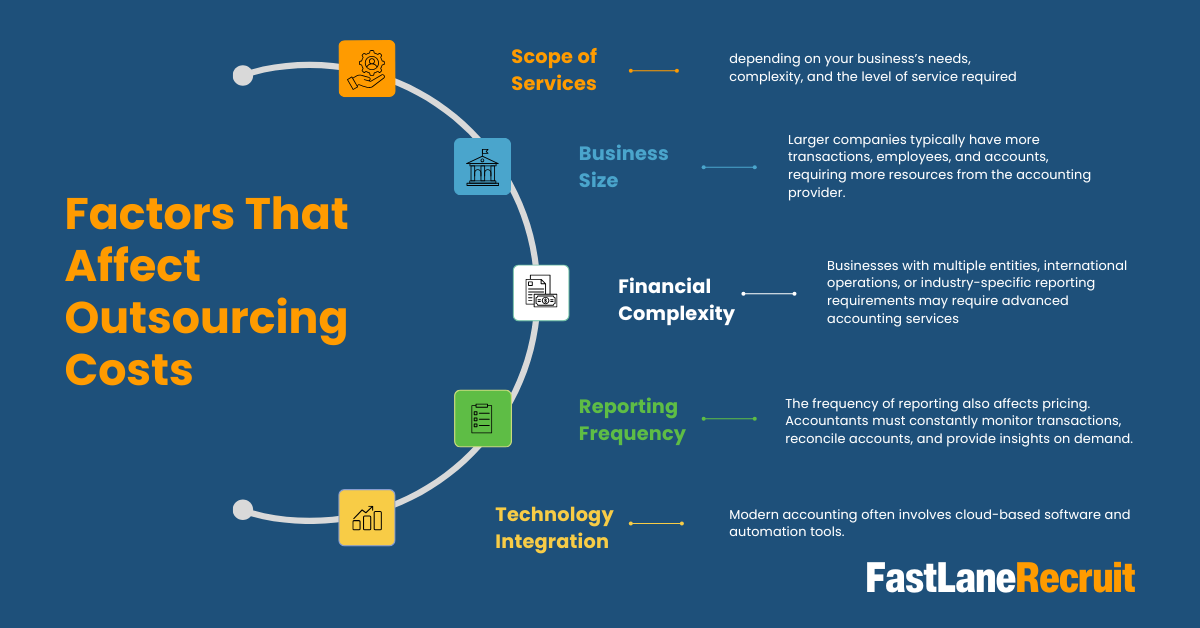
The cost of outsourced accounting isn’t a fixed number; it varies depending on your business’s needs, complexity, and the level of service required. Understanding the main cost drivers can help you plan your budget and select the right provider.
1. Scope of Services
The range of services you need is one of the biggest factors influencing pricing. Basic bookkeeping, such as recording transactions and reconciling accounts, generally costs less than full-service accounting, which may include:
- Payroll management
- Tax preparation and compliance
- Financial planning and forecasting
- CFO-level advisory services
Example: A small café that only needs monthly bookkeeping and payroll might pay around $500–$1,500 per month, while a medium-sized retail company requiring full accounting services could spend $3,000–$5,000 monthly.
2. Business Size
Larger companies typically have more transactions, employees, and accounts, requiring more resources from the accounting provider.
Example: A franchise with 10 locations will need a team to handle multiple bank accounts, invoices, payroll for hundreds of employees, and consolidated reporting—leading to higher monthly costs compared to a single-location business.
3. Financial Complexity
Businesses with multiple entities, international operations, or industry-specific reporting requirements may require advanced accounting services, which naturally increase the cost.
Example: A company operating across multiple countries might need support with foreign currency management, multi-jurisdiction tax compliance, and consolidated financial statements, whereas a local small business may only need simple bookkeeping and payroll.
4. Reporting Frequency
The frequency of reporting also affects pricing. Real-time or weekly financial reporting requires more effort and resources than monthly or quarterly reports, as accountants must constantly monitor transactions, reconcile accounts, and provide insights on demand.
Example: A growing e-commerce business tracking inventory and sales daily may choose weekly reports to quickly respond to trends, which could cost more than a business that only requires end-of-month financial statements.
5. Technology Integration
Modern accounting often involves cloud-based software and automation tools. Integrating these platforms into your systems may impact pricing depending on the complexity of setup and the tools used.
Example: A business that wants automated invoice processing, real-time dashboard analytics, and integration with payroll or CRM software may pay more upfront for setup and slightly higher monthly fees, but will benefit from increased efficiency and accuracy over time.
Summary
Ultimately, the cost of outsourcing accounting depends on how comprehensive, complex, and technology-driven your financial operations are. Businesses that understand these factors can better estimate their budgeting needs and choose a service that aligns with their goals.
Hidden Costs to Watch for When Outsourcing Accounting
Outsourcing accounting offers significant advantages, but like any service, it’s important to understand potential hidden costs before committing. These costs can catch businesses off guard if they aren’t explicitly addressed in service agreements. Being aware of them ensures your budgeting stays accurate and your partnership with the provider runs smoothly.
Common Hidden Costs
- Onboarding or Setup Fees
Some providers charge a one-time fee to set up your accounts, migrate data, and establish reporting systems. This fee covers the time and effort required to get your accounting processes up and running, but it can vary depending on the complexity of your business.
Example: A business with multiple bank accounts and prior accounting data might face higher setup fees than a simple single-entity company.
- Custom Reporting Charges
Standard packages usually include basic reports, but if you need customized financial reports or dashboards tailored to your business goals, some providers may charge extra.
Example: A restaurant chain wanting sales performance reports by location or menu item may incur additional fees for creating these custom reports.
- Software Licensing Fees
Not all outsourced accounting services include software costs in their package. You might need to purchase licenses for accounting platforms, payroll systems, or reporting tools separately.
Example: Cloud accounting software like Xero or QuickBooks may require additional subscription fees if the provider doesn’t include it in their package.
- Data Migration Costs
Transferring historical accounting data from your current system to the provider’s platform can require extra time and resources. Some providers charge for data cleaning, formatting, or migration support.
Example: A company moving 5 years of financial records to a new cloud system may incur additional fees for data import and validation.
- Additional Services Outside the Contract Scope
If you request services not included in the initial agreement—such as ad hoc audits, financial consulting, or emergency tax filings—providers may charge extra for these tasks.
Example: Handling payroll for a seasonal surge in employees might fall outside the standard contract and require a temporary fee adjustment.
How to Avoid Unexpected Costs
- Ask for a detailed pricing breakdown before signing any contract. Make sure setup, software, and custom reporting costs are clearly outlined.
- Clarify service scope so both parties agree on what’s included and what counts as an additional service.
- Review onboarding procedures and confirm if data migration is part of the package or billed separately.
- Maintain open communication with your provider to discuss changes in your business needs and potential cost implications in advance.
By proactively identifying these potential hidden costs, businesses can ensure predictable pricing, transparent services, and a smooth outsourcing experience, maximizing the benefits of professional accounting support.
Tips for Choosing the Right Accounting Outsourcing Partner
Selecting the right provider is essential for long-term success.
Key factors to evaluate:
Professional certifications
Look for accountants with recognized qualifications such as CPA, ACCA, or equivalent credentials.
Industry experience
Choose providers familiar with your business sector.
Technology capabilities
Ensure they use modern accounting software and cloud tools.
Data security standards
Financial information must be handled securely and confidentially.
Communication and reporting processes
Clear communication and regular financial reporting help maintain transparency.
Also Read: Why Malaysia Is a Strategic Hub for Offshore Accountants
Why Malaysia Is a Strategic Destination for Accounting Outsourcing
Many global businesses choose Malaysia as a preferred outsourcing destination for financial and professional services.
Malaysia offers a strong combination of skilled professionals, modern infrastructure, and international business experience.
Organizations such as Malaysia Digital Economy Corporation actively promote digital talent development and outsourcing capabilities in the region, while trade initiatives from Malaysia External Trade Development Corporation support international business collaboration.
Advantages of Outsourcing Accounting to Malaysia
| Advantage | Why It Matters |
| Skilled accounting professionals | Many accountants hold internationally recognized qualifications |
| English-proficient workforce | Enables smooth communication with global companies |
| Strong digital infrastructure | Supports remote collaboration and cloud accounting |
| Cost-efficient operations | Helps businesses reduce operational costs |
| Government support for outsourcing | National initiatives encourage digital services growth |
These factors make Malaysia an increasingly attractive destination for companies looking to outsource financial operations.
Alternative Solution: Hiring Malaysian Accountants Through an Employer of Record
While traditional outsourcing works well for many businesses, some organizations prefer having dedicated accountants and bookkeepers fully integrated into their internal team. This is where Employer of Record (EOR) service comes in as a flexible and efficient solution.
What Is an Employer of Record (EOR)?
An EOR allows businesses to hire skilled employees in another country without the need to establish a local legal entity. Essentially, the EOR acts as the official employer for compliance purposes, handling all employment-related responsibilities such as:
- Payroll processing
- Benefits administration
- Tax compliance
- Employment contracts and legal obligations
Meanwhile, the employee works directly with your business, following your workflows and reporting lines. This model combines the control of in-house hiring with the ease of outsourcing, making it ideal for global expansion.
Why Use an EOR for Accounting Teams?
For accounting and bookkeeping functions, hiring through an EOR provides several advantages:
- Access to Skilled Malaysian Accountants – Malaysia has a strong pool of qualified accounting professionals experienced in bookkeeping, financial reporting, tax preparation, and compliance.
- Cost Efficiency – Reduce operational costs associated with setting up a foreign entity while still having dedicated employees.
- Regulatory Compliance – The EOR ensures all local labor laws and employment regulations are met, mitigating legal risks.
- Scalability – Quickly expand your accounting team as your business grows without lengthy recruitment processes or legal setup.
- Integration with Your Team – Unlike standard outsourcing, employees hired through an EOR work as part of your internal operations, giving you greater control and alignment with your business goals.
Hire Malaysian Accounting Talent with FastLaneRecruit
FastLaneRecruit’s Employer of Record (EOR) service enables businesses to hire talented Malaysian accountants efficiently and reliably. Whether you need bookkeeping support, financial reporting, payroll, or tax services, FastLaneRecruit connects you with professionals who integrate seamlessly into your team.
Benefits of Partnering with FastLaneRecruit EOR:
- Hire qualified Malaysian accountants without establishing a local entity.
- Access a global talent pool while reducing operational costs.
- Ensure full compliance with Malaysian employment regulations.
- Quickly scale accounting teams as business needs evolve.
Example Use Case:
A growing e-commerce company in Europe wants a dedicated accounting team in Malaysia to handle daily bookkeeping, payroll, and monthly financial reporting. Using FastLaneRecruit’s EOR service, the company hires three skilled accountants who work directly with their finance department while the EOR manages compliance, payroll, and benefits, saving setup time and costs compared to opening a local office.
By leveraging an EOR like FastLaneRecruit, businesses get the best of both worlds: professional accounting expertise, operational efficiency, and compliance assurance, all while maintaining flexibility and control over their team.
Conclusion
Outsourcing accounting and bookkeeping can be a strategic move for businesses that want to improve financial management while controlling operational costs.
Depending on the level of support required, outsourced accounting services typically range from $500 to $10,000 per month. While costs vary based on factors such as business size, complexity, and service scope, outsourcing often delivers significant value through professional expertise, scalable support, and improved financial visibility.
For companies seeking long-term flexibility and dedicated accounting talent, solutions like FastLaneRecruit’s Employer of Record service provide an effective way to access skilled Malaysian professionals without the complexity of international hiring.
By choosing the right outsourcing partner or hiring model, businesses can strengthen their financial operations and focus on what matters most: growth and strategic success.
Ready to Streamline Your Accounting and Boost Efficiency?
Don’t let complex bookkeeping and accounting tasks slow down your business growth. Whether you’re looking to reduce operational costs, gain access to experienced accounting professionals, or scale your finance team quickly, there’s a smarter way forward.
FastLaneRecruit’s Employer of Record (EOR) service makes it easy to hire skilled Malaysian accountants and bookkeepers who integrate seamlessly with your team without the hassle of setting up a local entity. From bookkeeping and payroll to financial reporting and tax compliance, our experts handle the heavy lifting so you can focus on growing your business.
Connect with FastLaneRecruit and discover how outsourcing your accounting with our EOR service can save time, cut costs, and deliver reliable, expert financial support.
Frequently Asked Questions
1. How much does it cost to outsource accounting and bookkeeping?
The cost of outsourced accounting typically ranges from $500 to $10,000 per month, depending on the services required, transaction volume, and business complexity. Basic bookkeeping services generally start around $500 per month, while full-service accounting that includes payroll, tax preparation, and financial reporting can cost several thousand dollars monthly.
2. Is outsourcing accounting cheaper than hiring an in-house accountant?
Yes. Hiring an in-house accountant can cost $60,000 to $80,000 per year or more, excluding benefits, payroll taxes, and office expenses. Outsourcing allows businesses to access professional accounting services at a lower overall operational cost while maintaining financial accuracy and compliance.
3. What services are included in outsourced accounting?
Outsourced accounting services usually include bookkeeping, accounts payable and receivable management, payroll processing, financial reporting, tax preparation, and financial planning. Some providers also offer CFO-level advisory services and business forecasting.
4. What factors affect the cost of outsourcing accounting?
Several factors influence outsourcing costs, including the scope of services required, the size of the business, the number of financial transactions, reporting frequency, and the complexity of financial operations.
5. Can outsourced accounting services scale as my business grows?
Yes. One of the main advantages of outsourcing is scalability. Businesses can start with basic bookkeeping services and expand to full financial management, payroll processing, and strategic financial advisory as their operations grow.
6. Why do companies outsource accounting to Malaysia?
Malaysia has become a preferred destination for outsourcing because of its skilled accounting professionals, strong digital infrastructure, and English-speaking workforce. Businesses can access experienced talent while reducing operational costs and maintaining global financial standards.
7. What is an Employer of Record (EOR) and how does it help with hiring accountants?
An Employer of Record (EOR) allows companies to hire international professionals without establishing a local legal entity. The EOR handles payroll, compliance, and employment administration while the employee works directly with the company’s internal team.