
Malaysia remains one of Southeast Asia’s most attractive destinations for business expansion, talent acquisition, and regional operations. With a highly skilled workforce, competitive labor costs, and a strategic location in ASEAN, the country continues to attract multinational companies and startups alike.
However, employers hiring in Malaysia must comply with local employment laws, including the minimum wage regulations established by the Malaysian government. Failure to comply can result in penalties, reputational risks, and payroll complications.
Whether you are a local employer, foreign investor, or international company planning to hire Malaysian talent, understanding the latest minimum wage in Malaysia is essential for maintaining compliance and managing workforce costs effectively.
This guide explains the Malaysia minimum wage for 2026, employer obligations, payroll considerations, compliance requirements, and why many foreign businesses choose an Employer of Record (EOR) rather than incorporating a local company.
Content Outline
Key Summary
Malaysia’s Minimum Wage Remains RM1,700 Per Month
The current nationwide minimum wage in Malaysia is RM1,700 per month for eligible employees.
The Hourly Minimum Wage Is RM8.72
Employers paying workers based on hours must ensure compensation meets the minimum hourly wage requirement.
Foreign Workers Are Also Covered
The minimum wage applies to both Malaysian and foreign employees working under a contract of service.
Employers Must Meet Additional Payroll Obligations
Compliance involves more than salary payments and includes EPF, SOCSO, EIS, tax deductions, and payroll reporting.
EOR Services Offer a Faster Alternative to Company Incorporation
Foreign companies can hire employees legally in Malaysia through an Employer of Record without establishing a local entity.
What Is the Current Minimum Wage in Malaysia?
The current minimum wage in Malaysia is RM1,700 per month.
The increase took effect under the Minimum Wages Order 2024 and represents the latest adjustment by the Malaysian government to improve living standards and keep wages aligned with economic conditions.
The minimum wage serves as the lowest legal amount an employer can pay an eligible employee. Employers cannot offer salaries below this threshold unless specifically exempted under applicable regulations.
The Malaysia minimum wage applies nationwide, creating a standardized wage floor across all states and federal territories.
For businesses, the minimum wage should be viewed as a legal baseline rather than a market benchmark. Skilled professionals in sectors such as technology, finance, engineering, healthcare, and digital services often command salaries significantly above the statutory minimum.
Malaysia Minimum Wage 2026 at a Glance
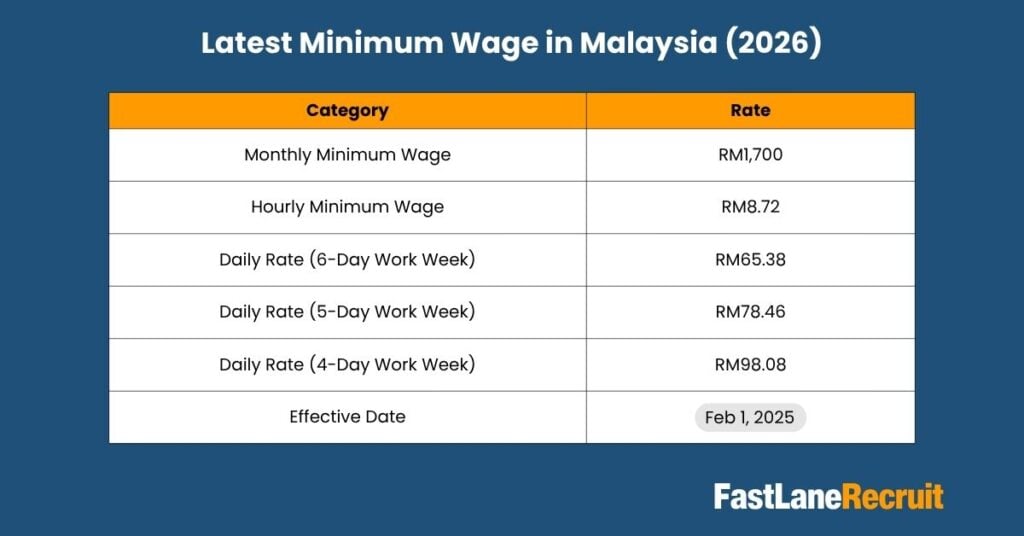
Although no new increase has been officially announced for 2026 at the time of writing, employers should continue monitoring future government reviews and wage policy updates.
History of Minimum Wage in Malaysia
Understanding how Malaysia’s wage policy has evolved helps employers anticipate future adjustments.
| Monthly Minimum Wage | |
| 2013 | RM900 |
| 2016 | RM1,000 |
| 2019 | RM1,100 |
| 2022 | RM1,500 |
| 2025 | RM1,700 |
Malaysia introduced its first nationwide minimum wage policy in 2013. Since then, wage levels have gradually increased to address inflation, labor market conditions, and rising living costs.
Who Is Covered Under Malaysia’s Minimum Wage Law?
The minimum wage in Malaysia generally applies to:
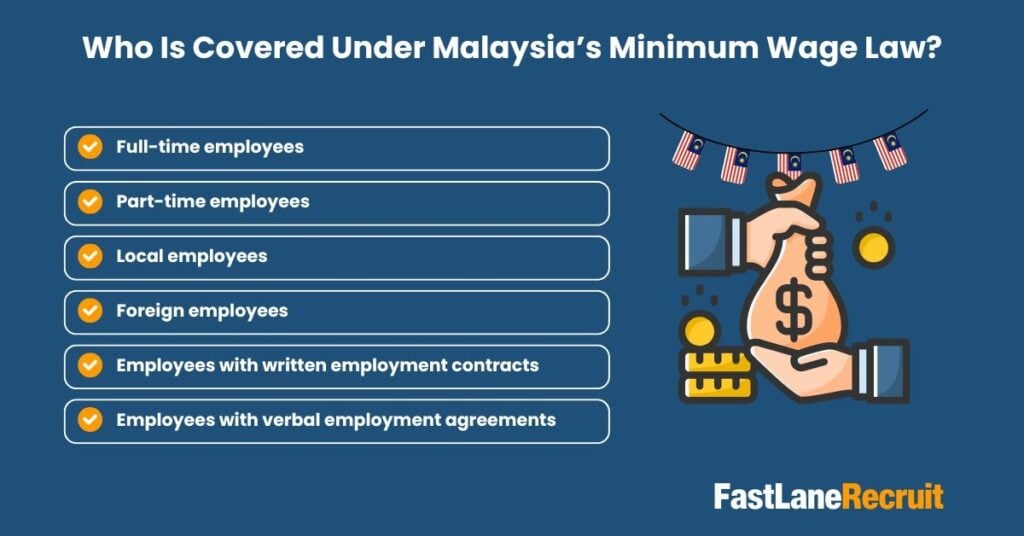
The law covers most workers engaged under a contract of service.
For international employers, this means foreign employees hired in Malaysia cannot be paid below the prescribed minimum wage simply because they are expatriates or migrant workers.
Who Is Exempt From the Malaysia Minimum Wage?
Certain categories of workers may not fall under standard minimum wage regulations.
These commonly include:
- Domestic servants
- Domestic helpers
- Certain apprenticeship arrangements
- Categories specifically exempted under government regulations
Employers should seek professional advice before assuming an employee qualifies for an exemption.
Does the Minimum Wage Apply to Foreign Workers?
One of the most frequently searched questions is whether foreign workers are entitled to the Malaysia minimum wage.
The answer is clear: foreign employees working under a contract of service are generally entitled to receive the same minimum wage protections as Malaysian citizens.
Employers cannot legally pay migrant workers below the statutory wage simply because of nationality.
This requirement applies across industries including:
- Manufacturing
- Construction
- Hospitality
- Logistics
- Retail
- Services
How Much Is Minimum Wage in Malaysia Per Hour?
The minimum hourly wage in Malaysia is RM8.72 per hour.
This rate is particularly important for:
- Part-time employees
- Shift workers
- Retail staff
- Hospitality workers
- Temporary employees
Employers using hourly compensation structures must ensure the total pay received meets or exceeds the prescribed hourly minimum.
How to Calculate Minimum Wage in Malaysia
Many employers ask how minimum wage calculations work in practice.
Monthly Employees
For employees receiving a monthly salary:
Monthly Salary = Minimum RM1,700
Employers cannot reduce compensation below this threshold.
Hourly Employees
Hourly Wage × Total Hours Worked
Example:
- Hourly Rate: RM8.72
- Monthly Hours Worked: 180
Monthly Earnings:
RM8.72 × 180 = RM1,569.60
In this situation, employers must ensure compliance with applicable wage regulations and working hour requirements.
Daily Wage Calculation
Daily rates vary depending on the number of working days per week.
| Working Days Per Week | Daily Wage |
| 6 Days | RM65.38 |
| 5 Days | RM78.46 |
| 4 Days | RM98.08 |
Employer Payroll Obligations Beyond Minimum Wage
Many foreign businesses mistakenly assume compliance ends once the minimum salary is paid.
In reality, employers must also manage:
Employees Provident Fund (EPF)
Mandatory retirement savings contributions.
Social Security Organisation (SOCSO)
Provides protection against workplace injuries and disability.
Employment Insurance System (EIS)
Offers financial assistance to eligible unemployed workers.
Monthly Tax Deductions (PCB)
Employers may be required to deduct and remit employee income tax.
Payroll Reporting
Employers must maintain proper payroll records and comply with reporting requirements.
These obligations create significant administrative responsibilities for foreign businesses entering Malaysia.
Penalties for Non-Compliance
Failure to comply with minimum wage laws may result in:
- Financial penalties
- Labor investigations
- Employee disputes
- Legal proceedings
- Reputational damage
Employers should establish proper payroll controls and seek professional support when hiring in Malaysia.
Also Read: Hiring in Malaysia: Costs, Process, and Compliance
How Minimum Wage Impacts Total Hiring Costs
The RM1,700 minimum wage does not represent the total cost of employment.
Additional costs may include:
- EPF contributions
- SOCSO contributions
- EIS contributions
- Recruitment expenses
- Payroll administration
- HR compliance management
- Employee benefits
As a result, workforce planning should consider the full employment cost rather than salary alone.
Employer of Record vs Company Incorporation in Malaysia
Many foreign businesses assume they must establish a Malaysian company before hiring employees.
In reality, an Employer of Record (EOR) often provides a faster, lower-risk solution.
Company Incorporation
Pros:
- Full operational control
- Long-term local presence
Cons:
- Higher setup costs
- Ongoing compliance obligations
- Corporate tax filings
- Payroll administration responsibilities
- Longer market entry timeline
Employer of Record (EOR)
Pros:
- Hire immediately without establishing an entity
- Faster market entry
- Reduced compliance risks
- Payroll and employment administration managed by specialists
- Lower upfront investment
Cons:
- Not intended for every long-term expansion strategy
For businesses testing the Malaysian market, hiring remote teams, or expanding quickly, an EOR is often the more efficient and cost-effective option.
Why Malaysia Remains Attractive for Global Hiring
Despite minimum wage increases, Malaysia remains highly competitive due to:
- Skilled English-speaking workforce
- Strong digital infrastructure
- Strategic ASEAN location
- Competitive labor costs
- Business-friendly environment
- Growing technology ecosystem
Many international companies continue to view Malaysia as a preferred destination for regional hiring and remote workforce expansion.
How FastLaneRecruit Helps Businesses Hire in Malaysia
Hiring employees in Malaysia involves more than understanding the minimum wage.
Companies must also navigate employment contracts, payroll administration, statutory contributions, labor compliance, and ongoing HR obligations.
FastLaneRecruit’s Employer of Record (EOR) service enables businesses to hire talent in Malaysia without establishing a local company.
With FastLaneRecruit, businesses can:
- Hire employees quickly and compliantly
- Avoid company incorporation costs
- Manage payroll and statutory contributions
- Reduce employment compliance risks
- Expand into Malaysia faster
- Focus on growth while experts handle employment administration
Whether you need to hire a single employee or build an entire team, FastLaneRecruit provides a compliant and scalable solution for international expansion.
Get a Consultation with our experts today to simplify your hiring process in Malaysia.
Conclusion
Understanding the minimum wage in Malaysia is essential for employers seeking to remain compliant and manage workforce costs effectively. While the statutory minimum wage currently stands at RM1,700 per month, employers must also consider payroll taxes, statutory contributions, labor regulations, and ongoing compliance obligations.
For foreign companies expanding into Malaysia, using an Employer of Record often provides a faster, more cost-effective alternative to company incorporation. By partnering with FastLaneRecruit, businesses can hire Malaysian talent confidently, reduce administrative burdens, and accelerate market entry while maintaining full compliance with local employment laws.
Frequently Asked Questions
How much is the minimum wage in Malaysia?
The current minimum wage in Malaysia is RM1,700 per month.
How much is minimum wage in Malaysia per hour?
The minimum hourly wage is RM8.72 per hour.
How much is minimum wage in Malaysia per month?
Eligible employees must receive at least RM1,700 per month.
What is minimum wage in Malaysia 2025?
The Malaysian government increased the minimum wage to RM1,700 effective 1 February 2025.
What is the minimum wage in Malaysia 2026?
As of 2026, the minimum wage remains RM1,700 per month unless future government revisions are announced.
How to calculate minimum wage in Malaysia?
Employers can calculate minimum wage based on monthly, daily, or hourly rates, ensuring employees receive at least the statutory minimum compensation.
When did minimum wage start in Malaysia?
Malaysia introduced its first nationwide minimum wage policy in 2013.
Does Malaysia’s minimum wage apply to foreign workers?
Yes. Foreign workers are generally entitled to the same minimum wage protections as Malaysian employees.
Can a foreign company hire in Malaysia without establishing a local company?
Yes. A foreign company can use an Employer of Record service such as FastLaneRecruit to hire employees legally without incorporating a Malaysian entity.