
Hiring an independent contractor can give businesses access to specialized talent without committing to a traditional employment arrangement. But getting a contractor started involves more than signing an agreement and sending an invoice.
A well-structured contractor onboarding process should establish the engagement terms, confirm the contractor’s status, collect the required documentation, set up payments and access, and make expectations clear from day one. For international contractors, businesses also need to consider country-specific tax, contractual and worker-classification requirements.
The key is to make onboarding structured enough to manage risk, but simple enough for contractors to start contributing quickly.
Content Outline
Key Summary
Classification should come before onboarding
Before onboarding someone as an independent contractor, confirm that the actual working relationship supports contractor status under the relevant jurisdiction’s rules. A contract label alone does not determine worker classification; the substance of the relationship can matter. The IRS, for example, states that classification depends in part on the degree of control over what work is done and how it is performed.
International contractor onboarding requires a country-specific approach
There is no universal contractor onboarding checklist that automatically works everywhere. Tax documentation, contract requirements, payment rules and worker-classification tests can vary by country.
Contractor management and EOR solve different problems
A genuine independent contractor relationship may be supported through contractor management or Contractor of Record services. If the individual should instead be an employee, an Employer of Record (EOR) can provide a local employment structure without requiring the client to establish its own entity in a supported country. FastLaneRecruit provides both contractor management support and EOR services for eligible international workforce arrangements.
What Is Contractor Onboarding?
Contractor onboarding is the process of preparing an independent contractor to begin providing services to a business.
Unlike employee onboarding, contractor onboarding generally focuses on the specific commercial relationship rather than integrating the individual into every aspect of the organization.
A structured process should establish:
| Area | What to confirm |
| Classification | Whether the individual can legitimately be engaged as an independent contractor |
| Agreement | Scope, services, duration, payment and responsibilities |
| Documentation | Required tax, identity and business information |
| Compliance | Applicable country-specific requirements |
| Payments | Invoice process, payment schedule, currency and banking details |
| Access | Systems, information and tools required for the engagement |
| Security | Confidentiality, data handling and IP requirements |
| Performance | Deliverables, milestones and acceptance criteria |
| Offboarding | End date, final invoice, records and access removal |
The goal is not to replicate employee onboarding. It is to create a clear, documented and appropriately structured contractor relationship.
Why Is Contractor Onboarding Important?
Moving quickly is often one of the reasons businesses choose contractors. However, skipping essential onboarding steps can create problems later.
Reduce compliance and classification risk
A worker should not automatically be treated as an independent contractor simply because the agreement calls them one. The actual relationship should be reviewed against applicable local requirements.
This is particularly important when a contractor:
- Works primarily for one business
- Is subject to extensive control over how work is performed
- Has employee-like responsibilities
- Works under highly prescribed schedules
- Becomes deeply integrated into internal operations
- Receives arrangements that resemble employee benefits
The precise legal tests vary by jurisdiction, so complex classification questions should receive appropriate local legal or tax review.
Avoid payment delays
Collect payment details and establish the invoicing process before work begins.
The contractor should know:
- Who approves invoices
- When invoices should be submitted
- What information an invoice must contain
- The payment schedule
- The payment currency and method
- Who to contact about payment issues
Get contractors productive faster
Contractors are often engaged because they already possess a specific skill set. A concise onboarding process should therefore give them the information they need to begin work without unnecessary internal training.
That includes:
- Project background
- Scope of work
- Deliverables
- Deadlines
- Key contacts
- Relevant documentation
- Required systems access
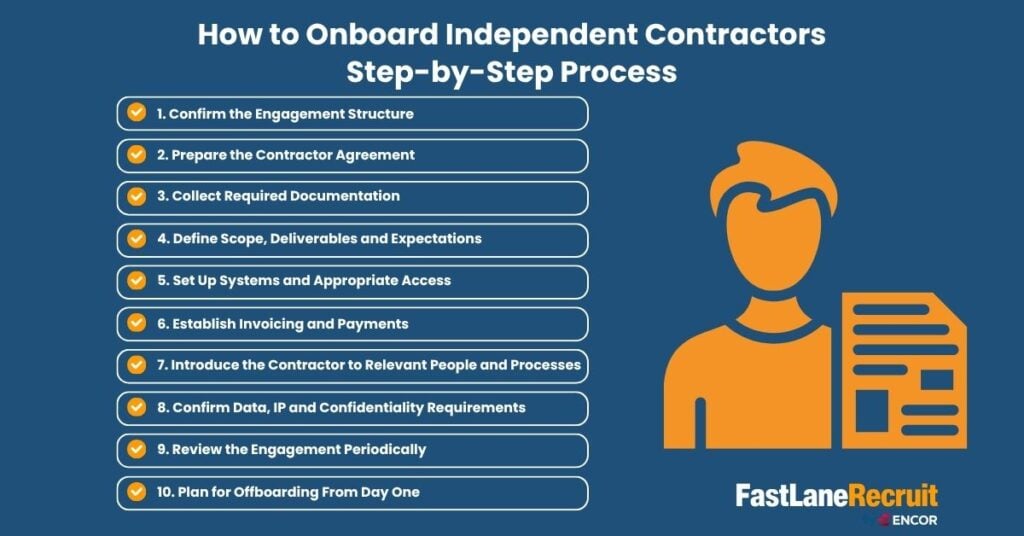
How to Onboard Independent Contractors: Step-by-Step Process
A repeatable contractor onboarding checklist can help businesses avoid missed documentation and inconsistent processes.
1. Confirm the Engagement Structure
Start by determining whether the planned relationship is genuinely suitable for an independent contractor.
Consider:
- What services will the individual provide?
- Who controls how the work is performed?
- Does the contractor operate an independent business?
- Can they provide services to other clients?
- Who supplies the tools and equipment?
- Is the engagement project-based or ongoing?
- What does local law say about contractor classification?
Do not rely solely on the title used in the contract.
Decision point: If the working relationship looks more like employment, evaluate an employment model such as EOR rather than forcing the relationship into a contractor structure.
2. Prepare the Contractor Agreement
The contractor agreement should clearly define the commercial relationship.
Depending on the engagement and jurisdiction, it may cover:
- Parties to the agreement
- Services
- Scope of work
- Deliverables
- Contract term
- Payment rates and terms
- Invoicing requirements
- Intellectual property
- Confidentiality
- Data protection
- Liability and indemnity
- Termination provisions
- Applicable law
For international contractors, avoid assuming that one generic agreement works in every country. Local requirements may affect the appropriate contract structure and terms. Remote’s current contractor-onboarding guidance similarly emphasizes tailoring agreements to local requirements.
3. Collect Required Documentation
The documents required depend on the contractor’s location, business structure and engagement.
A practical checklist may include:
- Legal name and contact information
- Business registration details, where applicable
- Tax identification information
- Required tax forms
- Bank or payment information
- Proof of identity, where required
- Contractor agreement
- Statement of Work
- NDA or confidentiality agreement
- IP assignment or ownership provisions
- Insurance documentation, where relevant
- Required licenses or professional certifications
For example, U.S. tax reporting rules changed for payments made in 2026: the federal Form 1099-NEC reporting threshold for certain nonemployee service payments is now $2,000, up from $600 for payments made before 2026. The applicable reporting rules and exceptions should be checked rather than assuming the same requirements apply globally.
4. Define Scope, Deliverables and Expectations
A contractor should know exactly what they have been engaged to deliver.
Document:
- Project objectives
- Scope of services
- Deliverables
- Milestones
- Deadlines
- Acceptance criteria
- Communication channels
- Reporting requirements
- Primary business contact
The emphasis should be on outcomes and agreed services, while avoiding unnecessary control over how a genuinely independent contractor performs the work.
5. Set Up Systems and Appropriate Access
Give contractors the access required to perform their contracted services—but avoid providing unnecessary access.
Consider:
- Email or communication tools
- Project management software
- File storage
- Client platforms
- Development environments
- Relevant databases
- Security policies
- Data-handling procedures
Use the principle of least-privilege access wherever possible.
Access should also have an owner and an end date so that permissions can be reviewed or removed when the engagement ends.
6. Establish Invoicing and Payments
Agree on the payment process before the contractor begins work.
Clarify:
- Hourly, daily, milestone or project-based rates
- Invoice frequency
- Payment terms
- Required supporting documents
- Payment currency
- Banking/payment method
- Expense reimbursement rules, if applicable
- Invoice approval process
For international contractors, currency conversion, cross-border payments and local requirements can add administrative complexity.
A structured contractor management process can centralize these activities and make international engagements easier to administer. FastLaneRecruit provides support covering contractor onboarding, contracts, invoicing, payments, documentation and related administration across supported markets.
7. Introduce the Contractor to Relevant People and Processes
Contractors do not need every aspect of employee onboarding, but they do need enough context to perform effectively.
Provide:
- Project stakeholders
- Key points of contact
- Relevant workflows
- Communication channels
- Project documentation
- Brand or technical guidelines
- Escalation procedures
For global teams, written documentation is particularly useful because contractors may work across different time zones.
8. Confirm Data, IP and Confidentiality Requirements
If a contractor will access sensitive information or create intellectual property, address these issues before work begins.
Depending on the engagement, this may include:
- NDA/confidentiality provisions
- Data protection requirements
- Information-security policies
- Intellectual property ownership
- Work-product rights
- Client data handling
- Restrictions on sharing confidential information
The exact legal treatment should be reviewed according to the applicable jurisdiction and contract.
9. Review the Engagement Periodically
Contractor classification should not necessarily be treated as a one-time administrative checkbox.
As the relationship changes, ask:
- Has the scope changed?
- Has the contractor become more integrated into the business?
- Has the company started controlling how the work is performed?
- Has the engagement become substantially longer or different from the original arrangement?
- Have local rules changed?
A relationship that was appropriately structured at the beginning can require reassessment when the facts change.
10. Plan for Offboarding From Day One
Contractor onboarding should also establish how the engagement will end.
At completion:
- Confirm the final deliverables
- Process the final invoice
- Recover company property where applicable
- Remove system access
- Close accounts
- Preserve required records
- Confirm IP and confidentiality obligations
- Document the end date
A defined offboarding process reduces the risk of forgotten access and incomplete records.
International Contractor Onboarding: What Changes?
Hiring contractors internationally can expand access to specialist talent, but the administrative and compliance requirements become more complex.
Different countries can apply different rules to:
- Worker classification
- Tax documentation
- Contract terms
- Payment methods
- Intellectual property
- Data protection
- Social contributions
- Licensing
- Immigration or work authorization
- Contractor duration and working arrangements
For this reason, a global contractor onboarding checklist should contain a core process plus country-specific requirements.
Use a country-specific compliance review
Before engaging an international contractor, confirm:
- The proposed relationship is permitted under local law.
- The contractor classification is appropriate.
- The contract reflects the actual relationship.
- Required documentation has been collected.
- Payment and tax requirements have been considered.
- Any relevant work authorization requirements have been addressed.
- The engagement is monitored if its scope or working arrangement changes.
International contractor onboarding resources increasingly emphasize country-specific documentation, tax requirements and classification rather than treating global onboarding as a single standardized process.
Contractor Onboarding Checklist
Use this quick checklist before a contractor starts:
| Before work starts | Completed |
| Confirm contractor classification | ☐ |
| Define scope and deliverables | ☐ |
| Sign contractor agreement | ☐ |
| Complete SOW, if applicable | ☐ |
| Collect required tax and identity information | ☐ |
| Confirm payment and banking details | ☐ |
| Complete NDA/IP documentation, where applicable | ☐ |
| Review country-specific requirements | ☐ |
| Set up required system access | ☐ |
| Share project documentation | ☐ |
| Confirm communication process | ☐ |
| Establish invoicing and payment process | ☐ |
| Define milestones and success criteria | ☐ |
| Schedule appropriate engagement reviews | ☐ |
| Document offboarding requirements | ☐ |
Important: This is an operational checklist, not a substitute for jurisdiction-specific legal or tax advice.
Common Contractor Onboarding Mistakes to Avoid
Treating every contractor like an employee
Giving a contractor extensive employee-like control, obligations or benefits can create classification concerns depending on the jurisdiction.
Using the same contract in every country
A contract suitable for one jurisdiction may not address the requirements of another.
Focusing on paperwork but ignoring the actual relationship
Classification is not determined only by what the contract says. How the relationship operates in practice can also matter.
Giving excessive system access
Contractors should generally receive access appropriate to their role and engagement.
Leaving payments until after the contractor starts
Missing payment details or unclear invoice procedures can create avoidable delays.
Failing to review long-term engagements
A contractor relationship can evolve. Review the arrangement if the scope, level of control or working relationship changes.
Contractor Management vs EOR: Which Model Fits?
One of the most important decisions is choosing the correct workforce model.
| Independent Contractor / Contractor Management | Employer of Record | |
| Worker status | Independent contractor | Employee |
| Legal employment | Not an employment relationship with the client | EOR is the local employer |
| Typical use | Genuine independent services/project engagements | Employment relationships in a country |
| Payroll | Contractor invoicing/payment administration | Employee payroll |
| Benefits | Depends on the contractor arrangement and local requirements | Statutory/contractual employee benefits as applicable |
| Local entity | May not require client entity, depending on arrangement and jurisdiction | EOR structure can enable hiring without client’s own local entity |
| Best question to ask | “Is this genuinely an independent contractor relationship?” | “Does this person need to be employed locally?” |
FastLaneRecruit’s contractor management services are designed for genuine independent contractor arrangements, while its EOR services support eligible employees through a local employment structure. The appropriate model depends on the actual relationship, business requirements and applicable local rules.
Also Read: Hiring Contractors vs Employees: How to Determine Worker Classification Correctly
When Should You Consider EOR Instead of Contractor Onboarding?
An EOR may be worth considering when the person you want to engage should actually be an employee rather than an independent contractor.
This can become particularly relevant when:
- The role is ongoing and central to your business.
- The company directs the individual’s day-to-day work.
- The individual is expected to work in a way similar to employees.
- You need a formal local employment relationship.
- You want to hire in a country where you do not have your own entity.
- The contractor relationship has evolved into an employee-like arrangement.
- You want to move an existing contractor into compliant employment.
FastLaneRecruit also provides contractor-to-employee conversion support, allowing eligible contractors to transition into employment through an EOR structure rather than requiring the client to immediately establish its own local entity.
A simple decision framework
Need genuine independent services?
→ Consider contractor management or Contractor of Record support.
Need an employee?
→ Consider EOR.
Not sure which relationship is appropriate?
→ Review the actual working arrangement and country-specific requirements before onboarding.
Also Read: What Is an Employer of Record (EOR)?
How FastLaneRecruit Supports Contractor Onboarding
Managing contractors across multiple countries can become difficult when contracts, documentation, payments and compliance processes are handled separately.
FastLaneRecruit provides international contractor management support designed to bring these processes together.
Contractor Onboarding
We help organize the information, documentation and administrative steps required to establish contractor engagements.
Contract Administration
We support structured contractor agreements and related documentation based on the engagement and applicable requirements.
Invoicing and Payments
We help businesses manage contractor invoicing and payment administration across supported international markets.
Compliance Support
We take a structured approach to contractor arrangements and country-specific requirements, while recognizing that classification ultimately depends on the facts of the engagement and applicable law.
Contractor of Record Support
For businesses engaging independent contractors internationally, FastLaneRecruit provides Contractor of Record support covering areas such as onboarding, agreements, payments, documentation and offboarding.
EOR When Employment Is the Better Fit
If the individual should be employed rather than engaged as an independent contractor, FastLaneRecruit can provide EOR support in eligible markets.
Our EOR model can handle the local employment process, including employment contracts, payroll, statutory requirements and ongoing employment administration, while the client continues to manage the employee’s day-to-day work.
Why Businesses Choose FastLaneRecruit
Businesses expanding internationally often need more than a contractor payment solution. They need a workforce partner that can help them navigate different engagement models as their needs change.
Contractor and EOR Support Under One Workforce Strategy
You can start with a genuine contractor arrangement and consider an EOR structure if the workforce requirement evolves.
Multi-Market Support
FastLaneRecruit supports international workforce requirements across selected markets in Asia Pacific, Europe, and the Middle East & Africa, including:
Malaysia, Singapore, Hong Kong, China, India, Philippines, Taiwan, Vietnam, Australia, United Kingdom, Switzerland, UAE, Saudi Arabia, Qatar
Availability and service scope can vary by country and engagement type, so the relevant market should be confirmed before onboarding.
Local Employment Through EOR
Where an employee relationship is appropriate, FastLaneRecruit’s EOR model can support hiring without requiring the client to immediately establish its own local employing entity in eligible markets.
Practical, Scalable Administration
Our support can help businesses organize contractor agreements, onboarding, documentation, invoicing, payments and related workforce administration as international hiring scales.
A Flexible Path From Contractor to Employee
Workforce requirements can change. FastLaneRecruit can support businesses that need to move from contractor engagement toward employment through EOR where appropriate.
Build a Compliant Contractor Onboarding Process With Confidence
The right contractor onboarding process should do more than get someone started quickly. It should create clarity around the relationship, establish the necessary documentation, simplify administration and give your business a way to identify when a contractor arrangement may need to change.
Whether you are onboarding one specialist or managing contractors across multiple countries, FastLaneRecruit can help you structure the engagement through contractor management, Contractor of Record and EOR solutions.
Ready to review your international workforce structure?
Book a Free Consultation with FastLaneRecruit to discuss your contractor onboarding requirements, international hiring plans and whether contractor management or EOR is the appropriate model for your workforce.
Frequently Asked Questions About Contractor Onboarding
What is contractor onboarding?
Contractor onboarding is the process of setting up an independent contractor to begin providing services to a business. It can include classification, agreements, documentation, payment setup, system access, project expectations and compliance checks.
What documents are needed for contractor onboarding?
Requirements vary by country and engagement. Common documents can include an independent contractor agreement, SOW, tax information, payment details, confidentiality or IP documentation, identification and relevant business or professional documents.
How do you onboard an independent contractor?
Start by confirming the engagement structure, then prepare the agreement, collect required documentation, establish payment procedures, provide appropriate access and project information, define deliverables and maintain appropriate records.
Is contractor onboarding the same as employee onboarding?
No. Contractor onboarding should reflect the independent nature of the relationship. Contractors generally need the information, access and documentation required to perform their agreed services rather than the full employee onboarding process.
How do you onboard international contractors?
Use a core onboarding process supplemented by country-specific requirements. Review classification, contracts, tax documentation, payments, data protection and other applicable local rules before the engagement begins.
Can contractors receive benefits?
Potentially, but the treatment of benefits and perks varies by jurisdiction and engagement. Businesses should assess whether proposed benefits could affect the characterization of the relationship and obtain appropriate local advice where necessary.
What is the difference between Contractor of Record and EOR?
A Contractor of Record supports an independent contractor arrangement, while an EOR employs the individual. FastLaneRecruit provides both contractor management/CoR support and EOR services, allowing businesses to select a model based on the actual workforce relationship.
Can FastLaneRecruit onboard independent contractors internationally?
Yes. FastLaneRecruit provides contractor management support across selected international markets, including contractor onboarding, contract administration, invoicing, payments and documentation. The precise service scope depends on the country and engagement.
What if my contractor should actually be an employee?
If the working relationship is more appropriately characterized as employment, an EOR may provide a suitable alternative where available. FastLaneRecruit can support eligible employee arrangements through its EOR services and can also support contractor-to-employee conversion.