
When your business needs specialized talent, the hardest part is not always finding the right person. It is choosing the right engagement model.
A consultant may help you diagnose a business problem, develop a strategy, or provide specialized expertise. A contractor may be brought in to execute defined work, add capacity, or deliver specific outputs. In practice, however, the line between the two can become blurred.
Understanding the difference between a consultant vs contractor matters because the engagement structure can affect how you define the scope of work, manage the relationship, pay the worker, document the arrangement, and address worker-classification requirements.
For international hiring, there is another important consideration: a worker described as a consultant or contractor may not necessarily be legally classified that way. The actual working relationship and applicable local rules can matter more than the label on the agreement.
This guide explains the key differences between consultants and contractors, when to use each, how costs and contracts typically work, and when Contractor Management or an Employer of Record (EOR) may be a more appropriate solution.
Content Outline
Key Summary
Consultant vs Contractor: The Core Difference
The simplest practical distinction is: Consultants primarily provide expertise, advice, analysis, or recommendations. Contractors primarily provide hands-on execution, specialized skills, or defined project capacity.
Choose a Consultant When You Need Expertise or Direction
A consultant may be suitable when your business needs: Strategic advice, Independent expertise, Business analysis, Auditing or assessment, Market-entry advice, A transformation roadmap, Specialized recommendations, Support solving a complex business problem
Choose a Contractor When You Need Execution or Additional Capacity
A contractor may be suitable when you need: Hands-on project work, Specialized technical skills, Additional workforce capacity, Defined deliverables, Temporary project support, Specific expertise to execute an established plan
Compliance Comes Before the Job Title
Calling someone a “consultant” or “contractor” does not automatically determine their legal status. Classification rules vary by jurisdiction and can consider factors such as control, independence, supervision, integration, economic dependence, and the actual nature of the work.
Contractor Management and EOR Serve Different Needs
If you have a genuine independent contractor relationship, Contractor Management or Contractor of Record services may help organize onboarding, contracts, documentation, invoices, payments, and related administration.
If the individual should instead be employed, an Employer of Record (EOR) can provide a local employment structure without requiring your business to establish its own entity in the relevant country.
What Is a Consultant?
A consultant is generally an external professional engaged to provide specialized knowledge, advice, analysis, or recommendations.
Businesses often bring in consultants when they have a problem that requires expertise they do not have internally.
For example, a company entering a new market might hire a consultant to assess market opportunities, develop an expansion strategy, or identify operational risks.
What Does a Consultant Do?
Depending on the field, a consultant may:
- Analyze a business problem
- Assess current processes or performance
- Develop recommendations
- Create strategic plans
- Conduct research or audits
- Provide specialized expertise
- Advise leadership teams
- Recommend solutions or improvements
The value of the engagement is often connected to the consultant’s knowledge, judgment, analysis, and recommendations.
How Are Consultants Typically Paid?
Consultants may be paid through:
- Fixed project fees
- Retainers
- Hourly rates
- Daily rates
- Milestone-based payments
The appropriate model depends on the scope of the engagement and how the consultant structures their services.
A consulting engagement may focus more heavily on a defined outcome or professional service than on supplying a certain number of working hours.
What Is a Contractor?
A contractor is an individual or business engaged to perform defined work or provide specialized capacity under an agreed contract.
Contractors are commonly used when a company already knows what needs to be done and requires someone with the skills or capacity to execute it.
For example, a company may hire a software developer on a project basis to build a specific feature or bring in a marketing contractor to execute an established content campaign.
What Does a Contractor Do?
A contractor may:
- Complete defined project tasks
- Deliver specific outputs
- Provide technical or professional skills
- Support an existing team
- Fill a temporary skills gap
- Work against milestones
- Execute an established plan
- Provide project-based capacity
Contractors can work independently, but the degree of client involvement varies considerably. Some engagements are highly autonomous, while others involve frequent coordination with the client’s team.
Also Read: Contractor of Record Services for Global Hiring
How Are Contractors Typically Paid?
Common payment structures include:
- Hourly rates
- Daily rates
- Fixed project fees
- Milestone payments
- Time-and-materials arrangements
- Payment per deliverable
The payment method should be clearly established in the contractor agreement.
Consultant vs Contractor: Key Differences
The difference between a consultant and contractor is primarily about the nature of the service being purchased, rather than which title appears on an agreement.
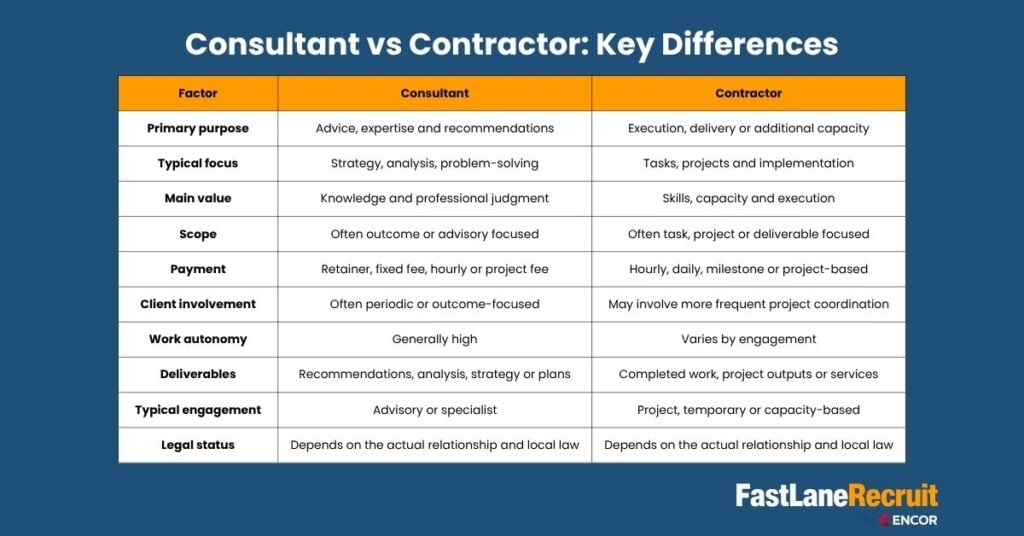
| Factor | Consultant | Contractor |
| Primary purpose | Advice, expertise and recommendations | Execution, delivery or additional capacity |
| Typical focus | Strategy, analysis, problem-solving | Tasks, projects and implementation |
| Main value | Knowledge and professional judgment | Skills, capacity and execution |
| Scope | Often outcome or advisory focused | Often task, project or deliverable focused |
| Payment | Retainer, fixed fee, hourly or project fee | Hourly, daily, milestone or project-based |
| Client involvement | Often periodic or outcome-focused | May involve more frequent project coordination |
| Work autonomy | Generally high | Varies by engagement |
| Deliverables | Recommendations, analysis, strategy or plans | Completed work, project outputs or services |
| Typical engagement | Advisory or specialist | Project, temporary or capacity-based |
| Legal status | Depends on the actual relationship and local law | Depends on the actual relationship and local law |
These distinctions are practical rather than universal legal definitions. In some jurisdictions, “consultant” may simply describe a type of independent professional rather than a separate legal employment category.
Consultant vs Contractor: Which Should You Hire?
The right choice depends on what your business needs the person to accomplish.
Hire a Consultant When You Need:
Strategic direction
You need someone to assess a problem and recommend what your business should do next.
Specialized expertise
Your internal team lacks the knowledge required to evaluate a complex issue.
Independent analysis
You need an external perspective rather than another person to carry out routine execution.
A defined advisory outcome
The engagement is centered around an assessment, strategy, roadmap, audit, or recommendation.
Hire a Contractor When You Need:
Hands-on execution
You already know what needs to be done and need someone to complete the work.
Additional capacity
Your existing team needs temporary or project-based support.
Specialized technical skills
You need a developer, designer, engineer, marketer, project specialist, or other professional to execute defined work.
A defined project or deliverable
The engagement can be clearly scoped around tasks, milestones, outputs, or a project timeline.
What If You Need Both?
Some business requirements involve both strategy and execution.
For example, a company entering a new market may use:
- A consultant to assess the market and develop the strategy.
- A contractor to execute specific project activities.
- Employees to manage the ongoing operation.
The important consideration is to define each relationship clearly rather than assuming that one engagement model fits every role.
Consultant vs Contractor: Cost and Payment Differences
There is no universal rule that consultants always cost more or contractors always cost less.
Pricing depends on:
- Expertise
- Industry
- Geography
- Project complexity
- Engagement duration
- Scope
- Deliverables
- Working hours
- Market rates
- Payment structure
A consultant may charge a premium for specialized expertise and strategic advice. A contractor may charge hourly, daily, or project-based rates depending on the work.
Consultant Costs
Consulting fees may include:
- Hourly or daily rates
- Fixed project fees
- Monthly retainers
- Milestone payments
Businesses are often paying primarily for expertise and professional judgment.
Contractor Costs
Contractor costs may include:
- Hourly rates
- Daily rates
- Project fees
- Milestone payments
- Deliverable-based payments
Businesses are often paying for specialized execution or capacity.
What About Employee Costs?
This is where the comparison becomes more important for international hiring.
An employee may create additional obligations involving:
- Payroll
- Statutory contributions
- Employment benefits
- Paid leave
- Tax withholding
- Local employment documentation
- Termination requirements
These requirements vary by country.
If your business needs an individual to work as an employee in a country where you do not have a local entity, an EOR can provide an alternative to establishing your own entity.
Consultant vs Contractor: Contract Differences
Whether you hire a consultant or contractor, the agreement should accurately reflect the actual relationship.
A well-structured agreement should generally address:
- Scope of services
- Deliverables
- Fees and payment schedule
- Project duration
- Responsibilities
- Confidentiality
- Intellectual property
- Data protection
- Termination
- Dispute resolution
- Applicable law
- Independent status, where appropriate
Why the Contract Matters
A contract creates a written framework for the relationship, but the document alone does not necessarily determine worker classification.
If the day-to-day relationship operates like employment, simply calling the individual a “consultant” or “independent contractor” may not eliminate classification risk. Current guidance and legal commentary emphasize looking at the substance of the working relationship, including control and supervision.
Contractor vs Consultant vs Employee
The distinction becomes clearer when an employee is added to the comparison.
| Factor | Consultant | Contractor | Employee |
| Primary purpose | Advice/expertise | Execution/capacity | Ongoing employment |
| Independence | Generally high | Generally independent | Employer-managed |
| Work scope | Advisory/outcome focused | Project/task focused | Ongoing role |
| Management | Usually limited | Varies | Regular employer supervision |
| Payment | Fee/retainer/project | Hourly/project/milestone | Salary/wages |
| Benefits | Generally not employee benefits | Generally not employee benefits | Usually subject to applicable statutory/contractual benefits |
| Employment relationship | Generally not employment | Generally not employment | Employment |
| Local entity need | Depends on arrangement/country | Depends on arrangement/country | Often requires an appropriate local employment structure |
This table is a practical comparison, not a universal legal test. The applicable classification depends on the jurisdiction and the facts of the relationship.
Contractor Misclassification: What Businesses Need to Know
One of the biggest mistakes in international hiring is assuming that changing the title changes the legal relationship.
A business might call someone a contractor while:
- Controlling their working hours
- Directing how they perform their work
- Integrating them into the company’s organization
- Giving them responsibilities similar to employees
- Requiring ongoing, indefinite services
- Providing the same level of supervision as employees
Depending on the country, these factors can contribute to an employment classification.
Government procurement guidance, for example, distinguishes contractors and consultants partly by supervision, responsibility for delivery, and the nature of the service provided.
Potential Risks of Misclassification
Depending on the jurisdiction and circumstances, misclassification may create exposure involving:
- Employment rights
- Backdated statutory contributions
- Taxes
- Benefits
- Penalties
- Interest
- Payroll obligations
- Claims from workers
- Regulatory scrutiny
The exact consequences differ by country, so businesses should obtain appropriate legal or tax advice when classification is unclear.
When Should You Use Contractor Management?
Contractor Management can be appropriate when the individual is genuinely an independent contractor and your business needs help administering the relationship.
Typical requirements may include:
- Contractor onboarding
- Agreement administration
- Documentation
- Invoice management
- Payment administration
- Record keeping
- Offboarding
- Compliance-related processes
FastLaneRecruit’s Contractor Management services are designed to support international contractor arrangements while helping businesses organize these administrative processes across supported markets.
Contractor Management May Be Suitable If:
- The individual genuinely operates independently.
- The engagement is project-based or service-based.
- The contractor controls how the work is performed within the agreed scope.
- Your business does not need an employment relationship.
- You want structured administration for international contractors.
When Should You Consider a Contractor of Record?
A Contractor of Record (CoR) can provide a structured framework for managing international contractor engagements.
It can help centralize activities such as:
- Contractor onboarding
- Contracts
- Documentation
- Invoicing
- Payment administration
- Offboarding
- Compliance-related processes
FastLaneRecruit provides Contractor hiring support for international contractor arrangements, with the precise scope depending on the country and engagement structure.
Contractor Management vs Contractor of Record
These terms can overlap in practice, but the important question is what administrative and compliance support your business actually needs.
If you are engaging multiple contractors across different countries, a centralized process can help reduce repetitive administrative work and create greater consistency.
When Should You Use an Employer of Record?
An Employer of Record (EOR) is designed for an employee relationship rather than a genuine independent contractor arrangement.
With an EOR structure, the EOR acts as the local legal employer while the client generally retains responsibility for the employee’s day-to-day work and performance. EOR services can include employment contracts, payroll, statutory requirements, benefits administration, and other local employment processes.
An EOR May Be Relevant When:
- You need to hire an employee in another country.
- You do not have a local employing entity.
- The role is ongoing rather than genuinely independent.
- The worker needs an employment relationship.
- You want to enter a market before establishing your own entity.
- You need local payroll and employment administration.
Contractor Management vs EOR
| Contractor Management / CoR | Employer of Record | |
| Worker model | Independent contractor | Employee |
| Employment relationship | Contractor relationship | Local employment relationship |
| Primary purpose | Manage contractor administration | Employ and administer employees |
| Payroll | Contractor payment administration | Employee payroll |
| Benefits | Generally not employee benefits | Applicable employee benefits/statutory requirements |
| Local employment | No employment relationship created by contractor management | EOR becomes the local legal employer |
| Best suited for | Genuine independent engagements | Employees working internationally |
The key is not to choose EOR simply because it is administratively convenient. First determine whether the person should genuinely be a contractor or an employee under the relevant country’s rules.
Also Read: Co-Employment Risk: What Businesses Need to Know and How an EOR Can Help
What If Your Contractor Should Become an Employee?
A contractor relationship can evolve.
A person who initially provides project-based support may eventually become:
- A core member of your team
- Responsible for ongoing business functions
- Subject to greater direction and supervision
- Needed on a long-term basis
- Integrated into day-to-day operations
When the actual working relationship changes, the appropriate employment structure may need to change as well.
FastLaneRecruit provides contractor-to-employee conversion support through EOR services, allowing eligible workers to transition into employment arrangements without requiring the client to establish a local entity in supported markets.
Why Businesses Choose FastLaneRecruit
Choosing between a consultant, contractor, and employee is only the first step. International hiring also requires a practical way to manage the selected workforce model.
FastLaneRecruit supports businesses with both Contractor Management and Employer of Record solutions, allowing businesses to consider different workforce structures as their international teams develop.
Contractor Support
For genuine independent contractor relationships, FastLaneRecruit can support processes such as:
- Contractor onboarding
- Contract administration
- Documentation
- Invoice and payment administration
- Offboarding
- Compliance-related processes
EOR Support
For employee relationships, FastLaneRecruit’s EOR services can support:
- Local employment contracts
- Employee onboarding
- Payroll
- Statutory requirements
- Benefits administration
- Ongoing employment administration
The exact services and requirements depend on the country and employment arrangement.
Multi-Country Workforce Support
FastLaneRecruit operates across selected markets including:
Malaysia, Singapore, Hong Kong, China, India, Philippines, Taiwan, Vietnam, Australia, United Kingdom, Switzerland, UAE, Saudi Arabia, Qatar
This enables businesses to consider different workforce models as they expand across multiple jurisdictions.
How to Choose the Right Workforce Model
Use these questions before hiring:
1. Do You Need Advice or Execution?
Advice, analysis or strategic direction: Consider a consultant.
Hands-on execution or project capacity: Consider a contractor.
2. Is the Work Project-Based or Ongoing?
Defined project or deliverables: A contractor or consultant may be appropriate.
Ongoing core business role: Assess whether an employment relationship is more appropriate.
3. How Much Control Will Your Business Exercise?
The more your company controls the person’s work, schedule, processes, and day-to-day activities, the more carefully you should assess whether the relationship is genuinely independent.
4. Where Will the Person Work?
Cross-border engagements require additional consideration because classification, tax, employment, and contractor rules differ between countries.
5. Do You Have a Local Entity?
If the person should be an employee and your business does not have a local employing entity, an EOR may provide a practical employment structure.
Ready to Choose the Right Global Hiring Model?
The right workforce structure depends on more than whether someone is called a consultant or contractor. Your business needs to consider the work itself, the level of independence and control, the country involved, and whether the relationship is genuinely independent or employment-based.
FastLaneRecruit can help you explore the appropriate model for your international workforce, whether you need Contractor Management/Contractor of Record support for independent contractors or EOR services for employees.
Build Your International Team With the Right Structure
Whether you are engaging one contractor, expanding a project team, or hiring employees in a new country, FastLaneRecruit can help you structure and manage your international workforce across supported markets.
Book a Free Consultation with an Expert to discuss your hiring requirements and determine which workforce solution may fit your business.
Consultant vs Contractor FAQs
Is a consultant the same as a contractor?
Not necessarily.
In everyday business language, the terms can overlap. A consultant generally focuses on advice, expertise, analysis, or recommendations, while a contractor more commonly focuses on executing defined work or providing project capacity.
Legally, however, “consultant” may not represent a separate worker classification. The applicable legal status depends on the jurisdiction and the actual working relationship.
What is the main difference between a consultant and a contractor?
The practical difference is usually the nature of the work.
A consultant is typically engaged for expertise, analysis, or recommendations. A contractor is typically engaged for execution, defined tasks, deliverables, or additional capacity.
Is a consultant an independent contractor?
In some jurisdictions, a consultant may be treated as an independent contractor if the relationship satisfies the relevant legal tests.
However, the terminology is not universal. Businesses should assess the actual working relationship and local requirements rather than relying only on the title used in an agreement.
Is it cheaper to hire a contractor or consultant?
There is no universal answer.
Rates depend on expertise, scope, project complexity, location, duration, and payment structure. Consultants may charge for specialized advice and expertise, while contractors may charge based on time, deliverables, or project scope.
The lower hourly or project rate is not necessarily the lower overall cost.
Do consultants and contractors receive employee benefits?
Genuine independent consultants and contractors generally do not receive employee benefits in the same way as employees. However, obligations vary by jurisdiction and depend on the actual classification.
Can a contractor become an employee?
Yes.
If the working relationship changes or the business determines that an employment relationship is more appropriate, the contractor may be transitioned into an employee arrangement subject to local requirements.
FastLaneRecruit can support eligible contractor-to-employee transitions through its EOR services in supported markets.
What is the difference between Contractor of Record and Employer of Record?
A Contractor of Record supports an independent contractor arrangement, while an Employer of Record is designed for an employee relationship.
FastLaneRecruit provides both contractor support and EOR services, depending on the actual workforce arrangement and country requirements.
Can I hire a contractor in another country without a local entity?
It may be possible, but the appropriate structure depends on the country, contractor relationship, and applicable rules.
Businesses should assess local contractor classification, tax, documentation, payment, and other requirements before proceeding. Contractor Management or Contractor of Record services can help organize eligible international contractor arrangements.
When should I use an EOR instead of a contractor?
Consider EOR when the person should genuinely be an employee, particularly when you need an ongoing employment relationship in a country where your business does not have its own local entity.
An EOR does not turn a contractor into an employee merely by changing the paperwork. The underlying working arrangement should support the employment model.