Hiring internationally gives businesses access to new talent, but expanding into another country raises an important question: Who legally employs your staff when you hire through an Employer of Record (EOR)?
An EOR arrangement allows businesses to employ workers in supported countries without establishing their own local legal entity for that purpose. The EOR becomes the legal employer under the arrangement, while the client company generally directs the employee’s day-to-day work, responsibilities, and performance.
However, understanding who employs your staff is only the beginning. Businesses also need to know how employment contracts, payroll, tax obligations, employee benefits, and statutory compliance are managed.
FastLaneRecruit provides EOR services across selected international markets, helping businesses manage local employment requirements while building teams beyond their home country.
Content Outline
Key Summary
The EOR is the legal employer
Under an EOR arrangement, the EOR employs the worker through an appropriate local employment arrangement.
Your business manages daily operations
The client company generally directs the employee’s work, responsibilities, and performance.
Payroll and tax administration are handled locally
The EOR manages agreed payroll processes, applicable deductions, statutory contributions, and related reporting according to local requirements.
Employee benefits depend on local rules
The EOR administers applicable statutory entitlements and agreed benefits based on the employment terms and jurisdiction.
A local entity may not be necessary
An EOR can provide an alternative to establishing a local employing entity, where the arrangement is legally and operationally suitable.
The right structure depends on your business
An EOR may suit companies entering new markets, hiring small international teams, or evaluating a market before establishing their own entity.
What Is an EOR Arrangement?
An Employer of Record (EOR) arrangement is an employment model in which a third-party organization legally employs a worker on behalf of a client company.
The EOR enters into the employment relationship with the worker and manages agreed employment administration, including employment contracts, payroll, tax-related processes, statutory contributions, and employee benefits, subject to local laws and the service agreement.
Meanwhile, the client company generally retains responsibility for business operations, including assigning work, setting objectives, supervising daily activities, and evaluating employee performance.
How Does an EOR Arrangement Work?
An EOR arrangement typically involves three parties:
| Party | Primary role |
| Employer of Record | Legally employs the worker and manages agreed employment administration and statutory obligations. |
| Client company | Selects the candidate, directs day-to-day work, and manages business objectives and performance. |
| Employee | Works for the client company’s business under an employment contract with the EOR. |
The precise division of responsibilities depends on the employment agreement, service contract, and applicable local law.
For businesses hiring internationally, this structure can simplify market entry by avoiding the need to establish a separate employing entity in every target country.
Who Legally Employs Your Staff Under an EOR Arrangement?
The Employer of Record is the legal employer under an EOR arrangement. The employee enters into an employment relationship with the EOR, while the client company generally manages the employee’s day-to-day work.
This distinction allows businesses to build international teams without immediately creating their own local employment infrastructure.
For example, a company headquartered in the United Kingdom wants to hire a marketing specialist in Malaysia but does not have a Malaysian employing entity. Where the arrangement is appropriate, the company can engage an EOR to employ the specialist locally.
The EOR manages the agreed employment administration, while the UK company directs the specialist’s marketing activities, sets targets, and evaluates performance.
What Does the Legal Employer Handle?
The EOR’s responsibilities commonly include:
- Preparing and administering employment contracts.
- Coordinating employee onboarding and employment documentation.
- Processing salaries and applicable payroll deductions.
- Managing relevant statutory contributions and employment-related filings.
- Administering applicable employee benefits.
- Maintaining required employment and payroll records.
- Supporting employment changes and offboarding.
The exact scope varies by country and service agreement. Using an EOR does not automatically eliminate every legal, tax, or operational risk for the client company.
What Responsibilities Remain With Your Business?
Although the EOR becomes the legal employer, your company generally retains operational control over the employee’s work.
Your responsibilities may include:
- Defining the employee’s role and responsibilities.
- Setting business goals and performance expectations.
- Managing day-to-day activities and deliverables.
- Providing work-related tools, systems, and access.
- Communicating business policies and operational requirements.
- Coordinating with the EOR when employment terms or working arrangements change.
This separation helps clarify how the employment relationship operates. It also allows businesses to focus on their operations while the EOR manages agreed local employment processes.
Also Read: What Does EOR Do? 10 Key Responsibilities of an Employer of Record
How Are Payroll, Tax, and Employee Benefits Managed Under an EOR Arrangement?
Payroll, tax administration, and employee benefits are central considerations when hiring across borders. Each country has its own rules governing salary payments, statutory deductions, employer contributions, and employment entitlements.
EOR services help businesses manage these requirements through a local employment framework.
1. Payroll Administration
The EOR manages the agreed payroll process for employees employed through its arrangement.
Depending on the country and service scope, this may include:
- Calculating employee salaries and applicable allowances.
- Processing payroll according to the agreed schedule.
- Applying relevant deductions and contributions.
- Arranging salary payments.
- Maintaining payroll records and supporting documentation.
- Processing eligible changes to compensation and employment terms.
Accurate payroll depends on timely information from the client company, including salary changes, approved leave, bonuses, and other relevant compensation details.
Business benefit: Your company can reduce the administrative burden of coordinating local payroll processes independently in every market where it hires.
2. Tax and Statutory Compliance
Employment-related tax and statutory obligations vary by jurisdiction. Depending on local requirements, the EOR may manage relevant payroll withholding, employer contributions, statutory filings, and associated records.
These responsibilities may involve:
- Calculating and withholding applicable payroll taxes.
- Administering required social security or pension contributions.
- Preparing relevant employment-related payroll reports.
- Maintaining required statutory documentation.
- Supporting compliance with local payroll deadlines.
The client company should still understand the obligations that may apply to its wider business activities. An EOR arrangement does not automatically resolve corporate tax, permanent establishment, immigration, or other legal considerations that may arise from operating internationally.
Business benefit: Working with an EOR can help your business navigate country-specific employment administration without having to develop every local payroll process internally.
3. Employee Benefits Administration
Employee benefits can include legally required entitlements and additional benefits agreed as part of the employment package.
Depending on the jurisdiction and service agreement, an EOR may administer:
- Statutory leave entitlements.
- Mandatory social insurance or pension contributions.
- Applicable health or insurance benefits.
- Employer-provided allowances.
- Other agreed employee benefits.
Not every benefit is mandatory in every country, and eligibility requirements differ. Businesses should confirm which benefits apply to their employees and which additional benefits are included in the proposed arrangement.
Business benefit: Your company can structure employment packages around local requirements while coordinating benefits administration through the EOR.
EOR Arrangement vs. Direct Employment: What Is the Difference?
An EOR arrangement and direct employment through your own local entity are two different approaches to international hiring.
The right option depends on your workforce plans, operational requirements, expected costs, and long-term presence in the target market.
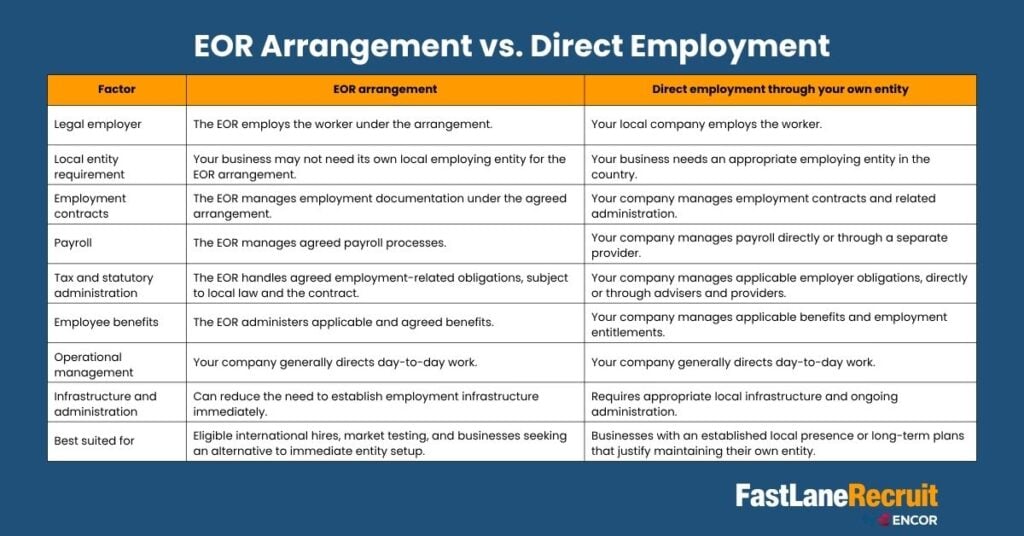
| Factor | EOR arrangement | Direct employment through your own entity |
| Legal employer | The EOR employs the worker under the arrangement. | Your local company employs the worker. |
| Local entity requirement | Your business may not need its own local employing entity for the EOR arrangement. | Your business needs an appropriate employing entity in the country. |
| Employment contracts | The EOR manages employment documentation under the agreed arrangement. | Your company manages employment contracts and related administration. |
| Payroll | The EOR manages agreed payroll processes. | Your company manages payroll directly or through a separate provider. |
| Tax and statutory administration | The EOR handles agreed employment-related obligations, subject to local law and the contract. | Your company manages applicable employer obligations, directly or through advisers and providers. |
| Employee benefits | The EOR administers applicable and agreed benefits. | Your company manages applicable benefits and employment entitlements. |
| Operational management | Your company generally directs day-to-day work. | Your company generally directs day-to-day work. |
| Infrastructure and administration | Can reduce the need to establish employment infrastructure immediately. | Requires appropriate local infrastructure and ongoing administration. |
| Best suited for | Eligible international hires, market testing, and businesses seeking an alternative to immediate entity setup. | Businesses with an established local presence or long-term plans that justify maintaining their own entity. |
When Should You Choose an EOR Arrangement?
An EOR may be appropriate when your business:
- Wants to hire its first employee in another country.
- Needs to enter a supported market without immediately establishing a local entity.
- Plans to build a small international team.
- Wants to simplify local employment and payroll administration.
- Needs an employment structure that can be assessed as its international workforce grows.
When Should You Consider Establishing Your Own Entity?
Direct employment through your own entity may be more appropriate when your business:
- Plans to establish a substantial, long-term local operation.
- Needs a permanent legal and commercial presence.
- Requires direct employment infrastructure for a larger workforce.
- Has business, regulatory, licensing, or immigration requirements that make its own entity more suitable.
- Has assessed the costs and administrative responsibilities of maintaining a local company.
An EOR is not automatically the best option for every business. The decision should account for local regulations, the nature of the work, workforce size, long-term strategy, and the full costs of each arrangement.
Also Read: How to Use an Employer of Record in the United States: A Complete Guide to US EOR
How Does an EOR Arrangement Work in Practice?
Although processes differ between countries, an EOR engagement generally follows five stages.
Step 1: Identify Your Hiring Requirements
Your company identifies the candidate, role, compensation package, work location, and expected employment terms.
The EOR can help establish which local employment requirements need to be addressed before onboarding.
Step 2: Prepare the Employment Contract
The EOR coordinates the appropriate employment documentation based on local requirements and the agreed terms.
The contract should clearly establish the employment relationship, compensation, applicable benefits, and other required employment conditions.
Step 3: Complete Employee Onboarding
The employee completes the required documentation and onboarding procedures.
Depending on the country and role, additional checks, registrations, or work authorization requirements may apply.
Step 4: Manage Payroll, Tax, and Benefits
Once employment begins, the EOR manages the agreed payroll and employment administration processes.
Your company provides relevant information about compensation changes, leave, bonuses, and other employment-related matters to support accurate processing.
Step 5: Maintain Ongoing Employment Administration
Throughout the employment relationship, the EOR supports agreed employment administration, including applicable statutory requirements, payroll changes, benefits coordination, and offboarding.
Businesses should review their employment arrangements when local regulations, workforce needs, or business operations change.
Why Businesses Choose FastLaneRecruit
International hiring requires more than finding qualified employees. Businesses must also consider employment contracts, payroll administration, statutory requirements, benefits, and ongoing workforce management.
FastLaneRecruit provides EOR services to help businesses employ talent in supported international markets without establishing their own local employing entity for every hire.
Multi-Market Employment Support
FastLaneRecruit supports EOR services across selected markets in Asia Pacific, Europe, and the Middle East & Africa.
Our coverage includes:
Malaysia, Singapore, Hong Kong, China, India, Philippines, Taiwan, Vietnam, Australia, United Kingdom, Switzerland, UAE, Saudi Arabia, Qatar.
This coverage gives businesses a potential route to hiring across multiple markets through one EOR partner, subject to country-specific service availability and employment requirements.
Local Employment and Compliance Administration
Employment laws, statutory contributions, payroll practices, and employee entitlements differ between countries.
FastLaneRecruit supports the employment administration required for eligible EOR arrangements, helping businesses navigate local processes while keeping their attention on workforce management and business growth.
Payroll, Tax, and Benefits Coordination
Our EOR services support agreed employment-related payroll processes, applicable statutory administration, and benefits coordination.
The precise scope depends on the employee’s location, applicable requirements, and the service agreement.
A Practical Approach to International Expansion
An EOR arrangement can help businesses assess new markets, hire an initial employee, or build a small team before deciding whether establishing a local entity is appropriate.
FastLaneRecruit helps businesses assess their hiring requirements and the available employment structure for their intended market.
Support Throughout the Employment Lifecycle
From employment documentation and onboarding to payroll administration and offboarding, FastLaneRecruit supports key stages of the employment relationship.
This gives businesses a structured approach to managing international employment while their internal teams concentrate on daily operations.
EOR Services or Contractor Management: Which Is Right for Your Business?
Not every international hire needs to be an employee. Some businesses engage independent professionals for defined projects, specialist services, or other work that is genuinely suitable for a contractor relationship.
The appropriate structure depends on the actual working relationship, the nature of the work, and the applicable legal requirements.
| Factor | EOR services | Contractor management |
| Worker relationship | Employment relationship with the EOR. | Engagement of an independent contractor, where legally appropriate. |
| Typical use case | Hiring employees in another country. | Engaging independent professionals for services or projects. |
| Payroll or payment | Employee payroll and applicable statutory administration. | Contractor invoicing, payment, and related administration. |
| Benefits | Applicable statutory and agreed employee benefits. | Generally governed by the contractor agreement and applicable law rather than employee benefit rules. |
| Main consideration | Employment obligations and local employment compliance. | Correct worker classification and compliance with local contracting rules. |
When Is EOR the Better Option?
Consider EOR services when the working relationship is employment in substance and your business needs a suitable local employment arrangement.
An EOR may be appropriate when you want an employee to work as part of your team over the longer term, subject to local law and the arrangement’s suitability.
When Is Contractor Management More Suitable?
Contractor management may be suitable when you engage an independent professional to provide services under a genuine contractor relationship.
However, the contractual label alone does not determine worker status. Local authorities may consider factors such as control, independence, the nature of the work, and the actual working relationship.
Choosing the correct arrangement matters. If you are uncertain whether a worker should be engaged as an employee or an independent contractor, assess the relevant local requirements before proceeding.
Hire Internationally With FastLaneRecruit EOR Services
Hiring across borders should help your business grow, not create unnecessary complexity around employment administration.
With FastLaneRecruit, you can explore an EOR arrangement that supports international employment, payroll administration, applicable statutory requirements, and employee benefits across our supported markets.
Whether you are hiring your first overseas employee, expanding an existing international team, or deciding between employee and contractor arrangements, our team can help you assess the appropriate next steps.
Ready to hire internationally?
Book a Free Consultation with FastLaneRecruit to discuss your hiring plans, target countries, and employment requirements.
If your business needs to engage independent professionals rather than employees, ask us about our contractor management services to explore the appropriate arrangement for your workforce.
Frequently Asked Questions About EOR Arrangements
1. Who is the legal employer in an EOR arrangement?
The Employer of Record is the legal employer under the arrangement. The employee enters into an employment relationship with the EOR, while the client company generally manages the employee’s day-to-day work and business responsibilities.
2. Who pays employees under an EOR arrangement?
The EOR manages the agreed employee payroll process and arranges salary payments according to the employment terms and applicable local requirements. The commercial agreement between the EOR and client company determines how employment costs are funded and invoiced.
3. Does an EOR handle payroll and tax?
An EOR typically manages agreed payroll administration, including applicable deductions, statutory contributions, and employment-related reporting. The exact responsibilities depend on local law and the service agreement. An EOR does not automatically assume every tax obligation associated with the client’s wider business operations.
4. Who provides employee benefits under an EOR arrangement?
The EOR administers applicable statutory entitlements and agreed employee benefits as required by the employment arrangement. The benefits available depend on the employee’s location, eligibility, employment terms, and local regulations.
5. Can I hire an employee overseas without establishing a local company?
In many cases, an EOR provides an alternative to establishing your own local employing entity. However, the arrangement must be suitable for the country, the role, and the applicable employment and regulatory requirements.
6. Does my company lose control of employees when using an EOR?
No. The client company generally retains control over day-to-day work, business objectives, and performance management. The EOR manages the formal employment relationship and agreed employment administration. The exact allocation of responsibilities depends on the arrangement and applicable law.
7. Is an EOR responsible for all employment compliance risks?
No. An EOR manages agreed employment responsibilities, but using one does not automatically eliminate all legal or regulatory risks for the client company. Businesses should assess employment, tax, immigration, corporate, and other obligations that may apply to their circumstances.
8. What is the difference between an EOR and a staffing agency?
An EOR legally employs a worker under an EOR arrangement and manages agreed employment administration. A staffing agency generally focuses on recruiting and placing candidates or supplying temporary workers, depending on its business model. Some staffing arrangements also include employment, so the actual contractual structure and responsibilities should be reviewed.
9. When should a business use EOR services instead of contractor management?
EOR services may be appropriate when the working relationship should be structured as employment. Contractor management is more suitable for genuine independent contractor engagements. The decision should reflect the actual working relationship and local classification rules, not simply the business’s preferred label.
10. Which countries does FastLaneRecruit support for EOR services?
FastLaneRecruit supports EOR services in Malaysia, Singapore, Hong Kong, China, India, Philippines, Taiwan, Vietnam, Australia, the United Kingdom, Switzerland, the UAE, Saudi Arabia, and Qatar. Service availability and employment requirements should be confirmed for the specific country and hiring arrangement.
11. Can I move employees from an EOR arrangement to my own entity later?
A transition may be possible when your business establishes an appropriate local entity and the relevant parties agree to the change. The process must account for local employment law, contractual requirements, employee rights, and any applicable transfer or termination procedures. It should not be assumed that an existing employment relationship can simply be transferred without further action.