Global hiring strategies are increasingly shifting away from traditional entity incorporation toward Employer of Record (EOR) solutions. Businesses expanding into Southeast Asia now prioritize speed, compliance certainty, and cost efficiency over establishing local subsidiaries.
Among the most frequently compared markets are Malaysia and the Philippines. Both countries offer strong talent pools, competitive labor markets, and established outsourcing ecosystems. However, their employment cost structures, statutory obligations, and compliance frameworks differ significantly.
This comparison of EOR Malaysia vs EOR Philippines cost is essential for companies evaluating:
- Cost of hiring employees without entity setup
- Compliance risk exposure in ASEAN markets
- Payroll and statutory contribution obligations
- Scalability of regional workforce expansion
The decision is no longer purely about which market is cheaper, it is about which market delivers sustainable hiring efficiency and long-term operational stability.
Content Outline
Key Summary
EOR Enables Fast and Compliant Global Hiring
Businesses can hire employees in Malaysia or the Philippines without establishing a local legal entity, reducing expansion costs and administrative burden.
The Philippines Is Ideal for Cost-Driven Scaling
With lower labor costs and a large English-speaking workforce, the Philippines is well-suited for customer support, BPO, and high-volume hiring.
Malaysia Offers Greater Stability and Predictability
Malaysia provides a structured regulatory environment, predictable employment costs, and strong compliance governance for international employers.
Consider Total Employment Costs
EOR fees are only part of the equation. Employers should also account for statutory contributions, mandatory benefits, compliance requirements, and termination obligations.
Match the Market to Your Hiring Goals
Choose the Philippines for rapid, cost-efficient workforce expansion, and Malaysia for professional talent, regional leadership roles, and long-term operational stability.
Understanding Employer of Record (EOR) in Malaysia and the Philippines
An Employer of Record (EOR) is a third-party legal employer that hires employees on behalf of a foreign company. The EOR manages payroll, tax compliance, employment contracts, and statutory benefits while the client company directs daily work activities.
This model eliminates the need for local entity incorporation.
What EOR Covers in Malaysia
In Malaysia, EOR services typically manage:
- Payroll processing and salary disbursement
- Employment contracts aligned with Employment Act 1955
- EPF (Employees Provident Fund) contributions
- SOCSO (Social Security Organization) contributions
- EIS (Employment Insurance System) contributions
- Leave entitlements and statutory compliance
- Termination and retrenchment compliance
Malaysia has a structured employment framework, making compliance predictable but mandatory.
Also read: EPF, SOCSO, and EIS Employer Contributions in Malaysia
What EOR Covers in the Philippines
In the Philippines, EOR services typically handle:
- Payroll and tax withholding
- SSS (Social Security System) contributions
- PhilHealth contributions
- Pag-IBIG Fund contributions
- 13th-month pay compliance
- Labor Code adherence for termination and benefits
The Philippines’ labour system includes mandatory additional benefits, which impact the total employment cost structure.
Also Read: 20 Best Employer of Record in the Philippines: EOR Philippines Guide 2026
EOR Malaysia vs EOR Philippines Cost Breakdown (2026 Overview)
Understanding cost requires separating EOR service fees from statutory employer contributions and hidden employment costs.
EOR Service Fees Comparison
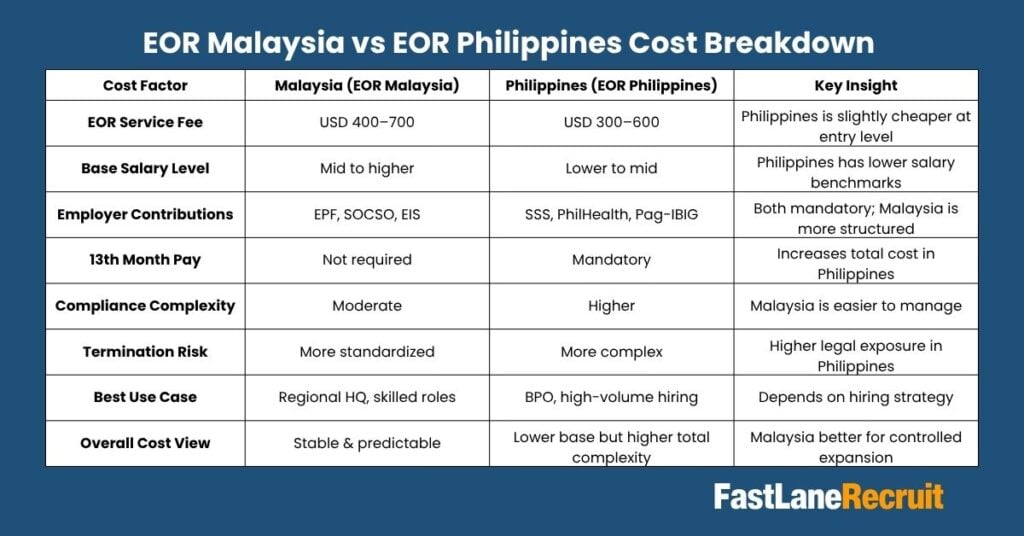
- Malaysia EOR service fee: USD 400 – 700 per employee/month
- Philippines EOR service fee: USD 300 – 600 per employee/month
At surface level, the Philippines often appears more cost-efficient. However, service fees represent only a portion of total employment cost.
Key cost drivers include:
- Payroll complexity
- Compliance administration intensity
- Benefit structuring requirements
- Termination and statutory risk exposure
Employer Statutory Contribution Comparison
Malaysia Employer Contributions:
- EPF (up to 13% depending on salary structure)
- SOCSO contributions
- EIS contributions
- Additional statutory obligations depending on role type
Malaysia contributions are structured and consistent, enabling predictable payroll forecasting.
Philippines Employer Contributions:
- SSS employer contributions (tiered by salary bracket)
- PhilHealth contributions
- Pag-IBIG Fund contributions
- Mandatory 13th-month salary requirement
The Philippines introduces an additional fixed annual payroll obligation (13th-month pay), which significantly impacts total annual cost planning.
Hidden Employment Costs Often Overlooked
Companies frequently underestimate additional costs beyond base salary and EOR fees.
Common hidden costs include:
- Mandatory bonuses (Philippines 13th-month pay)
- Termination compensation obligations
- Administrative payroll adjustments
- Currency fluctuation exposure in cross-border payroll
- Compliance penalties for misclassification risks
These costs can materially affect total hiring budgets.
EOR Malaysia vs EOR Philippines Cost Breakdown (2026 Summary Table)
Total Cost Perspective – Malaysia vs Philippines EOR Hiring
When evaluating total employment cost, the comparison must include:
- Base salary
- EOR service fees
- Employer statutory contributions
- Mandatory benefits
Key Insight:
- The Philippines often provides lower base labor cost advantages
- Malaysia offers higher predictability and lower compliance volatility
From a strategic finance perspective, predictability often reduces long-term risk exposure, especially for scaling organizations.
Cost vs Value Analysis for Global Hiring Decisions
Malaysia as an EOR Market
Malaysia is increasingly preferred for:
- Regional headquarters setup
- Mid-to-senior level hiring
- Finance, tech, and shared services roles
- Stable compliance environment
- Structured payroll systems
Strength lies in regulatory stability and workforce quality rather than lowest cost.
Philippines as an EOR Market
The Philippines is often chosen for:
- High-volume operational hiring
- Customer support and BPO roles
- Entry-level workforce scaling
- Cost-sensitive expansion models
- Large English-speaking talent pool
Strength lies in labor cost efficiency and workforce availability.
Decision Framework
Businesses typically evaluate:
- Total cost per employee
- Hiring scalability speed
- Legal risk exposure
- Workforce skill level
- Compliance complexity
Malaysia tends to win on stability and governance, while the Philippines leads in cost-driven volume hiring.
Also Read: Average Salary in the Philippines 2026
Why Businesses Choose EOR Over Company Incorporation in Malaysia
When expanding into Malaysia, many foreign businesses initially consider setting up a local subsidiary or branch office. While incorporation provides a permanent legal presence, it also involves significant time, costs, and ongoing compliance obligations.
As a result, many companies now choose Employer of Record (EOR) services as a faster and more flexible alternative, especially during the early stages of market expansion.
An EOR allows businesses to legally hire employees in Malaysia without establishing a local company. The EOR becomes the legal employer while the foreign company retains full control over the employee’s day-to-day work and performance.
Also Read: Top 15 Employer of Record (EOR) Services in Malaysia
Faster Market Entry
One of the primary reasons companies choose an EOR is speed.
Establishing a Malaysian entity typically requires:
- Company registration procedures
- Corporate bank account setup
- Tax registration
- Statutory employer registrations
- Compliance infrastructure development
These steps can take several weeks or even months depending on business structure and regulatory requirements.
With an EOR, companies can often begin hiring within days.
Example:
A European technology company wants to hire a Sales Director in Kuala Lumpur to explore the Malaysian market. Rather than waiting months to establish a subsidiary, it uses an EOR and hires immediately.
This allows the company to begin generating business opportunities while evaluating long-term expansion plans.
No Need for Legal Entity Setup
Company incorporation requires substantial administrative effort and ongoing maintenance.
Typical obligations include:
- Corporate secretarial services
- Annual filings
- Financial reporting
- Tax compliance
- Statutory record maintenance
- Regulatory reporting
An EOR eliminates the need to establish and maintain a local legal entity.
Example:
A US-based software company hiring three employees in Malaysia may find that incorporating a local company is disproportionate to its initial hiring needs. Using an EOR allows it to operate legally without creating unnecessary administrative complexity.
Reduced Administrative Overhead
Managing a foreign workforce involves much more than simply paying salaries.
Employers must also manage:
- Employment contracts
- Payroll processing
- Statutory contributions
- Leave administration
- Employee records
- Regulatory reporting
An EOR handles these responsibilities on behalf of the business.
This significantly reduces the workload for internal HR, finance, and legal teams.
Example:
Instead of building a local HR function for a small Malaysian team, a company can rely on the EOR’s infrastructure and expertise.
Lower Compliance Risk Exposure
Employment laws in Malaysia contain specific requirements regarding:
- Employment contracts
- Working hours
- Leave entitlements
- Payroll compliance
- Statutory contributions
- Employee termination procedures
Non-compliance can result in:
- Government penalties
- Employee disputes
- Reputational damage
- Legal liabilities
An EOR assumes responsibility for maintaining compliance with local labor regulations and employment requirements.
Example:
A foreign employer unfamiliar with Malaysian employment law may inadvertently violate statutory leave or termination regulations. An EOR helps mitigate these risks through local expertise.
Flexible Scaling Without Long-Term Commitments
Business expansion often involves uncertainty.
Companies may need to:
- Hire quickly
- Test new markets
- Expand teams gradually
- Adjust workforce size based on performance
An EOR offers greater flexibility compared to establishing a permanent corporate structure.
Example:
A startup may hire five employees in Malaysia to test demand for its product. If expansion proves successful, the company can later establish a local subsidiary. If not, it can scale down with significantly less complexity.
Ability to Test Market Viability Before Incorporation
Many businesses view EOR as a low-risk market entry strategy.
Instead of making a large investment upfront, companies can:
- Assess customer demand
- Build local partnerships
- Hire initial employees
- Evaluate market conditions
before deciding whether a full incorporation is necessary.
Example:
A manufacturing company exploring ASEAN expansion may use an EOR to hire business development personnel in Malaysia before committing capital to a permanent operation.
This approach reduces risk while preserving future growth options.
Why EOR Works Particularly Well in Malaysia
Malaysia offers a well-regulated employment environment governed primarily by the Employment Act 1955 and related labor legislation.
Through an EOR, businesses can:
- Hire legally under Malaysian employment laws
- Ensure payroll compliance
- Manage statutory contributions correctly
- Provide compliant employment contracts
- Reduce regulatory risk
All of this can be achieved without establishing a Malaysian subsidiary.
For companies seeking a fast, compliant, and scalable entry into the Malaysian market, EOR often provides the most practical solution.
When EOR Malaysia Becomes the Preferred Strategy
While EOR solutions can support many business models, there are specific situations where Malaysia becomes particularly attractive as an EOR destination.
Regional Expansion into ASEAN Markets
Malaysia is strategically positioned in Southeast Asia and serves as an important gateway to ASEAN markets.
Many multinational businesses use Malaysia as a regional hub for:
- Sales operations
- Shared service centers
- Regional management functions
- Business development teams
Example:
A European company entering Southeast Asia may establish a regional leadership team in Kuala Lumpur through an EOR before expanding into neighboring countries.
Hiring Skilled Professionals and Managerial Staff
Malaysia offers a strong talent pool across many professional sectors.
Popular roles include:
- Finance professionals
- Accountants
- Engineers
- IT specialists
- Project managers
- Legal professionals
- Regional executives
Many multinational employers view Malaysia as a source of highly qualified talent capable of supporting regional operations.
Establishing Operational or Finance Teams
Malaysia has become a preferred location for:
- Shared service centers
- Finance departments
- Accounting teams
- Procurement functions
- Business operations teams
Its combination of talent availability, business infrastructure, and English proficiency makes it particularly attractive for operational functions.
Example:
A multinational company may hire an offshore accounting team in Malaysia through an EOR to support regional financial operations.
Companies Requiring Strong Compliance Governance
Businesses operating in highly regulated industries often prioritize jurisdictions with clear and predictable employment regulations.
Malaysia offers:
- Established labor laws
- Structured compliance requirements
- Predictable regulatory frameworks
- Transparent employment standards
An EOR further strengthens compliance governance by ensuring adherence to local regulations.
Businesses Prioritizing Long-Term Workforce Stability
Malaysia generally offers a stable employment environment with relatively low workforce volatility compared to some other emerging markets.
Companies focused on:
- Employee retention
- Long-term workforce planning
- Leadership development
- Operational continuity
often find Malaysia particularly attractive.
Why Malaysia Appeals to International Employers
Malaysia provides a strong balance of:
- Talent quality
- Workforce stability
- English proficiency
- Regulatory clarity
- Business-friendly infrastructure
- Regional connectivity
These factors make EOR Malaysia an attractive solution for companies seeking sustainable regional growth.
When Philippines EOR May Be More Suitable
Although Malaysia offers many advantages, there are situations where the Philippines may be the stronger option depending on business objectives.
Large-Scale Customer Support Teams
The Philippines is widely recognized as one of the world’s leading destinations for customer service and contact center operations.
Its workforce offers:
- Strong English communication skills
- Customer service expertise
- Extensive BPO experience
- Large talent availability
Example:
A global e-commerce company building a 100-person customer support center may find the Philippines better suited to its workforce requirements.
Cost Minimization Is the Primary Objective
For businesses focused primarily on reducing labor costs, the Philippines may offer attractive workforce economics across certain roles.
This is particularly relevant for:
- Administrative support
- Customer service
- Data entry
- Back-office operations
- Virtual assistant functions
Organizations should, however, evaluate total employment costs rather than salary levels alone.
Rapid Workforce Scaling Is Needed
The Philippines has one of the largest outsourcing and service-sector talent pools in Asia.
This makes it easier for businesses to:
- Recruit quickly
- Scale large teams
- Support high-volume operations
Example:
A fast-growing technology company needing to hire 50 support agents within a short period may benefit from the Philippines’ larger labor market for customer service roles.
BPO and Service Operations Dominate Hiring Strategy
The Philippines has built a global reputation as a business process outsourcing (BPO) hub.
Common outsourced functions include:
- Customer support
- Technical support
- Payroll administration
- Bookkeeping
- HR support
- Virtual assistance
- Content moderation
For service-oriented operating models, Philippines EOR solutions often provide access to a mature outsourcing ecosystem.
Important Considerations When Choosing the Philippines
While the Philippines offers significant workforce advantages, employers should carefully account for:
- Mandatory government contributions
- Statutory employee benefits
- 13th-month pay requirements
- Employee protection regulations
- Termination and separation pay rules
These obligations can affect the overall cost of employment and workforce management.
Key Tip
Malaysia EOR is often the preferred choice for companies seeking skilled professionals, regional leadership teams, finance functions, and long-term workforce stability within a highly structured regulatory environment.
Philippines EOR may be more suitable for organizations focused on large-scale customer support, outsourcing operations, rapid workforce expansion, and cost-efficient service delivery.
The right choice ultimately depends on the company’s hiring objectives, talent requirements, compliance priorities, and long-term expansion strategy.
Why Malaysia Offers Strategic EOR Advantage
Malaysia provides several structural advantages for global employers:
- Clear and enforceable employment regulations
- Consistent statutory contribution framework
- Strong financial and corporate governance environment
- Lower legal ambiguity compared to many regional markets
- High-quality professional talent pool
- Ideal positioning for ASEAN regional expansion
From a strategic HR and finance perspective, Malaysia reduces uncertainty in long-term workforce planning.
Conclusion – Choosing Between EOR Malaysia and EOR Philippines
The decision between Malaysia and the Philippines is not solely a cost comparison. It is a strategic workforce decision influenced by compliance, scalability, and long-term operational risk.
The Philippines typically offers lower entry-level employment costs, making it attractive for volume-driven hiring models. However, Malaysia provides stronger regulatory stability, predictable compliance structures, and higher suitability for professional and regional roles.
For companies prioritizing structured expansion, governance, and long-term workforce sustainability, EOR Malaysia presents a more balanced and strategically secure option.
FastLaneRecruit enables businesses to leverage this advantage by providing compliant, efficient, and scalable EOR solutions in Malaysia, ensuring global companies can expand confidently without the burden of local incorporation.
Get Expert Assistance from FastLaneRecruit
FastLaneRecruit provides Employer of Record (EOR) solutions in Malaysia designed to help international companies hire quickly and compliantly without setting up a local entity.
Our EOR services include:
- End-to-end employee onboarding in Malaysia
- Payroll processing and statutory compliance management
- Employment contract structuring under Malaysian law
- EPF, SOCSO, and EIS administration
- Risk-managed cross-border hiring solutions
- Fast deployment of local talent teams
If your business is evaluating EOR Malaysia vs EOR Philippines cost, FastLaneRecruit helps you identify the most efficient hiring structure in Malaysia based on your expansion goals, cost model, and compliance requirements. Make your first move by contacting us today!
FAQ – EOR Malaysia vs EOR Philippines Cost
Which is cheaper, EOR Malaysia or EOR Philippines?
The Philippines is generally lower in base employment cost, but Malaysia offers more predictable compliance costs.
Is EOR better than company incorporation in Malaysia?
Yes for fast hiring, compliance safety, and low upfront cost—especially for foreign companies testing the market.
What industries benefit most from EOR Malaysia?
Tech, finance, shared services, regional HQ, and professional services.
Can EOR help hire remote employees in Southeast Asia?
Yes, EOR enables compliant hiring across multiple countries without local entities.