
An Employer of Record Philippines is a legal employment arrangement where a third-party provider becomes the official employer of record for workers hired on behalf of a foreign company. The client company retains full operational control over the employee’s day-to-day work, while the EOR handles all legal, payroll, tax, and compliance responsibilities.
This model is widely used by international companies seeking to hire talent in the Philippines without establishing a local entity. It provides a structured way to access skilled labor while remaining compliant with Philippine employment laws, tax regulations, and statutory contribution requirements.
The Philippines remains a key offshore hiring destination due to its large English-speaking workforce, strong outsourcing ecosystem, and cost efficiency. However, its regulatory environment requires strict compliance with labor and tax obligations, making EOR solutions a practical alternative to direct hiring.
Content Outline
Key Summary
Employer of Record enables hiring without a local entity
An Employer of Record (EOR) in the Philippines allows foreign companies to legally hire employees without setting up a local subsidiary. The EOR becomes the legal employer and handles employment contracts, payroll, tax compliance, and statutory obligations, while the client manages daily work activities.
The Philippines is a strong but highly regulated hiring market
The Philippines offers a large, English-speaking, cost-effective talent pool, especially for outsourcing, IT, and customer support roles. However, strict labor laws, mandatory benefits, and tax requirements make compliance complex for foreign employers without local expertise.
Compliance requirements are extensive and non-negotiable
Employers in the Philippines must comply with the Philippine Labor Code and government-mandated contributions, including SSS, PhilHealth, and Pag-IBIG. Additional obligations such as 13th-month pay, overtime regulations, and proper termination procedures are legally required.
EOR significantly reduces legal and operational risk
Using an EOR reduces risks associated with employee misclassification, non-compliance with labor laws, and payroll errors. It ensures that employment practices align with local legal standards, minimizing exposure to penalties or disputes.
Hiring through EOR is significantly faster than entity setup
Compared to establishing a local company, which can take several months, EOR hiring typically allows onboarding within one to two weeks. This makes it suitable for market entry testing, pilot hiring, and rapid team expansion.
EOR is ideal for flexible and distributed team models
Companies use EOR services in the Philippines for remote teams, customer support operations, project-based hiring, and regional expansion. It supports scalable workforce strategies without long-term infrastructure commitments.
Provider selection directly impacts compliance quality
The effectiveness of an EOR arrangement depends heavily on the provider’s legal expertise, payroll accuracy, and understanding of local employment regulations. Choosing a reliable partner is critical to maintaining compliance and operational stability.
Strategic hiring requires a regional perspective
Instead of focusing on a single country, many companies adopt a multi-country hiring strategy across Asia. This allows them to balance cost efficiency, talent availability, and operational scalability across markets like Malaysia and the Philippines.
Why the Philippines is a Strategic Hiring Market
The Philippines is one of the most established global outsourcing hubs, particularly for service-based and digital roles. Its workforce is widely used in customer support, finance operations, software development, and creative services.
Key characteristics of the Philippine labor market include:
- High English proficiency across professional roles
- Strong cultural compatibility with Western business environments
- Large and continuously growing BPO and outsourcing sector
- Competitive salary structure compared to Western markets
- Strong remote work readiness across urban talent pools
Despite these advantages, hiring employees directly requires compliance with complex legal and administrative obligations, including employment registration, payroll tax reporting, and statutory benefit contributions.
Hiring Challenges in the Philippines Without an EOR
Foreign companies hiring in the Philippines without an established entity face multiple operational and compliance barriers.
1. Legal entity requirement
Foreign companies generally cannot directly employ workers without registering a local entity with relevant government agencies.
2. Employment law compliance
Employers must comply with the Philippine Labor Code, which governs:
- Employment contracts
- Termination procedures
- Working hours and overtime rules
- Mandatory benefits
3. Government contributions and statutory obligations
Employers must manage mandatory contributions, including:
- Social Security System (SSS)
- PhilHealth (health insurance)
- Pag-IBIG Fund (housing fund)
4. Payroll and taxation complexity
Payroll administration requires:
- Accurate tax withholding under BIR regulations
- Monthly reporting and remittance
- 13th-month pay computation
- Allowance and bonus structuring
5. Misclassification risk
Incorrectly classifying employees as independent contractors can lead to:
- Legal penalties
- Back payments of benefits
- Tax liabilities
- Labor disputes
These challenges increase administrative burden and compliance risk for foreign employers.
Why Use an Employer of Record Instead of Setting Up a Local Entity in the Philippines
Establishing a legal entity in the Philippines is a resource-intensive process that may not be suitable for companies testing new markets or hiring small teams.
Entity setup requirements typically include:
- Registration with the Securities and Exchange Commission (SEC)
- Tax registration with the Bureau of Internal Revenue (BIR)
- Local bank account opening
- Ongoing corporate filings and audits
- Payroll infrastructure setup
Comparison: EOR vs Local Entity Setup
| Factor | Employer of Record (Philippines) | Local Entity Setup |
| Time to hire | 1–2 weeks | 2–6 months |
| Setup cost | Low | High |
| Legal compliance burden | Managed by EOR | Fully employer responsibility |
| Operational flexibility | High | Limited initially |
| Scalability | Fast scaling possible | Slow expansion |
| Administrative workload | Minimal | High |
An EOR structure is typically preferred for rapid hiring, market testing, and distributed team expansion.
Benefits of Using an Employer of Record in the Philippines
An EOR provides structured employment management and compliance handling, allowing companies to focus on operational execution rather than administrative complexity.
- Faster hiring process: Employees can be onboarded quickly without waiting for entity registration.
- Full compliance management: The EOR ensures adherence to Philippine labor laws and tax regulations.
- Payroll administration: Includes salary processing, tax withholding, and statutory contributions.
- Reduced operational burden: HR, payroll, and legal responsibilities are centralized with the EOR provider.
- Risk reduction: Minimizes exposure to compliance penalties and misclassification risks.
- Workforce flexibility: Enables scaling teams up or down based on business needs.
Compliance and Legal Framework in the Philippines
Employment in the Philippines is governed by a structured legal framework designed to protect employee rights.
Key regulations include:
- Philippine Labor Code
- Bureau of Internal Revenue (BIR) tax regulations
- Social Security System Act
- PhilHealth regulations
- Pag-IBIG Fund requirements
Mandatory employer obligations:
- Payment of 13th-month salary
- Overtime compensation according to labor law
- Statutory leave entitlements
- Government benefit contributions
- Proper employment contract issuance
An Employer of Record assumes responsibility for ensuring all obligations are met in accordance with local laws.
Payroll and Benefits Administration in the Philippines
Payroll in the Philippines is highly regulated and requires precise monthly administration.
Typical payroll structure:
- Base salary
- Allowances (transportation, meal, housing where applicable)
- Overtime pay
- Bonuses including mandatory 13th-month pay
Mandatory statutory contributions:
| Contribution Type | Government Agency |
| Social Security | SSS |
| Health Insurance | PhilHealth |
| Housing Fund | Pag-IBIG |
EOR payroll responsibilities:
- Monthly salary processing
- Tax computation and filing
- Employee benefits enrollment
- Government remittance management
- Payslip generation and reporting
Step-by-Step Hiring Process Using an Employer of Record
Step 1: Define role requirements
Establish job scope, responsibilities, and compensation structure.
Step 2: Talent sourcing and selection
The client identifies and selects the candidate.
Step 3: Employment structuring
The EOR drafts a compliant employment contract based on Philippine labor law.
Step 4: Legal onboarding
The employee is formally registered under the EOR entity.
Step 5: Payroll activation
Monthly payroll processing and statutory contributions begin.
Step 6: Ongoing employment management
Includes HR support, compliance monitoring, and administrative handling.
Industries That Benefit Most from EOR in the Philippines
The EOR model is widely used across industries requiring scalable and remote-ready talent.
- Business Process Outsourcing (BPO)
- Information Technology and Software Development
- Digital Marketing and Creative Services
- Finance and Accounting Support
- E-commerce Operations
- Customer Service and Support Centers
- Startup and SaaS companies expanding globally
Also Read: Top Accounting Outsourcing BPO Companies in USA
Common Use Cases for Employer of Record in the Philippines
- Market entry testing: Companies evaluate business viability before establishing a legal entity.
- Remote team expansion: Hiring distributed teams without geographical constraints.
- Customer support scaling: Building multilingual support operations efficiently.
- Short-term project hiring: Engaging talent for fixed-duration business initiatives.
- Cost-efficient workforce expansion: Accessing skilled labor at competitive cost structures.
Risks and Considerations When Using an EOR
While EOR solutions reduce complexity, companies should evaluate:
1. Provider dependency
Compliance quality depends on the EOR provider’s expertise.
2. Long-term cost structure
EOR services may become cost-inefficient at large scale.
3. Limited direct employment control
Legal employer relationship remains with the EOR.
4. Vendor risk
Poor provider selection can lead to compliance issues.
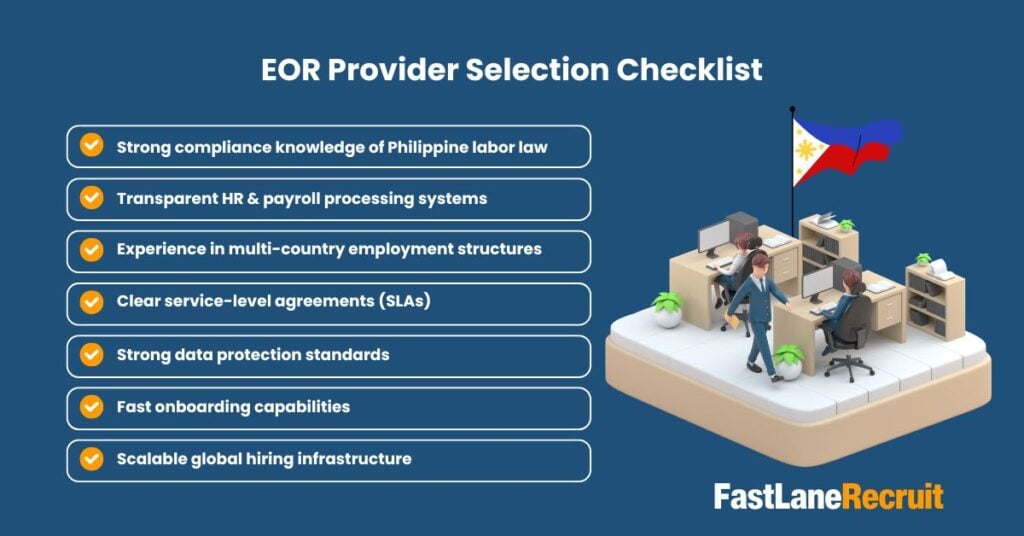
EOR Provider Selection Checklist
When evaluating an EOR provider, consider:
Why Companies Hire in Malaysia, Hong Kong, Singapore, China, UAE & Taiwan
While the Philippines is a strong hiring destination, many companies also expand into high-value regional hubs for strategic growth.
Why consider these markets?
- Malaysia → cost-efficient tech & shared services hub
- Hong Kong → financial services & international business gateway
- Singapore → regional HQ & high-skilled talent market
- China → large-scale engineering & manufacturing ecosystem
- UAE → Middle East expansion & tax-efficient structuring
- Taiwan → semiconductor, engineering, and R&D talent pool
Also Read: EOR Malaysia vs EOR Philippines Cost for Global Hiring
Country Comparison: Philippines vs Malaysia and Other Key Markets
Why Choose FastLaneRecruit for Regional Hiring Support
While FastLaneRecruit does not directly provide EOR services in the Philippines, we specialize in helping companies hire and expand across key strategic markets:
- Malaysia
- Hong Kong
- Singapore
- China
- UAE
- Taiwan
Our EOR solutions support businesses in:
- Cross-border recruitment
- Regional workforce planning
- Talent acquisition strategy
- Employer structuring guidance
Explore our business solutions that bring measurable results to your business.
Consult with our experts to kick start your business.
Conclusion
An Employer of Record in the Philippines is one of the most efficient ways for global companies to access skilled talent without establishing a local entity. It simplifies compliance, reduces administrative burden, and accelerates hiring.
However, for long-term regional expansion strategies, companies often benefit from building a multi-country hiring approach across markets like Malaysia, Singapore, Hong Kong, UAE, China, and Taiwan.
FastLaneRecruit supports businesses in designing and executing these cross-border hiring strategies.
FAQs: Employer of Record Philippines
What is an Employer of Record in the Philippines?
It is a third-party service that legally employs workers on behalf of a foreign company while managing payroll and compliance.
Is EOR legal in the Philippines?
Yes, EOR arrangements are widely used to facilitate compliant international hiring.
What is the main advantage of EOR hiring?
It allows companies to hire employees quickly without setting up a local entity.
How long does hiring take through EOR?
Typically between one to two weeks depending on onboarding requirements.
Can I scale teams using EOR?
Yes, EOR allows flexible scaling of teams without infrastructure constraints.