Germany is Europe’s largest economy and one of the world’s leading destinations for international business expansion. Home to globally recognized industries such as automotive manufacturing, engineering, renewable energy, pharmaceuticals, logistics, and technology, Germany offers access to a highly educated workforce and a stable economic environment.
For global companies seeking to hire talent in Germany, the opportunities are significant. However, entering the German employment market can be challenging due to complex labor laws, extensive employee protections, mandatory social security contributions, and strict payroll compliance requirements.
Establishing a local entity in Germany often requires substantial time, capital investment, and ongoing administrative commitments. For many businesses, especially those testing the market or hiring a small number of employees, this approach may not be practical.
This is where an Employer of Record Germany solution becomes valuable.
An Employer of Record (EOR) enables international companies to hire employees in Germany legally without setting up a German subsidiary. The EOR becomes the legal employer on paper while your company maintains control over daily work activities, performance management, and strategic direction.
In this guide, we’ll explore everything employers need to know about using an Employer of Record in Germany, including compliance requirements, payroll obligations, hiring challenges, legal considerations, benefits, costs, and alternative expansion options.
Content Outline
Key Summary
Germany Offers Access to Highly Skilled Talent
Germany is known for its strong workforce in engineering, manufacturing, software development, finance, healthcare, and research-driven industries.
German Employment Laws Are Highly Protective
Employers must comply with strict labor regulations regarding working hours, employee benefits, termination procedures, and social security contributions.
An Employer of Record Eliminates the Need for Entity Setup
Companies can hire employees in Germany without creating a local subsidiary, branch office, or GmbH.
Compliance Is One of the Biggest Hiring Challenges
German payroll taxes, employment regulations, and social insurance requirements can be difficult for foreign employers to manage independently.
EOR Solutions Accelerate Market Entry
Companies can begin hiring in Germany within weeks rather than spending months establishing a legal entity.
What Is an Employer of Record in Germany?
An Employer of Record (EOR) is a third-party organization that legally employs workers on behalf of another company.
The EOR assumes responsibility for:
- Employment contracts
- Payroll processing
- Tax withholding
- Social security administration
- Benefits administration
- Labor law compliance
- Employment documentation
- Regulatory reporting
Meanwhile, the client company remains responsible for:
- Employee supervision
- Work assignments
- Performance reviews
- Project management
- Business strategy
- Workplace objectives
This arrangement allows businesses to expand internationally without establishing their own local legal presence.
How Does an Employer of Record Germany Work?
The process is straightforward:
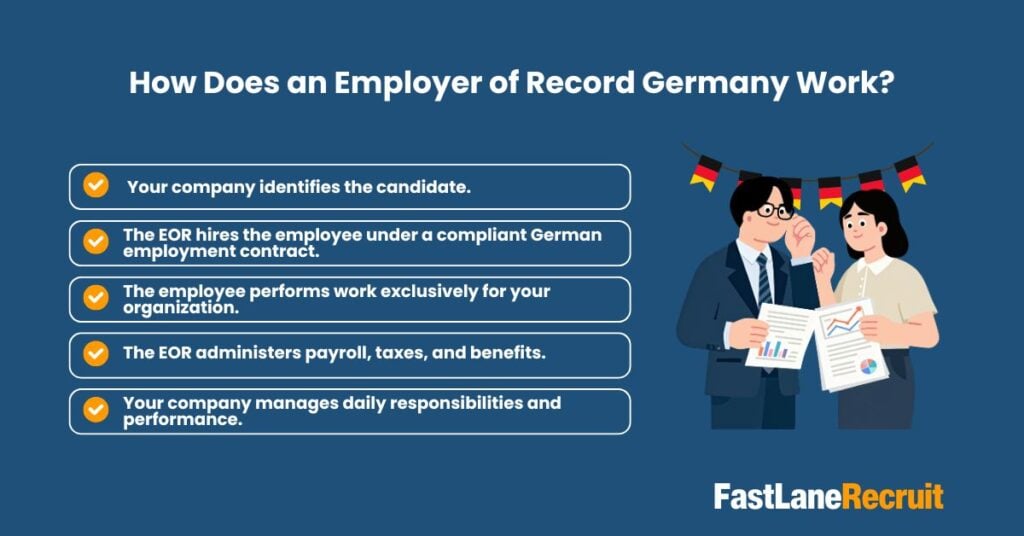
The employee experiences a normal employment relationship while your organization avoids the complexity of becoming a registered employer in Germany.
Germany Employment Market Overview
Germany is considered one of the most attractive labor markets in Europe.
| Category | Germany |
| Capital City | Berlin |
| Currency | Euro (EUR) |
| Population | 84+ Million |
| Official Language | German |
| EU Member | Yes |
| Standard Workweek | 40 Hours |
| Minimum Paid Leave | 20 Days |
| Healthcare System | Universal |
| Employment Protection | High |
Germany’s workforce is particularly strong in:
- Engineering
- Manufacturing
- Automotive
- Artificial Intelligence
- Information Technology
- Financial Services
- Biotechnology
- Renewable Energy
The country’s strong infrastructure and strategic location also make it a preferred destination for European expansion.
Why International Companies Use an Employer of Record in Germany
Hiring employees in Germany presents significant administrative and legal challenges for foreign businesses.
An Employer of Record helps overcome these barriers while supporting rapid market entry.
Market Entry Without Establishing a GmbH
Foreign companies often want to evaluate opportunities before committing to a permanent legal structure.
An EOR allows organizations to:
- Test demand
- Establish local operations
- Hire initial employees
- Build customer relationships
without incorporating a German entity.
Faster Hiring Timelines
Setting up a German subsidiary may take several months.
By contrast, an EOR allows businesses to onboard employees in a matter of weeks.
Reduced Compliance Risk
German labor regulations are highly detailed and continuously evolving.
An EOR helps ensure compliance with:
- Employment contracts
- Payroll regulations
- Tax requirements
- Social insurance obligations
- Working time regulations
- Termination procedures
Lower Administrative Burden
Instead of building local HR, payroll, legal, and finance functions, companies can rely on the EOR’s existing infrastructure.
Support for Remote Work Strategies
Many organizations want to hire individual employees or distributed teams throughout Europe.
An EOR enables compliant remote hiring without creating legal entities in multiple jurisdictions.
Also Read: What Is a Remote Job?
Hiring Challenges in Germany
Despite Germany’s attractive labor market, international employers frequently encounter several challenges.
Complex Labor Regulations
Germany has some of Europe’s strongest employee protection laws.
Employers must understand:
- Employment contracts
- Working time regulations
- Employee leave entitlements
- Collective bargaining agreements
- Termination restrictions
Failure to comply can result in legal disputes and financial penalties.
High Compliance Expectations
Government authorities expect employers to maintain accurate employment documentation and payroll records.
Foreign companies unfamiliar with German regulations may face compliance risks.
Social Security Administration
Employers must register employees with various social insurance programs and calculate contributions accurately.
These obligations can become administratively burdensome for organizations without local expertise.
Works Councils
Many German organizations operate with employee representative bodies known as Works Councils.
These groups have legal rights related to workplace policies and employee matters.
Competitive Talent Market
Germany continues to experience talent shortages in several industries, particularly:
- Software development
- Cybersecurity
- Engineering
- Healthcare
- Skilled trades
Employers must often provide competitive compensation and benefits packages to attract top talent.
Also Read: Managing Remote Employees: Hire, Onboard & Lead Remote Teams Effectively
Why Use an Employer of Record Germany Instead of Setting Up a Local Entity?
Choosing between an Employer of Record and establishing a German legal entity depends on your business goals.
For many organizations, an EOR provides a faster and more cost-effective solution.
Comparison Table
| Factor | Employer of Record | German GmbH |
| Setup Time | Days to Weeks | Several Months |
| Initial Investment | Low | High |
| Legal Entity Required | No | Yes |
| Payroll Setup | Included | Required |
| Tax Registration | Included | Required |
| Compliance Management | EOR Managed | Internal |
| HR Administration | EOR Managed | Internal |
| Ideal Team Size | 1-20 Employees | Larger Teams |
| Market Testing | Excellent | Less Flexible |
When an EOR Makes More Sense
An Employer of Record is typically the better option when:
- Hiring one or several employees
- Testing the German market
- Launching a pilot project
- Building remote teams
- Expanding rapidly
- Avoiding entity setup costs
Employer of Record Germany vs Staffing Agency vs Local Entity
Many companies confuse EOR services with staffing agencies.
The solutions serve different purposes.
| Criteria | Employer of Record | Staffing Agency | Local Entity |
| Permanent Employment | Yes | Usually Temporary | Yes |
| Legal Employer | EOR | Agency | Company |
| Payroll Management | Included | Included | Internal |
| Compliance Management | Extensive | Limited | Internal |
| Employee Control | High | Moderate | High |
| Entity Requirement | No | No | Yes |
| Suitable for Market Entry | Yes | Limited | Yes |
An EOR is generally the preferred solution for businesses seeking long-term employment relationships without establishing a local subsidiary.
Benefits of Using an Employer of Record in Germany
- Accelerated Expansion: Companies can begin hiring quickly without waiting for entity registration.
- Local Compliance Expertise: EOR providers understand German labor regulations and ensure legal compliance.
- Reduced Risk: Organizations avoid common mistakes involving payroll, taxes, benefits, and employment contracts.
- Lower Operational Costs: Businesses avoid incorporation expenses and ongoing administrative costs.
- Improved Employee Experience: Employees receive compliant contracts, timely payroll, statutory benefits, and local HR support.
- Scalable Growth: Companies can increase or decrease workforce size without maintaining local infrastructure.
Germany Employment Law and Compliance Framework
Employment compliance is one of the most important considerations when hiring in Germany.
Employment Contracts
German employment contracts typically include:
- Job title
- Compensation details
- Working hours
- Probation period
- Leave entitlements
- Notice periods
- Confidentiality provisions
- Termination conditions
Clear written agreements are strongly recommended.
Working Hours
German labor law generally limits employees to:
- 8 working hours per day
- Maximum average of 48 hours per week
Rest breaks and minimum rest periods must also be observed.
Probation Period
Probation periods commonly last up to six months.
Different notice requirements may apply during probation.
Paid Annual Leave
Employees are legally entitled to a minimum of:
- 20 paid vacation days annually based on a five-day workweek
Many employers offer additional leave to remain competitive.
Sick Leave
Employees are generally entitled to continued salary payments during qualifying illness periods.
Employers must follow statutory requirements concerning medical certification and compensation.
Public Holidays
Germany observes national and regional public holidays.
The number of public holidays varies by federal state.
Employee Termination
Germany has strong dismissal protections.
Employers must often demonstrate legitimate reasons for termination, particularly after probation.
Termination requirements may include:
- Notice periods
- Documentation
- Consultation procedures
- Severance considerations
Improper termination can expose employers to legal claims and financial liabilities.
Payroll and Benefits Administration in Germany
Managing payroll in Germany requires compliance with multiple tax and social insurance obligations.
Payroll Components
Employers typically process:
- Gross salary
- Income tax withholding
- Pension insurance contributions
- Health insurance contributions
- Unemployment insurance contributions
- Long-term care insurance contributions
Payroll calculations must be accurate and timely.
Employer Contributions
German employers contribute significantly toward social insurance programs.
These contributions represent a substantial component of total employment costs.
Mandatory Employee Benefits
Employers must generally provide access to:
- Healthcare coverage
- Pension contributions
- Unemployment protection
- Long-term care insurance
- Paid annual leave
- Sick leave benefits
Competitive Benefits
To attract top talent, many employers also offer:
- Additional paid leave
- Flexible work arrangements
- Professional development support
- Transportation allowances
- Wellness programs
- Supplemental insurance
An Employer of Record ensures these benefits are administered correctly and in compliance with local regulations.
Step-by-Step Process for Hiring Employees Through an Employer of Record in Germany
One of the main advantages of using an Employer of Record Germany solution is the ability to hire quickly while maintaining full compliance.
Step 1: Identify Your Hiring Requirements
Determine:
- Position requirements
- Employment type
- Compensation package
- Location requirements
- Reporting structure
At this stage, companies should also assess whether they require a single employee or a larger team.
Step 2: Select an Employer of Record Provider
Choose an EOR provider with:
- German employment expertise
- Payroll capabilities
- Compliance support
- Transparent pricing
- Strong customer support
A reliable provider should be able to explain local labor laws and hiring requirements clearly.
Step 3: Candidate Selection
The client company sources and interviews candidates.
The EOR does not typically participate in talent selection unless recruitment services are included.
Step 4: Employment Contract Preparation
The EOR prepares a locally compliant employment agreement that reflects:
- Job responsibilities
- Compensation
- Working hours
- Benefits
- Leave entitlements
- Termination provisions
Step 5: Employee Onboarding
The EOR manages:
- Employment documentation
- Registration requirements
- Payroll setup
- Benefits enrollment
- Compliance verification
Step 6: Payroll and Benefits Administration
Once employment begins, the EOR handles:
- Monthly payroll
- Tax withholding
- Social security contributions
- Benefit administration
- Regulatory reporting
Step 7: Ongoing Employee Management
Your company continues to oversee:
- Daily work assignments
- Performance reviews
- Promotions
- Team integration
- Professional development
This allows organizations to maintain operational control while outsourcing compliance responsibilities.
Industries That Benefit Most from Employer of Record Germany Services
Germany’s diverse economy creates opportunities across numerous sectors.
Certain industries particularly benefit from EOR solutions.
Technology and Software Development
Many international companies use EOR services to hire:
- Software engineers
- Product managers
- UX designers
- Data scientists
- Cybersecurity specialists
Germany’s technology hubs, including Berlin and Munich, provide access to highly skilled professionals.
Engineering and Manufacturing
Germany is globally recognized for engineering excellence.
Organizations frequently hire:
- Mechanical engineers
- Electrical engineers
- Manufacturing specialists
- Industrial designers
- Project managers
Automotive Sector
Germany remains a global automotive leader.
EOR solutions help companies recruit:
- Automotive engineers
- Supply chain specialists
- Research professionals
- Manufacturing experts
Life Sciences and Healthcare
Germany’s healthcare and biotechnology industries continue to expand.
Popular hiring areas include:
- Medical research
- Pharmaceuticals
- Biotechnology
- Clinical operations
Financial Services
International firms often use EOR arrangements to hire:
- Accountants
- Financial analysts
- Compliance specialists
- Risk management professionals
Employer of Record Germany Cost Breakdown
One of the most common questions employers ask is how much an Employer of Record costs compared to establishing a local entity.
While pricing varies by provider and employee compensation levels, businesses should evaluate total expansion costs rather than EOR fees alone.
Typical EOR Cost Components
EOR pricing may include:
- Employee onboarding fees
- Monthly service fees
- Payroll administration
- Benefits administration
- Compliance support
- Offboarding services
Cost Comparison: EOR vs Local Entity
| Expense Category | Employer of Record | German Entity |
| Incorporation Costs | None | High |
| Legal Fees | Minimal | Significant |
| Payroll Setup | Included | Additional Cost |
| HR Infrastructure | Included | Required |
| Compliance Management | Included | Internal Responsibility |
| Ongoing Administration | Lower | Higher |
| Time Investment | Low | High |
For companies hiring only a handful of employees, an EOR is often the more economical solution.
Risks and Considerations When Using an Employer of Record in Germany
Although EOR solutions provide significant advantages, companies should evaluate potential considerations before proceeding.
Long-Term Cost Considerations
As team sizes increase significantly, establishing a local entity may eventually become more cost-effective.
Organizations should periodically review their expansion strategy.
Limited Corporate Presence
An EOR allows hiring without incorporation but does not provide a permanent legal presence in Germany.
Businesses pursuing extensive operations may eventually require a subsidiary.
Service Quality Variations
Not all EOR providers offer the same level of support.
Selecting an experienced provider is critical for maintaining compliance.
Permanent Establishment Risks
Companies should assess whether their activities in Germany could trigger tax obligations or create a permanent establishment.
Professional legal and tax advice is recommended.
Employer of Record Germany Provider Selection Checklist
Choosing the right EOR provider can significantly impact your hiring success.
Use the following checklist when evaluating providers.
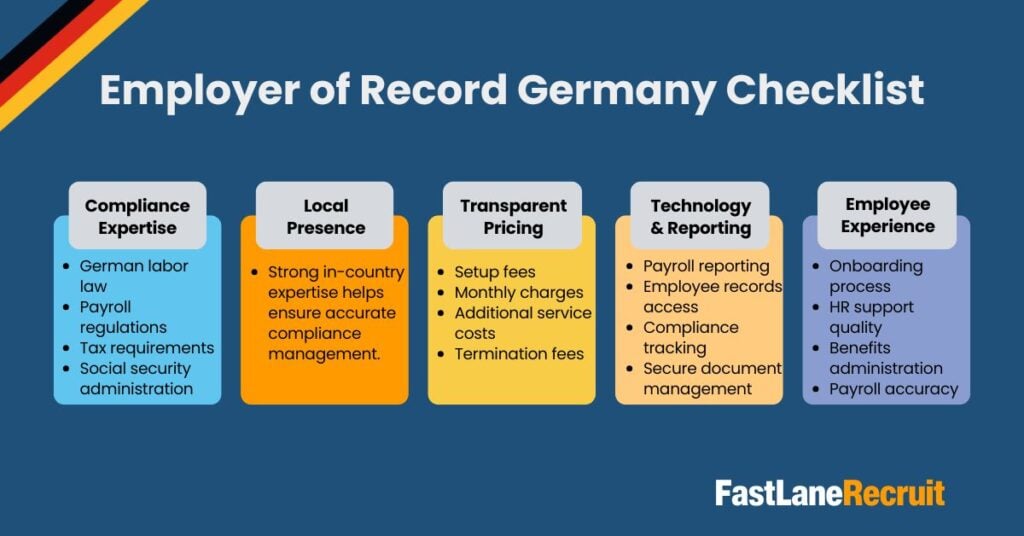
Important note: Scalability is one the things you need to consider since the provider should support future expansion as your workforce grows.
Common Use Cases for Employer of Record Germany
Employer of Record services are used by businesses of all sizes.
Testing the German Market
Companies can assess market demand before investing in a local subsidiary.
Hiring Remote Employees
Organizations can employ individual professionals located in Germany.
Expanding Across Europe
Germany often serves as a strategic hiring hub for European operations.
Building Sales Teams
Companies frequently use EOR solutions to hire:
- Sales representatives
- Business development managers
- Account executives
Project-Based Expansion
Organizations can hire talent for specific projects without establishing a permanent legal structure.
Supporting Global Workforce Strategies
EOR solutions enable businesses to hire the best talent regardless of geographic location.
Can You Hire Employees in Germany Without an Employer of Record?
Yes, foreign companies can hire employees in Germany without an EOR.
However, this generally requires:
- Establishing a legal entity
- Registering with tax authorities
- Managing payroll
- Administering social insurance
- Ensuring labor law compliance
For many organizations, these obligations create substantial administrative complexity.
An Employer of Record provides a faster and lower-risk alternative.
Why Germany Remains Attractive for Global Expansion
Germany continues to attract international businesses because of its economic strength and talent availability.
Europe’s Largest Economy
Germany provides access to one of the world’s largest and most stable economies.
Highly Skilled Workforce
The country produces strong talent in:
- Engineering
- Technology
- Manufacturing
- Finance
- Healthcare
Strategic European Location
Businesses can use Germany as a gateway to the wider European market.
Strong Infrastructure
Germany offers advanced transportation, logistics, and digital infrastructure.
Innovation Ecosystem
The country supports research, innovation, and startup development across numerous industries.
Why Consider Other Options for Hiring Talent?
While Germany offers excellent talent, businesses often face higher employment costs, complex labor regulations, and significant compliance requirements.
For organizations seeking a strategic expansion destination in Asia, Malaysia presents compelling advantages.
Cost-Effective Talent Acquisition
Malaysia offers access to highly educated professionals at significantly lower employment costs compared to many European markets.
Strong English Proficiency
Malaysia’s workforce is known for strong English communication skills, making collaboration with international teams easier.
Growing Technology Ecosystem
The country has become a regional hub for:
- Software development
- IT services
- Shared service centers
- Digital transformation projects
Business-Friendly Environment
Malaysia actively supports foreign investment and international business expansion.
Strategic ASEAN Location
Companies can access Southeast Asia’s rapidly growing markets through a Malaysian workforce.
Germany vs Malaysia Comparison for International Hiring
| Factor | Germany | Malaysia |
| Labor Cost | Higher | Lower |
| English Proficiency | Moderate | High |
| Talent Availability | High | High |
| Payroll Complexity | High | Moderate |
| Compliance Burden | High | Moderate |
| Market Access | Europe | ASEAN |
| Business Setup Costs | Higher | Lower |
| Expansion Speed | Moderate | Fast |
For many international businesses, Malaysia offers an attractive balance between talent quality, operational efficiency, and cost-effectiveness.
Why Choose FastLaneRecruit for International Expansion?
FastLaneRecruit helps businesses expand efficiently across key Asian markets.
Our expertise includes:
- Employer of Record services
- International recruitment
- Payroll administration
- Compliance support
- Workforce management
We currently support businesses hiring in:
- Malaysia
- Hong Kong
- Singapore
- China
- UAE
- Taiwan
Our team helps companies navigate local employment regulations while reducing administrative complexity.
What Sets FastLaneRecruit Apart?
Regional Expertise
We understand the employment regulations and hiring practices across major Asian business hubs.
Compliance-First Approach
Our solutions prioritize legal compliance and risk mitigation.
End-to-End Support
From recruitment to onboarding and payroll administration, we support the entire employee lifecycle.
Scalable Solutions
Whether hiring one employee or building a regional team, our services grow with your business.
Get Expert Assistance from FastLaneRecruit
If your organization is exploring international hiring opportunities, choosing the right market and workforce strategy is critical.
FastLaneRecruit helps global companies:
- Hire employees compliantly
- Expand into Asia faster
- Manage payroll efficiently
- Reduce compliance risks
- Build high-performing regional teams
Whether you are comparing Germany with Asia-Pacific hiring destinations or planning your next phase of international expansion, our experts can help you develop the right workforce strategy.
Contact FastLaneRecruit today to discuss Employer of Record solutions in Malaysia, Hong Kong, Singapore, China, UAE, and Taiwan.
Expand Faster with FastLaneRecruit
Looking to build international teams without the complexity of establishing local entities?
FastLaneRecruit helps global companies hire talent compliantly across Malaysia, Hong Kong, Singapore, China, UAE, and Taiwan through comprehensive Employer of Record and recruitment solutions.
Speak with our experts today to discover the most effective strategy for your international hiring and expansion goals.
Conclusion
Germany remains one of the world’s most attractive destinations for international hiring. The country offers a highly skilled workforce, a strong economy, and access to the broader European market. However, employers must navigate complex labor laws, payroll obligations, social insurance requirements, and employment compliance regulations.
An Employer of Record Germany solution allows businesses to hire employees quickly and compliantly without establishing a local legal entity. By outsourcing employment administration, payroll management, and regulatory compliance, organizations can focus on growth while reducing operational risk.
For businesses exploring international expansion opportunities, it is equally important to evaluate alternative hiring destinations. Markets such as Malaysia, Hong Kong, Singapore, China, UAE, and Taiwan may provide strategic advantages depending on your workforce objectives, budget, and growth plans.
Frequently Asked Questions About Employer of Record Germany
What is an Employer of Record in Germany?
An Employer of Record is a third-party organization that legally employs workers on behalf of another company while managing payroll, benefits, taxes, and compliance.
Can I hire employees in Germany without opening a company?
Yes. An Employer of Record allows businesses to hire employees legally without establishing a German legal entity.
Is an Employer of Record legal in Germany?
Yes. EOR arrangements are commonly used by international businesses seeking compliant hiring solutions.
How long does it take to hire through an Employer of Record?
Most companies can onboard employees within a few weeks, depending on documentation and employment requirements.
Who manages the employee’s daily work?
The client company manages daily responsibilities, performance, and supervision.
Does the EOR handle payroll taxes?
Yes. The EOR administers payroll and manages required tax and social security contributions.
Is Germany a good market for international hiring?
Yes. Germany offers access to highly skilled talent and one of Europe’s largest economies.
When should I choose an EOR instead of establishing a German subsidiary?
An EOR is often preferable when hiring a small number of employees, testing the market, or expanding quickly.
What industries commonly use EOR services in Germany?
Technology, engineering, manufacturing, automotive, healthcare, life sciences, and financial services are among the most common sectors.
Can an EOR help with remote employee hiring?
Yes. EOR providers are frequently used to hire remote employees in Germany.