Businesses today are no longer limited by geography, office infrastructure, or local hiring constraints. The global workforce has shifted toward distributed teams, where companies build capability across borders without establishing heavy operational setups.
At the center of this transformation is a concept that continues to dominate global search interest and business strategy discussions: BPO meaning in modern business operations.
In 2026, BPO is no longer just a cost-cutting tool, it has become a core workforce expansion strategy combined with outsourcing, offshore staffing, and Employer of Record (EOR) solutions.
Content Outline
Key Summary
BPO Is A Strategic Workforce Model, Not Just Outsourcing
Businesses use BPO to delegate non-core functions while improving efficiency and scalability.
EOR Enables Global Hiring Without Entity Setup
Companies can legally hire international talent without establishing a local company.
Malaysia Is A High-Growth Outsourcing Destination
It offers cost efficiency, multilingual talent, and strong regulatory stability.
FastLaneRecruit Enables End-To-End Workforce Expansion
From recruitment to payroll and EOR, companies can scale globally with reduced complexity.
What Is BPO Meaning In Business?
BPO meaning (Business Process Outsourcing) refers to delegating specific business operations to external service providers who specialize in executing them efficiently.
Instead of managing every function internally, companies outsource operational tasks such as:
- Human resources administration
- Payroll and accounting
- Customer service operations
- IT support and technical services
- Data management and back-office processing
The core idea is simple:
Companies focus on strategic growth while outsourcing operational execution.
In modern business environments, BPO has evolved into a global workforce optimization model powered by digital tools and remote teams.
Also Read: What Is Business Process Outsourcing (BPO) and How Does It Work?
How BPO Works In Modern Business Environments
Today’s BPO models are structured, technology-driven, and performance-focused.
Step 1: Identifying Non-Core Functions
Businesses evaluate internal workflows to determine which tasks can be outsourced without affecting core business performance.
Step 2: Selecting The Right Outsourcing Partner
Companies choose providers based on expertise, compliance capability, scalability, and industry experience.
Step 3: Transitioning Operations
Tasks, systems, and workflows are transferred to external teams or offshore units with structured onboarding.
Step 4: Performance Management Through SLAs
Service Level Agreements define quality standards, KPIs, and accountability metrics.
Step 5: Continuous Optimization And Scaling
Organizations refine outsourced processes to improve efficiency and reduce operational cost over time.
Also Read: Top Accounting Outsourcing BPO Companies in USA
Types Of BPO Services In 2026
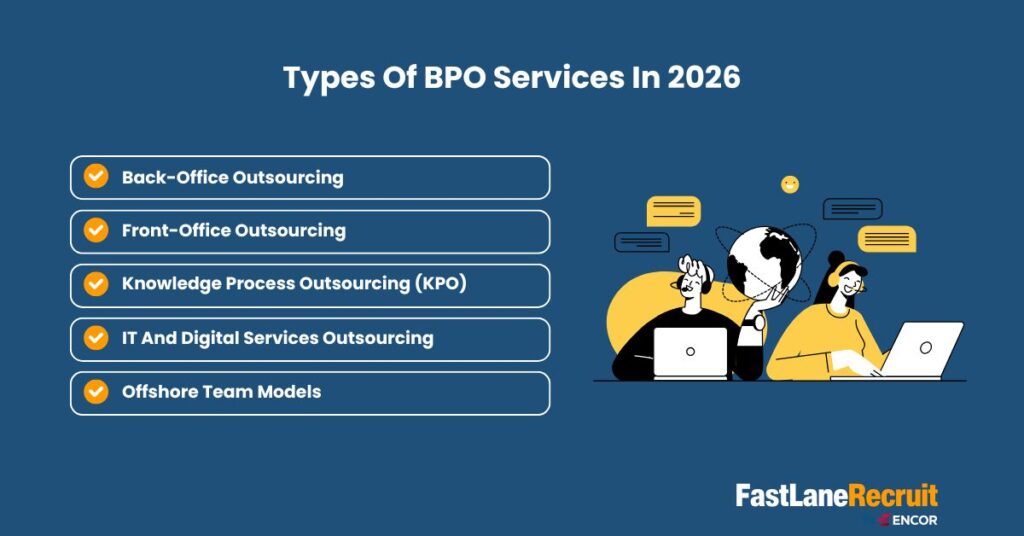
Back-Office Outsourcing
Includes HR administration, payroll processing, accounting, compliance, and documentation.
Front-Office Outsourcing
Includes customer service, sales support, and client communication operations.
Knowledge Process Outsourcing (KPO)
High-skill services such as research, analytics, financial modeling, and consulting support.
IT And Digital Services Outsourcing
Includes software maintenance, cloud operations, cybersecurity, and technical support.
Offshore Team Models
Dedicated teams located in cost-efficient regions to improve scalability and operational coverage.
BPO Meaning Vs EOR: Understanding The Difference
Although often used together, BPO and EOR serve different business needs.
BPO (Business Process Outsourcing)
- Outsources business functions
- Vendor manages the workforce and delivery
- Focus: operational efficiency
EOR (Employer Of Record)
- Enables legal employment in foreign countries
- Employer retains full operational control
- EOR manages payroll, contracts, and compliance
- Focus: global hiring expansion
In 2026, companies increasingly combine both models to build flexible global workforce systems.
Why Companies Are Shifting To Outsourcing And EOR Models
The modern workforce landscape is driven by speed, flexibility, and access to global talent.
Key Business Drivers:
- Rising talent shortages in local markets
- Increased hiring and operational costs
- Demand for 24/7 global operations
- Expansion into international markets
- Remote work normalization
As a result, outsourcing is no longer a support function, it is now a strategic growth lever.
Why Malaysia Is A Leading Outsourcing And EOR Destination
Malaysia has emerged as one of Asia’s strongest outsourcing hubs due to its balanced combination of talent, cost, and infrastructure.
1. Cost Efficiency Without Quality Loss
Businesses benefit from competitive labor costs while maintaining strong professional standards.
2. Multilingual And Skilled Workforce
English proficiency is strong, supported by multilingual capabilities across ASEAN markets.
3. Strategic APAC Location
Malaysia’s time zone supports operations across Asia-Pacific, the Middle East, and partial European coverage.
4. Stable Legal And Business Environment
Strong regulatory frameworks ensure compliance-friendly outsourcing and hiring structures.
5. Growing Digital And Remote Infrastructure
Rapid adoption of remote work systems and digital business operations enhances scalability.
These factors make Malaysia a strategic alternative to higher-cost markets like Singapore or Hong Kong.
Why FastLaneRecruit Is A Strategic Partner For Outsourcing And Recruitment
Companies expanding globally need more than vendors, they need structured workforce solutions that combine compliance, speed, and scalability.
FastLaneRecruit supports businesses through end-to-end workforce expansion services.
Core Services:
- Recruitment and talent acquisition
- Employer of Record (EOR) solutions
- Payroll outsourcing and management
- Offshore team setup
- HR compliance and workforce structuring
Business Advantages:
- Faster hiring cycles for global teams
- Reduced legal and administrative burden
- Access to pre-vetted talent pools
- Scalable hiring models for SMEs and enterprises
- Regional expertise in Asia-Pacific markets
Expand with FastLaneRecruit’s Regional Employer of Record (EOR) Services
FastLaneRecruit provides Employer of Record (EOR) services across Malaysia, Hong Kong, Singapore, China, the United Arab Emirates (UAE), and Taiwan, enabling businesses to hire employees quickly without establishing local legal entities. Our regional team manages employment contracts, payroll, statutory compliance, tax obligations, onboarding, and ongoing HR administration, ensuring your workforce remains fully compliant with local regulations while you focus on business growth.
Whether you’re hiring in a single country or building a regional team across multiple markets, FastLaneRecruit offers a seamless and scalable solution to support your international expansion.
Instead of managing fragmented HR systems and multiple service providers, businesses gain a centralized workforce expansion solution backed by local expertise and regional compliance support.
Ready to build your global workforce? Contact FastLaneRecruit today to discover how our recruitment, payroll, and Employer of Record solutions can accelerate your expansion across Asia and the UAE.
Final Thoughts
The meaning of BPO has evolved far beyond its original definition. In 2026, it represents a strategic approach to building global workforce systems that prioritize scalability, efficiency, and access to talent.
Companies that understand and adopt outsourcing and EOR models early gain a significant competitive advantage in speed, cost structure, and global reach.
With structured support from FastLaneRecruit, businesses can transition from traditional hiring limitations into a fully scalable global workforce model built for long-term growth.
FAQs About BPO Meaning And Outsourcing
What Does BPO Meaning Mean In Business Services?
BPO refers to Business Process Outsourcing, where companies delegate operational tasks like HR, payroll, and customer service to external providers.
What Are The Benefits Of Outsourcing To A BPO Firm?
Key benefits include:
- Reduced operational costs
- Access to specialized expertise
- Improved efficiency and scalability
- Faster business expansion
- Focus on core business strategy
What Is The Difference Between BPO And Outsourcing?
BPO is a structured form of outsourcing focused on specific business processes, while outsourcing is a broader term covering any delegated work.
What Is EOR And How Does It Support Global Hiring?
EOR (Employer of Record) enables companies to hire employees in foreign countries without establishing a legal entity.
Why Do Companies Use Malaysia For Outsourcing?
Malaysia offers cost-effective talent, strong English proficiency, stable regulations, and strategic APAC positioning.
Is Outsourcing Still Relevant In 2026?
Yes. Outsourcing has evolved into a global workforce strategy integrating technology, offshore teams, and EOR models.
Can Small Businesses Use BPO Or EOR Services?
Yes. SMEs use these models to scale operations without high infrastructure or hiring costs.