As global hiring becomes more common, businesses are increasingly working with distributed teams made up of freelancers, contractors, remote employees, and international staff. While this creates new growth opportunities, it also introduces complex compliance challenges related to worker classification, payroll, taxation, contracts, and labor laws.
This is where AOR services and Employer of Record (EOR) solutions become essential.
Although both models help companies hire and manage talent across borders compliantly, they serve very different purposes. An Agent of Record (AOR) primarily supports businesses engaging independent contractors, while an Employer of Record (EOR) legally employs full-time workers on behalf of a company.
Understanding the difference between AOR vs. EOR is critical for businesses looking to scale internationally without exposing themselves to compliance risks, worker misclassification penalties, or operational inefficiencies.
In this guide, we explain everything you need to know about AOR services, EOR solutions, their key differences, benefits, use cases, and how to choose the right model for your workforce strategy.
Content Outline
Key Summary
AOR vs. EOR serve different workforce needs
AOR (Agent of Record) is designed for managing independent contractors, while EOR (Employer of Record) is used for full-time employees hired internationally.
AOR services focus on contractor compliance:
They handle worker classification, contracts, onboarding, payments, and ongoing compliance to reduce misclassification risks.
EOR handles full employment responsibilities
This includes payroll, tax withholding, statutory benefits, HR administration, and labor law compliance in the employee’s country.
Worker classification is critical
Misclassifying employees as contractors can lead to legal penalties, back taxes, and reputational damage.
AOR is best for flexible, project-based work
Ideal for freelancers, gig workers, and short-term or scalable contractor engagements.
EOR is best for global expansion
It enables companies to hire full-time employees in new countries without setting up a local legal entity.
Many companies use both AOR and EOR together
A hybrid model helps manage contractors and employees within a single global workforce strategy.
Choosing the right model depends on workforce type and growth goals
AOR supports flexibility, while EOR supports long-term international hiring and compliance stability.
What Is Worker Misclassification?
Worker misclassification happens when a company incorrectly categorizes a worker as an independent contractor instead of an employee — or vice versa.
This is one of the most common compliance risks in global hiring today.
Many companies hire freelancers or gig workers because of the flexibility and lower administrative burden. However, problems arise when contractors are treated like employees. For example, if a company controls the worker’s schedule, work methods, or exclusivity, regulators may determine that the worker should legally be classified as an employee.
Several global companies have faced lawsuits and multi-million-dollar settlements over worker misclassification issues in recent years.
As remote work expands worldwide, governments are increasing scrutiny on contractor arrangements, especially in industries relying heavily on gig workers and distributed talent.
Misclassification risks may include:
- Government fines and penalties
- Back taxes and unpaid benefits
- Employment lawsuits
- Reputational damage
- Payroll compliance violations
- Intellectual property disputes
Because labor laws differ across countries and regions, managing a global workforce without expert compliance support can quickly become complicated.
This is why many businesses rely on AOR services or EOR providers to reduce legal and operational risks.
What Is an Agent of Record (AOR)?
An Agent of Record (AOR) is a third-party service provider that helps companies compliantly engage and manage independent contractors.
AOR services are specifically designed for freelancers, consultants, gig workers, and self-employed professionals rather than full-time employees.
The primary purpose of an AOR is to minimize worker misclassification risk while simplifying contractor onboarding, contracts, compliance, invoicing, and international payments.
Unlike employees, independent contractors maintain control over how, when, and where they work. However, because employment laws vary globally, determining whether a worker legally qualifies as a contractor is not always straightforward.
An AOR helps businesses navigate these complexities by ensuring contractor relationships remain compliant throughout the engagement.
How AOR Services Work
AOR services act as an intermediary between businesses and independent contractors.
The AOR handles administrative and compliance-related responsibilities while the client company continues managing the contractor’s day-to-day work and deliverables.
A typical AOR process includes:
- Worker classification assessment
- Contractor onboarding
- Drafting compliant agreements
- Collecting tax documentation
- Managing contractor payments
- Monitoring ongoing compliance risks
This allows businesses to work with international contractors more confidently without building internal compliance infrastructure.
Key Responsibilities of AOR Services
Worker Classification
One of the most important responsibilities of AOR services is determining whether a worker qualifies as an independent contractor under local laws.
Proper classification reduces the risk of fines, tax disputes, and employment claims.
Contract Management
An AOR prepares compliant contractor agreements, including:
- Service agreements
- Confidentiality clauses
- Intellectual property protections
- Non-disclosure agreements (NDAs)
These contracts are tailored to local labor regulations.
Contractor Onboarding
AOR providers collect and verify required documents such as:
- Tax forms
- Identification records
- Banking details
- Business registration information
Some providers also perform background checks and qualification reviews.
International Contractor Payments
Managing cross-border contractor payments can be operationally difficult due to currency conversion, local tax requirements, and invoicing standards.
AOR services simplify this process by centralizing contractor payment workflows.
Ongoing Compliance Monitoring
Labor laws frequently change. AOR providers monitor evolving contractor regulations and help businesses maintain compliant engagements over time.
Benefits of Using AOR Services
Businesses increasingly adopt AOR services because they offer both compliance protection and operational flexibility.
Key benefits include:
Reduced Misclassification Risk
AOR providers help ensure contractors are engaged legally and compliantly.
Faster Contractor Hiring
Companies can onboard international contractors quickly without establishing local entities.
Simplified Administrative Processes
AOR services streamline documentation, payments, and onboarding tasks.
Greater Workforce Flexibility
Businesses can scale project-based teams more efficiently.
Access to Global Talent
Companies can hire specialized contractors from virtually anywhere in the world.
What Is an Employer of Record (EOR)?
An Employer of Record (EOR) is a third-party organization that legally employs workers on behalf of another company.
Unlike AOR services, EOR solutions are designed for full-time and part-time employees rather than contractors.
The EOR becomes the legal employer responsible for:
- Payroll processing
- Employment taxes
- Benefits administration
- Labor law compliance
- Employment contracts
- HR administration
Meanwhile, the client company manages the employee’s daily responsibilities and performance.
An EOR allows businesses to hire employees internationally without establishing a legal entity in every country where they operate.
How EOR Services Work
When a company hires through an EOR, the EOR officially employs the worker under local employment laws.
The EOR handles all legal employment obligations, including:
- Payroll
- Tax withholding
- Social contributions
- Employee benefits
- Employment compliance
- Termination procedures
This enables businesses to expand globally much faster and more cost-effectively.
Key Responsibilities of an EOR
Payroll and Tax Administration
The EOR ensures employees are paid accurately and compliantly according to local tax laws.
Employee Benefits Management
EOR providers administer statutory benefits such as:
- Health insurance
- Pension contributions
- Paid leave
- Social security obligations
Employment Compliance
An EOR ensures compliance with:
- Local labor laws
- Employment contracts
- Working hour regulations
- Termination requirements
- Severance obligations
HR and Administrative Support
Many EOR providers assist with onboarding, employee documentation, and HR operations.
Benefits of Using an EOR
Global Expansion Without Legal Entities
An EOR allows companies to hire internationally without opening local subsidiaries.
Faster Market Entry
Businesses can enter new countries quickly while remaining compliant.
Reduced Administrative Burden
The EOR manages payroll, taxes, and HR compliance.
Improved Employee Experience
Employees receive compliant contracts, payroll, and local benefits.
Lower Compliance Risk
An EOR reduces exposure to labor law violations and payroll errors.
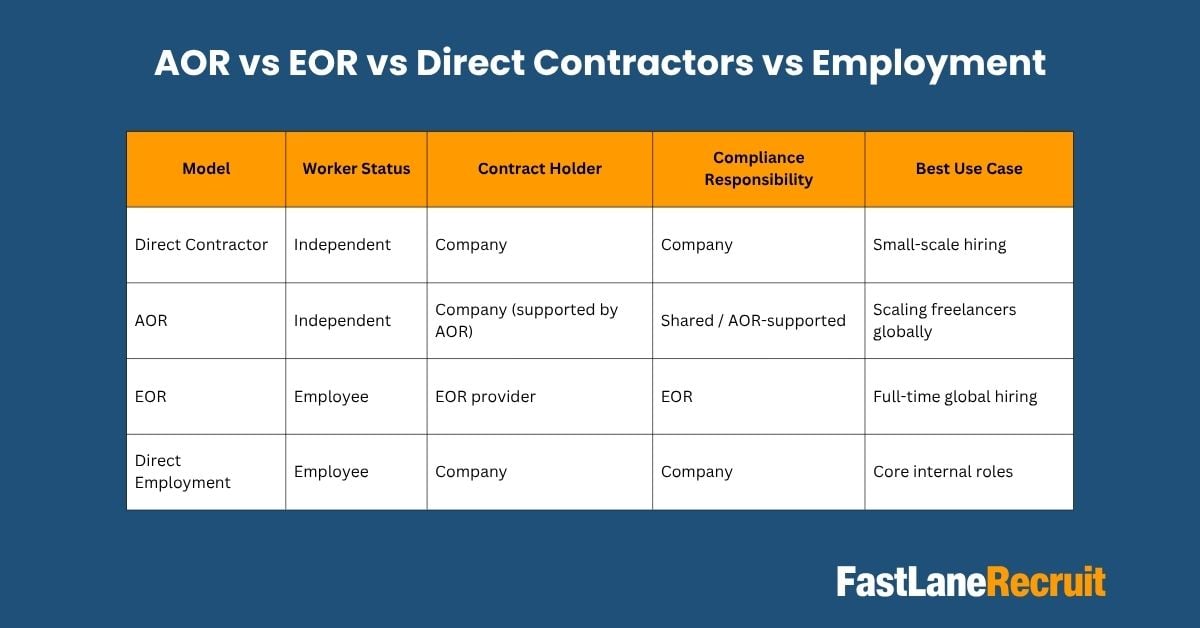
AOR vs. EOR: The Key Differences
Although AOR and EOR services both support global hiring, their functions are fundamentally different.
When Should You Use AOR Services?
AOR services are ideal when businesses need flexibility and contractor-based support.
Common scenarios include:
- Hiring freelancers
- Managing project-based work
- Scaling quickly
- Working with international consultants
- Engaging gig workers
- Accessing specialized expertise temporarily
Industries commonly using AOR services include:
- Technology
- Creative services
- Marketing
- Consulting
- Media
- Startups
When Should You Use an EOR?
An EOR is more suitable for businesses hiring permanent or long-term employees internationally.
Typical use cases include:
- Expanding into foreign markets
- Hiring remote employees abroad
- Building international teams
- Managing global payroll
- Supporting long-term workforce growth
Industries commonly using EOR services include:
- SaaS
- Finance
- Manufacturing
- Healthcare
- Enterprise technology
Common Misconceptions About AOR vs. EOR
“An EOR Removes All Employer Responsibilities”
Even with an EOR, companies still manage employee performance, projects, and operational direction.
“AOR Services Eliminate All Compliance Risks”
While AOR providers significantly reduce risk, businesses must still maintain compliant contractor relationships operationally.
“EOR Is Only for International Hiring”
EOR services can also help businesses navigate complex domestic employment regulations.
“Using an EOR Means Losing Control”
Companies retain full operational control over employees while the EOR handles legal employment administration.
How to Choose Between AOR vs. EOR
Choosing between AOR services and an EOR depends on your workforce structure and growth strategy.
Consider the following questions:
Are You Hiring Contractors or Employees?
- Contractors → AOR
- Employees → EOR
Do You Need Workforce Flexibility?
AOR services are better for temporary and project-based engagements.
Are You Expanding Internationally?
An EOR simplifies international employee hiring without legal entities.
Do You Need Benefits Administration?
EOR providers manage statutory employee benefits, while contractors typically handle their own benefits.
Can Businesses Use Both AOR and EOR?
Yes. Many modern companies operate hybrid workforces consisting of both contractors and employees.
Using both AOR services and EOR solutions allows businesses to:
- Scale globally faster
- Access broader talent pools
- Maintain workforce flexibility
- Improve compliance management
- Reduce operational complexity
Hybrid workforce models are becoming increasingly common among international businesses.
Final Thoughts on AOR vs. EOR
As businesses increasingly hire talent across borders, understanding the differences between AOR vs. EOR becomes essential for maintaining compliance and operational efficiency.
AOR services are best suited for businesses engaging independent contractors and freelancers, while EOR solutions provide compliant employment infrastructure for full-time international employees.
Choosing the right model depends on your hiring strategy, workforce structure, compliance obligations, and long-term business goals.
For companies building distributed global teams, leveraging experienced workforce partners can significantly reduce legal risk, simplify operations, and accelerate international growth.
How FastLane Recruit Supports Global Hiring
As global hiring becomes more competitive and compliance-driven, businesses need reliable partners to manage international workforce expansion effectively.
FastLane Recruit provides comprehensive global hiring and workforce solutions designed to help businesses hire internationally with confidence.
FastLane Recruit services include:
- Employer of Record (EOR) solutions
- International recruitment services
- Global payroll support
- Cross-border hiring assistance
- Remote workforce solutions
- Compliance-focused hiring strategies
- Contractor and workforce management support
Whether you need to hire international employees, manage contractors compliantly, or expand into new markets, FastLane Recruit helps simplify the global hiring process while reducing compliance risks.
Get in touch with us today for expert’s support!
Frequently Asked Questions About AOR vs. EOR
What is the difference between AOR and EOR?
AOR services support contractor compliance and management, while EOR services legally employ full-time workers on behalf of a company.
Can an AOR hire employees?
No. AOR services are designed specifically for independent contractors rather than employees.
Does an EOR manage payroll?
Yes. EOR providers handle payroll, tax withholding, employee benefits, and employment compliance.
Are AOR services suitable for freelancers?
Yes. AOR services are commonly used for freelancers, consultants, and independent contractors.
Which is better for international hiring?
It depends on the worker type. Use AOR services for contractors and EOR services for employees.
Can businesses use both AOR and EOR together?
Yes. Many companies use both models to manage hybrid global workforces.