Hiring internationally gives businesses access to new talent and markets, but the agreement behind each hire can determine how smoothly that expansion works. Unclear service fees, misunderstood employment responsibilities, or restrictive termination terms can create complications long after an employee starts work.
An employer of record agreement establishes the commercial terms between your business and an Employer of Record (EOR) provider. It should clarify the services provided, payment obligations, allocation of responsibilities, and procedures for managing the employment relationship.
Before signing, businesses should look beyond onboarding speed and advertised monthly fees. The right questions help you evaluate whether a provider offers appropriate country coverage, transparent pricing, clearly defined responsibilities, and practical support throughout the employment lifecycle.
This guide outlines 12 questions to ask before signing an EOR agreement, what to look for in the answers, and how FastLaneRecruit can support your international hiring requirements.
Content Outline
Key Summary
Review Both the Service Agreement and Employment Contract
Understand the commercial agreement between your company and the EOR, as well as the local employment contract the EOR will enter into with your employee.
Confirm the Full Cost of Employment
Ask for a breakdown of service fees, employer statutory contributions, benefits, deposits, and additional charges to understand the total financial commitment.
Clarify Compliance and Liability
Determine which responsibilities the EOR assumes, which remain with your business, and how the agreement addresses errors or failures by either party.
Check Employee Termination and Exit Terms
Review notice periods, termination-related costs, and the process for transferring employees if you later establish a local entity or change providers.
Verify Country-Specific Capabilities
Confirm that the provider can support your intended hiring location and explain the relevant local employment, payroll, and statutory requirements.
Verify Country-Specific Capabilities
Consider service scope, communication, payroll processes, data protection, and flexibility—not just the initial cost of hiring.
What Does the Employer of Record Agreement Actually Cover?
Before comparing fees or signing a proposal, establish exactly what the agreement covers.
An Employer of Record generally becomes the legal employer of a worker under the relevant arrangement, while the client company directs the employee’s day-to-day work. The EOR typically handles agreed employment administration, such as employment contracts, payroll, statutory contributions, and benefits administration.
However, the precise division of responsibilities depends on the service agreement, the local employment arrangement, and applicable law.
What to check
An employer of record agreement should clearly define:
- Scope of services: Employment contracts, onboarding, payroll processing, statutory filings, benefits administration, and ongoing HR support.
- Employer responsibilities: The employment obligations handled by the EOR under the arrangement.
- Client responsibilities: Day-to-day work direction, performance expectations, operational supervision, and other agreed responsibilities.
- Service limitations: Activities that fall outside the agreed scope or require additional fees.
- Service standards: Expected response times, payroll schedules, reporting, and escalation procedures, where applicable.
What to ask the provider
Which employment, payroll, and HR administration services are included in the agreement, and which responsibilities remain with our company?
Decision tip: Request a written scope of services rather than relying on a sales presentation or verbal assurance. Confirm that the commercial agreement accurately reflects the services you expect to receive.
Can You Legally Employ Our Workers in the Target Country?
An EOR provider’s international presence does not automatically mean it can support every country through the same employment model.
Employment regulations, payroll requirements, statutory contributions, and the legal arrangements available to providers vary by jurisdiction. Confirm the provider’s actual operating model in your intended hiring location.
What to check
- The legal entity that will employ your worker.
- Whether the provider employs workers directly through its own local entity or uses another party.
- Whether the proposed arrangement is permitted under applicable local requirements.
- How local employment contracts and mandatory registrations are handled.
- Whether the provider has the local expertise and operational capability to support the arrangement.
Where relevant, ask for clarification about licensing, registration, or other authorization requirements that apply to the provider’s activities in that country.
What to ask the provider
Which legal entity will employ our worker, and how will the proposed arrangement comply with the employment requirements in that country?
Decision tip: Request a country-specific explanation of the employment model. A provider should be able to explain who employs the worker and how local employment administration will be managed.
What Is Included in the EOR Pricing, and What Costs Extra?
An advertised monthly EOR fee does not necessarily represent the full cost of employment.
Your total expenditure may include employee compensation, employer-side statutory contributions, benefits, service fees, deposits, and additional administrative charges. The exact cost structure depends on the country, employment terms, and provider agreement.
What to check
| Cost component | What to clarify |
| EOR service fee | Is the fee fixed, percentage-based, or calculated another way? |
| Employee salary | How is compensation funded and paid? |
| Employer statutory contributions | Which mandatory contributions apply in the relevant country? |
| Employee benefits | Which statutory and optional benefits are included? |
| Onboarding and offboarding | Are there setup, termination, or administrative fees? |
| Deposits and reserves | Is an advance deposit required, how is it calculated, and when is it returned? |
| Additional services | Are off-cycle payroll, special reporting, or other requests charged separately? |
| Currency and payment charges | Are foreign exchange margins, transfer fees, or other payment costs applicable? |
What to ask the provider
Can you provide a written cost breakdown covering your service fees, employment costs, statutory contributions, deposits, and any additional charges?
Decision tip: Request an estimated total monthly employment cost for your specific country and employee profile. Ask which charges may change and how price adjustments are communicated.
Transparent pricing makes it easier to compare providers on a like-for-like basis rather than choosing solely on the lowest advertised fee.
Who Is Responsible for Employment Compliance and Payroll Errors?
Employment compliance is one of the most important considerations when hiring through an EOR.
A provider may manage payroll processing, statutory contributions, and employment documentation, but businesses should not assume that every employment, tax, or operational risk automatically transfers to the EOR.
The agreement should explain each party’s responsibilities and the procedures for resolving errors.
What to check
- Who prepares and administers local employment contracts?
- Who processes payroll and handles applicable statutory deductions?
- Who manages required employer contributions and employment-related filings within the agreed scope?
- Who monitors changes to relevant employment requirements?
- How are payroll errors, missed deadlines, or incorrect filings investigated and corrected?
- What happens if either party fails to provide accurate information or meet its obligations?
- How are liability, indemnification, and dispute resolution addressed?
What to ask the provider
If a payroll error, missed filing, or employment compliance issue occurs, how will it be resolved, and how does the agreement allocate responsibility for the resulting costs or claims?
Decision tip: Look for specific contractual language covering responsibilities, correction procedures, liability, and indemnification. Broad statements such as “we support compliance” are not a substitute for clearly defined obligations.
For complex or high-value arrangements, consider having qualified legal counsel review the agreement and its country-specific terms before signing.
Also Read: What Does EOR Do? 10 Key Responsibilities of an Employer of Record
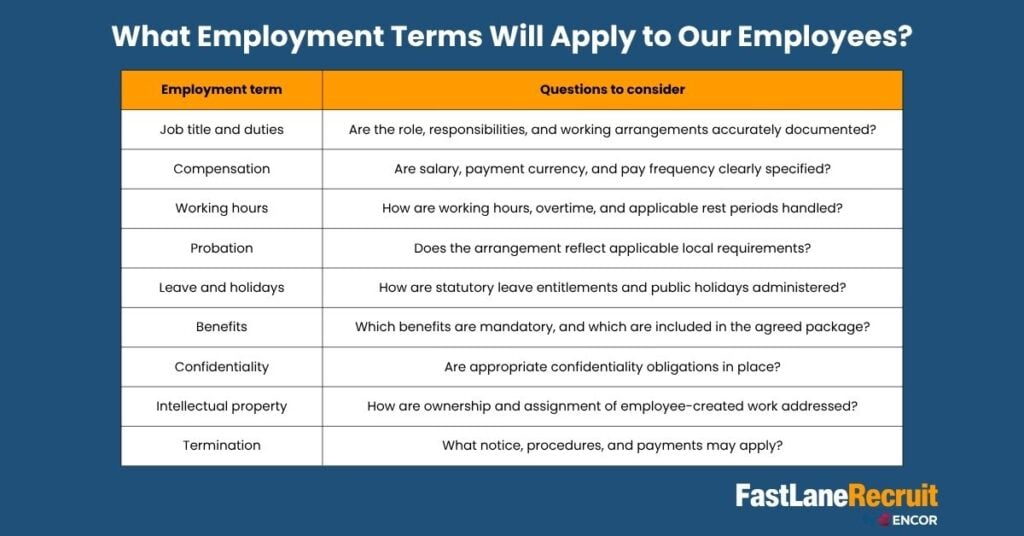
What Employment Terms Will Apply to Our Employees?
The commercial agreement between your company and the EOR is not necessarily the same document as the employment contract signed by the employee.
The local employment contract sets out the employee’s terms and conditions of employment, subject to applicable law. Your company should understand these terms before committing to the arrangement.
What to check
| Employment term | Questions to consider |
| Job title and duties | Are the role, responsibilities, and working arrangements accurately documented? |
| Compensation | Are salary, payment currency, and pay frequency clearly specified? |
| Working hours | How are working hours, overtime, and applicable rest periods handled? |
| Probation | Does the arrangement reflect applicable local requirements? |
| Leave and holidays | How are statutory leave entitlements and public holidays administered? |
| Benefits | Which benefits are mandatory, and which are included in the agreed package? |
| Confidentiality | Are appropriate confidentiality obligations in place? |
| Intellectual property | How are ownership and assignment of employee-created work addressed? |
| Termination | What notice, procedures, and payments may apply? |
The precise terms will vary by country and role. Some provisions may also require separate documentation or additional agreements.
What to ask the provider
Can we review the proposed local employment contract and confirm that its terms reflect our agreed compensation, role requirements, and applicable local employment rules before the employee signs?
Decision tip: Review the employment contract alongside the service agreement. Any difference between the two should be understood before onboarding begins.
How Are Payroll, Taxes, and Statutory Contributions Managed?
Payroll administration across multiple countries can involve different reporting requirements, contribution systems, payment schedules, and statutory deadlines.
Your EOR agreement should explain how payroll will operate and what information your business must provide to keep the process running smoothly.
What to check
- Payroll frequency and payment dates.
- Payroll cut-off dates for submitting salary changes and variable compensation.
- Responsibility for applicable tax withholding and employer contributions.
- Procedures for overtime, bonuses, commissions, and other variable pay.
- Payslip and payroll reporting arrangements.
- Handling of payroll corrections and off-cycle payments.
- Responsibilities for year-end reporting and employment-related documentation, where applicable.
What to ask the provider
What is the payroll calendar for our target country, what information must we submit, and how are statutory payments, reporting, and payroll corrections handled?
Decision tip: Request a sample payroll calendar and clarify the deadlines your team must meet. This is particularly important when managing employees across several countries or operating different payroll schedules.
Which Employee Benefits and Statutory Entitlements Are Included?
Employee benefits can affect both the total employment cost and the employee experience.
An EOR may administer statutory entitlements and agreed additional benefits, but the scope of coverage can differ by provider and country.
What to check
- Statutory leave and public holiday entitlements.
- Mandatory social insurance or pension contributions.
- Health insurance or other required coverage, where applicable.
- Optional benefits included in the employment package.
- Eligibility requirements and enrollment procedures.
- The cost of adding or changing benefits.
- How benefits are administered when employment ends.
What to ask the provider
Which benefits and statutory entitlements are included in our proposed arrangement, which are optional, and how will changes to employee benefits affect our costs?
Decision tip: Ask for a written breakdown of statutory entitlements and optional benefits for the relevant country. Avoid assuming that a benefits package available in one market will be available under the same terms elsewhere.
What Happens If We Need to Terminate an Employee?
Employee termination can involve notice requirements, documentation, accrued entitlements, severance payments, and other country-specific procedures.
The EOR agreement should clarify how termination requests are managed, who is responsible for each step, and how the associated costs are determined.
Importantly, the client company’s decision to end an assignment does not necessarily mean the employment relationship can be terminated immediately or without additional obligations.
What to check
- The process for submitting and approving a termination request.
- Applicable notice periods and procedural requirements.
- Responsibility for preparing termination documentation.
- Treatment of unused leave, notice pay, severance, and other amounts due, where applicable.
- How termination-related costs are estimated and approved.
- How employment disputes or claims are handled.
- Which charges apply to the EOR’s termination administration.
What to ask the provider
If we decide to end an employee’s employment, what process must we follow, what costs could arise, and how will the termination be handled under local requirements?
Decision tip: Ask for a country-specific explanation of the termination process before hiring. The relevant costs and procedures may depend on the employee’s contract, length of service, circumstances, and applicable law.
What Are the Notice Periods and Exit Terms for Ending the EOR Agreement?
Ending the commercial relationship with an EOR is different from terminating an employee.
Your business may want to move employees to its own local entity, switch providers, or stop operating in a particular market. The agreement should establish how these changes can be managed.
What to check
- Notice required to terminate the service agreement.
- Minimum contract duration or renewal provisions.
- Early termination charges, if applicable.
- Outstanding invoices and employment-related liabilities.
- Procedures for transferring employees to another provider or local entity.
- Responsibility for employment documentation and payroll records.
- Treatment of employee data during the transition.
- Any applicable employee consent, consultation, or transfer requirements.
What to ask the provider
If we establish our own local entity or change EOR providers, what steps, notice periods, fees, and employee-related obligations will apply?
Decision tip: Confirm that the exit process is practical and transparent. A well-defined transition procedure can reduce administrative disruption if your international hiring strategy changes.
How Will Employee Data and Confidential Information Be Protected?
EOR arrangements involve personal and employment information, which may include identification documents, compensation details, banking information, and payroll records.
Where employees are hired across borders, data protection requirements and restrictions on international data transfers may also apply.
What to check
- What personal data the provider collects and processes.
- The purposes for which employee information is used.
- Who can access employee records.
- How data is stored, transferred, and protected.
- Whether subcontractors or third-party systems process employee data.
- How data incidents are reported and managed.
- How long records are retained and how they are handled after termination.
- Which party is responsible for applicable data protection obligations.
What to ask the provider
How do you protect employee data, manage cross-border data transfers, and respond to a data breach or unauthorized disclosure?
Decision tip: Review the relevant data protection clauses and any associated privacy documentation. Confirm that the proposed arrangements meet the requirements applicable to your business and employees.
What Service Standards and Support Can We Expect?
The quality of an EOR relationship depends on more than the ability to issue employment contracts and process payroll.
Businesses also need clear communication, reliable administrative processes, and a way to resolve issues when something goes wrong.
What to check
- Your primary point of contact.
- Response times for payroll and employment queries.
- Escalation procedures for urgent issues.
- How payroll discrepancies are investigated.
- What reporting and employment documentation will be provided.
- How employee onboarding and offboarding are coordinated.
- Whether service-level commitments are documented.
- Which services or support requests fall outside the agreed scope.
What to ask the provider
Who will manage our account, how will we escalate urgent employment or payroll issues, and what service standards are documented in the agreement?
Decision tip: Ask the provider to explain its actual operating process, including communication channels, payroll deadlines, and escalation procedures. Clear service expectations help both parties understand what effective support should look like.
Also Read: When to Use an Employer of Record: 7 Signs Your Business Needs an EOR
Can the EOR Support Our Future International Expansion?
Your immediate requirement may be to hire one employee, but your workforce needs could change as your business grows.
Choosing a provider that understands your likely expansion plans can help you evaluate whether the arrangement will remain suitable over time.
What to check
- Current EOR availability in your target countries.
- Whether the provider can support additional employees or markets as your needs evolve.
- How pricing changes with headcount, compensation, or service requirements.
- Whether the provider can support different employee profiles and roles.
- How new-country onboarding requirements are assessed.
- How an eventual transition to your own entity would be managed.
- Whether the provider can support your required employment administration and payroll processes across the relevant markets.
What to ask the provider
Can you support our planned hiring locations and expected workforce growth, and how would the service arrangement change if we expanded or established our own entities?
Decision tip: Evaluate the provider against both your immediate hiring requirements and your likely next stage of growth. Confirm current country availability and the proposed employment model before making commitments.
Employer of Record Agreement Checklist: What to Confirm Before Signing
Use this checklist to consolidate the most important points from the 12 questions.
| Area | What to confirm before signing |
| Service scope | Included services, exclusions, and responsibilities are documented. |
| Legal employment | The employing entity and local employment model are clear. |
| Pricing | Service fees, employment costs, deposits, and additional charges are explained. |
| Compliance | Responsibilities, liability, and correction procedures are defined. |
| Employment terms | The proposed local employment contract is available for review. |
| Payroll | Payment schedules, deadlines, and statutory administration are explained. |
| Benefits | Statutory entitlements and optional benefits are distinguished. |
| Employee termination | Procedures, potential costs, and local requirements are understood. |
| Agreement termination | Notice periods, exit fees, and employee transition procedures are clear. |
| Data protection | Employee data handling and relevant security responsibilities are documented. |
| Service standards | Contacts, response expectations, and escalation procedures are established. |
| Future expansion | Country coverage and transition options align with your plans. |
EOR Agreement Red Flags to Watch For
Consider asking for clarification or independent review if the agreement contains:
- Vague descriptions of the services included in the fee.
- Unexplained charges or unclear pricing adjustments.
- Unclear identification of the legal employing entity.
- Ambiguous responsibility for payroll errors or statutory filings.
- No practical process for resolving disputes or escalating service issues.
- Unclear termination procedures or unexpectedly restrictive exit terms.
- Inadequate explanation of employee data handling.
- Verbal assurances that are not reflected in the written agreement.
Important: A single unclear provision does not automatically mean a provider is unsuitable. The key is whether the provider can explain the issue, clarify the contractual terms, and document an appropriate arrangement.
For complex agreements, obtain qualified legal advice before signing.
How to Choose the Right Employer of Record Provider
The right EOR provider should be able to explain its operating model, demonstrate relevant country-specific capabilities, and document the services and responsibilities included in the agreement.
Use the following criteria to compare potential providers.
| Evaluation criterion | What a strong provider should demonstrate |
| Country coverage | Clear confirmation of current service availability and the relevant local employment model. |
| Pricing transparency | A written breakdown of service fees and employment-related costs. |
| Compliance processes | Clearly defined responsibilities and country-specific employment administration procedures. |
| Payroll operations | Documented payroll schedules, submission deadlines, and correction processes. |
| Employee support | Clear communication channels and procedures for resolving employment issues. |
| Contract clarity | A defined service scope, understandable terms, and transparent exit procedures. |
| Scalability | The ability to assess additional hiring requirements and explain any changes to the arrangement. |
Price matters, but it should not be the only deciding factor. A lower service fee may not offer the best overall value if the scope of services is limited or important charges are excluded.
Likewise, broad international coverage does not necessarily mean that every country is supported through the same operating model.
Before committing, request written answers to your most important questions and evaluate the agreement against your actual hiring requirements.
Why Businesses Choose FastLaneRecruit for EOR Services
International hiring requires coordination across employment contracts, payroll, statutory contributions, and local employment requirements. FastLaneRecruit helps businesses manage these employment administration needs when hiring in supported international markets.
Our Employer of Record services allow businesses to employ talent in eligible markets without establishing their own local entity solely for employment purposes, subject to the proposed arrangement and applicable requirements.
Local Employment and Payroll Administration
We support agreed employment administration activities, including locally appropriate employment contracts, payroll processing, statutory contributions, and benefits administration where included in the service arrangement.
Support Across Multiple Markets
FastLaneRecruit operates in the following markets:
- Asia Pacific: Malaysia, Singapore, Hong Kong, China, India, Philippines, Taiwan, Vietnam, Australia,
- Europe: United Kingdom, Switzerland
- Middle East & Africa: UAE, Saudi Arabia, Qatar
Country availability and the applicable employment model should be confirmed for your specific hiring requirements before proceeding.
Clearer Service Scope and Cost Planning
We help businesses assess their employment administration needs and understand the proposed service arrangement. Discussing the relevant requirements in advance can help clarify the expected scope, responsibilities, and costs.
Support for International Workforce Growth
Whether you are hiring your first employee in a new market or planning a broader international team, we can help you evaluate your EOR requirements and identify the next steps for your hiring plans.
A Practical Approach to International Employment
Choosing an EOR is an important business decision. We encourage businesses to clarify their target country, employee requirements, expected hiring timeline, and service expectations before finalizing an arrangement.
Our goal is to help you understand the proposed employment structure and determine whether our EOR services are suitable for your needs.
Ready to Review Your International Hiring Requirements?
A well-understood employer of record agreement can help your business approach international hiring with clearer expectations about costs, employment administration, and responsibilities.
Before signing, make sure the proposed arrangement reflects your target country’s requirements, your employee’s employment terms, and your company’s operational needs.
FastLaneRecruit helps businesses manage employment administration and payroll across supported international markets.
Discuss your hiring plans with our team to understand the available EOR services, clarify the proposed scope, and identify the next steps for expanding your workforce.
Book a Free Consultation with an Expert.
Frequently Asked Questions About Employer of Record Agreements
1. What Is an Employer of Record Agreement?
An employer of record agreement is the commercial agreement between a business and an EOR provider. It establishes the services to be provided, fees, responsibilities, and other contractual terms governing the relationship.
It is distinct from the local employment contract that the EOR generally enters into with the employee.
2. What Should an Employer of Record Agreement Include?
An employer of record agreement should clearly address:
- Scope of services.
- Employment and payroll responsibilities.
- Fees and payment terms.
- Compliance obligations and liability.
- Employee data protection.
- Service standards and dispute resolution.
- Termination and employee transition procedures.
The exact provisions depend on the arrangement, target country, and applicable law.
3. What Questions Should I Ask an EOR Provider Before Signing?
Ask about country coverage, the legal employing entity, service scope, total costs, payroll processes, compliance responsibilities, employee benefits, termination procedures, data protection, and support arrangements.
Request written answers to important questions so you can compare providers using consistent criteria.
4. How Much Does an Employer of Record Agreement Cost?
The cost depends on the provider’s service fees, the employee’s compensation, employer statutory contributions, benefits, and any applicable additional charges.
Some providers charge a fixed fee per employee, while others use percentage-based or alternative pricing structures.
Request an itemized quotation that explains both the EOR service fee and the expected total employment cost for your target country.
5. Who Is Responsible for Compliance Under an EOR Agreement?
The EOR generally handles agreed employment administration responsibilities, which may include employment contracts, payroll processing, statutory contributions, and benefits administration.
The client company typically retains responsibility for day-to-day work direction and other obligations assigned to it under the agreement or applicable law.
The precise allocation of responsibility depends on the contractual arrangement and local requirements. Review the relevant provisions rather than assuming all compliance risks transfer to the EOR.
6. Can I Review the Employment Contract Before Signing an EOR Agreement?
You should ask to review the proposed local employment contract and understand how its terms align with the commercial agreement.
Review the employee’s compensation, role, working arrangements, benefits, leave, and termination provisions, taking applicable local requirements into account.
7. What Happens If I Want to Terminate an EOR Agreement?
The process depends on the contract’s notice periods, termination provisions, outstanding obligations, and applicable law.
You should confirm any exit fees, outstanding payments, employee transition procedures, and requirements for transferring employees to another provider or your own entity.
Ending the service agreement does not automatically end an employee’s employment without further obligations.
8. Can I Transfer Employees From an EOR to My Own Company Later?
A transition may be possible if your business later establishes a local entity, but the process depends on the country, employment arrangement, contractual terms, and applicable law.
Ask the EOR provider to explain the process, potential costs, employment documentation, and any required employee consultation or consent before signing.
9. Can FastLaneRecruit Help My Business Hire Employees Without Establishing a Local Entity?
FastLaneRecruit provides EOR services in supported markets, allowing eligible businesses to hire employees without establishing their own local entity solely for employment purposes.
The appropriate arrangement depends on the target country, employee requirements, and applicable local rules. Contact our team to confirm availability and discuss your hiring plans.
10. How Do I Know Whether FastLaneRecruit Is the Right EOR Provider for My Business?
Consider your target countries, expected headcount, service requirements, pricing, payroll needs, and preferred level of support.
FastLaneRecruit can discuss your international hiring requirements, explain the proposed service scope, and help you evaluate whether our EOR services fit your plans.