An Employer of Record (EOR) in the US is a third-party organization that legally employs workers on behalf of another company. The EOR assumes responsibility for employment-related obligations such as payroll administration, tax withholding, employment contracts, benefits management, and labor law compliance.
While the EOR serves as the legal employer, your company continues to oversee the employee’s daily work, performance, responsibilities, and business objectives.
This arrangement allows international businesses to hire talent in the United States without establishing a legal entity, opening a local payroll account, or navigating complex federal and state employment regulations independently.
Content Outline
Key Summary
What an Employer of Record (EOR) in the US Is
An Employer of Record (EOR) in the US enables foreign companies to hire employees legally without setting up a US subsidiary or corporation.
Legal Employment Structure Explained
The EOR becomes the legal employer while you maintain full day-to-day management and operational control of the employee.
US Employment Law Complexity
US employment laws vary across federal, state, and local jurisdictions, making compliance highly complex for overseas employers.
What an EOR Provider Manages
EOR providers handle payroll, tax withholding, benefits administration, employee onboarding, and full employment compliance on behalf of the client company.
Business Benefits of Using a US EOR
Hiring through an EOR can significantly reduce expansion costs, minimize legal risk, and accelerate market entry into the United States.
Industries That Commonly Use US EOR Services
Technology, consulting, financial services, healthcare, and remote-first companies frequently use EOR services when entering the US market.
How Does a US Employer of Record Work?
The relationship typically involves three parties:
| Party | Responsibility |
| Client Company | Manages employee’s daily work, objectives, performance, and reporting |
| Employer of Record | Handles legal employment, payroll, benefits, taxes, and compliance |
| Employee | Performs work exclusively for the client company |
The EOR signs the employment agreement, processes payroll, administers benefits, manages tax filings, and ensures compliance with applicable labor laws.
Why Are Companies Hiring in the US?
The United States remains one of the world’s largest and most attractive labor markets.
Businesses hire US employees to:
- Access highly skilled talent
- Expand into the North American market
- Build local sales and customer success teams
- Support US-based clients
- Establish regional operations
- Recruit specialized technology and engineering talent
The US workforce offers expertise across industries including software development, artificial intelligence, cybersecurity, healthcare, biotechnology, financial services, consulting, and advanced manufacturing.
However, hiring employees in the US presents significant legal and compliance challenges.
Challenges of Hiring Employees in the US
Before hiring directly, foreign companies must understand the complexity of US employment regulations.
Multi-Level Employment Laws
US employment compliance operates across three layers:
Federal Laws
Federal regulations include:
- Fair Labor Standards Act (FLSA)
- Equal Employment Opportunity laws
- Family and Medical Leave Act (FMLA)
- Occupational Safety and Health regulations
- Immigration and work authorization requirements
State Laws
Each state maintains its own employment regulations covering:
- Minimum wage
- Overtime rules
- Paid leave requirements
- Termination procedures
- Non-compete restrictions
Local Regulations
Cities and counties may introduce additional requirements regarding:
- Sick leave
- Predictive scheduling
- Salary transparency
- Worker protections
Payroll Tax Complexity
Employers may need to manage:
- Federal income tax withholding
- Social Security taxes
- Medicare taxes
- Federal unemployment taxes
- State income taxes
- State unemployment insurance
Employee Benefits Expectations
Competitive US employers often provide:
- Health insurance
- Dental coverage
- Vision plans
- Retirement benefits
- Paid time off
- Life insurance
- Wellness programs
Managing these obligations without local expertise can expose businesses to compliance risks and penalties.
Why Use an Employer of Record US Instead of Setting Up a Local Entity?
Many businesses initially assume they need a US subsidiary before hiring local employees.
In reality, an Employer of Record can often provide a faster and more cost-effective alternative.
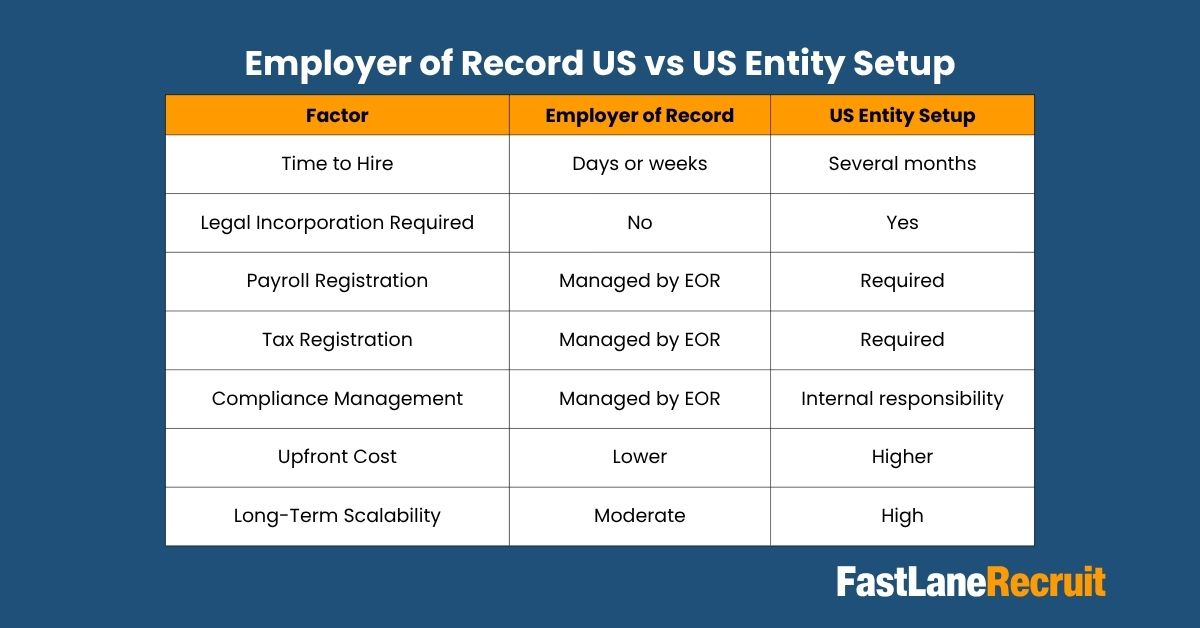
- Testing the US market
- Hiring a small team
- Recruiting remote employees
- Building a sales presence
- Expanding quickly without infrastructure investment
Benefits of Using an Employer of Record in the US
Faster Market Entry
Companies can hire employees quickly without waiting for entity formation, tax registration, and payroll setup.
Reduced Compliance Risk
EOR providers stay current with changing federal, state, and local employment regulations.
Simplified Payroll Management
The EOR manages payroll processing, tax filings, deductions, and statutory obligations.
Cost Savings
Businesses avoid many costs associated with legal incorporation, accounting, payroll systems, and HR infrastructure.
Access to Competitive Benefits
Many EOR providers leverage established benefits programs to offer competitive employment packages.
Focus on Core Business Activities
Leadership teams can concentrate on growth and operations rather than employment administration.
Also Read: Recruitment Costs in 2026: The True Cost of Hiring and How Businesses Can Reduce It
US Employment Compliance and Legal Framework
When hiring employees in the United States, companies must comply with various regulations.
Employment Classification
Workers must be correctly classified as:
- Employees
- Independent contractors
Misclassification can result in significant penalties, tax liabilities, and legal disputes.
Wage and Hour Laws
Employers must comply with:
- Minimum wage requirements
- Overtime regulations
- Recordkeeping obligations
- Final pay requirements
Anti-Discrimination Regulations
Employers must follow laws prohibiting discrimination based on:
- Race
- Gender
- Age
- Religion
- Disability
- National origin
Work Authorization Requirements
Employers must verify employment eligibility through required documentation and verification procedures.
A qualified EOR helps ensure compliance across all applicable regulations.
Payroll and Benefits Administration in the US
Payroll administration involves much more than salary payments.
A US Employer of Record typically manages:
Payroll Processing
- Salary calculations
- Overtime calculations
- Bonus payments
- Commission payments
Tax Administration
- Federal tax withholding
- State tax withholding
- Social Security contributions
- Medicare contributions
- Unemployment taxes
Employee Benefits
Common benefits include:
- Medical insurance
- Dental insurance
- Vision coverage
- Retirement plans
- Paid leave programs
- Disability insurance
Year-End Reporting
The EOR prepares required tax documents and reporting obligations.
Step-by-Step Process for Hiring Through an Employer of Record in the US
Step 1: Identify Hiring Requirements
Determine:
- Role
- Compensation
- Location
- Benefits package
Step 2: Select an EOR Provider
Evaluate:
- Compliance expertise
- Geographic coverage
- Technology platform
- Service quality
Step 3: Employee Onboarding
The EOR prepares:
- Employment agreements
- Tax forms
- Benefits enrollment documents
Step 4: Payroll Activation
The employee is added to the EOR payroll system.
Step 5: Ongoing Employment Management
The EOR handles:
- Payroll
- Compliance updates
- Benefits administration
- HR support
Meanwhile, your company manages the employee’s work and performance.
Industries That Benefit Most from US Employer of Record Services
Technology
- Software development
- SaaS companies
- AI startups
- Cybersecurity firms
Professional Services
- Consulting firms
- Accounting firms
- Legal support services
Financial Services
- FinTech companies
- Investment platforms
- Insurance technology firms
Healthcare
- HealthTech startups
- Medical service providers
E-Commerce
- Cross-border retailers
- Marketplace businesses
Risks and Considerations Before Using an EOR
While EOR solutions provide significant advantages, companies should evaluate:
| Consideration | Impact |
| Service Fees | Higher than direct payroll processing |
| Limited Corporate Presence | No permanent establishment |
| Vendor Dependence | Reliance on EOR capabilities |
| Scalability | Entity setup may become preferable for large teams |
An EOR is often most effective during market entry and early-stage expansion.
Employer of Record vs Staffing Agency vs Local Entity
| Factor | EOR | Staffing Agency | Local Entity |
| Legal Employer | EOR | Agency | Your Company |
| Employee Selection | Client | Agency | Client |
| Payroll Management | EOR | Agency | Internal |
| Compliance Responsibility | EOR | Agency | Internal |
| Long-Term Employment | Yes | Usually Temporary | Yes |
| Entity Required | No | No | Yes |
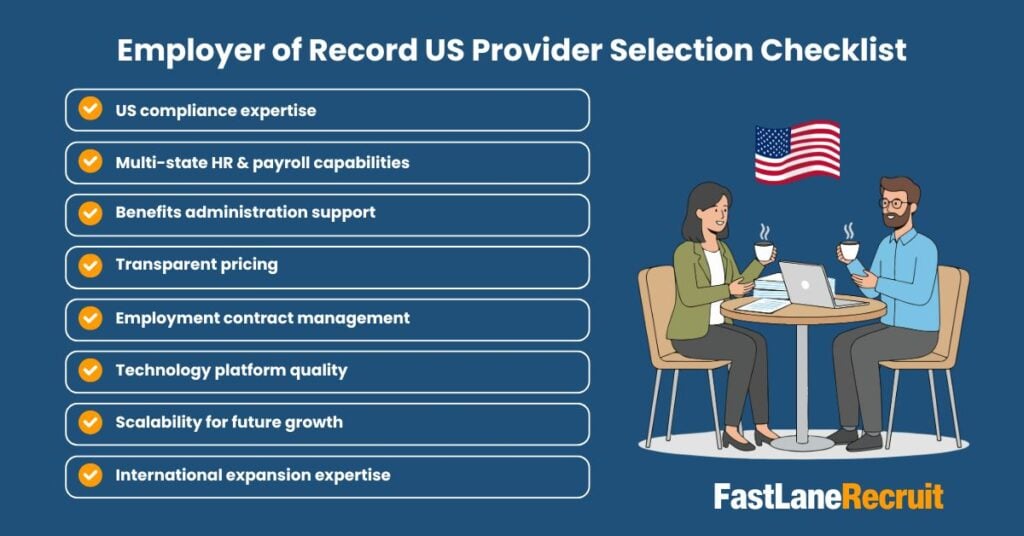
Employer of Record Provider Selection Checklist
Before choosing an EOR partner, consider:
Common Use Cases for US Employer of Record Services
Market Testing: Hire one or two employees before committing to a US entity.
Sales Expansion: Build local sales teams quickly.
Remote Workforce Hiring: Recruit talent regardless of location.
Project-Based Expansion: Support short-term market opportunities.
International Business Growth: Establish a presence while minimizing administrative complexity.
Looking Beyond the US? Why Asia Is Becoming a Preferred Hiring Destination
While the United States remains a major talent market, many global companies are increasingly building teams in Asia to improve cost efficiency and access specialized talent.
Fast-growing businesses frequently explore:
- Malaysia
- Hong Kong
- Singapore
- China
- UAE
- Taiwan
for regional expansion and remote workforce growth.
Why Hire Talent in Malaysia?
Malaysia offers:
- Competitive labor costs
- Strong English proficiency
- Growing technology talent pool
- Strategic ASEAN location
- Business-friendly environment
Also Read: Hiring Malaysian Talent: Employer of Record Malaysia Guide for Australian Companies
Why Hire Talent in Hong Kong?
Hong Kong provides:
- International business expertise
- Financial services talent
- Gateway to Greater China
- Strong legal framework
Why Hire Talent in Singapore?
Singapore offers:
- Highly educated workforce
- Global business hub
- Strong technology ecosystem
- Excellent regulatory environment
Talent Market Comparison
| Market | Talent Quality | Cost Efficiency | Regional Access |
| United States | Excellent | Moderate | North America |
| Malaysia | Strong | Excellent | ASEAN |
| Hong Kong | Excellent | Moderate | Greater China |
| Singapore | Excellent | Moderate | Southeast Asia |
| Taiwan | Strong | Good | East Asia |
| UAE | Strong | Moderate | Middle East |
Expand Across Asia with FastLaneRecruit
If your company is exploring international hiring opportunities, FastLaneRecruit can help you build compliant teams across:
- Malaysia
- Hong Kong
- Singapore
- China
- UAE
- Taiwan
Our Employer of Record solutions simplify international hiring by managing:
- Employment contracts
- Payroll administration
- Tax compliance
- Benefits management
- HR support
This allows your business to hire quickly and confidently without establishing a local legal entity.
Consult with FastLaneRecruit today to explore compliant hiring solutions across Asia’s leading business hubs.
Ready to Hire International Talent Without Establishing a Local Entity?
Whether you are expanding into Asia or building a distributed workforce across multiple countries, FastLaneRecruit can help simplify global hiring.
Our Employer of Record services support compliant hiring, payroll administration, benefits management, and HR operations across:
- Malaysia
- Hong Kong
- Singapore
- China
- UAE
- Taiwan
Contact FastLaneRecruit today and discover how quickly you can build your international team.
Frequently Asked Questions
What is an Employer of Record in the US?
An Employer of Record is a third-party organization that legally employs workers on behalf of another company while managing payroll, taxes, benefits, and compliance responsibilities.
Can I hire US employees without opening a US company?
Yes. An Employer of Record allows foreign companies to hire US employees legally without establishing a local entity.
Is using an EOR legal in the US?
Yes. EOR arrangements are widely used by international companies and are legal when structured properly and operated in compliance with applicable employment laws.
How long does it take to hire through a US EOR?
Many EOR providers can onboard employees within days or weeks, depending on the employee’s location and employment requirements.
What industries commonly use EOR services?
Technology, consulting, healthcare, financial services, e-commerce, and remote-first organizations frequently use EOR solutions.
When should I establish a US entity instead of using an EOR?
Businesses planning large-scale long-term operations may eventually benefit from establishing their own legal entity. However, many companies use an EOR first to test the market and reduce expansion risk.