
Global businesses are no longer outsourcing only to reduce costs. In 2026, outsourcing has evolved into a strategic expansion model that enables companies to scale operations, enter new markets, and build resilient global teams.
Among Southeast Asian destinations, Malaysia has emerged as one of the most reliable and balanced outsourcing hubs, combining cost efficiency, multilingual talent, and enterprise-grade infrastructure.
This shift is reshaping how companies think about hiring, operations, and regional expansion—especially when comparing traditional company incorporation versus modern Employer of Record (EOR) models.
Content Outline
Key Summary
Malaysia is emerging as Southeast Asia’s top outsourcing hub in 2026
Driven by talent quality, multilingual workforce, cost efficiency, and stable infrastructure.
Outsourcing in Malaysia is shifting from cost-saving to strategic growth
Companies now use outsourcing for scalability, customer experience, and global expansion.
EOR is becoming a stronger alternative to company incorporation
Businesses avoid legal complexity, reduce setup time, and hire faster in Malaysia.
Malaysia offers a balanced outsourcing advantage in SEA
Combining cost efficiency (India/Philippines level) with stronger governance and talent diversity.
FastLaneRecruit enables faster market entry and workforce scaling in Malaysia
Through outsourcing and Employer of Record (EOR) solutions.
What Is Outsourcing in Malaysia?
Outsourcing in Malaysia refers to delegating business functions such as customer service, HR, finance, IT support, and back-office operations to specialized providers located in Malaysia.
Common outsourced functions include:
- Customer experience (call center, live chat, omnichannel support)
- Accounting and payroll processing
- HR administration and recruitment support
- Data processing and compliance operations
- IT and technical support services
Unlike traditional outsourcing, Malaysia’s model is increasingly enterprise-integrated, meaning providers act as operational extensions of global companies rather than third-party vendors.
Why Outsourcing in Malaysia Leads Southeast Asia in 2026
1. Strategic Location for APAC Expansion
Malaysia sits at the heart of ASEAN and APAC trade routes, enabling companies to:
- Serve multiple time zones efficiently
- Support regional customers in real time
- Build centralized hubs for Asia operations
This makes Malaysia ideal for companies seeking regional headquarters or shared service centers.
Also Read: Why Malaysia Is a Premier Destination for Offshore Cybersecurity Talent in APAC
2. Multilingual Workforce Advantage
One of Malaysia’s strongest competitive advantages is its workforce diversity.
Malaysia offers professionals fluent in:
- English (business proficiency)
- Mandarin (critical for China and SEA markets)
- Bahasa Malaysia
- Tamil and other regional languages
This enables businesses to run multi-market customer support from a single location, reducing operational fragmentation.
3. Cost Efficiency Without Quality Loss
Malaysia provides a strong cost-to-quality balance:
- Lower operational costs compared to Western markets
- Higher service consistency than many low-cost outsourcing destinations
- Strong compliance and corporate governance standards
This makes Malaysia a premium-value outsourcing destination, not just a low-cost option.
4. Strong Digital Infrastructure and Business Ecosystem
Malaysia has developed a mature outsourcing ecosystem supported by:
- Reliable telecommunications and cloud infrastructure
- Government-backed digital economy initiatives
- Growing shared services and outsourcing (SSO) hubs
- Stable legal and regulatory environment
These factors allow enterprises to operate secure, scalable, and compliant outsourcing functions.
5. Skilled and Enterprise-Ready Talent Pool
Malaysia produces a strong pipeline of graduates in:
- Business administration
- Accounting and finance
- IT and software engineering
- Customer experience operations
This ensures outsourcing providers can deliver globally aligned service quality suitable for multinational operations.
Outsourcing vs Company Incorporation in Malaysia: Why EOR Wins in 2026
Many businesses entering Malaysia face a critical decision:
Option 1: Company Incorporation
- Requires legal entity setup
- Involves regulatory compliance and ongoing filings
- Higher time and administrative cost
- HR, payroll, and tax systems must be built from scratch
Option 2: Employer of Record (EOR) Model
Through EOR, companies can:
- Hire employees legally in Malaysia without setting up a company
- Reduce time-to-market significantly
- Outsource payroll, compliance, and HR administration
- Scale teams flexibly without long-term legal commitments
Why EOR is becoming the preferred model:
- Faster market entry (weeks instead of months)
- Lower operational risk
- Reduced legal complexity
- Easier regional scaling strategy
In 2026, many companies are relying on EOR as a first step before formal incorporation, especially in Southeast Asia expansion strategies.
Also Read: Company Incorporation vs EOR in Malaysia: The Real Cost analysis & Hiring strategy
Key Industries Using Outsourcing in Malaysia
1. Customer Experience (CX)
- Omnichannel support (chat, email, voice, social)
- Technical support
- Customer retention and engagement
2. Finance and Accounting
- Bookkeeping
- Payroll processing
- Financial reporting
3. HR and Recruitment Support
- Candidate sourcing
- Payroll and compliance management
- Employee onboarding support
4. Technology and SaaS Support
- User onboarding
- Product support
- Tier-1 and Tier-2 technical assistance
Malaysia vs Other Outsourcing Destinations in SEA
| Factor | Malaysia | Philippines | India |
| Language Diversity | High | Medium | Medium |
| Cost Efficiency | Balanced | High | Very High |
| Governance | Strong | Moderate | Moderate |
| Talent Quality | High | High | High |
| Regional Access | Excellent | Good | Good |
Malaysia stands out as a balanced outsourcing hub, combining governance, talent quality, and regional access.
Strategic Benefits of Outsourcing in Malaysia
Businesses choose Malaysia for:
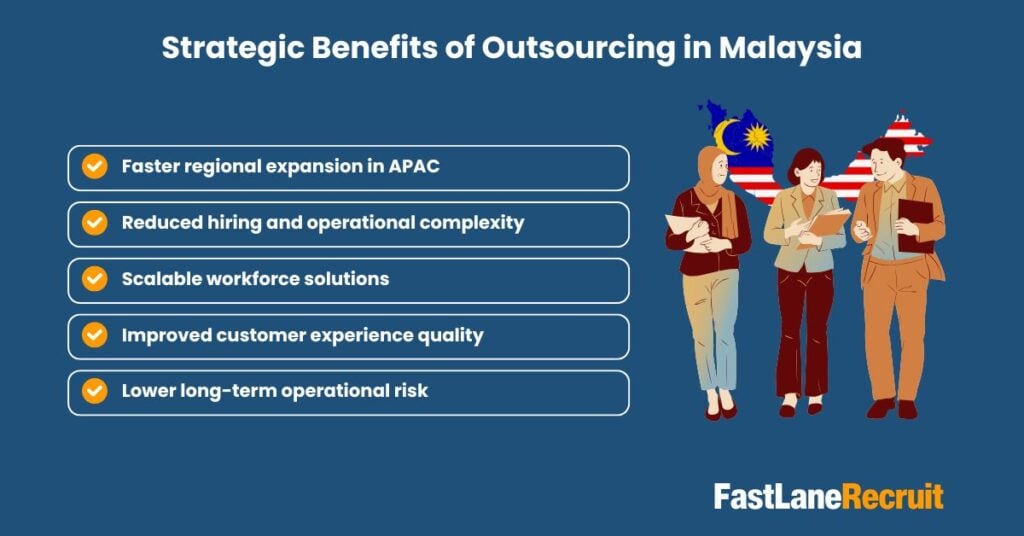
It is increasingly used as a strategic operational base rather than a cost-cutting destination.
Why Businesses Choose FastLaneRecruit in Malaysia
Companies looking to enter Malaysia require more than outsourcing, they need structured workforce deployment and compliance support.
FastLaneRecruit helps businesses:
- Hire talent in Malaysia without entity setup
- Deploy EOR-based workforce quickly
- Manage payroll, HR, and compliance seamlessly
- Scale regional operations efficiently
This enables companies to focus on growth while operational complexity is handled locally.
How FastLaneRecruit Supports Business Expansion
Employer of Record (EOR) Services
Hire employees in Malaysia without incorporating a legal entity.
Outsourcing Talent Solutions
Access skilled professionals across HR, finance, customer service, and admin roles.
Compliance Management
Ensure full alignment with Malaysian labor laws and payroll regulations.
Scalable Workforce Deployment
Expand or reduce teams based on business needs.
Make your First move with FastLaneRecruit
Expand your business in Malaysia without the complexity of incorporation.
Partner with FastLaneRecruit to access:
- Employer of Record (EOR) solutions
- Outsourcing talent deployment
- Compliance-ready workforce management
- Fast market entry into Malaysia
Start scaling your team in Southeast Asia with confidence and efficiency. Get a consultation with us today to grow your business to the next level.
Conclusion: Malaysia Is Becoming Southeast Asia’s Strategic Outsourcing Core
Outsourcing in Malaysia is no longer just an operational decision—it is a strategic growth enabler for global companies expanding in Asia.
With strong governance, multilingual talent, cost efficiency, and EOR-enabled hiring models, Malaysia is positioned as a leading outsourcing hub in Southeast Asia in 2026.
For businesses seeking fast, compliant, and scalable expansion, outsourcing combined with EOR provides a clear competitive advantage.
FAQ: Outsourcing in Malaysia (2026)
Why is outsourcing in Malaysia growing in 2026?
Because companies are shifting toward scalable, cost-efficient, and multilingual hubs for APAC expansion.
What industries use outsourcing in Malaysia the most?
Customer service, finance, HR, IT support, and SaaS operations.
Is Malaysia better than the Philippines or India for outsourcing?
Malaysia offers a more balanced mix of governance, language diversity, and regional access.
What is the difference between outsourcing and EOR?
Outsourcing delegates tasks, while EOR enables legal hiring without entity incorporation.
Can I hire employees in Malaysia without a company?
Yes, through an Employer of Record (EOR) provider like FastLaneRecruit.
Is outsourcing in Malaysia cost-effective?
Yes, it provides strong cost efficiency without sacrificing service quality.
What makes Malaysia attractive for global companies?
Multilingual talent, stable infrastructure, and strategic ASEAN positioning.