Hiring talent in the Philippines has become increasingly popular among global companies due to its strong English proficiency, skilled workforce, and growing expertise in industries like IT, BPO, healthcare, and finance.
However, when hiring internationally, one of the most important steps in the recruitment process is conducting a background check for employment.
A background check helps employers verify a candidate’s identity, qualifications, work history, and legal standing before finalizing a hire. In the Philippines, this process must also follow strict privacy laws, especially the Data Privacy Act of 2012, which ensures personal data is handled responsibly.
This guide explains how background checks work in the Philippines, what is legally allowed, and best practices for global employers managing international hiring.
Content Outline
Key Summary
What a Background Check Covers
A background check for employment verifies identity, work history, education, criminal records, and eligibility to ensure candidates are qualified and trustworthy.
Legal Compliance Is Mandatory
Background checks in the Philippines are regulated by the Data Privacy Act of 2012 and enforced by the National Privacy Commission, requiring consent and proper data handling.
Consent and Transparency Are Required
Employers must obtain clear candidate consent before running any checks and explain how personal data will be collected and used.
Timing Matters in Hiring
Background checks should be conducted after a conditional offer and before onboarding to ensure fairness and reduce unnecessary data collection.
Industry-Specific Screening Is Common
Sectors like banking, BPO, healthcare, IT, education, and logistics rely heavily on background checks due to higher risk and regulatory requirements.
Common Mistakes Can Lead to Risk
Skipping consent, collecting irrelevant data, inconsistent screening, or poor data protection can result in compliance issues and poor hiring decisions.
Structured Process Improves Hiring Quality
A clear step-by-step approach (identity, employment, education, criminal, and reference checks) helps employers make more reliable and confident hiring decisions.
What Is a Background Check for Employment?
A background check for employment is the process of verifying a candidate’s personal, professional, and sometimes financial information before hiring.
In the Philippines, this typically includes:
- Identity verification
- Employment history checks
- Education verification
- Criminal record screening (NBI clearance)
- Reference checks
- Work authorization verification
These checks help employers ensure that candidates are qualified, trustworthy, and suitable for the role.
Why Background Checks Are Important
A background check for employment is not just a formality. It plays an important role in building a strong and reliable workforce.
It helps employers:
- Confirm that candidates are qualified for the role
- Reduce hiring risks and avoid mismatches
- Build trust in the hiring process
- Maintain workplace safety and compliance
- Make more confident hiring decisions
In short, it helps companies hire the right people with greater confidence and less uncertainty.
Also Read: Job Level Classification: How to Build a Fair, Consistent System Your Team Will Actually Use
Are Background Checks Legal in the Philippines?
Yes, background checks are legal in the Philippines, but they are strictly regulated to protect a candidate’s personal information and privacy rights.
This means employers are allowed to verify a candidate’s identity, work history, education, and other job-related details, but only if they follow the correct legal process and respect data privacy rules.
In practice, this ensures that background checks are done fairly, transparently, and only for legitimate hiring purposes.
Key Legal Framework in the Philippines
When conducting a background check for employment, employers must comply with several important laws and guidelines:
1. Data Privacy Act of 2012 (Republic Act No. 10173)
This is the main law governing how personal data is collected, used, and stored in the Philippines.
It ensures that:
- Personal information is protected
- Data is collected only for valid reasons
- Individuals have control over their own data
Official reference:
Data Privacy Act of 2012 (Official Gazette)
2. National Privacy Commission (NPC)
The National Privacy Commission (NPC) is the government body responsible for enforcing data privacy laws in the Philippines.
They:
- Monitor compliance with the Data Privacy Act
- Issue guidelines for employers and organizations
- Handle complaints related to misuse of personal data
- Promote safe handling of employee information
3. Implementing Rules and Regulations (IRR)
The IRR provides more detailed instructions on how the Data Privacy Act should be applied in real-world situations.
For background checks, it helps define:
- How consent should be collected
- What counts as lawful data processing
- How long data can be stored
- Security requirements for handling sensitive information
4. Philippine Labor Code
The Labor Code ensures that hiring practices remain fair and non-discriminatory.
It supports:
- Equal opportunity hiring
- Protection against unfair employment practices
- Ethical treatment of job applicants
Key Legal Requirements for Background Checks
To stay compliant when conducting a background check for employment in the Philippines, employers must follow these core rules:
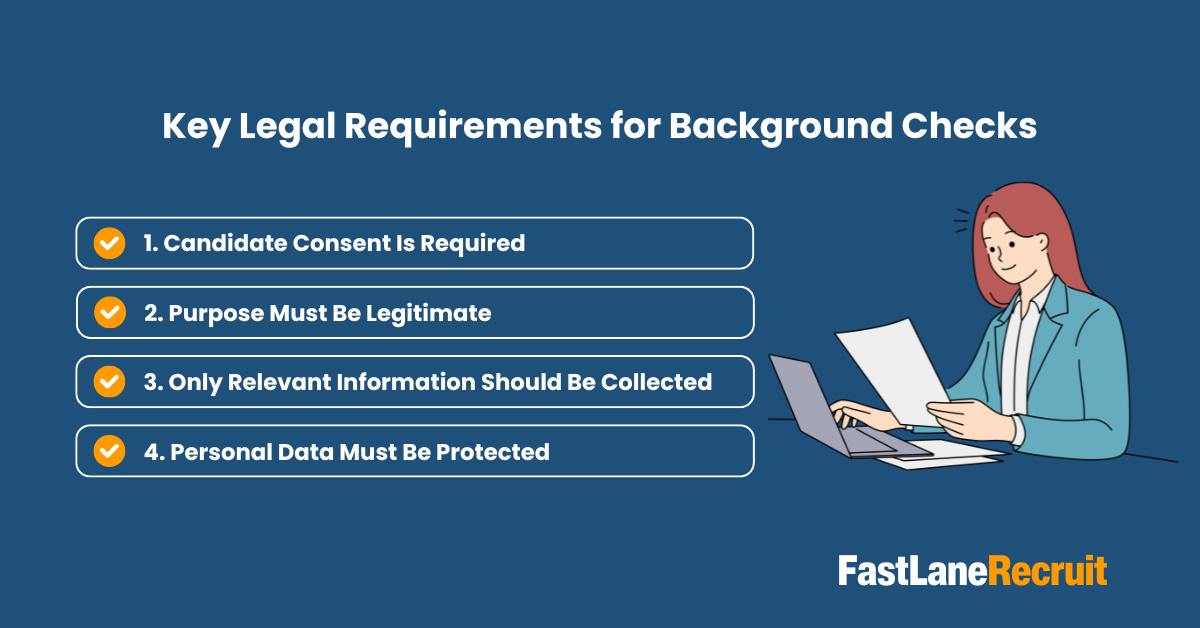
1. Candidate Consent Is Required
Before any background check begins, the candidate must clearly agree to it.
- Consent should be informed and voluntary
- Written or documented approval is strongly recommended
- Candidates must understand what information will be checked
2. Purpose Must Be Legitimate
Background checks should only be used for valid hiring reasons, such as:
- Confirming qualifications
- Assessing job suitability
- Ensuring workplace safety
- Meeting regulatory requirements
3. Only Relevant Information Should Be Collected
Employers should only request information that is directly related to the job role.
For example:
- A finance role may require credit checks
- A general admin role may not need financial background screening
4. Personal Data Must Be Protected
Employers are responsible for securing all candidate information collected during the screening process.
This includes:
- Safe storage of documents
- Restricted access to sensitive data
- Proper data retention and deletion policies
- Protection against unauthorized access or misuse
Why These Rules Matter
These legal safeguards are designed to create a balance between:
- Employer needs to hire the right candidate
- Candidate rights to privacy and fair treatment
When done correctly, background checks help improve hiring quality without violating personal privacy or trust.
Also Read: What Is Business Process Outsourcing (BPO) and How Does It Work?
What Background Checks Are Common in the Philippines?
Employers in the Philippines typically conduct several standard checks depending on the role.
Common Background Checks
| Type of Check | Purpose | Usage Level |
| Identity Verification | Confirms identity and legal documents | Common |
| Employment History | Validates previous roles and experience | Common |
| Education Verification | Confirms academic credentials | Common |
| Criminal Record Check (NBI Clearance) | Ensures legal compliance and safety | Common |
| Reference Checks | Evaluates character and performance | Common |
| Credit Checks | Financial responsibility assessment | Limited (finance roles) |
| Social Media Screening | Public behavior review | Emerging |
| Work Authorization Check | Confirms right to work | Common |
Criminal record verification is usually processed through the National Bureau of Investigation (NBI) clearance system.
Industries That Commonly Require Background Checks
In the Philippines, background checks for employment are commonly used across many industries, especially where employees handle sensitive data, customer trust, financial transactions, or safety-related responsibilities.
While background screening can be applied to almost any role, some industries rely on it more heavily due to higher operational or regulatory risks.
Below are the key industries where background checks are most commonly required and why they matter.
1. Banking and Financial Services
The banking and finance sector is one of the strictest when it comes to hiring standards.
Background checks are important because employees often:
- Handle customer funds and transactions
- Access sensitive financial data
- Work under strict regulatory oversight
Employers in this sector typically conduct detailed identity, employment, education, and credit-related checks to ensure financial integrity and trustworthiness.
2. Business Process Outsourcing (BPO)
The Philippines is one of the world’s leading BPO hubs, supporting global companies in customer service, IT support, and back-office operations.
Background checks are important here because employees may:
- Access confidential client data
- Handle international customer accounts
- Work with proprietary business systems
As a result, companies often prioritize employment verification, identity checks, and reference validation to maintain client trust and data security.
3. Healthcare
Healthcare roles require a high level of responsibility, as employees directly impact patient safety and well-being.
Background checks in this sector help verify:
- Medical licenses and certifications
- Educational qualifications
- Professional history and experience
- Criminal records where applicable
This ensures that only qualified and trustworthy professionals are placed in patient-facing roles.
4. Education
Schools, universities, and training institutions also rely heavily on background checks, especially for roles involving students.
Employers typically verify:
- Academic qualifications
- Teaching certifications
- Employment history
- Character references
This helps ensure a safe and reliable learning environment, particularly when working with minors.
5. IT and Software Services
The IT sector often involves access to sensitive systems, intellectual property, and client data.
Background checks are used to confirm:
- Technical qualifications and certifications
- Previous employment in similar roles
- Identity and professional credibility
This helps reduce risks related to data security breaches and unauthorized access.
6. Retail and Hospitality
In customer-facing industries, trust and reputation are essential.
Background checks help employers:
- Ensure employees can handle customer interactions responsibly
- Reduce risk of theft or misconduct
- Verify previous work experience in service roles
While checks may be lighter compared to finance or healthcare, they still play an important role in hiring decisions.
7. Logistics and Construction
These industries often involve physical operations, safety risks, and responsibility for equipment or goods.
Employers may conduct background checks to:
- Verify identity and employment history
- Confirm driving records (for logistics roles)
- Ensure safety compliance and reliability
- Assess previous work experience in similar environments
This helps maintain operational safety and reduce workplace risks.
Why These Industries Rely More on Background Checks
Across these sectors, background checks are especially important because they help organizations:
- Protect sensitive data and financial assets
- Maintain customer and public trust
- Ensure regulatory and legal compliance
- Improve workplace safety and reliability
- Reduce hiring risks and employee mismatch
In short, industries with higher responsibility or exposure to risk tend to use background check for employment processes more rigorously to ensure they hire the right people for the right roles.
Also Read: Guide to PEO vs EOR
What Types of Background Checks Are Restricted?
Under Philippine law, certain checks require caution or explicit consent.
Employers should avoid or strictly control:
- Collecting health records without consent
- Reviewing religious or political affiliations
- Gathering ethnicity or demographic data
- Accessing unnecessary financial records
- Any discriminatory screening practices
The key principle is relevance, only collect data required for the job role.
When Should Background Checks Be Conducted?
Timing is an important part of running an effective background check for employment, especially in the Philippines where data privacy laws and fair hiring practices must be followed.
Conducting checks at the right stage of the hiring process helps employers stay compliant, reduce risks, and ensure candidates are treated fairly throughout recruitment.
In general, the best practice is to conduct background checks at a specific point in the hiring journey rather than at the very beginning.
1. After a Conditional Job Offer
In the Philippines, background checks are most commonly done after a conditional job offer has been made.
This means the employer has already decided that the candidate is suitable for the role, but final confirmation depends on the verification results.
At this stage:
- The candidate has already passed interviews and assessments
- The employer is confident in the candidate’s potential
- Background checks are used as a final validation step
This approach helps ensure fairness because candidates are not screened too early in the process, and sensitive data is only collected when necessary.
2. Before Final Employment Confirmation
Background checks should be completed before the candidate is officially confirmed as an employee.
This step ensures:
- All provided information is accurate and verified
- There are no discrepancies in employment history or qualifications
- Any potential issues are identified before onboarding
At this stage, employers can still make informed decisions based on verified information, without disrupting an already active employment relationship.
3. Before Onboarding Begins
Another key point is completing all checks before the onboarding process starts.
This helps ensure that:
- Only verified candidates enter the company system
- Internal access (tools, data, systems) is given securely
- Compliance requirements are fully met before employment begins
This step is especially important for roles involving sensitive data, financial responsibility, or client-facing duties.
Why Timing Matters in Background Checks
Proper timing of a background check for employment is not just about efficiency; it is also about compliance and fairness.
Conducting checks too early can:
- Lead to unnecessary collection of personal data
- Increase compliance risks under the Data Privacy Act
- Create a negative candidate experience
Conducting them at the right stage helps employers:
- Respect candidate privacy
- Maintain a transparent hiring process
- Make informed and legally compliant hiring decisions
- Reduce hiring risks without over-collecting information
In the Philippines, background checks should be treated as a final verification step rather than an early screening tool. The most effective approach is to conduct them after a conditional offer and before final onboarding, ensuring both compliance and a fair hiring experience for candidates.
Step-by-Step Process: Background Check for Employment in the Philippines
1. Obtain Candidate Consent
- Written or digital approval is mandatory
- Clearly explain the purpose and scope
2. Identity Verification
- Validate government-issued IDs
- Confirm personal details
3. Employment History Verification
- Contact previous employers
- Verify job title, duration, and responsibilities
4. Education Verification
- Confirm degrees and certifications
- Validate institutions
5. Criminal Record Check
- Obtain NBI clearance
- Review relevant legal records
6. Reference Checks
- Speak with previous supervisors
- Assess behavior and performance
7. Optional Role-Based Checks
- Credit history (financial roles only)
- Social media screening (public data only)
8. Document and Secure Data
- Store records securely
- Follow Data Privacy Act guidelines
Also Read: Global Employment Outsourcing: Complete Guide to Hiring International Teams
Common Mistakes to Avoid
When conducting a background check for employment, even well-intentioned employers can run into issues if the process is not handled carefully. In the Philippines, where data privacy and fair hiring practices are strictly regulated, small mistakes can lead to compliance risks, delays in hiring, or even reputational damage.
Below are some of the most common mistakes employers should avoid when running background checks.
1. Skipping Candidate Consent
One of the most serious mistakes is starting a background check without getting clear permission from the candidate.
In the Philippines, consent is not optional. Employers must ensure that:
- Candidates are fully informed about the background check
- Consent is given before any personal data is collected
- The purpose of the check is clearly explained
Without consent, the entire process may be considered non-compliant with data privacy laws.
2. Collecting Unnecessary Personal Data
Another common issue is requesting information that is not relevant to the role.
Employers should avoid collecting:
- Personal details unrelated to the job
- Sensitive information that is not required for hiring decisions
- Excessive documentation that goes beyond role requirements
A good rule is to only collect what is directly needed to assess job suitability.
3. Not Explaining Data Usage Clearly
Transparency is a key requirement in any background check for employment process.
Mistakes often happen when employers:
- Do not explain why data is being collected
- Fail to inform candidates how their information will be used
- Do not clarify who will have access to the data
Clear communication builds trust and helps ensure compliance with the Data Privacy Act.
4. Relying Only on Social Media Screening
While social media screening can provide additional insights, it should never be the sole method of evaluation.
Relying only on online profiles can:
- Create biased hiring decisions
- Provide incomplete or misleading information
- Overlook verified professional experience and qualifications
Social media checks should only be a supporting tool, not the main basis for hiring decisions.
5. Ignoring Data Protection Requirements
Handling candidate information without proper safeguards is a major risk.
Employers must ensure:
- Secure storage of personal data
- Restricted access to sensitive information
- Proper data retention and deletion policies
- Protection against unauthorized access or misuse
Failure to follow these practices can lead to legal and compliance issues.
6. Applying Inconsistent Screening Standards
Inconsistent background checks across candidates can create unfair hiring practices.
This happens when:
- Different candidates are screened using different criteria
- Certain roles are over-checked while others are under-checked
- Decisions are not based on standardized guidelines
Consistency is important to ensure fairness, reduce bias, and maintain a structured hiring process.
Why Avoiding These Mistakes Matters
Avoiding these errors is not just about compliance; it directly impacts hiring quality and company reputation.
When background checks are done correctly, employers benefit from:
- More reliable hiring decisions
- Reduced legal and compliance risks
- Stronger candidate trust and experience
- Better long-term employee performance
A well-structured background check for the employment process ensures both protection for the company and fairness for the candidate.
How Global Employers Simplify Hiring Across Markets
While this guide focuses on the Philippines, many companies hiring across Asia often expand into nearby markets like Malaysia for regional workforce scaling.
Managing background checks, payroll compliance, and employment laws across multiple countries can become complex without local expertise.
This is where an Employer of Record (EOR) model becomes valuable, especially for compliant hiring in Malaysia.
Scale Hiring in Malaysia with FastLaneRecruit (EOR Solution)
If your company is looking to hire talent in Malaysia, FastLaneRecruit provides a compliant and efficient Employer of Record (EOR) solution.
With FastLaneRecruit, you can:
- Hire Malaysian employees without setting up a local entity
- Ensure compliance with Malaysian employment regulations
- Manage payroll and onboarding smoothly
- Reduce administrative workload while staying compliant
- Focus on scaling your business instead of legal complexity
FastLaneRecruit helps global companies build and manage teams in Malaysia through a fully compliant EOR model.
Conclusion
A background check for employment in the Philippines is a crucial part of hiring that ensures trust, compliance, and workplace safety.
When properly executed, it helps employers:
- Verify candidate credibility
- Reduce hiring risks
- Stay compliant with local laws
- Build stronger, more reliable teams
However, international hiring also brings complexity, especially when scaling across multiple countries.
For companies expanding into Malaysia, FastLaneRecruit’s EOR solution offers a compliant and efficient way to hire and manage employees without setting up a local entity.
Hire Smarter in Malaysia with FastLaneRecruit
Managing international hiring doesn’t have to be complicated. While background checks, compliance rules, and employment regulations vary from country to country, having the right partner can make the entire process much smoother.
FastLaneRecruit helps global companies hire and manage talent in Malaysia through a fully compliant Employer of Record (EOR) and recruitment solution.
With us, you can:
- Hire Malaysian talent without setting up a local entity
- Stay compliant with local employment regulations
- Streamline onboarding and payroll management
- Reduce administrative workload while scaling faster
- Focus on growing your team, not navigating legal complexity
If you are expanding into Southeast Asia, Malaysia offers a strong talent pool across multiple industries, and FastLaneRecruit makes accessing it simple, structured, and compliant.
Ready to build your team in Malaysia?
Partner with FastLaneRecruit and start hiring confidently through our recruitment and EOR solutions today.