Which Hiring Model Is Best for Your Business?
Hiring the right people can shape the future of your business. Whether you are growing locally, expanding into new markets, or building a remote team, the people you hire will influence productivity, culture, and long-term success.
One of the most common questions employers ask is this: Should we build an in-house recruitment team or partner with a recruiting agency?
The answer depends on your hiring goals, timeline, budget, and internal resources.
For some businesses, an in-house recruiter offers greater control and long-term workforce planning. For others, a recruitment agency provides faster access to qualified talent and specialist hiring expertise.
In this guide, we compare in-house recruiter vs. recruiting agency, explain the pros and cons of each model, and help you decide which approach fits your business best. We will also cover why many global companies are choosing to hire in Malaysia and how FastLaneRecruit can support your growth.
Content Outline
Key Summary
Choosing the Right Hiring Model Depends on Business Needs
Your decision between in-house recruitment and a recruitment agency should be based on hiring volume, urgency, budget, and long-term business goals rather than a one-size-fits-all approach.
In-House Recruiters Offer Stronger Cultural Alignment
Internal recruiters understand your company values, team dynamics, and long-term direction, which helps improve culture fit and employee retention.
Recruitment Agencies Provide Faster Access to Talent
Agencies can speed up hiring through existing talent networks, sourcing tools, and access to passive candidates who are not actively applying for jobs.
Cost Should Be Evaluated Beyond Salary and Fees
True hiring cost includes time-to-hire, productivity loss from vacancies, hiring mistakes, and internal HR workload, not just recruiter salary or agency fees.
In-House Recruitment Supports Long-Term Strategy
Internal recruiters are better suited for building talent pipelines, employer branding, and consistent workforce planning across departments.
Recruitment Agencies Add Value in Specialized and Urgent Hiring
External recruiters are especially effective for hard-to-fill roles, leadership positions, and new market expansion, where speed and expertise are critical.
Hybrid Recruitment Models Offer the Best Balance
Many modern companies combine both approaches, using in-house teams for culture and planning while relying on agencies for speed, scale, and specialist hiring.
What Is an In-House Recruiter?
An in-house recruiter is a hiring professional who works directly for your company as part of your internal team. Unlike an external recruitment agency that works with multiple businesses, an in-house recruiter focuses only on your organisation’s hiring goals, workforce needs, and company culture.
Their main responsibility is to help the company find, attract, and hire the right employees for open positions. Because they are part of the business, they usually have a deeper understanding of the company’s values, team structure, and long-term growth plans.
This allows them to identify candidates who not only have the right skills, but who are also likely to fit well with the company culture and stay longer.
Typical Responsibilities of an In-House Recruiter
An in-house recruiter often manages the full hiring process from start to finish. Their tasks may include:
- Writing job descriptions that clearly explain the role, responsibilities, and qualifications required
- Posting job openings on company websites, job boards, and professional platforms
- Screening resumes to identify qualified candidates
- Conducting initial interviews or phone screenings
- Coordinating interviews between candidates and hiring managers
- Managing communication throughout the hiring process to keep candidates informed
- Supporting onboarding after a candidate accepts the offer
- Building long-term talent pipelines for future hiring needs
- Strengthening employer branding by promoting the company as a great place to work
Why Companies Choose In-House Recruiters
Because in-house recruiters work within the company every day, they often understand internal hiring needs better than outside recruiters. They know:
- The type of people who succeed in the business
- Team personalities and working styles
- Leadership expectations
- Future expansion plans
- Company values and culture
This insight can help improve hiring decisions and create a smoother candidate experience.
Best for These Types of Businesses
An in-house recruiter is often a strong choice for:
- Businesses with regular hiring needs throughout the year
- Companies building long-term teams and planning future growth
- Employers hiring across multiple departments such as sales, finance, HR, and operations
- Organisations focused on employer branding and creating a strong workplace culture
- Larger companies that need continuous recruitment support
Example
A growing technology company hiring new developers, sales staff, and support employees every month may benefit from an in-house recruiter. Since hiring happens regularly, having someone internally focused on recruitment can save time and support steady growth.
Also Read: Hybrid And Remote Work Trends in Malaysia
What Is a Recruiting Agency?
A recruiting agency is an external hiring partner that helps businesses find, assess, and hire employees. Instead of managing recruitment entirely in-house, companies work with an agency to support part or all of the hiring process.
Recruitment agencies work with many employers and often have experienced recruiters who specialise in matching the right candidates to the right roles. Their goal is to save businesses time, improve hiring results, and provide access to talent that may be difficult to reach through normal job advertisements alone.
Because agencies recruit daily across multiple industries and job functions, they often have broader market knowledge and ready-to-engage candidate networks.
How a Recruiting Agency Works
When a company needs to hire, they provide the agency with details such as:
- Job title and responsibilities
- Required skills and experience
- Salary range
- Preferred qualifications
- Company culture and team needs
- Hiring timeline
The agency then searches for suitable candidates, screens applicants, and presents qualified shortlists for interviews.
This allows the employer to focus on selecting the best person rather than spending large amounts of time sourcing and filtering applications.
Why Companies Use Recruitment Agencies
Many companies choose recruitment agencies because hiring internally can be time-consuming, especially when roles are urgent or difficult to fill.
Recruitment agencies can often move faster because they already have:
- Existing talent databases
- Industry connections
- Proven sourcing methods
- Candidate screening processes
- Current salary market knowledge
They may also reach passive candidates, professionals who are open to opportunities but not actively applying for jobs.
Typical Services Provided by a Recruiting Agency
A recruitment agency may offer a wide range of hiring support, including:
- Candidate sourcing through databases, referrals, networking, and outreach
- Resume screening to identify suitable applicants quickly
- Shortlisting qualified candidates based on skills and fit
- Interview coordination between employers and applicants
- Market salary insights to help companies stay competitive
- Executive search for senior leadership roles
- High-volume hiring support for rapid expansion or multiple vacancies
- Temporary or contract staffing when short-term support is needed
- International hiring assistance for companies entering new markets
Why Recruitment Agencies Add Value
A strong recruitment agency can help businesses:
- Reduce time-to-hire
- Improve hiring quality
- Access wider talent pools
- Lower internal HR workload
- Gain specialist hiring expertise
- Scale hiring support when demand increases
For growing companies, this flexibility can be very valuable.
Best for These Types of Hiring Needs
A recruiting agency is often the right choice for:
Urgent Hiring Needs
When a position must be filled quickly, agencies can move faster than starting from scratch internally.
Hard-to-Fill Roles
Specialist roles in technology, finance, engineering, or multilingual support often require targeted sourcing.
Specialist or Leadership Positions
Senior hires usually need confidential search methods and stronger candidate evaluation.
New Market Expansion
If a business is hiring in a new country, a local recruitment partner can provide valuable market knowledge.
Temporary Spikes in Hiring Demand
If hiring demand increases suddenly, agencies help companies scale quickly without expanding internal headcount.
Example
A US company expanding customer support operations in Southeast Asia may use a recruitment agency to hire a Malaysian support team quickly. The agency can source local candidates, screen applicants, and present qualified shortlists faster than building an internal hiring process from the ground up.
Also Read: Operations Management Compliance in Malaysia
In-House Recruiter vs. Recruiting Agency: Quick Comparison
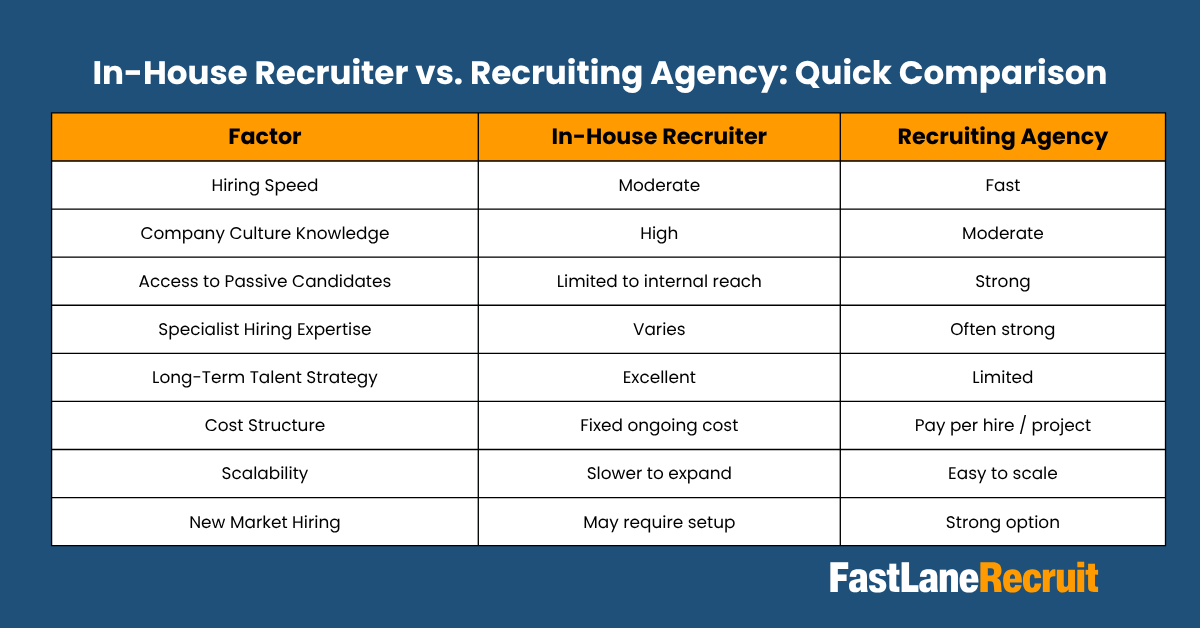
Both in-house recruiters and recruiting agencies can help businesses hire great talent, but they work in different ways. The right option often depends on your hiring volume, urgency, internal resources, and long-term business plans.
An in-house recruiter is part of your internal team and focuses only on your company. A recruiting agency is an external partner that supports hiring when needed and often works across multiple industries and markets.
The table below compares the key differences to help you choose the best fit for your business.
| Factor | In-House Recruiter | Recruiting Agency |
| Hiring Speed | Moderate | Fast |
| Company Culture Knowledge | High | Moderate |
| Access to Passive Candidates | Limited to internal reach | Strong |
| Specialist Hiring Expertise | Varies | Often strong |
| Long-Term Talent Strategy | Excellent | Limited |
| Cost Structure | Fixed ongoing cost | Pay per hire / project |
| Scalability | Slower to expand | Easy to scale |
| New Market Hiring | May require setup | Strong option |
Detailed Breakdown of Each Factor
1. Hiring Speed
In-House Recruiter: Moderate
Internal recruiters often manage hiring carefully and may balance recruitment with other HR priorities. They usually start sourcing candidates through job ads, referrals, and internal systems. This can take time, especially if there is no ready talent pipeline.
Recruiting Agency: Fast
Recruitment agencies are usually able to move faster because they already have candidate databases, sourcing systems, and active talent networks. They can begin outreach immediately and present qualified candidates quickly.
Best Choice:
If speed is critical, an agency may be the stronger option.
2. Company Culture Knowledge
In-House Recruiter: High
Because they work inside your business, in-house recruiters understand your company values, leadership style, team personalities, and workplace expectations. This helps them assess culture fit more accurately.
Recruiting Agency: Moderate
Agencies can learn your culture, but they need time, briefing, and regular communication to fully understand internal dynamics.
Best Choice:
If culture fit is your top priority, internal recruitment often has an advantage.
Also Read: Ultimate Guide to Employee Onboarding Checklist
3. Access to Passive Candidates
In-House Recruiter: Limited to Internal Reach
Internal teams may rely more heavily on job boards, company career pages, and employee referrals. They may have smaller external networks depending on team size and experience.
Recruiting Agency: Strong
Agencies often reach passive candidates, professionals who are not actively applying for jobs but may consider the right opportunity. This is especially useful for niche or senior positions.
Best Choice:
For difficult searches, agencies usually provide broader candidate access.
4. Specialist Hiring Expertise
In-House Recruiter: Varies
Some companies have strong internal recruiters with sector knowledge, but others may need to hire across many different functions at once. This can make specialist recruiting more challenging.
Recruiting Agency: Often Strong
Many agencies specialise in areas such as technology, finance, healthcare, manufacturing, executive search, or multilingual hiring. Their focused expertise can improve results.
Best Choice:
For technical or specialist roles, agencies often add value.
5. Long-Term Talent Strategy
In-House Recruiter: Excellent
Internal recruiters can build long-term hiring pipelines, succession plans, workforce forecasting, and employer branding strategies. They support future growth, not just immediate vacancies.
Recruiting Agency: Limited
Agencies are usually focused on filling open roles rather than managing internal workforce planning.
Best Choice:
For sustained growth planning, in-house recruitment is stronger.
6. Cost Structure
In-House Recruiter: Fixed Ongoing Cost
Even when hiring slows down, companies still carry costs such as:
- Salary
- Benefits
- Recruitment tools
- Training
- Job board subscriptions
Recruiting Agency: Pay Per Hire / Project
Agencies usually charge when hiring support is needed. This may include placement fees, retained search fees, or project-based hiring support.
Best Choice:
- Ongoing frequent hiring: In-house may be efficient long term
- Occasional or urgent hiring: Agency can be more flexible
7. Scalability
In-House Recruiter: Slower to Expand
If hiring demand suddenly rises, companies may need to hire additional recruiters or stretch internal teams.
Recruiting Agency: Easy to Scale
Agencies can often increase sourcing capacity quickly and support multiple vacancies at once.
Best Choice:
For rapid growth or hiring spikes, agencies are usually easier to scale.
8. New Market Hiring
In-House Recruiter: May Require Setup
Hiring in a new country may involve learning local salary expectations, talent availability, hiring practices, and compliance requirements.
Recruiting Agency: Strong Option
Local agencies understand the talent market and can reduce hiring delays when entering new regions.
Best Choice:
For overseas expansion, agencies are often the faster and lower-risk option.
Which Option Is Best Overall?
There is no single answer. It depends on your business stage and hiring goals.
Choose an In-House Recruiter If You Need:
- Ongoing recruitment support
- Strong employer branding
- Long-term workforce planning
- Better internal collaboration
- Consistent culture-focused hiring
Choose a Recruiting Agency If You Need:
- Faster hiring results
- Specialist talent
- Short-term hiring support
- Overseas hiring assistance
- Flexible recruitment capacity
Smart Option: Use Both
Many successful businesses use a hybrid model:
| Internal Team Handles | Agency Handles |
| Employer branding | Hard-to-fill roles |
| Culture fit | Urgent hiring |
| Workforce planning | Executive search |
| Internal processes | New market hiring |
This approach combines internal control with external speed and expertise.
When comparing in-house recruiter vs recruiting agency, focus on total hiring impact, not only cost. The best solution is the one that helps you hire the right people efficiently and supports long-term business growth.
Also Read: Workplace Dynamics and Their Impact on Your Organization
Benefits of an In-House Recruiter
1. Better Understanding of Your Business
Internal recruiters know your values, leadership style, and workplace expectations. This can improve candidate fit.
2. Stronger Employer Branding
They represent your company directly throughout the hiring process and help create a consistent candidate experience.
3. Long-Term Workforce Planning
An in-house team can build talent pipelines and support future hiring goals.
4. Closer Hiring Manager Collaboration
They work directly with department leaders and can adjust hiring strategies quickly.
Challenges of an In-House Recruiter
1. Higher Fixed Costs
You may need to cover:
- Salary
- Benefits
- Recruitment software
- Job board subscriptions
- Training costs
2. Limited Reach for Niche Roles
Internal teams may struggle when hiring rare skill sets or senior specialists.
3. Slower During Hiring Surges
If you suddenly need to hire many employees, internal teams may become overstretched.
Also Read: RPO vs. In-House Recruitment: Which Hiring Strategy Works Best?
Benefits of a Recruiting Agency
1. Faster Hiring Process
Agencies already have talent databases, sourcing systems, and recruiter networks.
2. Access to Qualified Passive Talent
Many strong candidates are not actively job searching. Agencies often know how to reach them.
3. Specialist Expertise
Some agencies focus on finance, technology, sales, manufacturing, healthcare, or multilingual hiring.
4. Flexible Hiring Support
Use agency support only when needed rather than maintaining permanent overhead.
5. Useful for Overseas Expansion
If you are hiring in a new country, a local recruitment partner can reduce setup time.
Challenges of a Recruiting Agency
1. Placement Fees
Most agencies charge a percentage of annual salary or a project fee.
2. Less Internal Visibility
An external recruiter may need time to fully understand your company culture and hiring preferences.
3. Quality Depends on Partner Selection
Not all agencies provide the same level of service, speed, or market expertise.
Also Read: Difference Between Talent Sourcer vs Recruiter
Which Option Is More Cost-Effective?
When comparing an in-house recruiter vs. a recruiting agency, many businesses focus first on one question: Which option costs less upfront?
This often means comparing:
- Agency placement fees
- Internal recruiter salary
While this is a common starting point, it does not show the full financial picture.
The true cost of hiring also includes:
- Time-to-hire
- Lost productivity while the role remains vacant
- Manager time spent interviewing candidates
- Delayed projects or missed revenue opportunities
- Hiring mistakes and replacement costs
- Extra workload placed on internal HR teams
In many cases, the lowest-cost option at the start may become more expensive over time.
Understanding the True Cost of Hiring
An open position can impact more than headcount. It can slow operations, increase pressure on current employees, and delay growth plans.
For example:
- A vacant sales role may reduce new business opportunities
- A missing finance employee may slow reporting processes
- An unfilled customer service role may affect response times
- A vacant technical role may delay product delivery
This is why businesses should compare return on investment (ROI) rather than only upfront fees.
In-House Recruitment Costs May Include
Hiring internally can be effective for businesses with regular recruitment needs, but there are ongoing expenses to consider.
Recruiter Salary and Benefits
An in-house recruiter is a permanent employee, so costs may include:
- Base salary
- Bonuses
- Benefits
- Paid leave
- Insurance
- Retirement contributions where applicable
These costs continue even during quieter hiring periods.
HR Management Time
Internal hiring often requires support from HR teams and department managers.
This may include time spent on:
- Vacancy planning
- Resume reviews
- Interview scheduling
- Candidate interviews
- Offer approvals
- Onboarding preparation
That time has business value and should be considered.
Hiring Tools and Systems
Internal teams often need recruitment tools such as:
- Applicant Tracking Systems (ATS)
- Job board subscriptions
- LinkedIn recruiter access
- Assessment platforms
- Interview scheduling tools
Job Advertising Costs
To attract candidates, companies may spend on:
- Sponsored job postings
- Employer branding campaigns
- Career page improvements
- Recruitment marketing efforts
Longer Vacancy Periods
If hiring takes longer due to limited internal capacity, vacancies may remain open for weeks or months.
This can lead to:
- Overtime costs
- Slower team output
- Reduced customer service levels
- Increased employee workload
Recruiting Agency Costs May Include
Recruitment agencies usually charge when support is required, making them a flexible hiring option.
Placement Fee
This is the most common model. The agency charges after a successful hire.
It may be:
- A percentage of annual salary
- A flat placement fee
- Country-specific pricing model
Project Fee
For multiple hires or recruitment campaigns, agencies may offer project-based pricing.
Common examples include:
- Team expansion
- New office launches
- Seasonal hiring
- Shared service centre growth
Retained Search Fee
Often used for senior or confidential hires such as:
- Country Manager
- CFO
- Head of Sales
- Director-level roles
This model usually includes dedicated search support and deeper market mapping.
Hidden Cost Comparison Example
| Scenario | Lower Upfront Cost | Higher Long-Term Cost Risk |
| Internal recruiter but role vacant for 3 months | Yes | High |
| Agency fills role in 3 weeks | No | Lower |
| Wrong hire replaced after 6 months | Appears low initially | Very high |
| Specialist agency finds strong long-term fit | Moderate | Lower |
This shows why upfront fees alone can be misleading.
Important Tip: Speed Can Create Better ROI
If an important role stays vacant, the business impact can be significant.
Sales Role Vacant
- Fewer leads followed up
- Slower revenue growth
Operations Role Vacant
- Delayed internal processes
- Higher workload on current staff
Finance Role Vacant
- Reporting delays
- Increased compliance pressure
Technical Role Vacant
- Product launch delays
- Slower delivery timelines
In these situations, faster hiring may deliver stronger ROI than choosing the lowest-cost option.
Also Read: Fixed-Term Employment Contracts: Pros and Cons for Employers
When In-House Recruitment May Be More Cost-Effective
An internal recruiter may offer better long-term value when you:
- Hire consistently throughout the year
- Need recurring roles filled regularly
- Want to build internal hiring systems
- Have enough hiring volume to justify fixed costs
When a Recruiting Agency May Be More Cost-Effective
A recruitment agency may be the better option when you:
- Hire occasionally rather than continuously
- Need urgent hiring support
- Need specialist or leadership talent
- Want to avoid permanent recruitment overhead
- Are expanding into a new market
- Need to scale hiring quickly
The Smart Option: Hybrid Recruitment Model
Many growing companies now combine both models.
Example Hybrid Setup:
| Internal Team Handles | Agency Handles |
| Employer branding | Hard-to-fill roles |
| Culture fit screening | Executive search |
| Hiring approvals | Urgent hiring |
| Workforce planning | Overseas recruitment |
This approach gives businesses both control and speed.
Why Hire in Malaysia?
Malaysia has become an attractive hiring destination for global companies looking to build efficient, skilled teams in Asia.
1. Skilled Multilingual Talent Pool
Malaysia offers professionals who commonly speak English, Malay, and Chinese languages, useful for regional operations.
2. Strong Talent in Key Functions
Popular hiring areas include:
- Finance and accounting
- Customer support
- IT and software
- Digital marketing
- Shared services
- Operations and administration
3. Strategic ASEAN Location
Malaysia offers strong connectivity to Singapore, Thailand, Indonesia, and broader Asia-Pacific markets.
4. Business Efficiency
Many companies choose Malaysia to improve operating efficiency while maintaining quality talent standards.
5. Supportive Investment Environment
Malaysia continues to attract foreign investment through industrial and digital growth initiatives.
Trusted Sources:
- Malaysia Investment Development Authority
- TalentCorp Malaysia
- Department of Statistics Malaysia
Example: Hiring in Malaysia for Global Growth
A UK software company wants to expand customer support across Asia.
In-House Model:
They build an internal recruiting function, purchase tools, advertise jobs, and manage hiring internally.
Agency Model:
They partner with FastLaneRecruit to source pre-screened Malaysian candidates quickly and reduce hiring delays.
Result: Faster team launch and lower internal workload.
Tips Before Choosing a Hiring Model
Choosing between an in-house recruiter and a recruiting agency is not just a structural decision. It is a strategic one that should align with your business growth, hiring demand, and internal capacity.
Before deciding which model to use, it helps to evaluate a few key areas. These questions can guide you toward a more practical and cost-effective hiring approach.
1. Review Your Hiring Volume
One of the most important factors is how often you hire.
Hiring needs can vary significantly between companies. Some businesses only hire occasionally, while others are scaling teams continuously.
For example:
- Hiring one or two roles per quarter is very different from
- Hiring 10 to 20 roles within a few months
If hiring is infrequent, maintaining a full internal recruitment function may not be the most efficient approach. On the other hand, companies with steady hiring demand often benefit from building internal recruitment capabilities over time.
Understanding your hiring volume helps determine whether you need a permanent internal structure or flexible external support.
2. Consider Internal Capacity
Even if your business has hiring needs, it is important to evaluate whether your internal team can realistically manage recruitment effectively.
Ask yourself:
- Does HR already have enough bandwidth?
- Are hiring managers available to support interviews?
- Is there a structured recruitment process in place?
- Do you have access to sourcing tools and candidate networks?
If internal teams are already handling multiple responsibilities such as payroll, employee relations, and compliance, recruitment may become slower or less effective without additional support.
A recruitment model should match not only your needs but also your internal capacity to execute hiring well.
3. Measure Hiring Speed
Hiring speed is directly linked to business performance.
Every day a role stays open can have a real operational impact. Depending on the role, delays may affect:
- Revenue generation
- Customer service quality
- Project delivery timelines
- Team workload and burnout
- Business expansion plans
Instead of only asking how much recruitment costs, it is equally important to ask:
What does it cost the business if this role remains unfilled for 30, 60, or 90 days?
In many cases, faster hiring can generate better business outcomes than choosing the lowest-cost recruitment option.
4. Think Long-Term
Hiring is not only about filling current vacancies. It is also about preparing for future growth.
A good hiring strategy should consider:
- Whether your company is expanding into new markets
- Whether new departments will be created
- Whether demand for talent is increasing or stable
- Whether hiring needs will remain consistent next year
If your hiring needs are expected to grow steadily, investing in an in-house recruitment function may make sense over time.
However, if hiring demand is unpredictable or project-based, a flexible external recruitment partner may be more efficient.
Planning ahead helps avoid sudden recruitment gaps or unexpected hiring bottlenecks.
5. Use Specialists Where Needed
Not all roles are equally easy to fill. Some positions require deep industry knowledge, technical expertise, or access to niche talent pools.
Examples include:
- Senior leadership roles
- Highly technical positions (IT, engineering, data)
- Multilingual or regional support roles
- Roles in new or unfamiliar markets
In these cases, external recruitment specialists often add significant value because they already understand the market, salary benchmarks, and candidate availability.
Instead of relying only on internal sourcing, companies can improve hiring success by combining internal effort with external expertise when needed.
This approach reduces time-to-hire and improves the likelihood of finding the right candidate.
Before choosing a hiring model, it is important to look beyond cost alone. A strong recruitment strategy considers volume, capacity, speed, long-term goals, and role complexity.
The most effective companies are often those that remain flexible, using in-house recruitment for consistent hiring needs and external specialists when speed, expertise, or market access is required.
Why Choose FastLaneRecruit for Hiring Malaysian Talent?
FastLaneRecruit supports global companies in building strong, reliable teams in Malaysia through a structured, efficient, and people-focused recruitment process. Whether you are hiring your first employee in Malaysia or expanding an existing team, the goal is to make hiring simpler, faster, and more effective.
Hiring in a new market often comes with challenges such as understanding local talent availability, salary expectations, and recruitment practices. FastLaneRecruit helps bridge this gap by combining local market knowledge with end-to-end recruitment support, so businesses can focus on growth while the hiring process is handled professionally.
Our Support Includes:
- Candidate sourcing and screening
- Professional shortlisting
- Hiring market guidance
- Local talent insights
- Faster time-to-hire
- Support for overseas employers
- Scalable hiring solutions
Why This Matters for Global Companies
Hiring in Malaysia can offer access to a skilled, multilingual, and adaptable talent pool. However, success depends on understanding the local market and using the right recruitment strategy.
FastLaneRecruit helps reduce complexity by combining:
- Local market knowledge
- Structured candidate evaluation
- Efficient hiring workflows
- International hiring experience
This allows companies to focus on business expansion while ensuring hiring quality remains consistent.
FastLaneRecruit is designed to simplify hiring in Malaysia for international businesses. Whether you are expanding into the region or strengthening an existing team, the focus is on delivering a smoother hiring experience, better candidate matches, and more efficient recruitment outcomes.
Conclusion
There is no single winner in the debate between in-house recruiter vs. recruiting agency. The right solution depends on your business stage, hiring urgency, and long-term goals.
Choose in-house recruitment when you need long-term hiring control and consistent recruitment demand.
Choose a recruiting agency when speed, specialist talent, or market access matters most.
For many businesses, the strongest option is a hybrid approach that combines internal leadership with external hiring expertise.
If you are planning to hire in Malaysia, FastLaneRecruit can help you find quality candidates faster and build a team that supports sustainable growth.
Ready to Hire in Malaysia?
Contact FastLaneRecruit today to discuss your hiring needs and discover the right recruitment strategy for your business.