Ending an employment relationship across borders involves more than notifying an employee and processing their final salary. Businesses must consider contractual obligations, local employment laws, notice periods, severance entitlements, and the documentation required to close an employment relationship properly.
When a company hires internationally through an Employer of Record (EOR), the termination process also requires coordination between the company and its EOR provider. Although the company typically manages the employee’s day-to-day work and performance, the EOR acts as the formal employer and handles employment administration within the agreed service arrangement.
Understanding how to terminate an employee through an EOR helps businesses plan workforce changes, manage employment costs, and reduce avoidable compliance risks.
FastLaneRecruit supports international employment through EOR services, helping businesses manage employment administration across supported markets without establishing a local entity in every country where they hire.
Content Outline
Key Summary
Coordinate With the EOR Before Communicating a Termination Decision
The client company should inform its EOR provider before communicating a proposed termination to the employee. The EOR can review the circumstances, employment contract, applicable procedures, and relevant local requirements.
Notice Periods and Severance Depend on Local Requirements
There is no universal EOR notice period or severance formula. Applicable employment laws, contractual terms, length of service, termination reason, and other circumstances may affect the employee’s entitlements.
Final Pay Extends Beyond Outstanding Salary
Depending on the jurisdiction and employment arrangement, final payments may include outstanding wages, payment in lieu of notice, accrued leave, severance or redundancy payments, and other amounts due.
Documentation and Offboarding Require Careful Coordination
Employers should maintain appropriate termination records, confirm final payments, manage benefits and company property, and arrange access revocation in accordance with applicable requirements.
An EOR Can Help Coordinate International Employee Termination
An EOR can support employment administration and coordinate relevant termination procedures in its supported markets. Businesses should confirm the scope of assistance available for their specific circumstances.
How Does Terminating an Employee Through an EOR Work?
Terminating an employee through an Employer of Record involves ending an employment relationship in which the EOR is the formal employer and the client company directs the employee’s day-to-day activities.
The client may identify the business reason for termination, such as organizational restructuring or ongoing performance concerns. However, the proposed termination should be reviewed with the EOR before the company communicates a final decision or promises a specific termination date.
The EOR can assess the employment arrangement, coordinate the required documentation, and help determine the appropriate next steps under the applicable local rules and contractual terms.
Who Is Responsible for EOR Employee Termination?
The division of responsibilities depends on the EOR agreement, employment contract, local law, and the circumstances of the termination.
| Responsibility | Client Company | EOR Provider |
| Identify business reasons for termination | Provides the business rationale | Reviews the request within the agreed service scope |
| Review employee performance | Provides relevant performance records | Coordinates the employment process as applicable |
| Assess contractual and local requirements | Supplies relevant business information | Helps review applicable employment requirements |
| Confirm termination documentation | Provides supporting information | Prepares or coordinates required employment documents, as agreed |
| Calculate final employment payments | Confirms relevant compensation information | Coordinates payroll calculations and processing within the service scope |
| Communicate the termination | Coordinates communication with the EOR | Handles formal employer communications as required |
| Complete offboarding | Manages internal access, equipment, and operational handover | Coordinates employment-related closure and final administration |
Important: This is a general responsibility framework, not a universal allocation of legal duties. The actual responsibilities must be confirmed against the relevant employment contract, EOR agreement, and local law.
Also Read: EOR Arrangement: Who Legally Employs Your Staff?
What Is the EOR Employee Termination Process?
A structured termination process helps businesses address employment obligations before finalizing an employee’s departure.
Although the exact steps vary by country, the following framework provides a practical starting point.
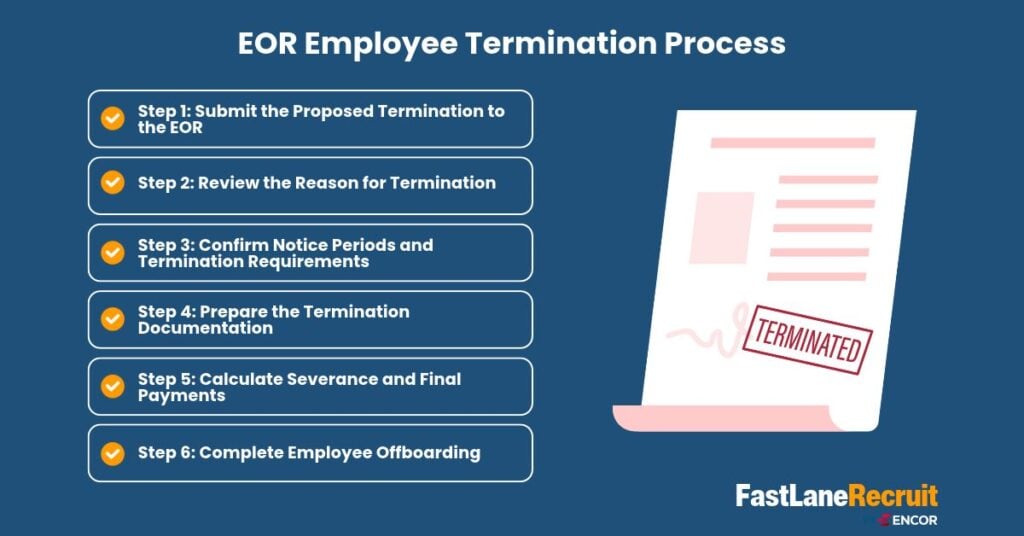
Step 1: Submit the Proposed Termination to the EOR
Inform the EOR about the proposed termination before communicating a final decision to the employee.
Provide relevant details, including:
- The reason for the proposed termination.
- The employee’s start date and employment details.
- Relevant performance records or disciplinary documentation, where applicable.
- The preferred termination date.
- Any proposed notice arrangements or payment in lieu of notice.
- Relevant business changes, such as restructuring or role elimination.
The EOR can review the request and identify the information or procedures needed before proceeding.
Step 2: Review the Reason for Termination
The reason for termination can affect the required process, available options, and potential employment risks.
Common circumstances include:
- Performance-related termination: Concerns about performance, conduct, or failure to meet documented expectations.
- Misconduct: Alleged violations of workplace policies or employment obligations.
- Redundancy or restructuring: Changes in business operations or the elimination of a position.
- Mutual separation: An agreed arrangement to end employment, subject to applicable requirements.
- Fixed-term contract expiry: The end of an agreed employment period, which may still involve specific notice or procedural obligations.
Before proceeding, determine whether the proposed reason requires supporting evidence, performance management, consultation, a disciplinary process, or other procedural safeguards.
Do not assume that an employee can be dismissed immediately simply because the business has a valid operational reason.
Step 3: Confirm Notice Periods and Termination Requirements
Notice periods depend on the relevant jurisdiction, employment contract, length of service, termination circumstances, and applicable exceptions.
The EOR should help coordinate a review of:
- Contractual notice provisions.
- Statutory minimum notice requirements.
- Any applicable consultation or notification procedures.
- Whether payment in lieu of notice is permitted.
- Restrictions relating to protected leave or other legally protected circumstances.
- Any additional obligations associated with redundancy or restructuring.
Decision point: Do not confirm the employee’s final working day until the required notice arrangements and termination procedure have been reviewed.
Step 4: Prepare the Termination Documentation
The documentation required depends on the country and reason for termination.
It may include:
- A formal termination notice or letter.
- Supporting performance or disciplinary records.
- Consultation or meeting records, where required.
- Documentation relating to redundancy or restructuring.
- A final settlement calculation.
- Relevant employment separation records.
The EOR should coordinate the employment documentation within its agreed responsibilities. The client should provide accurate information and retain its own business records.
Clear documentation supports consistent decision-making and helps establish what was communicated, when the decision was made, and how the relevant requirements were addressed.
Step 5: Calculate Severance and Final Payments
Before closing the employment relationship, determine which payments are owed and when they must be made.
Depending on local requirements and the employee’s circumstances, these may include:
- Outstanding salary and wages.
- Payment in lieu of notice, where applicable.
- Accrued but unused annual leave or other payable leave entitlements.
- Statutory severance or redundancy payments, where applicable.
- Contractual bonuses, commissions, or other outstanding compensation.
- Other employment-related payments required by law or contract.
The EOR can coordinate relevant payroll calculations and final payments within the agreed service scope.
The client should review any exceptional compensation arrangements and provide the necessary payroll information promptly.
Step 6: Complete Employee Offboarding
Once the termination arrangements are confirmed, coordinate the employee’s departure.
Operational offboarding may include:
- Confirming the employee’s final working day.
- Coordinating the return of company property.
- Revoking access to business systems at the appropriate time.
- Transferring work responsibilities and relevant records.
- Reviewing benefits and insurance arrangements.
- Completing payroll and employment administration.
- Retaining employment records in accordance with applicable requirements.
Coordinate access removal with the employment timeline, business security needs, and local requirements. Avoid actions that inadvertently prevent an employee from completing required duties or accessing information they are legally entitled to receive.
How Is Severance Pay Calculated for an EOR Employee?
Severance pay is a payment that may be due when employment ends under specified circumstances. It is distinct from ordinary salary and may also be separate from payment in lieu of notice or accrued leave entitlements.
There is no universal EOR severance formula. Whether severance is payable, how it is calculated, and when it must be paid depend on the applicable jurisdiction, the employment contract, and the circumstances of termination.
What Factors Affect EOR Severance Pay?
| Factor | Why It Matters |
| Country of employment | Determines the applicable statutory employment framework |
| Length of service | May affect eligibility and the amount payable |
| Reason for termination | Redundancy and other termination circumstances may have different requirements |
| Contractual terms | May provide entitlements beyond statutory minimums, subject to applicable law |
| Salary and compensation | May determine the basis for calculating qualifying payments |
| Employee status and circumstances | Special protections or employment arrangements may affect the process |
| Collective agreements or workplace rules | May introduce additional obligations where applicable |
Severance Pay vs. Other Termination Payments
Businesses should distinguish between the different amounts that may be payable when terminating an employee.
| Payment Type | Purpose |
| Outstanding salary | Pays the employee for work already performed |
| Payment in lieu of notice | Compensates the employee for an applicable notice period that is not worked |
| Severance pay | Provides a payment where required by law, contract, or an applicable agreement |
| Redundancy pay | May apply when a role is eliminated under relevant redundancy rules |
| Accrued leave payment | Pays eligible unused leave entitlements |
| Other outstanding compensation | Covers qualifying bonuses, commissions, or other amounts owed |
Not every employee will be entitled to every payment listed above. Some entitlements may overlap or be subject to specific calculation rules.
How Can Businesses Avoid Severance Calculation Errors?
Before approving the final settlement, businesses should:
- Confirm the employee’s jurisdiction and employment terms.
- Verify the length of service and relevant salary information.
- Identify any statutory, contractual, or collective-agreement entitlements.
- Confirm whether notice must be worked or paid out.
- Review accrued leave and other outstanding compensation.
- Confirm the applicable payment deadlines and payroll treatment.
- Retain the supporting calculations and payment records.
An EOR can help coordinate these checks as part of its agreed employment and payroll administration services.
Also Read: Severance Pay Malaysia 2026: Rules, Formula, Eligibility, and Employer Responsibilities
What Notice Period Applies When Terminating an EOR Employee?
The applicable notice period depends on the country of employment and the specific employment arrangement. A contract may specify a notice period, but contractual terms must be assessed against the relevant statutory requirements.
In some circumstances, payment in lieu of notice may be permitted. Other situations may require additional procedures or involve specific exceptions.
What Should Employers Check Before Giving Notice?
Review the following before confirming a termination date:
- The notice clause in the employment contract.
- Applicable statutory minimum notice requirements.
- Any additional notice obligations under relevant agreements.
- Whether notice must be provided in writing.
- Whether payment in lieu of notice is permitted.
- Whether consultation or other procedures must occur before notice is issued.
- The rules governing final salary and other payments.
Why Country-Specific Review Matters
Employment termination rules differ significantly between jurisdictions.
For example, the United Kingdom has statutory notice and redundancy rules, while Australia’s Fair Work framework addresses notice, final pay, and redundancy entitlements under applicable circumstances.
These examples illustrate why employers should not apply a single global termination policy without reviewing local requirements.
An EOR can help coordinate the relevant employment administration in its supported markets. Businesses facing disputed dismissals, complex redundancies, or other high-risk situations should consider obtaining jurisdiction-specific legal advice where appropriate.
What Risks Should Employers Consider Before Termination?
An employee termination that is poorly planned or inadequately documented can create financial, operational, and legal exposure.
Businesses using an EOR should address the following risks before proceeding.
1. Terminating Without Reviewing Local Requirements
A process that is acceptable in one country may be insufficient in another.
How to reduce the risk: Ask the EOR to review the proposed termination against the applicable employment requirements before confirming the process or termination date.
2. Underestimating Final Employment Costs
Businesses may budget for outstanding salary but overlook notice payments, accrued leave, severance, or other contractual entitlements.
How to reduce the risk: Request a detailed estimate of anticipated termination payments before approving the final arrangement.
3. Insufficient Documentation
Missing performance records, unclear business reasons, or inconsistent communications may complicate the termination process.
How to reduce the risk: Maintain accurate records and provide the EOR with relevant documentation before the termination is finalized.
4. Communicating the Decision Too Early
Announcing a termination before reviewing the legal and contractual requirements may create avoidable complications.
How to reduce the risk: Coordinate with the EOR before communicating a final decision, issuing a termination notice, or promising a specific end date.
5. Overlooking Final Payroll and Benefits
Unresolved salary, leave, benefits, or other employment matters can create disputes after the employee leaves.
How to reduce the risk: Use a final-settlement checklist and confirm which payments, benefits, and records must be completed or updated.
6. Mishandling Employee Data and Access
Termination may involve personal information, confidential business records, system access, and company property.
How to reduce the risk: Coordinate access revocation, information retention, and equipment recovery with the relevant internal teams while respecting applicable data protection and employment requirements.
How Can Businesses Choose the Right EOR Support for Employee Termination?
Not every EOR provider offers the same level of support. Before selecting a provider or relying on an existing arrangement, businesses should assess whether the service meets their international employment needs.
What to Evaluate in an EOR Provider
| Evaluation Criteria | Questions to Ask |
| Country coverage | Does the provider support employment in the employee’s country? |
| Local employment expertise | Can the provider identify relevant notice, severance, and procedural requirements? |
| Employment documentation | Can it prepare or coordinate the required employment documents? |
| Payroll administration | Can it coordinate final salary and applicable termination payments? |
| Offboarding support | Does its service cover the employment administration required to close the relationship? |
| Communication and coordination | Is there a clear process for submitting and reviewing termination requests? |
| Service scope and fees | Are termination-related responsibilities, costs, and exclusions clearly documented? |
When Should Businesses Consult an EOR?
Contact the EOR early when considering:
- Termination during probation.
- Performance-related dismissal.
- Employee misconduct.
- Redundancy or restructuring.
- A mutual separation arrangement.
- Termination involving substantial notice or severance costs.
- Complex cross-border employment situations.
Early coordination gives the business time to understand its obligations, estimate costs, and plan the next steps before communicating a final decision.
An EOR provides employment administration support, but its involvement does not automatically eliminate legal risk or replace independent legal advice where needed.
How FastLaneRecruit Supports International Employment and Offboarding
Managing employee termination across borders requires coordination between employment documentation, payroll, local requirements, and internal business operations.
FastLaneRecruit provides Employer of Record services to help businesses hire and manage employees in supported markets without establishing a local entity in every country where they operate.
EOR Employment Administration
Our EOR services support international employment administration, including employment contracts, onboarding, payroll coordination, benefits administration, and relevant employment processes.
When an employment relationship needs to end, businesses can discuss the applicable arrangements and required administrative steps with our team.
Payroll and Final Settlement Coordination
Employee termination may involve outstanding salary, applicable notice payments, accrued leave, severance, and other qualifying entitlements.
Our employment and payroll services can help coordinate relevant administrative requirements within the agreed service scope and applicable local framework.
Support Across Supported Markets
FastLaneRecruit supports international employment across the following markets:
- Asia Pacific: Malaysia, Singapore, Hong Kong, China, India, Philippines, Taiwan, Vietnam, Australia,
- Europe: United Kingdom, Switzerland
- Middle East & Africa: UAE, Saudi Arabia, Qatar
The services available and the requirements applicable to a particular termination depend on the country, employment arrangement, and agreed scope of service.
Why Businesses Choose FastLaneRecruit
International Employment Support
Our EOR services help businesses manage employment administration when hiring in supported markets without establishing a separate local entity for each hire.
Coordinated Payroll Administration
We help businesses coordinate payroll-related processes as part of their international employment arrangements, including relevant employment payments within the agreed scope.
Support Across Multiple Markets
Our coverage across Asia Pacific, Europe, and the Middle East enables businesses to explore international hiring through one service relationship, subject to country availability and the specific requirements of each engagement.
Practical Employment Administration
We help businesses coordinate relevant employment processes, documentation, and administrative requirements throughout the employment lifecycle.
Planning to end an international employment relationship? Discuss your circumstances with FastLaneRecruit to understand how our EOR services may support the employment administration required in your employee’s country.
Manage International Employee Termination With FastLaneRecruit
Terminating an employee through an EOR requires careful coordination of employment obligations, notice arrangements, final payments, documentation, and offboarding. Reviewing these requirements early helps businesses make informed decisions and plan workforce changes more effectively.
FastLaneRecruit supports international employment through EOR services across 14 supported markets, helping businesses coordinate employment administration without establishing a local entity in every country where they hire.
Considering an employee termination or planning a workforce change in another country?
Contact FastLaneRecruit to discuss your international employment requirements and explore how our EOR services may support your business.
Book a Free Consultation with an Expert.
Frequently Asked Questions About EOR Employee Termination
1. Can a Company Terminate an Employee Hired Through an EOR?
A client company can generally request that an EOR employment arrangement be terminated, but the process must follow the applicable employment contract, local law, and EOR agreement. The EOR should be consulted before the client communicates a final decision to the employee.
2. Who Is Responsible for Terminating an EOR Employee?
The EOR is the formal employer and typically handles formal employment administration, while the client company provides the business rationale and relevant information. The exact division of responsibilities depends on the agreement and local requirements.
3. How Does the EOR Termination Process Work?
The process generally involves submitting the proposed termination to the EOR, reviewing the reason and applicable requirements, confirming notice arrangements, preparing documentation, calculating final payments, and completing offboarding. The exact procedure varies by country.
4. Is Severance Pay Mandatory When Terminating an EOR Employee?
Severance is not universally payable in every termination. Eligibility and calculation depend on local employment law, contractual terms, the reason for termination, length of service, and other relevant circumstances.
5. How Is Severance Pay Calculated for an EOR Employee?
The calculation depends on the applicable jurisdiction and the employee’s circumstances. Relevant factors may include length of service, salary, termination reason, statutory requirements, and contractual entitlements. The EOR can help coordinate the calculation within its agreed service scope.
6. Can an EOR Employee Be Terminated Immediately?
Immediate termination is not automatically permitted simply because a client company requests it. The applicable rules may require notice, payment in lieu of notice, procedural safeguards, or other steps. The proposed termination should be reviewed with the EOR before a termination date is confirmed.
7. What Payments Must Be Made When an EOR Employee Leaves?
Depending on local law and the employment arrangement, final payments may include outstanding salary, payment in lieu of notice, accrued leave, severance or redundancy pay, and other outstanding compensation. Not every payment applies in every case.
8. How Long Does It Take to Terminate an Employee Through an EOR?
There is no universal timeline. The duration depends on the country, notice period, reason for termination, required procedures, documentation, and any applicable consultation or dispute process. Businesses should consult their EOR before setting an expected termination date.
9. Does an EOR Handle Employee Offboarding?
An EOR can handle or coordinate employment-related offboarding tasks within its agreed service scope. The client company generally remains responsible for internal operational matters such as work handovers, company equipment, and its own systems and access controls.
10. Can FastLaneRecruit Help Businesses Manage International Employee Termination?
FastLaneRecruit provides EOR services across supported markets in Asia Pacific, Europe, and the Middle East. Businesses can contact our team to discuss their employment arrangement, country-specific requirements, and the administrative support available for their circumstances.