Your next international hire could help develop your most valuable business asset, whether it is proprietary software, a product design, a marketing strategy, or confidential customer information. But when employees work across borders, protecting intellectual property (IP) requires more than simply signing an employment contract.
Businesses hiring internationally through an Employer of Record (EOR) need to understand who owns employee-created work, how confidentiality obligations are documented, and which responsibilities remain with the company.
IP protection when hiring through an EOR depends on clear contractual arrangements, applicable local laws, and effective internal security controls. An EOR can support local employment administration, but businesses must ensure that their IP ownership requirements and information security measures are properly addressed.
This guide explains the key risks, contractual safeguards, and practical steps businesses should consider when hiring internationally through an EOR.
Content Outline
Key Summary
An EOR Does Not Automatically Guarantee IP Ownership
An EOR can support employment contracts and local employment administration. However, ownership of employee-created intellectual property depends on applicable law, contractual provisions, and the circumstances in which the work was created.
IP Assignment and Confidentiality Clauses Serve Different Purposes
IP assignment provisions address ownership or transfer of intellectual property rights. Confidentiality clauses restrict the unauthorised use or disclosure of protected information. Businesses may need both.
Local Employment Laws Matter
Countries can have different rules governing employee inventions, copyright, contractual enforceability, and employee rights. Employment documentation should be reviewed against the requirements of the relevant jurisdiction.
Businesses Must Maintain Their Own Security Controls
Access permissions, secure document storage, multifactor authentication, and offboarding procedures help protect confidential information and proprietary assets. These operational safeguards remain important regardless of the employment model.
The Right EOR Should Support Your International Employment Requirements
Businesses should evaluate an EOR’s local employment expertise, contractual processes, payroll administration, and ability to support the requirements of their target markets.
What Is IP Protection When Hiring Through an EOR?
IP protection when hiring through an EOR refers to the contractual, legal, and operational measures businesses use to protect intellectual property created, accessed, or handled by employees employed through an Employer of Record arrangement.
Intellectual property can include assets that provide a business with a competitive advantage, such as software, inventions, designs, written content, proprietary processes, and confidential commercial information.
When hiring internationally, businesses need to consider how these assets are protected under the employment arrangement and applicable local law.
What Types of Intellectual Property Should Businesses Protect?
| IP or information type | Examples | Key protection consideration |
| Copyrighted works | Software code, website content, graphics, reports, and marketing materials | Confirm ownership, assignment requirements, and permitted use |
| Inventions and patents | Product innovations, technical processes, and new devices | Review employee invention rules and contractual assignment provisions |
| Trademarks and brand assets | Logos, brand identities, and campaign materials | Clarify ownership, authorised use, and registration responsibilities |
| Trade secrets | Proprietary methods, formulas, and technical know-how | Restrict access and implement appropriate confidentiality measures |
| Confidential business information | Pricing strategies, customer lists, financial information, and business plans | Define confidential information and establish appropriate handling requirements |
Not all confidential information qualifies as a trade secret, and different forms of intellectual property receive different legal protections. Businesses should identify the assets they need to protect and determine which legal and contractual safeguards apply.
Why Is IP Protection Important When Hiring Internationally Through an EOR?
International hiring gives businesses access to talent in new markets without necessarily establishing a local entity. However, cross-border employment can introduce additional contractual and operational considerations.
1. IP Ownership Rules Can Differ Between Countries
Businesses should not assume that intellectual property created by an employee automatically belongs to the client company.
Ownership can depend on the type of IP, the employee’s duties, applicable legislation, and the terms of the employment agreement. Some jurisdictions have specific rules for employee inventions, while copyright ownership may follow different principles.
For example, the European Commission’s IP Helpdesk explains that employee IP ownership is not harmonised across Europe and is generally governed by national law. Particular rules can apply to inventions and work created outside an employee’s employment duties.
Businesses should therefore assess the relevant local requirements rather than rely on a single contract template for every market.
2. Employment Contracts May Not Address Every IP Requirement
A standard employment contract may not fully address the ownership and protection requirements associated with a particular role.
This can be especially important when employees develop software, create designs, conduct research, or access proprietary business information.
Businesses should review whether the relevant employment documentation appropriately addresses IP ownership, confidentiality, permitted use, and any additional formalities required under local law.
3. Confidential Information May Be Exposed Through Weak Access Controls
Employees may need access to customer databases, source code, internal documents, financial records, and project management systems to perform their work.
Without appropriate permissions and security procedures, sensitive information may be exposed to unauthorized users or retained after an employee’s responsibilities change.
IP protection therefore requires both contractual safeguards and operational controls.
4. Employee Offboarding Can Create Additional Risks
When an employment relationship ends, businesses need to ensure that confidential information remains protected and access to company systems is removed appropriately.
Important tasks include recovering company equipment, disabling accounts, transferring work product, and confirming that applicable confidentiality obligations remain documented.
The exact process should reflect local employment requirements, contractual terms, and the company’s internal security policies.
What Should an EOR Employment Contract Include to Support IP Protection?
Employment contracts are an important part of an IP protection strategy, but they should be reviewed alongside other agreements and internal policies.
The appropriate provisions depend on the role, the assets involved, and the laws of the country where the employee is employed.
1. Intellectual Property Ownership and Assignment
IP assignment provisions should clearly address the ownership or transfer of rights in work created during employment, where legally permissible.
Businesses should consider:
- Which categories of work or intellectual property are covered.
- Whether the provision applies to work created within the employee’s assigned duties.
- Whether a separate assignment or additional documentation is required.
- How pre-existing intellectual property is treated.
- Whether local law imposes restrictions or additional obligations.
Important: Paying an employee to create something does not, by itself, establish that every intellectual property right automatically transfers to the client company in every jurisdiction.
The contract and applicable law must be assessed together.
2. Confidentiality Clauses
Confidentiality clauses establish expectations for handling non-public business information.
Depending on the role and local law, they may address:
- Source code, technical documentation, and product plans.
- Customer information and commercial records.
- Internal financial information and pricing strategies.
- Unreleased marketing campaigns and business plans.
- Restrictions on unauthorised disclosure or use.
- Appropriate handling and return of confidential materials.
Confidentiality provisions should be sufficiently clear to identify the information being protected and the employee’s obligations.
3. Pre-Existing Intellectual Property
Employees may bring existing software, research, designs, or other intellectual property into a new role.
Businesses should identify relevant pre-existing assets and document how they may be used in company work.
Where appropriate, the parties should clarify whether the business receives a licence, whether any rights are assigned, and what restrictions apply.
This helps reduce the risk of disputes over ownership after a project has been completed.
4. Disclosure and Documentation of Work Product
For roles involving software development, research, product design, or invention, businesses may need procedures for documenting work product and disclosing potentially patentable inventions.
The employment arrangement should reflect any applicable reporting obligations, assignment requirements, and documentation formalities.
5. Post-Employment Confidentiality Obligations
Businesses should clarify which confidentiality and IP-related obligations continue after employment ends, subject to applicable law.
These provisions should distinguish legitimate protection of confidential information from restrictions that may be unenforceable or inconsistent with employee rights.
6. Local Legal Review
A contract suitable for one country may not be suitable for another.
Before international hiring, businesses should confirm whether the proposed provisions comply with the relevant employment, IP, and other applicable laws.
An EOR can support local employment documentation and administration within the scope of its services. Specialist legal advice may still be necessary for complex IP ownership, patent assignment, licensing, or enforcement questions.
Also Read: How Do EOR Services Manage Payroll, Taxes, and Employee Benefits?
How Can Businesses Protect Intellectual Property When Hiring Through an EOR?
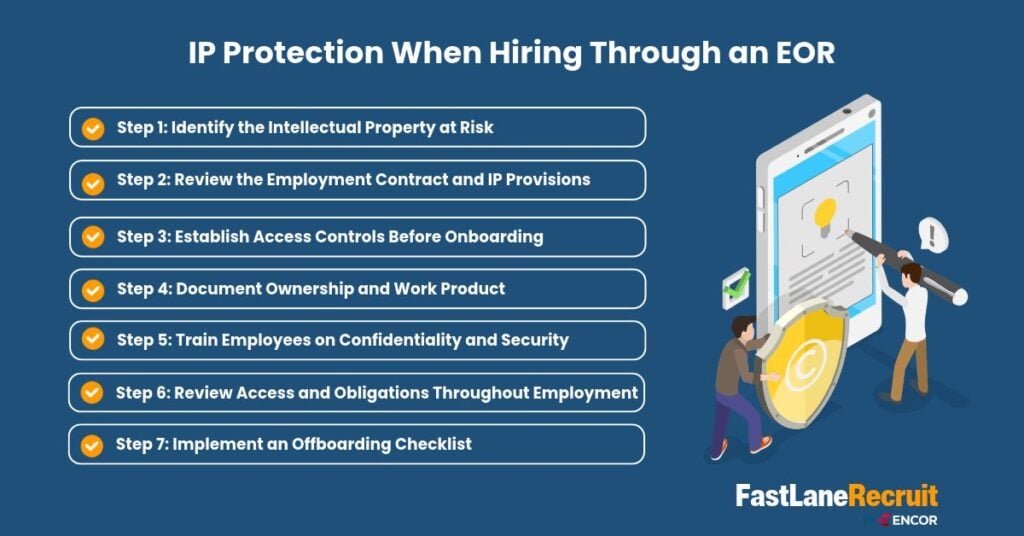
Protecting intellectual property requires coordination between employment documentation, internal security controls, and ongoing workforce management.
The following checklist provides a practical starting point.
Step 1: Identify the Intellectual Property at Risk
Determine which assets the employee will create, access, or manage.
For example, a software developer may need access to source code and technical documentation, while a marketing specialist may create campaign materials, brand assets, and customer research.
Identifying these assets helps businesses determine which contractual and security measures are appropriate.
Step 2: Review the Employment Contract and IP Provisions
Confirm that the employment documentation addresses ownership, confidentiality, and the use of company information.
Check whether additional agreements or local legal formalities are necessary.
Do not assume that a confidentiality agreement alone transfers ownership of intellectual property.
Step 3: Establish Access Controls Before Onboarding
Give employees access only to the systems and information needed for their responsibilities.
Appropriate controls may include:
- Role-based access permissions.
- Multifactor authentication.
- Secure storage and controlled file sharing.
- Restrictions on administrator privileges.
- Documented approval for access to sensitive systems.
- Periodic reviews of user permissions.
The appropriate controls will depend on the sensitivity of the information and the organisation’s security requirements.
Step 4: Document Ownership and Work Product
Maintain records of relevant assignments, deliverables, approvals, and IP-related agreements.
For projects involving inventions, software, or other valuable assets, establish clear procedures for recording contributions and documenting ownership arrangements.
Step 5: Train Employees on Confidentiality and Security
Employees should understand which information is confidential, how company systems may be used, and what to do if information is lost or disclosed without authorisation.
Policies should also explain how employees are expected to handle company documents, devices, credentials, and project files.
Step 6: Review Access and Obligations Throughout Employment
Access requirements may change when employees move to new roles or take on different responsibilities.
Review permissions periodically and update them when necessary. Keep appropriate records of relevant changes.
Step 7: Implement an Offboarding Checklist
When employment ends, coordinate the necessary employment administration and internal security actions.
| Offboarding action | Purpose |
| Revoke access to company systems | Reduce the risk of unauthorised access |
| Recover company equipment | Retrieve devices and other company assets |
| Transfer work product and project records | Maintain business continuity |
| Review outstanding IP documentation | Identify incomplete assignments or records |
| Remind employees of applicable continuing obligations | Reinforce confidentiality and other valid contractual requirements |
| Preserve necessary records | Support appropriate recordkeeping and future enquiries |
Offboarding procedures should be coordinated with the EOR where employment administration is involved, while the client company manages its own systems, devices, and operational access.
Who Is Responsible for IP Protection When Hiring Through an EOR?
An EOR arrangement divides responsibilities between the legal employer and the client company. The precise allocation depends on the service agreement, employment documents, local law, and the responsibilities assigned to each party.
The EOR does not automatically assume every responsibility relating to the client’s intellectual property.
Understanding the EOR’s Role and the Client Company’s Responsibilities
| Area | EOR’s potential role | Client company’s responsibility |
| Employment documentation | Support preparation and administration of local employment contracts within the agreed service scope | Define the role and identify the contractual protections required |
| IP ownership | Incorporate or coordinate relevant employment provisions where included in the service and legally appropriate | Confirm ownership objectives and obtain specialist legal advice when needed |
| Confidentiality | Support documentation of applicable employment obligations | Define internal confidentiality requirements and manage access to business information |
| Payroll and employment administration | Process payroll and support applicable employment administration | Provide accurate employee and compensation information and meet contractual obligations |
| System security | Coordinate employment-related processes within the agreed scope | Manage company accounts, devices, permissions, and cybersecurity controls |
| Employee offboarding | Support the employment administration process | Revoke system access, recover assets, transfer work product, and preserve necessary records |
The key distinction: An EOR supports the employment relationship and its associated administration. The client company must also maintain appropriate controls over its intellectual property, systems, and confidential information.
Businesses should document responsibilities clearly before onboarding employees.
What Should Businesses Look for in an EOR Provider for IP Protection?
Choosing an EOR involves more than comparing service fees or onboarding timelines. Businesses should understand how the provider supports employment documentation and local compliance in the country where the employee will work.
Use the following checklist when evaluating potential providers.
1. Local Employment Expertise
Ask how the provider handles employment contracts and local employment requirements in your target market.
Confirm whether its processes account for relevant local rules and whether additional legal review may be necessary for specialised contractual provisions.
2. Clear Contractual Responsibilities
Review the service agreement to understand which employment administration tasks the EOR handles and which remain with your business.
Ask how requests for additional contractual provisions are assessed and whether they fall within the agreed service scope.
3. Defined Onboarding and Offboarding Procedures
Understand how the provider coordinates employment documentation, employee onboarding, and employment termination administration.
Separately establish your internal procedures for granting and revoking access to company systems.
4. Transparent Service Scope and Pricing
Confirm which services are included in the EOR arrangement, which incur additional fees, and which require separate professional advice.
A clear service scope helps businesses plan their international hiring arrangements more effectively.
5. Appropriate Data Handling Practices
Ask how employee personal information is collected, used, stored, and shared as part of the employment administration process.
Confirm the parties’ respective responsibilities under applicable data protection requirements.
Remember that protecting employee personal data and protecting a company’s intellectual property are related but distinct obligations.
Also Read: When to Use an Employer of Record: 7 Signs Your Business Needs an EOR
How FastLaneRecruit Supports International Employment
Expanding into another country involves employment contracts, payroll administration, statutory obligations, and ongoing HR processes. Businesses need a clear understanding of these requirements before bringing international employees into their teams.
FastLaneRecruit provides Employer of Record services to help businesses hire employees in supported markets without establishing their own local entity solely for employment purposes.
Employment Contracts and Onboarding
We support local employment arrangements and employee onboarding in accordance with the requirements of the relevant market and the agreed service scope.
Businesses should communicate their IP ownership and confidentiality requirements early so that appropriate contractual provisions can be assessed for inclusion where applicable.
Payroll and Employment Administration
Our EOR services support payroll processing, applicable statutory contributions, and ongoing employment administration.
This allows businesses to coordinate important employment processes while maintaining responsibility for their own intellectual property strategy, systems, and operational security.
Ongoing Employment Support
We help businesses coordinate employment administration throughout the employment lifecycle, including relevant onboarding and offboarding processes.
The scope of support depends on the country, applicable local requirements, and the agreed service arrangement.
Incorporating Data Protection into International Employment
Protecting employee information and confidential business data is an important consideration when hiring internationally. Businesses should understand how personal data is collected, accessed, stored, and shared throughout the employment relationship.
FastLaneRecruit supports international employment administration in accordance with the applicable requirements and agreed service scope. Businesses should also establish appropriate internal access controls, information security policies, and procedures for managing confidential information.
The responsibilities of the EOR and client company should be clearly defined to support appropriate data handling and compliance with applicable data protection requirements.
Where Does FastLaneRecruit Operate?
FastLaneRecruit supports international employment across the following markets:
- Asia Pacific: Malaysia, Singapore, Hong Kong, China, India, Philippines, Taiwan, Vietnam, Australia,
- Europe: United Kingdom, Switzerland
- Middle East & Africa: UAE, Saudi Arabia, Qatar
Service availability and the appropriate employment arrangement should be confirmed for the specific country and hiring requirement.
Why Businesses Choose FastLaneRecruit
International hiring requires a partner that understands the practical requirements of employment administration across different markets.
Regional Employment Expertise
We help businesses navigate local employment processes and coordinate relevant administrative requirements in supported markets.
Simplified International Hiring
Our EOR model allows businesses to hire employees in supported markets without establishing a local entity solely for employment purposes.
Employment and Payroll Administration
We support employment contracts, onboarding, payroll processing, applicable statutory contributions, and other agreed employment administration services.
Clear Service Scope
We help businesses understand the employment administration services available under the proposed arrangement, including the responsibilities that remain with the client.
Support for Business Expansion
Whether you are hiring your first international employee or building a team in a new market, we can help you assess your employment requirements and determine whether an EOR arrangement is appropriate.
Protect Your Business Interests While Expanding Internationally
Hiring internationally can help your business access specialised talent and enter new markets. However, successful expansion requires clear employment arrangements, appropriate IP documentation, and effective internal security practices.
An Employer of Record can simplify local employment administration, but your business should also establish clear responsibilities for intellectual property ownership, confidentiality, access control, and offboarding.
FastLaneRecruit supports international employment through EOR services across selected markets in Asia Pacific, Europe, and the Middle East. Our team can help you understand the employment administration requirements involved in your planned expansion.
Ready to Hire Internationally?
Discuss your hiring requirements with FastLaneRecruit to explore whether our EOR services are suitable for your business and target market.
Book a Free Consultation with an Expert
Build your international team with a clearer understanding of local employment requirements and responsibilities.
Frequently Asked Questions About IP Protection and EOR Services
1. Does an EOR protect intellectual property when hiring internationally?
An EOR can support employment documentation and local employment administration, which may include relevant contractual provisions where appropriate. However, an EOR does not automatically guarantee intellectual property ownership or protection.
Businesses should review their employment agreements, applicable local laws, and internal security controls to ensure that their IP protection requirements are addressed.
2. Who owns intellectual property created by an employee hired through an EOR?
Ownership depends on applicable law, the type of intellectual property, the employee’s duties, and the contractual arrangements.
Businesses should not assume that paying an employee to create a work product automatically transfers every IP right. Appropriate assignment provisions and additional documentation may be required.
3. Should an EOR employment contract include an IP assignment clause?
Where appropriate and legally permissible, an IP assignment clause can help establish how ownership or transfer of rights in employee-created work is handled.
The clause should reflect the relevant jurisdiction and the type of work involved. Some situations may require additional agreements or formalities.
4. Is a confidentiality agreement enough to protect intellectual property?
No. A confidentiality agreement can restrict the unauthorised use or disclosure of protected information, but it does not necessarily transfer ownership of intellectual property.
Businesses may also need IP assignment provisions, access controls, secure information handling procedures, and documented offboarding processes.
5. Can a company use the same IP protection clause in every country?
A single clause should not be assumed to work in every jurisdiction. Countries may apply different rules to employee inventions, copyright ownership, contractual enforceability, and employee rights.
Businesses should review employment documentation against the applicable local requirements before hiring internationally.
6. What happens to intellectual property when an employee leaves an EOR arrangement?
The business should review the applicable ownership and confidentiality provisions, ensure that work product and project records are transferred appropriately, recover company assets, and revoke system access.
Any outstanding IP assignment or documentation requirements should be addressed in accordance with the relevant contract and local law.
7. Is an EOR responsible for cybersecurity and company data protection?
An EOR may have responsibilities relating to the employee information and systems it handles under the service arrangement. However, the client company generally remains responsible for managing its own business systems, access permissions, and operational security.
The parties should clarify their respective data protection and security responsibilities rather than assuming that the EOR covers every risk.
8. Can FastLaneRecruit help us hire employees internationally while protecting our business interests?
FastLaneRecruit provides EOR services in supported markets, helping businesses coordinate employment contracts, onboarding, payroll, and applicable employment administration.
Businesses can discuss their hiring plans and relevant employment requirements with our team. Specific IP provisions, specialist legal advice, and internal cybersecurity controls should be assessed according to the business’s needs and the applicable local requirements.