Managing finances is one of the most important responsibilities for any business. Accurate accounting ensures compliance, supports decision-making, and gives leaders the financial clarity needed to grow.
However, maintaining a full in-house finance department is not always practical, especially for startups, growing companies, and international businesses expanding into new markets.
This is why outsourced accounting has become a widely adopted strategy. Instead of hiring multiple in-house finance professionals, businesses partner with external specialists who manage financial operations remotely.
In this guide, we will explain:
- What outsourced accounting is
- The types of accounting services businesses outsource
- Benefits and common misconceptions
- Cost considerations
- How to choose the right outsourcing partner
- Why many companies are outsourcing accounting to global talent pools, including Malaysian accountants.
Content Outline
Key Summary
What Is Outsourced Accounting
Outsourced accounting allows businesses to delegate financial tasks, like bookkeeping, payroll, and tax compliance, to external specialists, improving efficiency and expertise.
Wide Range of Services
From basic bookkeeping to virtual CFO advisory, outsourced accounting covers payroll, accounts receivable/payable, financial reporting, budgeting, and forecasting.
Cost Efficiency
Outsourcing often costs 40–60% less than maintaining in-house finance teams, saving businesses from salaries, benefits, office space, and software expenses.
Access to Specialized Expertise
Businesses gain a team of accountants, tax professionals, and financial strategists, even for complex multi-country operations, without hiring full-time staff.
Scalability for Growing Businesses
Services can scale with company needs, start with bookkeeping, then add payroll, tax advisory, and CFO-level guidance as your business expands.
Debunking Common Myths
Outsourcing doesn’t mean losing control or risking data. Cloud-based systems, encrypted platforms, and dedicated account managers ensure transparency and security.
Building Global Teams via EOR
Companies can hire remote accountants in Malaysia through FastLaneRecruit’s Employer of Record (EOR) model, ensuring compliance, cost efficiency, and dedicated team management.
What Is Outsourced Accounting?
Outsourced accounting is when a business hires an external accounting firm or professional team to handle its financial tasks instead of managing everything internally with its own staff. In simple terms, the company allows experts outside the organization to take care of accounting work such as recording transactions, managing payroll, preparing financial reports, and handling taxes.
Instead of hiring and maintaining a full in-house accounting department, businesses partner with specialists who already have the knowledge, tools, and experience needed to manage finances efficiently. These outsourced teams often work remotely using cloud-based accounting software, allowing business owners to access their financial data anytime.
Outsourced accounting providers typically manage a wide range of financial activities, including:
- Bookkeeping – Recording daily financial transactions such as sales, expenses, and payments.
- Payroll Processing – Calculating employee salaries, handling tax deductions, and ensuring employees are paid correctly and on time.
- Accounts Payable and Receivable – Managing invoices, vendor payments, and tracking money owed by customers.
- Financial Reporting – Preparing key reports like profit and loss statements, balance sheets, and cash flow reports.
- Tax Preparation and Compliance – Filing tax returns, managing deductions, and ensuring the business follows tax regulations.
- Budgeting and Forecasting – Creating financial plans and predicting future revenue and expenses.
- Strategic Financial Advisory – Providing insights and recommendations to improve profitability and guide business decisions.
Rather than relying on just one in-house accountant, outsourcing gives companies access to an entire team of specialists. This team may include bookkeepers who manage daily transactions, controllers who oversee financial accuracy, tax professionals who handle compliance, and even virtual Chief Financial Officers (CFOs) who provide high-level financial strategy and guidance.
Also Read: Offshore Vs Local: Accountants 2025 Salary Benchmark Report (Australia Vs Malaysia Edition)
Example of Outsourced Accounting
Example 1: Small Startup
Imagine a startup online clothing store with five employees. The owner spends hours every week trying to manage receipts, invoices, and payroll. Instead of hiring a full-time accountant which could cost $60,000 or more annually, the owner hires an outsourced accounting firm.
The outsourced team:
- Records daily sales and expenses in accounting software
- Processes monthly payroll for employees
- Prepares quarterly financial reports
- Files business taxes at the end of the year
This allows the owner to focus on marketing and growing the business rather than managing spreadsheets.
Example 2: Growing Business
A mid-sized technology company experiencing rapid growth needs more advanced financial planning but cannot yet afford a full-time CFO. The company outsources accounting services that include bookkeeping, financial reporting, and a virtual CFO who provides strategic advice.
The virtual CFO helps the company:
- Plan budgets for expansion
- Analyze cash flow
- Prepare financial reports for investors
As a result, the company can make smarter financial decisions while keeping operational costs under control.
Why Outsourced Accounting Is Increasingly Popular
Professional organizations such as the American Institute of Certified Public Accountants highlight that modern accounting is rapidly evolving with cloud-based technology. Platforms like QuickBooks, Xero, and NetSuite allow accountants and business owners to collaborate in real time, even when they are in different locations.
Because of these digital tools, outsourced accounting teams can securely access financial records, update reports instantly, and communicate with business owners through online dashboards and collaboration tools. This makes remote accounting support just as effective, often even more efficient, than maintaining a traditional in-house finance department.
Why Businesses Choose Outsourced Accounting
Businesses of all sizes, from startups to large corporations, are increasingly choosing outsourced accounting to manage their financial operations more effectively. Instead of building large internal finance departments, companies partner with external accounting professionals who can handle complex financial tasks with greater efficiency and expertise.
Outsourcing accounting is not only about reducing workload; it is also a strategic decision that helps businesses improve accuracy, gain expert insights, and adapt more easily as they grow. Below are some of the key reasons why many organizations adopt outsourced accounting services.
1. Operational Efficiency
One of the biggest advantages of outsourced accounting is improved operational efficiency. Accounting tasks such as recording transactions, reconciling bank accounts, processing invoices, and preparing reports require significant time and attention.
By outsourcing these routine financial activities to specialists, businesses can ensure that the work is completed accurately and on schedule. This allows internal teams and business owners to focus on more important priorities such as product development, customer relationships, and strategic growth.
Example:
A small marketing agency may spend several hours each week managing invoices and expense records. By outsourcing bookkeeping, the agency can free up time for client work and campaign planning while professional accountants handle the financial records.
2. Access to Expertise
Outsourced accounting gives businesses access to experienced financial professionals without the cost or long-term commitment of hiring full-time staff.
External accounting firms often employ specialists in multiple areas, including bookkeeping, tax compliance, financial reporting, and financial strategy. This means companies can benefit from a broader range of expertise than they might obtain with a single in-house accountant.
Example:
A growing e-commerce company may require help with international tax regulations, financial forecasting, and inventory accounting. An outsourced accounting provider can supply experts in each of these areas without the company needing to hire multiple employees.
3. Scalable Support
As businesses grow, their financial management needs become more complex. Outsourced accounting services offer flexible support that can scale up or down depending on the company’s needs.
A startup may begin with basic bookkeeping services, and as the company expands, it can add more advanced services such as financial analysis, budgeting, and virtual CFO support.
Example:
A startup might initially outsource only monthly bookkeeping. As the company grows and seeks investment, the outsourced provider may begin preparing detailed financial reports and forecasts for investors.
4. Financial Accuracy
Accounting errors can lead to serious problems such as inaccurate reports, tax penalties, or poor financial decisions. Outsourced accounting firms use structured processes, professional standards, and specialized software to reduce the risk of errors.
Experienced accountants also regularly review financial records to ensure compliance with regulations and accounting principles.
Example:
A retail store that handles hundreds of daily transactions could easily make mistakes in tracking revenue or expenses. An outsourced accounting team uses automated systems and regular reconciliations to ensure that records remain accurate.
5. Better Decision-Making
Accurate and well-organized financial data is essential for making informed business decisions. Outsourced accounting providers often deliver clear financial reports, dashboards, and performance analysis that help business owners understand their financial position.
These insights can guide decisions related to pricing, investment, expansion, and cost management.
Example:
A restaurant owner might receive monthly reports showing revenue trends, profit margins, and operating costs. This information helps them decide whether to open another location or adjust their pricing strategy.
Also Read: Building a High-Performing Offshore Accounting Team in Malaysia (Singapore Edition)
Types of Outsourced Accounting Services
Accounting outsourcing can cover a wide range of financial functions. Businesses often start with basic services and gradually expand to more advanced support.
1. Bookkeeping
Bookkeeping forms the foundation of financial management. It involves recording daily financial transactions and maintaining organized financial records.
Typical tasks include:
- Recording transactions
- Reconciling bank accounts
- Maintaining general ledgers
- Preparing monthly financial summaries
2. Payroll Processing
Payroll management ensures employees are paid accurately and on time while meeting regulatory requirements.
Outsourced payroll services may include:
- Salary calculations
- Tax deductions and reporting
- Benefits administration
- Payroll compliance
3. Accounts Payable and Accounts Receivable
Efficient management of invoices and payments helps maintain healthy cash flow.
| Function | Tasks |
| Accounts Payable | Vendor payments, invoice verification |
| Accounts Receivable | Customer invoicing, payment tracking |
| Cash Flow Monitoring | Ensuring incoming and outgoing funds stay balanced |
4. Financial Reporting
Financial reports help business leaders understand company performance and make strategic decisions.
Common reports include:
- Profit and Loss statements
- Balance sheets
- Cash flow statements
- Budget reports
These reports are essential for investors, lenders, and internal planning.
5. Financial Planning and Virtual CFO Services
For growing companies, outsourcing can extend beyond routine accounting.
Strategic services may include:
- Financial forecasting
- Budget planning
- Investment planning
- Business performance analysis
Virtual CFOs provide high-level financial insights without the cost of hiring a full-time executive.
Cost of Outsourced Accounting
One of the main reasons businesses consider outsourced accounting is the potential to manage financial operations more cost-effectively. Maintaining a full in-house finance team can be expensive, especially for small and medium-sized businesses that may not require full-time accounting staff every day.
The cost of outsourced accounting typically depends on several factors, including:
- Business size – Larger companies usually have more complex financial needs.
- Transaction volume – Businesses with many daily transactions require more accounting work.
- Service scope – Basic bookkeeping costs less than full financial management or advisory services.
- Industry complexity – Businesses operating in highly regulated industries may need specialized expertise.
Because outsourcing providers often serve multiple clients at the same time, they can distribute costs more efficiently. This allows companies to access professional accounting services without paying full salaries, employee benefits, and office infrastructure.
Below is a general overview of typical pricing structures for outsourced accounting services.
| Service Level | Typical Cost |
| Basic bookkeeping | $500 – $2,500 per month |
| Full accounting support | $3,000 – $8,000 per month |
| In-house accountant salary | $60,000+ per year |
| Full-time CFO salary | $150,000+ per year |
These figures vary depending on the country, the complexity of financial operations, and the level of expertise required.
Estimated Accounting Salary Costs by Country
To better understand the financial advantage of outsourcing, it is helpful to compare typical accounting salaries in different business hubs across Asia. Countries with higher labor costs often see greater demand for outsourcing solutions.
Hong Kong
In financial centers like Hong Kong, accounting professionals command relatively high salaries due to the city’s strong financial sector and high cost of living.
Estimated annual salaries:
- Accountant: USD $40,000 – $70,000
- Senior accountant: USD $60,000 – $90,000
- Chief Financial Officer (CFO): USD $180,000 – $300,000+
For many small and mid-sized companies in Hong Kong, outsourcing certain accounting functions can significantly reduce payroll costs while maintaining professional financial management.
Also Read: Building a High-Performing Offshore Accounting Team in Malaysia (Hong Kong Edition)
Singapore
Singapore is another major financial hub where companies often outsource accounting to improve efficiency and control expenses.
Estimated annual salaries:
- Accountant: USD $45,000 – $75,000
- Senior accountant: USD $70,000 – $100,000
- CFO: USD $200,000 – $350,000+
Because salaries and operational costs are high in Singapore, many businesses outsource routine accounting tasks while keeping only strategic financial roles in-house.
Malaysia
Compared with other regional financial centers, Malaysia offers lower salary costs, but outsourcing can still be beneficial for companies that want access to specialized expertise without expanding their internal teams.
Estimated annual salaries:
- Accountant: USD $18,000 – $35,000
- Senior accountant: USD $30,000 – $50,000
- CFO: USD $90,000 – $150,000
Some international companies even outsource accounting work to Malaysia because of its strong professional talent pool and relatively lower operational costs.
Why Outsourcing Can Be More Cost-Effective
Hiring a full in-house finance team usually involves more than just salaries. Companies must also pay for:
- Employee benefits and insurance
- Office space and equipment
- Accounting software and system licenses
- Ongoing training and professional development
Outsourcing allows businesses to access a team of experts such as bookkeepers, tax specialists, and financial advisors without maintaining multiple full-time roles.
For example, a startup may only need bookkeeping and financial reporting services that cost $1,000–$3,000 per month, which is significantly less than hiring a full-time accountant. As the company grows, it can gradually add services such as tax advisory or virtual CFO support.
Cost Efficiency and Flexibility
Ultimately, outsourced accounting provides businesses with a flexible financial management solution. Instead of committing to long-term employment costs, companies can adjust the level of support they receive depending on their growth stage, operational needs, and budget.
This flexibility is one of the reasons outsourced accounting has become a popular strategy for businesses looking to balance professional financial management with sustainable cost control.
Common Myths About Outsourced Accounting
Even though outsourced accounting is becoming increasingly popular, many business owners still hold misconceptions about what it entails. Understanding the truth behind these myths can help companies make informed decisions and maximize the benefits of outsourcing.
Myth 1: Outsourcing Means Losing Control
Some business owners fear that handing over financial tasks to an external provider will make them lose oversight of their company’s finances. In reality, modern outsourced accounting uses cloud-based platforms, real-time dashboards, and automated reporting systems. These tools allow business owners to:
- Access financial data anytime, from anywhere
- Track transactions, invoices, and cash flow in real time
- Receive alerts for unusual transactions or potential discrepancies
Solution: To maintain control, companies can set up customized access levels for internal stakeholders, schedule regular financial review meetings with the outsourced team, and use software that integrates with existing systems like QuickBooks, Xero, or NetSuite.
Example: A mid-sized retail company can outsource bookkeeping but still generate daily sales reports and monitor inventory costs via a secure online portal.
Also Read: Building a High-Performing Offshore Accounting Team in Malaysia (Australia Edition)
Myth 2: Only Large Companies Outsource Accounting
Many small business owners believe outsourcing is only for big corporations. The truth is that small and mid-sized businesses often benefit the most. Outsourcing gives them access to:
- Professional accounting expertise without hiring full-time staff
- Advanced financial analysis tools usually reserved for larger companies
- Strategic advice from virtual CFOs for growth planning
Solution: SMBs can start with partial outsourcing, such as payroll or accounts payable, and gradually expand services as their business grows.
Example: A five-person startup may begin outsourcing payroll and bookkeeping while keeping high-level decision-making in-house. As the company grows, it can add tax compliance and FP&A services.
Myth 3: Outsourcing Is Risky for Financial Data
Security concerns are common when businesses consider outsourcing. However, reputable providers implement robust security protocols to protect sensitive information. These often include:
- Encrypted cloud systems for secure data storage and transmission
- Compliance with international standards like ISO 27001, SOC 2, or GDPR
- Regular security audits and strict user access controls
Solution: Companies should vet potential providers carefully by asking for:
- Security certifications and audit reports
- Detailed information about backup, encryption, and disaster recovery processes
- Policies on employee access and confidentiality agreements
Example: A Singapore-based e-commerce company outsources its accounting to a firm in Malaysia. The provider uses end-to-end encryption and allows only authorized personnel to access sensitive financial records.
Other Common Misconceptions
- Outsourcing is impersonal – Leading providers assign dedicated account managers who understand your business, seasonal cycles, and reporting needs.
- Outsourcing is expensive – Compared to hiring full-time staff with salaries, benefits, and infrastructure, outsourcing often costs 40–60% less for the same level of expertise.
- Communication is difficult – Modern collaboration tools like Zoom, Slack, and shared cloud drives make communication faster and more efficient than in-house workflows.
Solutions for These Concerns:
- Set clear expectations and KPIs with your outsourcing provider
- Schedule regular check-ins and updates
- Use shared dashboards for transparency and real-time reporting
By understanding and addressing these myths, companies can confidently leverage outsourced accounting to reduce costs, improve financial accuracy, and gain access to expert advice, all while retaining control and visibility over their finances.
Also Read: Types Of Accounting Services That Can Be Outsourced
When Should a Business Consider Outsourcing Accounting?
Outsourcing accounting isn’t just for large corporations, it can benefit businesses of all sizes, especially when internal resources are stretched or financial complexity increases. Here are some clear signs that your company might be ready to outsource:
1. Accounting Tasks Consume Too Much Internal Time
If your team spends most of their day on routine bookkeeping, payroll, or accounts payable and receivable, it can take focus away from core business activities.
- Example: A small retail company may find its internal staff spending hours reconciling bank statements instead of working on sales strategies or customer engagement.
- Solution: Outsourcing bookkeeping or payroll allows your team to redirect their time to strategic priorities while ensuring accurate, timely financial processing.
2. Financial Reporting Lacks Accuracy or Consistency
Inconsistent reports, frequent errors, or missing deadlines can signal that your internal accounting processes need support.
- Example: A mid-sized tech startup struggles with monthly P&L statements and cash flow reports, making it difficult to make informed decisions.
- Solution: An outsourced accounting provider implements structured processes, quality checks, and automated reporting tools, reducing errors and providing consistent, reliable financial data.
3. Business Growth Increases Financial Complexity
As your company grows, accounting needs often become more complex: multiple revenue streams, intercompany transactions, and regulatory compliance requirements.
- Example: A company expanding internationally may need to track taxes in multiple jurisdictions, manage currency conversions, and comply with local accounting standards.
- Solution: Outsourced teams bring expertise in handling multi-entity or multi-country accounting, ensuring compliance and minimizing risk.
4. Leaders Need Better Financial Visibility for Decision-Making
Business leaders often require timely, clear, and actionable financial insights to guide growth decisions.
- Example: A CEO wants to evaluate product profitability or forecast cash flow but struggles to get reports that are accurate or delivered on time.
- Solution: Outsourced accounting providers can deliver real-time dashboards, customized reports, and strategic financial analysis, enabling faster, data-driven decisions.
5. Cost and Resource Optimization
Hiring and training full-time accounting staff can be costly, especially for specialized roles like tax experts or CFO-level advisors.
- Solution: Outsourcing gives access to experienced professionals at a fraction of the cost, while allowing flexibility to scale services up or down as your business evolves.
6. Hybrid Models Work Best for Many Companies
Many businesses adopt a hybrid model, keeping a small internal finance team for core knowledge and strategy, while outsourcing specialized or high-volume tasks.
- Example: A 50-employee company may maintain an in-house accountant but outsource payroll, tax compliance, and financial forecasting to experts.
- Benefit: This approach balances internal control with efficiency, cost savings, and access to expert knowledge.
Summary:
Businesses should consider outsourcing accounting whenever internal resources are overextended, financial reporting is inconsistent, complexity grows, or leadership needs better visibility into company finances. Outsourcing is not an all-or-nothing approach, it can complement existing teams, providing the right mix of control, efficiency, and expertise.
Also Read: How to Hire an Offshore Accountant in Malaysia
Tips for Choosing the Right Outsourced Accounting Partner
Selecting the right provider is essential for long-term success.
Here are several practical tips to consider.
| Factor | What to Look For |
| Industry experience | Providers familiar with your business sector |
| Security standards | Strong data protection policies |
| Technology compatibility | Integration with accounting software |
| Communication | Regular reporting and responsive support |
| Transparent pricing | Clear service scope and billing structure |
Many businesses also start with a pilot project, such as outsourcing bookkeeping, before expanding to broader financial services.
Future Trends in Outsourced Accounting
Accounting outsourcing continues to evolve as technology and global work models change.
Key trends shaping the future include:
- Increased automation through AI-powered accounting tools
- Expansion of global accounting talent pools
- Greater emphasis on compliance and financial transparency
- Outsourced providers offering strategic advisory services
These developments are transforming outsourced accounting from a simple cost-management tactic into a strategic business partnership.
Why Businesses Are Outsourcing Accounting to Malaysian Accountants
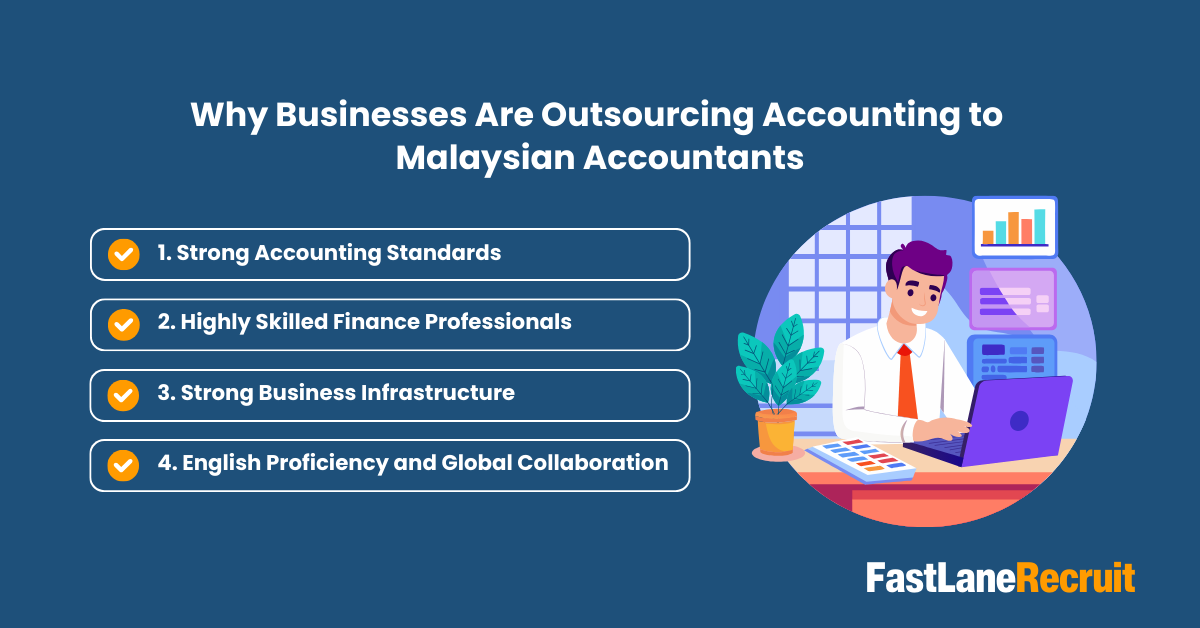
Global outsourcing has expanded significantly in recent years. Alongside traditional outsourcing locations, Malaysia has become an attractive destination for accounting talent.
Businesses often choose outsourced accounting to Malaysian accountants for several reasons.
1. Strong Accounting Standards
Malaysia follows internationally recognized financial frameworks and professional certifications. Professional oversight is provided by organizations such as the Malaysian Institute of Accountants.
2. Highly Skilled Finance Professionals
Malaysia produces thousands of accounting graduates each year, many trained in global accounting standards such as IFRS.
3. Strong Business Infrastructure
The digital economy initiatives led by the Malaysia Digital Economy Corporation have helped strengthen Malaysia’s outsourcing ecosystem.
4. English Proficiency and Global Collaboration
Many Malaysian accountants work with international clients and are familiar with global financial reporting practices.
For companies expanding internationally, outsourcing accounting to Malaysia can provide access to experienced finance professionals while maintaining operational efficiency.
Also Read: Why Malaysia Is a Strategic Hub for Offshore Accountants
Building a Global Accounting Team with FastLaneRecruit
While some businesses prefer to fully outsource their finance function, others want a more hands-on approach, working directly with dedicated accounting professionals. In such cases, hiring remote accountants can be an ideal solution.
FastLaneRecruit specializes in helping companies build and manage a global accounting team through an Employer of Record (EOR) model, providing the best of both worlds: flexibility and control.
Benefits of Hiring Through FastLaneRecruit
1. Hire Talent Without Setting Up a Local Entity
Expanding internationally often requires establishing a legal entity in the country of operation, a process that can be expensive and time-consuming. With FastLaneRecruit’s EOR model, businesses can hire qualified accountants in Malaysia immediately without the need for a local subsidiary.
2. Ensure Compliance with Local Regulations
Employment laws, tax requirements, and labor regulations differ from country to country. FastLaneRecruit manages all compliance matters, ensuring your team adheres to Malaysian employment regulations and avoids costly legal pitfalls.
3. Build a Dedicated Remote Finance Team
Rather than relying on shared outsourced resources, businesses can create a team fully aligned with their internal culture, processes, and objectives. This allows for better integration with your existing operations and more direct control over accounting workflows.
4. Scale Operations as Your Business Grows
Whether your business is a small startup or a mid-sized company expanding internationally, the EOR model makes it easy to add or adjust your accounting team as your needs evolve. You can start with a few key roles and expand to cover full finance operations, including bookkeeping, payroll, tax compliance, and financial planning.
5. Retain Flexibility with Cost Efficiency
This approach combines the cost advantages of outsourcing with the strategic benefits of a dedicated team, giving you access to high-quality talent at competitive rates without the overhead of traditional in-country operations.
Why Choose FastLaneRecruit?
FastLaneRecruit has extensive experience in helping companies build and manage global accounting teams. With their expertise, you can:
- Hire skilled Malaysian accountants quickly
- Minimize administrative and legal burden
- Ensure seamless communication and workflow integration
- Focus on growth while your finance team handles the numbers
Also Read: Accountants Salary Guide 2026
Conclusion
Accounting is the backbone of every successful business. As financial regulations evolve and companies expand globally, managing accounting internally can become increasingly complex.
Outsourced accounting provides a flexible solution by giving businesses access to skilled professionals, structured financial processes, and scalable support.
From bookkeeping and payroll to strategic financial planning, outsourcing allows leaders to focus on what matters most: growing their business.
For companies looking to build a global finance team, outsourced accounting to Malaysian accountants offers an effective way to access skilled talent while maintaining operational efficiency.
If your organization is exploring new ways to strengthen its financial operations, outsourcing or hiring remote accountants through an EOR model may be the next step toward sustainable growth.
Get Started Today
Take the first step toward building a global, flexible, and scalable accounting team. Whether you’re looking to supplement your in-house finance department or establish a fully remote team, FastLaneRecruit provides the expertise, compliance, and infrastructure to make it happen.
📞 Book a FREE consultation or reach out to our team today to learn how FastLaneRecruit can transform your accounting operations and support your international growth goals.