Financial management plays a critical role in every organization. From tracking transactions to managing payroll, taxes, and financial reporting, accounting ensures that businesses operate efficiently and remain compliant with regulations.
As companies grow, many leaders face an important decision: should they hire an in-house accountant or rely on outsourced accounting solutions? Each model offers different advantages depending on the company’s size, operational complexity, and growth stage.
In recent years, accounting outsourcing has become increasingly common as businesses seek access to specialized expertise, flexible cost structures, and scalable finance teams. At the same time, many organizations still prefer maintaining an in-house accounting team for closer operational integration.
This guide compares in house accounting vs outsourcing, including cost structures, expertise access, scalability, and operational efficiency. It also explores how global companies are increasingly building distributed finance teams through international hiring models.
Content Outline
Key Summary
Understand the Two Accounting Models
In-house teams handle daily finances internally, while outsourced providers manage accounting remotely. Each has distinct benefits in control, expertise, and cost.
In-House Accounting: Benefits and Costs
Provides direct oversight, faster collaboration, and operational integration. Costs include salaries, benefits, training, software, and office infrastructure.
Outsourced Accounting: Flexible Expertise
Access CPAs, tax specialists, analysts, or fractional CFOs without full-time hiring. Offers scalable services, advanced technology, and cost efficiency.
Cost Comparison: Fixed vs Flexible Expenses
In-house accounting has fixed payroll and overhead, while outsourcing converts these into flexible, service-based expenses aligned with your growth.
Technology and Efficiency Advantages
Outsourced teams often use cloud-based platforms like QuickBooks or Xero for automation, real-time reporting, and streamlined financial processes.
Global Talent and Remote Teams
Companies can hire skilled accountants internationally, maintaining consistent finance operations across regions while scaling teams efficiently.
Choosing the Right Model or Hybrid Approach
Evaluate transaction volume, budget, expertise needs, and expansion plans. Many businesses combine in-house oversight with outsourced expertise for optimal results.
Understanding the Two Accounting Models
Before deciding which approach is best, it helps to clearly understand how in-house accounting and outsourced accounting work in real business situations. Both models handle the same financial responsibilities, but they differ in who performs the work, how teams are structured, and how businesses access expertise.
What Is an In-House Accountant?
In-house accounting refers to a financial team that is employed directly by your company. These professionals work internally and are responsible for managing the organization’s financial activities on a daily basis.
Typical responsibilities of an in-house accounting team include:
- Bookkeeping and transaction management – recording sales, expenses, and payments
- Payroll processing – calculating employee salaries, taxes, and benefits
- Financial reporting and budgeting – preparing profit-and-loss reports and financial forecasts
- Compliance and tax preparation – ensuring the business follows local tax and financial regulations
Because in-house accountants work closely with other departments such as HR, operations, and management, they gain a deep understanding of the company’s operations, financial goals, and internal processes. This close collaboration can make communication faster and allow financial insights to be shared quickly with leadership teams.
Example: In-House Accounting in a Growing Company
Imagine a mid-sized manufacturing company with 150 employees. The company hires:
- a finance manager
- two accountants
- a payroll specialist
This internal team manages daily bookkeeping, tracks inventory costs, prepares monthly financial reports, and works closely with the operations team to monitor production expenses.
Because the accounting team is fully integrated into the company, they can quickly respond to internal questions such as:
- “How much did raw material costs increase this quarter?”
- “What is the current payroll budget for the new hiring plan?”
Costs to Consider with In-House Accounting
While an internal team offers direct access and control, it also requires ongoing investment. Businesses typically need to cover:
- employee salaries and benefits
- payroll taxes
- accounting software and technology
- training and certifications
- office space and equipment
According to the U.S. Bureau of Labor Statistics, accountants and auditors earn a median annual wage of around $80,000, depending on experience and specialization.
For larger organizations with complex operations, this investment can be worthwhile. However, smaller companies may find it challenging to maintain a full accounting department.
Also Read: Offshore Vs Local: Accountants 2025 Salary Benchmark Report (Australia Vs Malaysia Edition)
What Are Outsourced Accounting Solutions?
Outsourced accounting involves partnering with an external accounting provider or professional firm that manages financial operations on behalf of your business. Instead of hiring full-time employees, the company contracts experts who handle accounting tasks remotely.
Outsourced accounting services may include:
- Bookkeeping and reconciliations – keeping financial records accurate and up to date
- Payroll management – calculating salaries, deductions, and payments
- Tax planning and preparation – preparing tax filings and identifying tax-saving opportunities
- Financial analysis and reporting – generating insights that support decision-making
- Compliance support – ensuring the business meets financial regulations and reporting requirements
Many outsourcing providers also give businesses access to senior finance professionals such as:
- Certified Public Accountants (CPAs)
- financial analysts
- tax specialists
- fractional Chief Financial Officers (CFOs)
This allows companies to access specialized expertise without hiring multiple full-time employees.
Example 1: Outsourced Accounting for a Startup
Consider a technology startup with 20 employees. The founders want to focus on product development and customer growth, but they still need professional financial management.
Instead of hiring an internal accounting team, the startup works with an outsourced accounting firm that provides:
- monthly bookkeeping and financial reports
- payroll services for employees
- tax filing support
- quarterly financial analysis for investors
This arrangement allows the startup to receive professional financial support while keeping operational costs flexible.
Example 2: Outsourced Accounting for Global Businesses
Companies expanding into multiple countries may also use outsourced accounting to manage regional compliance requirements.
For example, a company expanding into Malaysia may need to comply with regulations from authorities such as the Companies Commission of Malaysia and the Inland Revenue Board of Malaysia.
An outsourcing provider with regional expertise can help businesses:
- maintain accurate financial records
- prepare tax filings according to local laws
- manage payroll for international employees
This can simplify operations when entering new markets.
Outsourced vs In-House Accounting: Key Differences
| Decision Factor | In-House Accounting | Outsourced Accounting |
| Cost Structure | Fixed expenses including salaries, benefits, and infrastructure | Flexible service-based pricing |
| Expertise | Limited to internal team’s experience | Access to specialists such as tax experts and financial analysts |
| Scalability | Requires hiring additional staff | Easily scaled depending on workload |
| Technology | Company must purchase and maintain software | Providers often use advanced accounting platforms |
| Operational Risk | Work depends on a few internal staff members | Work distributed across a professional team |
| Focus on Core Business | Leadership may spend time managing finance operations | Business leaders focus on growth and strategy |
Cost Comparison: In-House vs Outsourced Accounting
One of the most important factors businesses consider when deciding between in-house accounting and outsourced accounting is cost. Accounting is a critical function, but maintaining an internal finance department can involve several direct and indirect expenses. Understanding these costs helps business leaders choose a model that aligns with their budget, operational needs, and long-term growth plans.
Also Read: Building a High-Performing Offshore Accounting Team in Malaysia (Singapore Edition)
Typical Costs of In-House Accounting
Building an in-house accounting team means hiring professionals who work exclusively for your organization. While this provides direct access to financial information and internal collaboration, it also comes with ongoing employment and operational costs.
According to wage data from the Bureau of Labor Statistics:
- Bookkeeping and auditing clerks earn around $49,000 annually on average.
- Accountants and auditors typically earn $80,000 or more per year, depending on experience and specialization.
However, salaries represent only part of the overall expense. Businesses must also account for additional operational costs that come with hiring and maintaining an internal team.
Additional Expenses for In-House Accounting
Beyond salaries, companies usually need to budget for:
- Employee benefits and payroll taxes
Health insurance, retirement contributions, bonuses, and employer payroll taxes can significantly increase the total employment cost. - Accounting software and technology
Companies often purchase financial management tools, payroll systems, and reporting platforms. - Office space and infrastructure
Internal teams require workspace, computers, and IT support. - Training and professional development
Accounting professionals must stay updated with evolving tax laws and financial regulations through ongoing training and certifications. - Recruitment and onboarding costs
Hiring qualified accounting professionals can take time and involve recruitment expenses.
Example: Cost of an Internal Accounting Team
Consider a mid-sized company hiring an internal accounting team consisting of:
| Role | Estimated Annual Cost |
| Accountant | $80,000 |
| Bookkeeper | $49,000 |
| Benefits and payroll taxes | $20,000+ |
| Software and tools | $3,000–$5,000 |
| Training and professional development | $2,000+ |
In this simplified example, the total annual accounting cost may exceed $150,000. For many small or growing companies, this level of fixed expense can be difficult to sustain, especially if accounting workloads fluctuate throughout the year.
Also Read: Building a High-Performing Offshore Accounting Team in Malaysia (Hong Kong Edition)
Outsourced Accounting Pricing Models
Outsourced accounting providers typically offer flexible pricing structures, allowing businesses to pay only for the services they need. This flexibility makes outsourcing attractive for organizations that want professional financial support without maintaining a full-time internal team.
Common pricing models include:
| Pricing Model | Typical Use Case |
| Hourly services | Small businesses needing occasional bookkeeping or tax support |
| Monthly retainers | Growing companies requiring consistent accounting services |
| Tiered service packages | Businesses needing advanced financial management, such as CFO-level insights |
Each model allows companies to select the level of support that matches their financial needs and operational complexity.
Example: Outsourced Accounting Cost Structure
A growing startup might outsource its accounting tasks through a monthly service package that includes:
- bookkeeping and reconciliations
- payroll processing
- tax preparation
- monthly financial reports
The company may pay a fixed monthly fee, rather than hiring multiple internal employees. As the business grows, additional services such as financial forecasting or strategic advisory can be added without expanding internal headcount.
Fixed Costs vs Flexible Costs
Outsourced accounting solutions allow businesses to convert fixed payroll expenses into flexible service-based costs, while an in-house accountant typically represents a long-term employment investment.
| Cost Type | In-House Accounting | Outsourced Accounting |
| Cost Structure | Fixed payroll and operational costs | Flexible service-based expenses |
| Hiring Expenses | Recruitment and onboarding required | No internal hiring required |
| Technology Investment | Company purchases software and systems | Often included by provider |
| Scalability | Additional staff needed as workload increases | Services can scale as needed |
With outsourced accounting, companies can convert fixed employment expenses into flexible operational costs, allowing them to adjust financial support based on workload and business growth.
Cost Efficiency for Growing Businesses
For startups, small businesses, and companies expanding internationally, outsourcing accounting can provide several financial advantages:
- Reduced overhead and administrative costs
- Access to specialized accounting expertise
- Flexible service levels based on business needs
- Improved financial efficiency during periods of growth
By reducing the need for permanent internal staff, businesses can allocate more resources toward strategic initiatives such as product development, market expansion, and hiring core talent.
Ultimately, the right accounting model depends on the size of the organization, the complexity of financial operations, and the level of internal oversight required. Understanding the cost structure of both approaches allows business leaders to make informed decisions that support long-term sustainability and growth.
Also Read: Building a High-Performing Offshore Accounting Team in Malaysia (Australia Edition)
Access to Expertise and Specialized Skills
Accounting involves more than recording transactions. Modern businesses often require expertise in areas such as:
- tax compliance
- financial forecasting
- audit preparation
- data analysis
- strategic planning
An in-house team may consist of one or two professionals managing multiple responsibilities. Businesses often turn to outsourced accounting solutions when they require access to tax specialists, financial analysts, or fractional CFO expertise without hiring multiple in-house accountants.
Outsourced providers, however, typically offer teams of specialists including:
- Certified Public Accountants (CPAs)
- financial analysts
- payroll specialists
- tax advisors
This access to broader expertise can be especially valuable for companies navigating complex financial requirements or expanding internationally.
Efficiency and Technology Advantages
Modern accounting relies heavily on digital platforms and automation.
Cloud-based accounting tools such as those developed by Intuit and Xero allow businesses to:
- track financial data in real time
- automate reconciliation and reporting
- integrate with banking and payroll systems
- generate dashboards and financial insights
Outsourced accounting providers frequently leverage these technologies to streamline workflows and improve accuracy.
For internal teams, implementing and maintaining these systems may require additional time and investment.
Control, Communication, and Collaboration
Many companies value the direct visibility and collaboration provided by an internal accounting team.
Benefits of in-house collaboration include:
- real-time communication with other departments
- immediate access to financial data
- stronger alignment with company culture
However, modern outsourcing solutions increasingly provide transparency through:
- shared dashboards and financial reporting
- cloud accounting platforms
- scheduled review meetings
- service-level agreements (SLAs)
These tools help maintain accountability and visibility even when accounting teams operate remotely.
When In-House Accounting Makes Sense
In-house accounting may be the better option when:
- the business is large and has complex financial operations
- daily financial oversight is required
- internal compliance requirements are extensive
- the company has sufficient resources to maintain a full team
Large enterprises often maintain internal finance departments while outsourcing specialized services such as tax advisory or auditing.
When Outsourced Accounting Is the Better Choice
Outsourcing can be especially beneficial for:
Startups and Early-Stage Businesses
Growing companies often prioritize product development and market expansion. Outsourcing accounting allows founders to focus on core operations while ensuring financial management is handled professionally.
Fast-Growing Companies
Businesses experiencing rapid growth may need scalable financial support that can adapt quickly to changing workloads.
Companies Expanding Internationally
Organizations entering new markets must comply with different regulations and tax systems.
For example, companies expanding into Malaysia may need to work with regulatory authorities such as the Companies Commission of Malaysia and the Inland Revenue Board of Malaysia to meet local compliance requirements.
Outsourced providers with regional expertise can help businesses navigate these regulatory frameworks more efficiently.
Also Read: Types Of Accounting Services That Can Be Outsourced
Tips for Choosing the Right Accounting Model
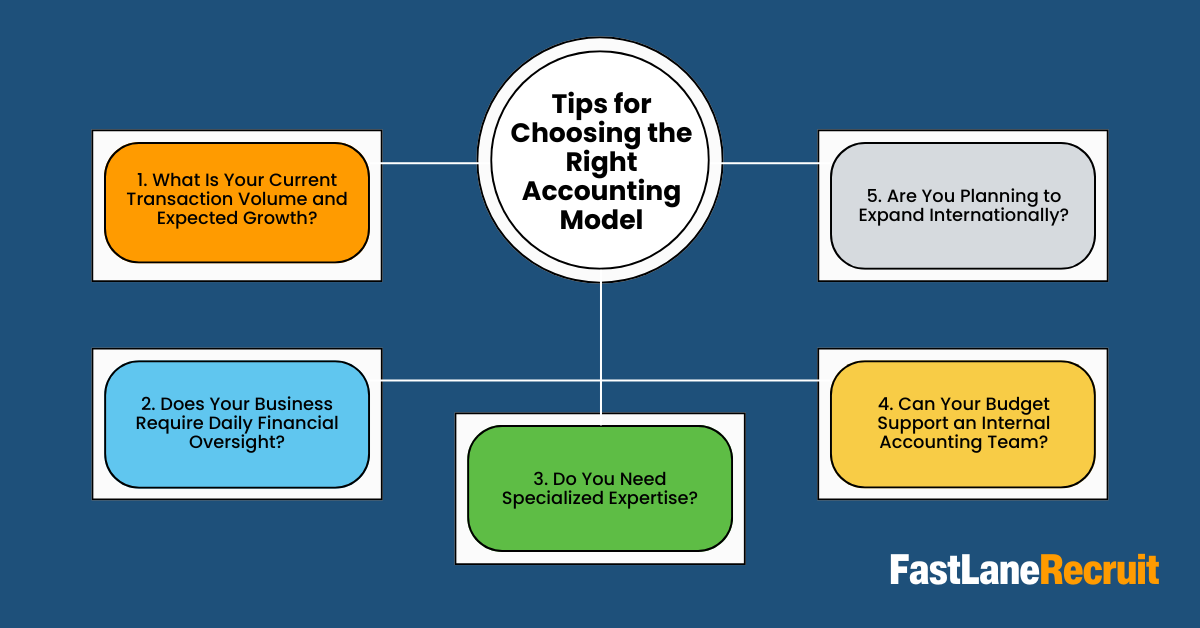
Choosing between in-house accounting and outsourced accounting is an important strategic decision. The right model depends on several factors, including the size of your business, the complexity of your financial operations, and your long-term growth plans.
Before making a decision, business leaders should evaluate their operational needs and financial goals. Asking the right questions can help determine which approach will provide the most value and support sustainable growth.
Below are some key considerations to help guide the decision-making process.
1. What Is Your Current Transaction Volume and Expected Growth?
The number of financial transactions your business processes each month can significantly influence the type of accounting support you need.
For example:
- Small businesses or startups with limited transactions may only need basic bookkeeping and financial reporting. In this case, outsourcing can be a cost-effective way to access professional accounting support without hiring full-time staff.
- Larger companies with thousands of monthly transactions may benefit from a dedicated in-house team that can manage complex financial operations and provide continuous oversight.
It is also important to consider how your transaction volume may change in the future. If your business is experiencing rapid growth, you may need a scalable accounting solution that can expand alongside your operations.
2. Does Your Business Require Daily Financial Oversight?
Some organizations rely heavily on real-time financial monitoring to support operational decisions. In these cases, having an internal accounting team can be beneficial.
An in-house accounting department may be more suitable when:
- departments require frequent financial updates
- managers need daily access to financial data
- close collaboration between finance and operations is necessary
However, many outsourced accounting providers now offer cloud-based dashboards and financial reporting tools that allow business leaders to view financial information in real time. These systems often integrate with accounting platforms developed by companies such as Intuit and Xero, making remote collaboration more efficient.
3. Do You Need Specialized Expertise?
Accounting responsibilities can go beyond routine bookkeeping. Many companies require expertise in areas such as:
- tax planning and compliance
- financial forecasting and modeling
- audit preparation
- international financial regulations
Hiring specialists for each of these areas internally may be costly and difficult, particularly for small or growing businesses.
Outsourced accounting providers often maintain teams of professionals with different areas of expertise, allowing companies to access specialized knowledge when needed. Professional practices typically follow standards supported by organizations such as the International Federation of Accountants, helping ensure consistency and high-quality financial reporting.
4. Can Your Budget Support an Internal Accounting Team?
Budget considerations play a major role in selecting the right accounting model.
Maintaining an internal accounting team requires ongoing expenses such as:
- employee salaries and benefits
- payroll taxes
- accounting software licenses
- training and certification programs
- office space and equipment
For some companies, these fixed costs are manageable and provide long-term stability. However, businesses with limited budgets or fluctuating workloads may benefit from the flexible pricing structure of outsourced accounting services, where companies pay only for the services they require.
Evaluating the full cost of building and maintaining an internal finance team can help determine whether outsourcing may be a more efficient option.
Also Read: How to Hire an Offshore Accountant in Malaysia
5. Are You Planning to Expand Internationally?
Companies that plan to enter new markets must also consider international accounting and compliance requirements. Each country has its own tax regulations, financial reporting standards, and employment laws.
For example, businesses expanding into Malaysia must comply with regulatory authorities such as the Companies Commission of Malaysia and the Inland Revenue Board of Malaysia.
Outsourced accounting providers or global hiring solutions can help businesses navigate these requirements more effectively by offering expertise in regional regulations and financial reporting practices.
Considering a Hybrid Accounting Approach
Many organizations ultimately choose a hybrid accounting model, combining the benefits of both in-house and outsourced accounting.
In a hybrid structure:
- an internal finance manager or small accounting team handles day-to-day financial oversight and internal coordination
- outsourced professionals provide specialized services such as tax advisory, financial analysis, or compliance support
Example of a Hybrid Model
A growing e-commerce company might structure its accounting operations as follows:
- In-house finance manager responsible for budgeting and internal reporting
- Outsourced bookkeeping provider managing daily transactions and reconciliations
- External tax specialists preparing annual tax filings and compliance reports
This approach allows the company to maintain internal financial visibility while benefiting from the expertise and flexibility offered by external professionals.
By carefully evaluating these factors, businesses can choose an accounting model that supports operational efficiency, financial transparency, and long-term growth.
Global Talent and the Rise of Remote Accounting Teams
In recent years, the way companies build finance teams has changed significantly. Advances in cloud technology, secure data platforms, and digital collaboration tools have made it easier than ever for businesses to work with accounting professionals located anywhere in the world. As a result, remote and distributed accounting teams are becoming increasingly common for companies of all sizes.
Instead of relying only on local hiring, businesses can now access qualified finance professionals across multiple regions. This shift allows organizations to strengthen their accounting capabilities while remaining flexible as they grow.
Companies are leveraging global talent to:
- Expand talent pools – Businesses are no longer limited to hiring within their local market. They can access experienced accountants, analysts, and finance specialists worldwide.
- Maintain consistent financial operations across locations – Organizations with offices in multiple countries can build accounting teams that support regional compliance and financial reporting.
- Build scalable finance teams – As a company grows, it can gradually expand its accounting workforce without immediately setting up new offices or subsidiaries.
Cloud-based accounting systems have played a key role in enabling this trend. Platforms developed by companies such as Intuit and Xero allow finance teams to collaborate in real time, access financial dashboards, and manage records securely from anywhere.
Example: A Distributed Finance Team
Imagine a technology company headquartered in the United States that is expanding into Southeast Asia. Instead of hiring all accounting staff locally, the company builds a distributed finance team:
- A finance manager based at headquarters
- Accountants working remotely in Southeast Asia
- A payroll specialist supporting regional employees
Using cloud accounting software, the team collaborates seamlessly to manage financial reporting, payroll, and compliance across multiple markets.
This approach allows the company to build a strong finance function while maintaining operational flexibility.
Also Read: Why Malaysia Is a Strategic Hub for Offshore Accountants
Why Malaysia Is Becoming a Popular Destination for Accounting Talent
Countries such as Malaysia have become attractive locations for finance and accounting professionals. Several factors contribute to this trend:
- Strong professional education systems that produce skilled accounting graduates
- Growing expertise in international accounting standards and compliance
- A workforce experienced in supporting regional and global businesses
Many professionals in Malaysia are trained in globally recognized accounting frameworks supported by organizations such as the International Federation of Accountants. This alignment with international standards helps ensure consistency in financial reporting and compliance practices across borders.
For global companies, hiring accounting professionals in Malaysia can provide access to skilled talent while supporting regional business operations.
Alternative Solution: Hiring Malaysian Accountants Through an Employer of Record
While global hiring offers many advantages, establishing a legal entity in another country can be complex. Businesses expanding internationally must comply with local employment laws, tax regulations, and payroll requirements.
For companies that want to access international talent without setting up a foreign subsidiary, an Employer of Record (EOR) model offers a practical solution.
An EOR acts as the official employer on behalf of the company while the employee works directly with the business’s internal teams. This allows organizations to hire global professionals while ensuring compliance with local regulations.
An EOR provider typically manages:
- Payroll and employment compliance
- Tax administration and statutory contributions
- Employment contracts and documentation
- Local labor law compliance
This model enables companies to build international teams quickly while reducing administrative complexity.
Example: Hiring an Accountant in Malaysia Through an EOR
Consider a growing e-commerce company that wants to expand its financial operations in Southeast Asia. Instead of opening a new legal entity in Malaysia, the company uses an EOR provider to hire a Malaysian accountant.
The accountant becomes part of the company’s finance team and handles tasks such as:
- regional bookkeeping and financial reporting
- coordinating with tax advisors
- managing local payroll records
Meanwhile, the EOR provider manages the employee’s payroll, employment contracts, and compliance with Malaysian regulations such as those overseen by the Inland Revenue Board of Malaysia and the Companies Commission of Malaysia.
This arrangement allows the business to operate efficiently in a new market without the administrative burden of establishing a local entity.
Building Global Finance Teams with FastLaneRecruit
Through FastLaneRecruit’s Recruitment and Employer of Record service, companies can hire experienced Malaysian accountants while maintaining full operational oversight of their finance teams.
This approach offers several advantages:
- Access to Malaysian accountants with regional expertise
- Compliant international hiring aligned with local regulations
- Simplified workforce management without setting up overseas entities
- Scalable finance teams that can grow with the business
For organizations expanding across Asia or building distributed finance teams, EOR solutions provide a flexible alternative to traditional outsourcing models. Businesses can combine the benefits of remote talent, internal collaboration, and regulatory compliance to support long-term growth in global markets.
The Rise of Offshore Accounting Teams
Many global companies are now building distributed accounting teams by hiring finance professionals across multiple regions. This model combines the benefits of outsourced accounting solutions with the operational control of an internal team.
Instead of relying solely on local hiring, businesses can access offshore accountants who support bookkeeping, payroll, financial reporting, and compliance from remote locations. Cloud accounting platforms such as Xero and QuickBooks allow finance teams to collaborate in real time while maintaining secure financial data management.
This hybrid approach enables organizations to scale accounting operations efficiently while maintaining financial transparency and control.
Conclusion
Choosing between outsourced accounting and in-house accounting depends on your company’s size, growth stage, and operational priorities.
In-house accounting offers direct control and deep integration with internal teams, while outsourced accounting provides access to specialized expertise, scalable services, and flexible cost structures.
As global talent networks continue to expand, businesses now have more options than ever to build efficient finance teams. Whether through outsourcing providers or international hiring models like an Employer of Record, organizations can create accounting solutions that support long-term growth and operational efficiency.
If your business is exploring ways to access skilled accounting professionals in Malaysia or build a global finance team, FastLaneRecruit’s EOR service can help you hire compliant, experienced talent without the complexity of establishing a local entity. Contact us for a FREE consultation!