

Front end development outsourcing has become a practical way for companies to improve digital products, expand engineering capacity, and access specialised UI development skills without immediately building a large in-house team. For businesses managing websites, SaaS platforms, ecommerce stores, mobile apps, or customer portals, the frontend experience directly affects usability, conversion, brand trust, and product adoption.
However, outsourcing frontend development is not only about assigning interface work to an external vendor. The right model depends on how much control your company wants, how complex the product is, how often designs change, and whether you need short-term project delivery or a long-term development team.
This guide explains what front end outsourcing means, when it makes sense, what skills to look for, common risks to manage, and how companies can build dedicated frontend teams in Malaysia with recruitment, EOR, payroll, and compliance support from FastLaneRecruit.
Content Outline
What Is Front End Development Outsourcing?
Front end development outsourcing is the process of engaging external developers or a remote development team to build and maintain the user-facing parts of a website, web application, or software product. This includes the layout, interface components, navigation, responsiveness, accessibility, animations, browser compatibility, and integration with backend APIs.
Common frontend technologies include HTML, CSS, JavaScript, TypeScript, React, Angular, Vue.js, Next.js, Tailwind CSS, and design systems connected to tools such as Figma. In many projects, frontend developers also work closely with UX/UI designers, backend engineers, QA testers, product managers, and DevOps teams.
Companies usually outsource frontend development to:
- Build web applications faster
- Access specialised frontend frameworks
- Improve UI quality and responsiveness
- Support internal engineering teams
- Scale development capacity during product growth
- Reduce the hiring pressure on local teams
- Build long-term offshore development capability
For companies that want more control than a traditional agency model, an alternative is to hire dedicated frontend developers through an offshore team structure. FastLaneRecruit helps employers hire Front-end Developers in Malaysia and manage employment through compliant local hiring support.
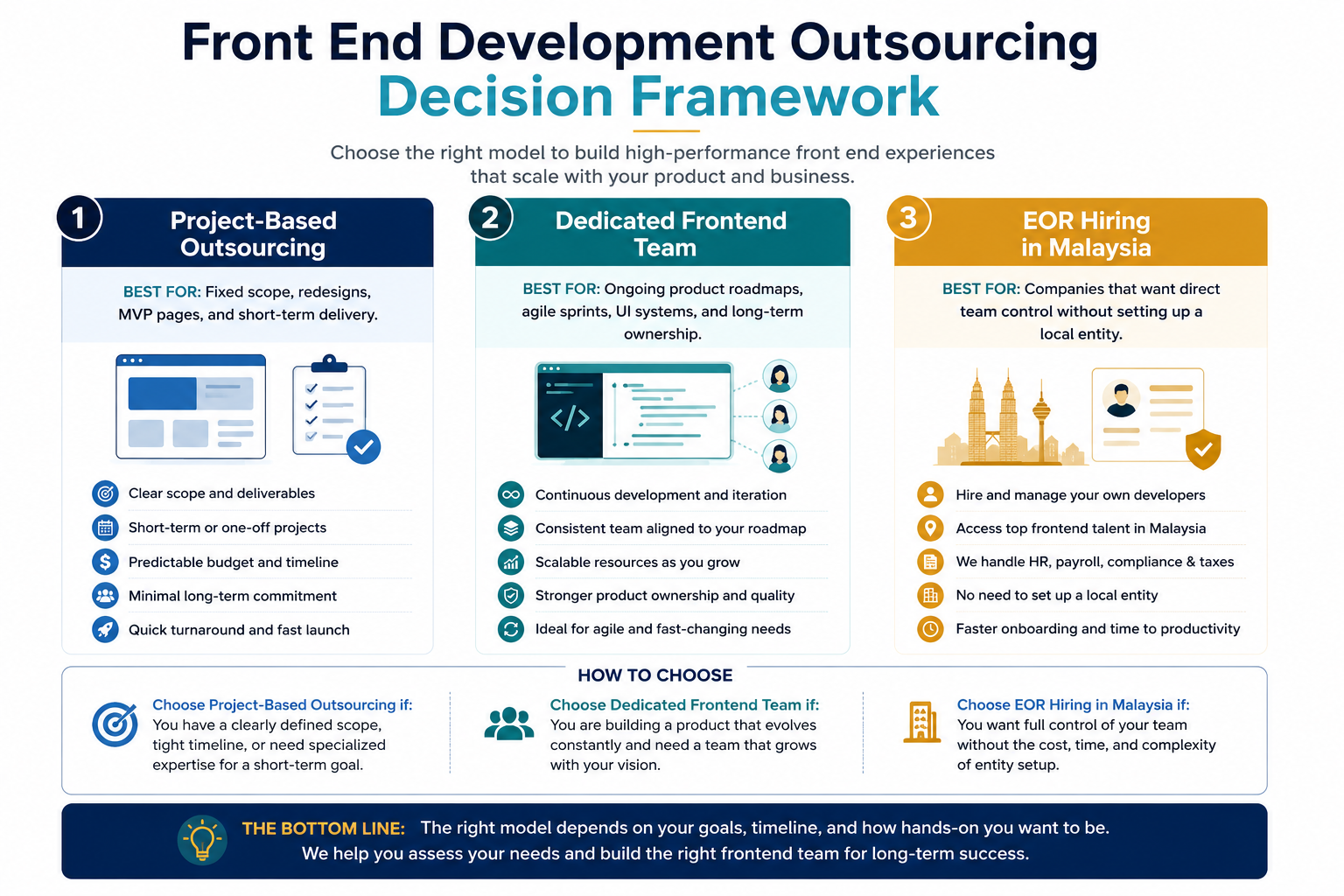
Front End Outsourcing vs Hiring a Dedicated Frontend Team
Not every company needs the same outsourcing model. A startup building an MVP may need project-based delivery, while a SaaS company with an active product roadmap may need dedicated developers who work directly with its internal team.
Project-Based Frontend Outsourcing
Project-based outsourcing works well when the scope is clear, timelines are fixed, and deliverables can be defined upfront. Examples include a landing page build, website redesign, ecommerce frontend refresh, or a one-time web app interface project.
The benefit is speed and simplicity. The limitation is that long-term product ownership, code familiarity, and ongoing iteration may be weaker once the project ends.
Dedicated Frontend Developers
A dedicated frontend team model gives the company more continuity and control. The developers work closely with your internal team, follow your sprint process, and gain deeper knowledge of your product, users, design system, and codebase.
This model is useful for companies with ongoing product development, regular releases, complex UI requirements, or multiple frontend properties to maintain. FastLaneRecruit supports this through offshore IT team building in Malaysia while helping employers manage recruitment, onboarding, payroll, HR administration, and compliance.
Employer of Record for Frontend Hiring
For companies that want to hire Malaysian frontend developers without setting up a Malaysian entity, an Employer of Record in Malaysia can legally employ the talent on behalf of the company. The client manages the day-to-day work, while FastLaneRecruit supports local employment, payroll, statutory contributions, onboarding, and HR compliance.
Why Companies Outsource Frontend Development
Frontend work is highly visible. Users may never see the backend system, but they immediately experience slow pages, poor mobile responsiveness, confusing navigation, inconsistent UI, or broken forms. As digital products become more important to business growth, companies need frontend capability that is both technically strong and commercially aware.
Key Benefits of Front End Development Outsourcing
Access to Specialised Frontend Skills
Modern frontend development is more complex than building static web pages. Developers must understand component architecture, state management, API integration, performance optimisation, accessibility, responsive design, testing, and deployment workflows.
Outsourcing allows companies to access developers with specific experience in frameworks such as React, Angular, Vue, or Next.js. It can also help companies hire for adjacent roles such as Software Developer, Web Developer, UX/UI Designer, QA Tester, or Full Stack Developer depending on the project scope.
Faster Product Delivery
When internal teams are already stretched, frontend outsourcing can help move product work forward without delaying existing roadmaps. A dedicated frontend developer or team can support backlog delivery, UI enhancements, design system implementation, page speed improvements, feature releases, and cross-browser fixes.
This is especially useful for companies with seasonal campaigns, investor deadlines, product launches, or enterprise client commitments.
More Flexible Team Scaling
Hiring locally can take time, especially when frontend skills are in high demand. Outsourcing gives companies more flexibility to scale development capacity up or down based on product priorities.
Companies planning long-term hiring budgets should also review front-end developer salary in Malaysia before finalising compensation ranges.
For longer-term needs, companies can build a remote frontend team in Malaysia and expand gradually as product demand grows. FastLaneRecruit helps employers hire employees in Malaysia while supporting compliant employment and workforce administration.
Better Focus for Internal Teams
When frontend delivery is supported by an external or offshore team, internal engineers can focus on architecture, product strategy, backend systems, security, integrations, and stakeholder management. The key is to define responsibilities clearly so the outsourced team does not operate in isolation.
Access to Malaysia-Based Tech Talent
Malaysia is increasingly attractive for regional and global companies hiring remote technology professionals. Employers value Malaysia for English proficiency, multilingual talent, regional business familiarity, compatible time zones, and a growing pool of digital and software professionals.
For companies in Singapore, Hong Kong, Australia, and other global markets, Malaysia can be a practical location to build a dedicated frontend or wider software development team. FastLaneRecruit helps companies build software development teams in Malaysia through recruitment and employment support.
What Frontend Work Can Be Outsourced?
Companies can outsource a wide range of frontend development tasks depending on product maturity and internal capability.
Common frontend outsourcing tasks include:
- Website development and redesign
- SaaS dashboard development
- Ecommerce frontend development
- Mobile-responsive web interfaces
- React, Angular, Vue, and Next.js development
- API integration with backend systems
- Design system and component library implementation
- Landing pages and campaign pages
- UI performance optimisation
- Accessibility improvements
- Cross-browser and mobile testing
- Frontend maintenance and bug fixes
- Migration from legacy frontend frameworks
- Frontend QA and regression testing
For more complex projects, frontend developers may need to work alongside backend developers, QA testers, cloud engineers, data specialists, and product managers. In these cases, companies should consider whether they need one developer, a blended development team, or a full offshore technology function.
How to Choose an Outsourcing Frontend Development Company
Choosing an outsourcing frontend development company should not be based only on portfolio design. A good-looking interface is important, but employers should also evaluate engineering quality, communication, process maturity, code maintainability, and ability to work with internal teams.
1. Define the Scope Clearly
Before engaging a provider, clarify whether the work is project-based, ongoing, or team-based. Define the product goals, required technologies, design inputs, API dependencies, performance requirements, expected timeline, and ownership of code.
A clear scope reduces misalignment and helps determine whether you need a vendor, freelancer, or dedicated frontend developer.
2. Review Technical Capability
Look for experience in the frontend framework your product uses. If your application is built in React, hiring a general web developer may not be enough. For enterprise or SaaS applications, assess skills in TypeScript, component architecture, testing, accessibility, state management, performance optimisation, and CI/CD workflows.
3. Assess Communication and Collaboration
Frontend developers often work closely with designers, backend engineers, marketers, and product teams. Strong communication is important because frontend work involves visual judgement, user experience trade-offs, and frequent iteration.
A good outsourcing setup should include clear sprint planning, progress updates, documentation, code reviews, and issue tracking.
4. Check Code Quality and Maintainability
Frontend code should be clean, reusable, documented where needed, and aligned with your internal standards. Poor frontend code can create long-term problems, including slow pages, inconsistent UI, difficult debugging, and expensive rebuilds.
Ask how the provider handles pull requests, testing, linting, design system consistency, browser testing, and handover documentation.
5. Confirm Security, IP, and Access Controls
Frontend developers may need access to repositories, APIs, analytics tools, staging environments, CMS platforms, or customer-facing systems. Employers should define access permissions, security controls, confidentiality terms, and intellectual property ownership before work begins.
6. Consider Employment and Compliance
If you are hiring dedicated frontend developers in another country, compliance matters. Employment contracts, payroll, statutory contributions, benefits, leave, onboarding, and offboarding should be managed correctly. FastLaneRecruit’s payroll services in Malaysia and EOR support help companies manage Malaysia-based employees with the right local processes.
Common Risks in Front End Outsourcing
Frontend outsourcing can be effective, but only when the operating model is managed properly. Common risks include unclear requirements, weak design handoff, inconsistent coding standards, timezone delays, lack of product context, poor QA, and limited accountability after launch.
Another common issue is choosing a vendor for short-term speed when the business actually needs long-term product ownership. If your frontend roadmap is continuous, a dedicated team may be more effective than repeatedly outsourcing isolated projects.
Companies should reduce risk by setting clear acceptance criteria, maintaining code review processes, using shared project management tools, defining response times, and ensuring the outsourced team understands the product, users, and business goals.
Why Malaysia Is a Strong Location for Frontend Development Teams
Malaysia offers a practical combination of technical capability, language proficiency, regional familiarity, and business-friendly time zone alignment. For companies in Asia-Pacific markets, Malaysia-based frontend developers can collaborate in similar working hours with Singapore, Hong Kong, and Australia.
Employers also benefit from access to professionals across software development, web development, QA, digital marketing, operations, and project coordination. This makes Malaysia suitable not only for single-role hiring, but also for building wider offshore teams around product and technology functions.
FastLaneRecruit supports companies that want to hire remote employees in Malaysia while keeping control of day-to-day work and product direction.
How FastLaneRecruit Supports Frontend Development Outsourcing
FastLaneRecruit is not a BPO provider and does not run outsourced software operations on behalf of clients. Instead, FastLaneRecruit helps global companies recruit, employ, onboard, and manage Malaysia-based talent legally and efficiently.
For frontend development teams, FastLaneRecruit can support:
- Recruitment of frontend developers and related technology roles
- Candidate sourcing and screening
- Employment through EOR where required
- Payroll administration and statutory compliance
- Onboarding and HR documentation
- Leave, benefits, and monthly employment administration
- Long-term offshore team building support
This model gives employers direct control over the developer’s daily work, priorities, sprint participation, and product standards, while FastLaneRecruit manages the Malaysia employment and compliance layer.
When Should You Outsource Frontend Development?
Frontend outsourcing may be suitable when your company needs to move faster, lacks specific frontend skills internally, wants to reduce hiring delays, or needs additional capacity for product delivery.
It may be especially useful if:
- Your internal developers are overloaded
- Your website or app needs a UI refresh
- You need React, Angular, Vue, or Next.js skills
- You are launching a new product or platform
- You need ongoing frontend maintenance
- You want to build a remote software team in Malaysia
- You want to hire without setting up a Malaysian entity
If the work is strategic and ongoing, consider building a dedicated frontend team instead of treating frontend development as a one-off outsourced task.
Conclusion
Front end development outsourcing can help companies improve product delivery, access specialised technical skills, and scale development capacity more efficiently. The best approach depends on whether your business needs a fixed project vendor, a dedicated frontend developer, or a long-term offshore team.
For companies that want more control, continuity, and compliance support, Malaysia offers a strong talent market for frontend and wider software development roles. FastLaneRecruit helps employers recruit, employ, onboard, and manage Malaysia-based frontend developers through recruitment, EOR, payroll, and HR compliance support.
Speak with FastLaneRecruit to explore how to build your Malaysia-based frontend development team with the right recruitment and employment structure.
FAQs
What is front end development outsourcing?
Front end development outsourcing means engaging external developers or remote teams to build and maintain the user-facing parts of a website, web application, or software product.
What is the difference between frontend outsourcing and hiring a dedicated frontend developer?
Frontend outsourcing is often project-based, while hiring a dedicated frontend developer gives the company more control, continuity, and long-term product knowledge.
What skills should outsourced frontend developers have?
Important skills include HTML, CSS, JavaScript, TypeScript, React, Angular, Vue, Next.js, responsive design, accessibility, API integration, testing, and performance optimisation.
Can I hire frontend developers in Malaysia without setting up a company?
Yes. Companies can use an Employer of Record to legally employ Malaysia-based frontend developers without establishing a local entity.
Is Malaysia a good location for frontend development outsourcing?
Malaysia is a strong option for companies seeking English-speaking, regionally aligned technology talent in a compatible time zone for Singapore, Hong Kong, Australia, and wider APAC markets.