For global companies expanding or building remote development teams in Malaysia
When global companies hire front-end developers in Malaysia, they tap into a strong, English-proficient, cost-efficient talent pool. But behind the attractive cost lies a maze of payroll and employment compliance obligations. Misstep on statutory contributions, tax remittances, or employment contracts, and you risk penalties, back payments, or reputational damage.
This guide is designed specifically for non-Malaysian employers (startups, tech firms, agencies) who want to onboard Malaysian developers compliantly. You’ll get:
- A practical payroll setup checklist
- Key Malaysian legislation you must follow
- Statutory contributions, caps, and examples
- Common pitfalls to avoid
- Tips based on outsourcing experience
- FastLaneRecruit’s EOR service simplifies everything
By the end, you’ll be equipped with the knowledge to scope your total employer cost, understand what you must remit locally, and decide whether to handle payroll in-house or via an EOR partner.
Content Outline
Key Summary
Understand Malaysia’s Payroll Framework
Employers must comply with local laws like the Employment Act, EPF, SOCSO, and PCB to ensure accurate and lawful payroll processing.
Choose the Right Hiring Model
Decide between direct employment, contractor, or Employer of Record (EOR) with EOR being the most compliant and cost-efficient for foreign companies.
Register with Relevant Authorities
Employers with a local entity must register with KWSP, PERKESO, LHDN, and HRD Corp before processing payroll.
Know the Statutory Contributions
Understand the required deductions for EPF, SOCSO, EIS, PCB, and HRD levy — including new EPF rules for foreign employees effective October 2025.
Avoid Common Compliance Mistakes
Stay updated with contribution rate changes, avoid late remittances, and ensure correct employee classification to prevent costly penalties.
Plan for Total Employment Costs
Factor in 10–20% above gross salary to cover statutory contributions and levies when budgeting for Malaysian hires.
Maintain Accurate Records
Keep payroll, remittance, and contract records for at least seven years to meet Malaysian audit and reporting standards.
Use an EOR for Simplified Hiring
FastLaneRecruit’s EOR service handles payroll setup, tax filings, and compliance, allowing global employers to focus on scaling their teams.
Payroll Setup Checklist for Global Employers
Setting up payroll in Malaysia isn’t just about paying salaries; it’s about ensuring full compliance with local tax, social security, and labor regulations. For global companies hiring Malaysian front-end developers, the process can seem daunting, especially if you don’t have a local entity. Below, we break down the key steps to follow.
Also Read: Top Professional SEO Services in the US
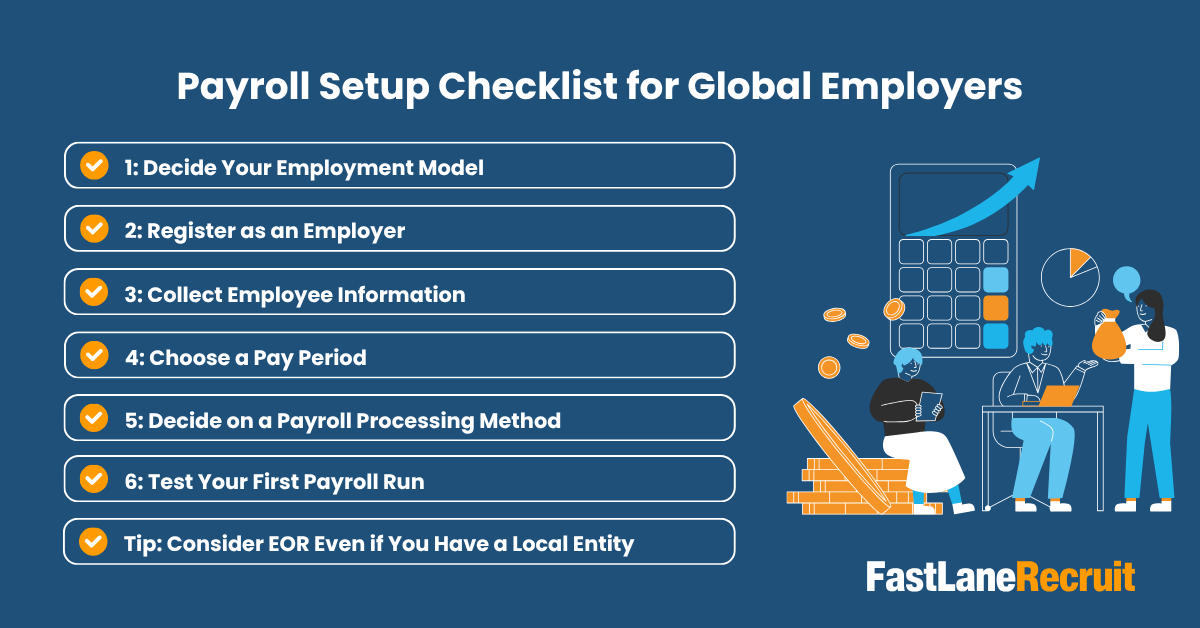
Step 1: Decide Your Employment Model
Before hiring your first developer, determine how you’ll employ them; this decision affects everything from compliance obligations to cost management.
| Model | Description | Example |
| Direct Employment (Local Contract) | You hire the developer as a full-time employee under your Malaysian legal entity. You must register with EPF, SOCSO, and LHDN. | A U.S. software company with a Malaysian subsidiary hires 3 front-end developers as local employees. |
| Contractor / Freelancer | The developer works independently and invoices you. You’re not responsible for their statutory contributions — but misclassification risks exist. | A design agency pays a Malaysian developer per project without fixed hours or supervision. |
| Employer of Record (EOR) / PEO | A local EOR (like FastLaneRecruit) becomes the legal employer and handles payroll, tax, and compliance. You manage the developer’s tasks directly. | A Singapore tech startup hires 5 Malaysian front-end developers via FastLaneRecruit’s EOR service, avoiding entity setup and compliance risks. |
Tip: For most non-Malaysian employers, using an EOR is the fastest and most compliant route to hire Malaysian developers, no need to open a local company or navigate registration paperwork.
Step 2: Register as an Employer
If you’re hiring directly under a Malaysian entity, you must register with multiple government agencies before you can legally pay salaries or remit contributions.
| Authority | Purpose |
| KWSP (EPF) | Manages retirement savings for employees. Employer must contribute 12–13%. |
| PERKESO (SOCSO & EIS) | Provides social protection and unemployment insurance. |
| LHDN (Inland Revenue Board) | Handles income tax deductions (PCB/MTD). |
| HRD Corp (Human Resource Development) | Manages skills development levy for qualifying employers. |
Example:
A UK-based SaaS company opening a Malaysian branch must register for all four systems before running payroll. Missing any of these will result in penalties or inability to remit statutory payments.
Tip: EOR providers like FastLaneRecruit handle all registrations on your behalf, ensuring zero setup delays.
Step 3: Collect Employee Information
Accurate employee data ensures correct payroll calculation and compliance with statutory filings. For each new hire, you’ll need:
- NRIC or Passport Number – for identity and tax purposes
- Bank Account Details – for salary transfers
- Tax Status – determine if the employee is a tax resident or non-resident (which affects PCB rates)
- EPF Nomination Form (Form KWSP 3) – required for EPF registration
- Work Pass / Employment Pass – if hiring foreign nationals
Example:
A non-resident developer hired on a 6-month project may have a 30% flat PCB tax rate, unlike residents taxed progressively. Proper classification prevents underpayment of taxes.
Resource: Inland Revenue Board of Malaysia – Tax Residency Guidelines
Step 4: Choose a Pay Period
In Malaysia, salaries are generally paid monthly. Employers typically fix a payday between the 25th and the last day of the month, with contributions and deductions due shortly after.
| Statutory Item | Payment Due Date |
| EPF (KWSP) | By the 15th of the following month |
| SOCSO / EIS | By the 15th of the following month |
| PCB (MTD) | By the 15th of the following month |
| HRD Levy (if applicable) | By the 15th of the following month |
Example:
If you pay your developers on October 31, all statutory contributions must be submitted by November 15. Late payments can incur fines or interest under respective Acts.
Tip: Automate this process using payroll software or your EOR’s integrated system to avoid missed deadlines.
Also Read: How to Successfully Outsource Data Engineering
Step 5: Decide on a Payroll Processing Method
Managing payroll manually can be error-prone, especially when dealing with multiple contributions and frequent updates in laws. Choose between:
- In-house Payroll Software:
Ideal if you already have a registered Malaysian entity and HR team.- Example tools: Talenox, Info-Tech, Swingvy, Kakitangan.com
- Pros: Greater control, local data storage
- Cons: You must stay updated with legal changes
- EOR / Outsourced Payroll Partner:
Perfect for global firms without local registration. The EOR acts as your compliance partner and handles every payroll element.- Example: FastLaneRecruit’s EOR solution manages EPF, SOCSO, EIS, and PCB filings seamlessly.
- Pros: Fast onboarding, zero setup cost, fully compliant
- Cons: Slightly higher monthly service fee (offset by reduced risk)
Step 6: Test Your First Payroll Run
Before rolling out full payments, conduct a pilot payroll run. This helps validate your calculations and ensures compliance.
- Simulate deductions: Verify EPF (11% employee, 12–13% employer), SOCSO, EIS, PCB, and HRD levy.
- Check payslip formats: Must include statutory deductions, allowances, and employer details.
- Confirm remittance files: Ensure file formats align with KWSP, PERKESO, and LHDN online submission portals.
Example:
A global company miscalculates EPF at 10% instead of 11% for six months — leading to back payments, penalties, and compliance audits. Testing your first run prevents such issues.
Tip: Retain digital payslips for at least seven years to meet audit and labor law record-keeping requirements.
Expert Tip: Consider EOR Even if You Have a Local Entity
Even established multinationals in Malaysia use EOR or outsourced payroll partners to minimize administrative risk.
For instance, a U.S. game studio with a Malaysian branch outsourced its payroll to an EOR during a merger, ensuring smooth continuity, accurate remittances, and zero disruption to developer salaries.
Why this matters:
- Malaysia updates contribution tables annually.
- Late remittance penalties can reach RM10,000+ per offense.
- Errors can affect your employer reputation with LHDN and KWSP.
Partnering with an experienced EOR like FastLaneRecruit keeps your payroll compliant, accurate, and stress-free allowing you to focus on scaling your Malaysian developer team.
Also Read: Data Engineering Salary Guide 2025
Key Legislation & Legal Obligations in Malaysia
When hiring Malaysian front-end developers, global employers must comply with local employment and payroll laws. Malaysia’s labor framework ensures fair employee treatment, transparent wages, and consistent contributions to social and tax systems. Understanding these legal pillars helps avoid compliance risks and costly penalties.
Below is a breakdown of the main Acts and obligations every employer, whether direct or via an EOR, should know.
Employment Act 1955 (Peninsular Malaysia)
The Employment Act 1955 is Malaysia’s cornerstone labor law, governing employee rights, minimum employment standards, and working conditions. It covers areas like wages, working hours, rest days, termination, and paid leave.
| Key Area | What It Covers | Example |
| Working Hours | Maximum of 45 hours per week (effective Jan 2023 amendment). | Developers can work up to 9 hours per day, 5 days a week. |
| Overtime | Pay is 1.5x normal hourly rate for hours beyond 45 per week. | A developer earning RM4,000/month receives RM34/hour; overtime = RM51/hour. |
| Annual Leave | Minimum 8–16 days depending on years of service. | A developer with 3 years’ tenure gets 12 days per year. |
| Public Holidays | At least 11 gazetted holidays, including Malaysia Day. | Employers must pay 2x wages if employees work on a public holiday. |
| Termination Notice | Between 4–8 weeks depending on length of service. | A developer with 2 years’ service must receive 4 weeks’ notice. |
Applicability:
Historically, employees earning more than RM4,000/month were partially excluded from certain protections (e.g., overtime, rest day pay). However, the 2023 amendments expanded protection to more workers, including many developers in mid-range salary brackets.
Note: Sabah and Sarawak follow their own labour ordinances, the Labour Ordinance (Sabah Cap. 67) and Labour Ordinance (Sarawak Cap. 76), which have similar but distinct provisions.
Resource:
Ministry of Human Resources Malaysia – Department of Labour
Employees Provident Fund (EPF) Act 1991
The EPF Act 1991 governs Malaysia’s mandatory retirement savings scheme, administered by KWSP (Kumpulan Wang Simpanan Pekerja). Both employer and employee must contribute monthly, based on the employee’s wages.
| Category | Employee Rate | Employer Rate | Due Date |
| Age below 60 | 11% | 12% (13% if wages < RM5,000) | 15th of following month |
| Age 60 and above | 0% (optional) | 4% | 15th of following month |
Example:
A Malaysian front-end developer earning RM6,000 contributes RM660 (11%), while the employer contributes RM720 (12%). Total EPF contribution = RM1,380 per month.
Compliance Tip:
All employers must remit EPF contributions through the i-Akaun (Employer) portal by the 15th of the following month. Late submissions may attract dividends lost and fines up to RM10,000.
Resource:
KWSP – Employer Guidelines
Social Security Act 1969 (SOCSO) & Employment Insurance System (EIS)
The Social Security Organisation (PERKESO) enforces two major protections for Malaysian workers:
- SOCSO (Employment Injury Scheme & Invalidity Scheme)
- Provides medical benefits, disability coverage, and dependents’ pensions for work-related injuries or illnesses.
- Mandatory for all employees, local or foreign.
- EIS (Employment Insurance System)
- Offers income support and job-search assistance for workers who lose employment involuntarily.
- Applies only to Malaysian citizens and permanent residents.
| Type | Employee Contribution | Employer Contribution | Total |
| SOCSO | 0.5% | 1.75% | 2.25% |
| EIS | 0.2% | 0.2% | 0.4% |
Example:
A developer earning RM6,000 contributes RM30 to SOCSO and RM12 to EIS, while the employer contributes RM105 and RM12 respectively.
Resource:
PERKESO Contribution Tables
PSMB Act 2001 (Human Resource Development – HRD Corp Levy)
The Human Resources Development Corporation (HRD Corp) manages a levy system for skill development under the PSMB Act 2001. This fund supports employee training and reskilling initiatives.
| Company Size | Levy Rate | Notes |
| 10+ Malaysian employees | 1% of monthly wages | Mandatory |
| 5–9 Malaysian employees | 0.5% (optional) | Optional registration |
| <5 employees | Exempt | – |
Example:
A company with 15 Malaysian front-end developers each earning RM6,000 pays:
1% × (RM6,000 × 15) = RM900/month to HRD Corp.
Tip: Employers can later claim training costs (e.g., Xero certification, web accessibility courses) from the HRD levy account.
Resource:
HRD Corp Employer Portal
Also Read: Hiring Data Engineer in Malaysia
Tax Obligations: PCB / MTD (Potongan Cukai Bulanan)
All employers in Malaysia must withhold and remit monthly income tax deductions, known as Potongan Cukai Bulanan (PCB) or Monthly Tax Deduction (MTD), to LHDN (Inland Revenue Board).
| Item | Description |
| Deduction Basis | Progressive, based on resident status, marital status, and allowances. |
| Submission Deadline | 15th of the following month. |
| Tools | e-PCB / e-Data PCB / Payroll software integration. |
| Penalty for Late Payment | Up to RM200 fine per employee, plus interest. |
Example:
A resident developer earning RM6,000/month with no dependents may have a PCB deduction of around RM200–RM250 monthly. Employers must submit this to LHDN by the 15th of the next month.
Resource:
LHDN – PCB Schedule & Calculator
New EPF Rule for Foreign Employees (Effective October 1, 2025)
Starting October 1, 2025, all non-Malaysian employees with valid work passes will be subject to mandatory EPF contributions, a significant update for global employers.
| Category | Employee Rate | Employer Rate | Notes |
| Foreign employees (non-Malaysians) | 2% | 2% | Unless formally exempted under specific bilateral agreements |
Example:
A Filipino front-end developer earning RM8,000 will contribute RM160 (2%), matched by the employer’s RM160.
This new rule ensures foreign workers also build retirement savings in Malaysia.
EEAT Note:
The EPF Board’s official circular (2025) highlights that this amendment aims to promote financial security and equality among all workers, regardless of nationality.
Planning Tip for Global Employers:
If you currently hire foreign developers, update your budget forecasts and payroll software settings ahead of October 2025 to include these contributions.
Employer Record-Keeping and Reporting Obligations
Employers must maintain transparent and auditable records under Malaysian law.
| Requirement | Duration | Responsible Party |
| Payroll records, payslips, EPF/SOCSO receipts | 7 years | Employer |
| Employee contracts and termination letters | At least 3 years after separation | Employer |
| Annual EA Form (for employee income reporting) | Submit to employees by 28 Feb | Employer |
Example:
A company undergoing an LHDN audit in 2027 must produce payroll records dating back to 2020. Digital archiving through secure cloud payroll systems is strongly recommended.
Tips for Employers
Malaysia’s payroll laws are well-structured but detail-heavy. Each Act interlinks with others — for instance, EPF, SOCSO, and PCB all rely on accurate salary reporting. Non-compliance can result in:
- Financial penalties (RM200–10,000 per breach)
- Delayed statutory filings
- Reputational risks with Malaysian authorities
Using an EOR like FastLaneRecruit can help global companies stay compliant by managing registration, monthly submissions, and reporting under all these Acts, ensuring your focus remains on your business growth, not paperwork.
Statutory Contributions & Deductions — What You Must Remit
Here’s a summary of the core statutorily required remittances in Malaysia for typical employees (Malaysian citizens or permanent residents, under 60 years old):
| Statutory Item | Employee Deduction | Employer Contribution | Notes & Caps |
| EPF (KWSP) | 11% of monthly wages (for most employees) | 13% (if salary ≤ RM5,000) else 12% for salary > RM5,000 | Must refer to Third Schedule under EPF Act. |
| SOCSO (PERKESO) | 0.5% | ~1.75% (employer portion) | Capped contributions for wages above RM6,000. |
| EIS (Employment Insurance System) | 0.2% | 0.2% | Total 0.4%. Cap may apply (e.g. limit RM11.90). |
| PCB / MTD (Tax) | Deducted from employee salary | — | Remit to LHDN by 15th of following month |
| HRD Levy | — | 1% (if ≥10 employees) or 0.5% (5–9 employees) | Applies only if your company is within industries covered and meets employee thresholds |
Note for foreign employees: From Oct 2025, EPF contributions will apply at a reduced fixed 2% (employer + employee) for non-Malaysians unless exempted.
Also, in cases of late remittance penalties or interest may apply under various Acts.
Example Cost Breakdown for a Front-end Developer
Below is a rough illustrative cost breakdown for a Malaysian front-end developer, to help global teams budget. Replace the gross salary and check live rates via official calculators (KWSP, PERKESO, LHDN).
Scenario assumptions:
- Employee: Malaysian under 60
- Gross monthly salary: RM 8,000
- EPF employer rate: 13% (salary ≤ RM5,000 would also get 13%, but for higher salary employer side is 12%)
- SOCSO (employer): 1.75% of wage, but subject to cap (≈ RM104.15 for RM6,000)
- EIS (employer): 0.2% capped at RM11.90 for wages ≥ RM6,000
- PCB: estimate based on progressive tax (varies per employee)
- HRD levy (if applies): 1% of monthly wage (if your company has ≥10 Malaysian employees)
| Component | Amount (RM) | Notes |
| Gross salary | 8,000 | Base salary |
| Employer EPF (12%) | 960 | 12% of 8,000 (confirm exact employer rate with KWSP) |
| Employer SOCSO (capped) | 104.15 | SOCSO employer capped for wages > RM6,000 (use PERKESO table) |
| Employer EIS (capped) | 11.90 | EIS employer capped for wages > RM6,000 |
| HRD levy (1%) | 80.00 | If company meets threshold (1% × 8,000) |
| Total employer cost | 9,156.05 | Gross + EPF(employer) + SOCSO(employer) + EIS(employer) + HRD |
On the employee side:
- Employee EPF (11%): RM 880.00 (11% × 8,000)
- Employee SOCSO (capped): RM 29.75 (employee cap for > RM6,000)
- Employee EIS (capped): RM 11.90 (employee cap for > RM6,000)
- PCB: depends on individual reliefs — calculate per LHDN rules.
- Net take-home (before PCB) = Gross − (EPF employee + SOCSO employee + EIS employee) = RM 7,078.35
Net take-home = Gross – (Employee EPF + SOCSO + EIS + PCB)
This exercise highlights that total employer cost can be 10–20%+ above gross salary, depending on contributions, benefits, and company size.
Common Payroll & Compliance Mistakes (and How to Avoid Them)
Hiring Malaysian front-end developers offers great talent and cost efficiency but payroll and compliance errors can be costly if overlooked. Many global employers, especially those new to Malaysian regulations, encounter similar pitfalls. Below are the most common mistakes and how to prevent them.
Also Read: Data Engineer Hiring Guide
Ignoring Evolving Rules for Foreign Employees
What happens:
Malaysia is tightening its inclusion of foreign employees in the statutory framework. From October 1, 2025, all non-Malaysian employees holding valid work passes will be mandatorily covered under the EPF at a 2% employer + 2% employee rate.
Why it matters:
Failing to plan for this change may lead to retroactive liabilities — meaning employers could be forced to pay arrears for months of missed contributions.
Example:
A Singapore-based tech firm employing 10 Filipino developers in Malaysia fails to apply the 2% EPF contribution in 2025. In early 2026, the company faces RM19,200 in back payments (RM160 × 10 developers × 12 months) plus fines.
How to avoid it:
- Stay updated via official KWSP circulars and FastLaneRecruit compliance alerts.
- Adjust your payroll system and employment contracts before October 2025 to reflect the 2% contribution.
- Budget an additional 4% of gross salary (2% employer + 2% employee) for affected hires.
Using Outdated Contribution Rates or Caps
What happens:
Malaysia updates its contribution rates, wage ceilings, and levy thresholds every few years. Employers using outdated rates risk under- or over-contribution, both of which may trigger audits or penalties.
| Statutory Item | Updated in | Common Oversight |
| SOCSO wage ceiling | 2023 | Many still use the old RM4,000 cap (now RM5,000). |
| EPF contribution rates | 2022 | Temporary pandemic reduction to 9% expired. |
| HRD levy applicability | 2021 | Lower threshold extended to 10+ employees. |
Example:
A U.S. employer continues using the old SOCSO ceiling of RM4,000 while paying developers RM6,000, leading to underpayment of RM45/month per employee.
How to avoid it:
- Cross-check official websites (EPF, PERKESO, HRD Corp) before every new fiscal year.
- Automate compliance updates via a cloud payroll system or EOR partner that syncs with the latest rates.
According to KPMG Malaysia’s payroll advisory (2024), 35% of payroll errors among SMEs stem from outdated contribution tables.
Overlooking Statutory Filings & Deadlines
What happens:
Malaysia’s statutory deadlines are strict, usually the 15th of the following month for EPF, SOCSO, EIS, and PCB remittances. Missing them can trigger fines, interest, and reputational damage.
| Contribution | Deadline | Late Penalty |
| EPF | 15th of following month | Dividend loss + fine up to RM10,000 |
| SOCSO / EIS | 15th of following month | RM500–RM4,000 per employee |
| PCB (Tax) | 15th of following month | RM200 fine + interest per month |
Example:
A payroll manager on leave delays EPF submission by one week, resulting in a RM2,000 fine for five employees.
How to avoid it:
- Use automated payroll calendars and recurring reminders.
- Assign backup approvers for payroll submission during leave periods.
- Engage an EOR like FastLaneRecruit, which handles all submissions on your behalf.
Misclassifying Employees (Contractor vs. Employee)
What happens:
Some companies label Malaysian workers as “independent contractors” to avoid payroll taxes and statutory contributions. However, under Malaysian law, classification depends on the nature of the working relationship, not the contract title.
| Classification Test | Description |
| Control Test | Does the employer direct work schedules and methods? |
| Integration Test | Is the person part of the company’s day-to-day operations? |
| Economic Dependence Test | Does the person rely mainly on one company for income? |
Example:
A U.S. software company pays a Malaysian front-end developer monthly, assigns fixed working hours, and provides equipment, effectively making them an employee, not a contractor. LHDN later reclassifies the worker, resulting in retroactive PCB and EPF liabilities.
How to avoid it:
- If you manage the developer’s daily work, treat them as an employee under an EOR or local entity.
- Keep written contracts that clearly define employment terms.
- Consult with payroll specialists before onboarding new hires.
Also Read: Why Should You Hire Data Engineers in Malaysia?
Poor Record-Keeping and Documentation
What happens:
Failing to maintain accurate records can create serious problems during audits or inspections by LHDN, KWSP, or the Department of Labour.
Documents often missing during audits:
- Payslips and bank transfer records
- Signed employment contracts
- Statutory payment receipts (EPF, SOCSO, PCB)
- Timesheets and leave records
Example:
During a 2027 payroll audit, a global employer can’t produce 2021 payslips for several developers. LHDN imposes a compliance penalty for incomplete records.
How to avoid it:
- Store digital copies of all payroll records for at least 7 years.
- Use a secure HRIS or payroll management system (e.g., Talenox, Swingvy).
- Conduct annual internal audits to verify data completeness.
Underestimating the Total Cost of Employment
What happens:
Many foreign employers calculate salary budgets without including statutory costs (EPF, SOCSO, EIS, HRD levy, tax handling). This leads to underbudgeting or cash flow stress.
| Cost Element | Typical Rate | Example (RM6,000 salary) |
| EPF (Employer) | 12% | RM720 |
| SOCSO (Employer) | 1.75% | RM105 |
| EIS (Employer) | 0.2% | RM12 |
| HRD Levy (if applicable) | 1% | RM60 |
| Total Additional Cost | ≈15% | RM897/month per employee |
Example:
A startup hiring five front-end developers at RM6,000/month each must budget ~RM35,000/month including contributions, not RM30,000.
How to avoid it:
- Use cost simulators from KWSP, PERKESO, and LHDN before hiring.
- Always add 15–18% buffer to cover employer obligations and service fees.
Neglecting Local Holiday & Leave Compliance
What happens:
Malaysia has a mix of federal and state public holidays, varying by region (e.g., Selangor vs. Penang). Failure to honor mandatory holidays or grant correct annual leave can violate the Employment Act.
| Category | Minimum Entitlement | Notes |
| Public Holidays | 11 days/year (5 compulsory) | Including National Day, Malaysia Day, Labour Day |
| Annual Leave | 8–16 days | Depends on years of service |
| Sick Leave | 14–22 days | Varies with service duration |
| Maternity Leave | 98 days (effective 2023) | Paid leave mandatory |
Example:
A U.S. employer doesn’t observe Hari Raya Aidilfitri, assuming it’s not a national holiday. Employees file complaints to the Department of Labour, resulting in warnings and back pay obligations.
How to avoid it:
- Maintain a Malaysia-specific leave policy, including federal and state holidays.
- Sync your HR calendar with the Malaysian government holiday list each year.
- Use EOR-managed payroll systems that auto-adjust leave entitlements.
Quick Summary: Compliance Success Formula
| Focus Area | Best Practice |
| Stay Updated | Monitor EPF, PERKESO, LHDN, and HRD announcements. |
| Automate Processes | Use compliant payroll systems or EOR solutions. |
| Record Everything | Keep digital files for 7+ years. |
| Plan Ahead | Include all statutory costs and foreign worker updates. |
Choosing Between In-House Payroll & EOR
| Factor | In-House Payroll Advantage | EOR / Outsourced Advantage |
| Control & ownership | Full visibility and control | Lower internal burden; you delegate compliance risk |
| Cost | Lower per head once scale is high | Predictable per-employee rate with no local entity setup |
| Compliance risk | You must monitor local regulation changes | EOR handles statutory updates and filings |
| Speed to hire | Slower (registering, setting up) | Faster onboarding, no entity registration required |
| Scalability | Good if many hires | Ideal for small to medium teams across multiple countries |
If you’re building a modest-sized distributed dev team, EOR is often the safer, faster, lower-risk route.
Tips & Recommendations for Outsourcing / EOR Use
1. Offer transparency with “Total Cost to Company” (TCC) packages
When hiring Malaysian talent, present offers that clearly outline gross salary, statutory deductions (EPF, SOCSO, EIS, PCB), and employer contributions. This approach helps international employers maintain trust and ensures candidates understand their take-home pay versus total employment value.
| Component | Example (Monthly) | Notes |
| Gross Salary | RM 8,000 | Basic pay before deductions |
| Employer EPF (13%) | RM 1,040 | Statutory contribution |
| Employer SOCSO + EIS | RM 60 | Approximate |
| Total Employer Cost | RM 9,100 | For budgeting clarity |
2. Partner with a reliable EOR — like FastLaneRecruit
A professional Employer of Record (EOR) such as FastLaneRecruit simplifies payroll setup, onboarding, and statutory compliance for overseas employers. FastLaneRecruit:
- Automates EPF, SOCSO, and PCB remittances based on current government rates.
- Ensures compliance with Malaysia’s Employment Act and labor ordinances.
- Manages onboarding and employment contracts aligned with local law.
- Protects foreign employers from penalties or delays in payroll submissions.
By leveraging FastLaneRecruit, businesses can focus on managing performance and scaling operations while leaving local compliance and administrative details to experts.
3. Start with a pilot hire
Before scaling, onboard one or two hires to validate payroll workflows, approval chains, and remittance processes. Use this pilot phase to confirm that your EOR partner (e.g. FastLaneRecruit) accurately handles:
- Statutory filings and remittances
- Payslip generation and record retention
- Currency conversions and salary payouts
4. Include local perks and benefits
To attract and retain top Malaysian front-end developers, consider localized perks such as:
- Private medical insurance (optional but highly valued)
- State-specific paid holidays (e.g., Selangor, Penang)
- Internet or tech allowances for remote roles
These additions not only improve offer acceptance rates but also align your package with Malaysia’s competitive employment standards.
5. Conduct quarterly payroll audits
Every quarter, review your payroll data and statutory contributions. Verify that your EOR or payroll provider has:
- Applied the correct contribution rates
- Met all submission deadlines (KWSP, SOCSO, LHDN)
- Updated to reflect any new employee status (promotion, probation, or resignation)
FastLaneRecruit provides transparent reporting dashboards, allowing employers to view real-time payroll records, remittance histories, and compliance updates reducing the risk of discrepancies.
6. Stay updated on legislative changes
Malaysia frequently updates contribution rates, exemptions, and employment conditions. Follow official government sources like:
- KWSP (EPF)
- PERKESO (SOCSO)
- LHDN (Tax)
A reputable EOR like FastLaneRecruit automatically integrates these updates, ensuring continuous compliance without manual intervention.
Conclusion
Hiring front-end developers in Malaysia offers great technical and cost advantages but mismanaging payroll and compliance can cost much more than budgeted. As global employers, you must factor in EPF, SOCSO, EIS, PCB, HRD levy (if applicable), and new rules for foreign employees.
Use official sources (KWSP, PERKESO, LHDN) to verify rates each payroll cycle. And if local complexity overwhelms you, engage an EOR partner so you can focus on your core business while compliance is handled for you.
Simplify Hiring in Malaysia — Leave Compliance to the Experts
Expanding your team shouldn’t mean navigating complex payroll rules or worrying about compliance pitfalls. With FastLaneRecruit’s Employer of Record (EOR) service, you can hire top Malaysian front-end developers without setting up a local entity while staying 100% compliant with Malaysia’s labor laws.
Our team handles everything from onboarding and employment contracts to monthly payroll, EPF/SOCSO/EIS remittances, and tax filings, ensuring your global hires are managed smoothly and lawfully.
Avoid costly fines, administrative overload, and delays. Let FastLaneRecruit simplify your expansion into Malaysia with transparent reporting, local expertise, and dedicated support.
Get in touch with FastLaneRecruit today for a custom cost estimate and discover how easy it is to build your Malaysia-based development team with full confidence and compliance.