

As companies increasingly rely on freelancers and independent contractors to scale globally, managing compliance, contracts, and payments has become significantly more complex.
This is where the Agent of Record (AOR) model comes in — a structured way to manage contractor relationships without converting them into employees.
However, AOR is often misunderstood. Some assume it replaces employment obligations entirely. Others think it offers no real value beyond basic administration. The reality sits in between.
This guide explains what an AOR is, how it works, what it covers, and how to evaluate whether your business needs one — including how the aor contract structure plays a critical role in reducing compliance risk.
Content Outline
Key Summary
Agent of Record (AOR) Supports Contractor Compliance
AOR is a compliance-focused model that helps companies manage independent contractors while reducing the risk of worker misclassification.
AOR Works Through a Formal Contract Structure
An AOR agreement defines responsibilities, liability boundaries, and compliance obligations between the company, contractor, and AOR provider.
Companies Retain Operational Control Over Contractors
Businesses still manage hiring decisions, task allocation, and performance oversight, while AOR handles classification and compliance processes.
AOR Is Different From Employer of Record (EOR)
AOR applies to independent contractors, while EOR is used for full-time employees and covers payroll, taxes, and statutory benefits.
Worker Classification Accuracy Is Critical
Incorrect classification can lead to legal penalties, tax exposure, and operational risks, especially in cross-border arrangements.
AOR Is Valuable for Global Contractor Workforce Management
It is particularly useful for companies scaling freelance or contractor teams across multiple countries with different legal requirements.
AOR Reduces Compliance Risk Without Changing Work Structure
It allows companies to maintain flexible contractor relationships while ensuring regulatory compliance is properly managed.
AOR Is a Governance Layer, Not a Replacement System
It should be viewed as a compliance safeguard layered on top of existing contractor management processes, not a substitute for them.
What Is an Agent of Record (AOR)?
An Agent of Record (AOR) is a third-party entity that manages compliance and administrative aspects of working with independent contractors on behalf of a company.
Unlike an Employer of Record (EOR), an AOR does not employ the worker. Instead, it supports the company’s existing contractor relationships by ensuring they are structured and managed correctly.
At the center of this relationship is the aor contract, which defines responsibilities between:
- The client company
- The contractor
- The AOR provider
This contract is the legal foundation that ensures compliance, classification accuracy, and proper payment handling.
In practice, an AOR typically handles:
- Contractor classification review
- Structuring compliant engagement agreements
- Managing tax documentation
- Supporting cross-border payment compliance
The contractor remains independent, while the company retains operational control over the work.
Why Businesses Use the AOR Model
Most companies don’t adopt AOR at the beginning of their contractor journey.
It usually becomes necessary when:
- Freelancer numbers grow beyond manual management capacity
- Teams expand across multiple countries
- Compliance requirements become difficult to track internally
- Finance and HR teams face increasing administrative load
As businesses scale, the risks of misclassification, tax errors, and inconsistent contracting increase significantly.
The AOR model provides a structured layer between growth and compliance risk.
How an AOR Works (Step-by-Step)
The AOR process typically follows a structured workflow:
1. Contractor Sourcing
The company identifies and selects the freelancer or contractor directly.
2. AOR Contract Setup
An aor contract is signed outlining:
- Legal responsibilities
- Compliance obligations
- Payment structures
- Liability boundaries
3. Classification Review
The AOR evaluates whether the contractor is correctly classified under relevant labor laws.
4. Onboarding & Documentation
Required documents are collected, such as:
- Identity verification
- Tax forms
- Contractor agreements
- Compliance records
5. Payment Processing
The AOR ensures payments are processed correctly and in compliance with local regulations.
6. Ongoing Compliance Monitoring
The engagement is continuously reviewed to ensure classification remains valid over time.
What an AOR Covers (and What It Doesn’t)
Understanding scope is critical.
AOR Covers:
- Contractor classification support
- Structuring compliant engagement agreements
- Managing tax documentation
- Supporting compliant payments
- Maintaining audit-ready records
AOR Does NOT Cover:
- Hiring or selecting contractors
- Managing daily work or performance
- Defining project scope or deliverables
- Providing employee benefits
The AOR is a compliance and operational support layer — not a replacement for management.
AOR vs EOR vs Direct Contractors vs Employment
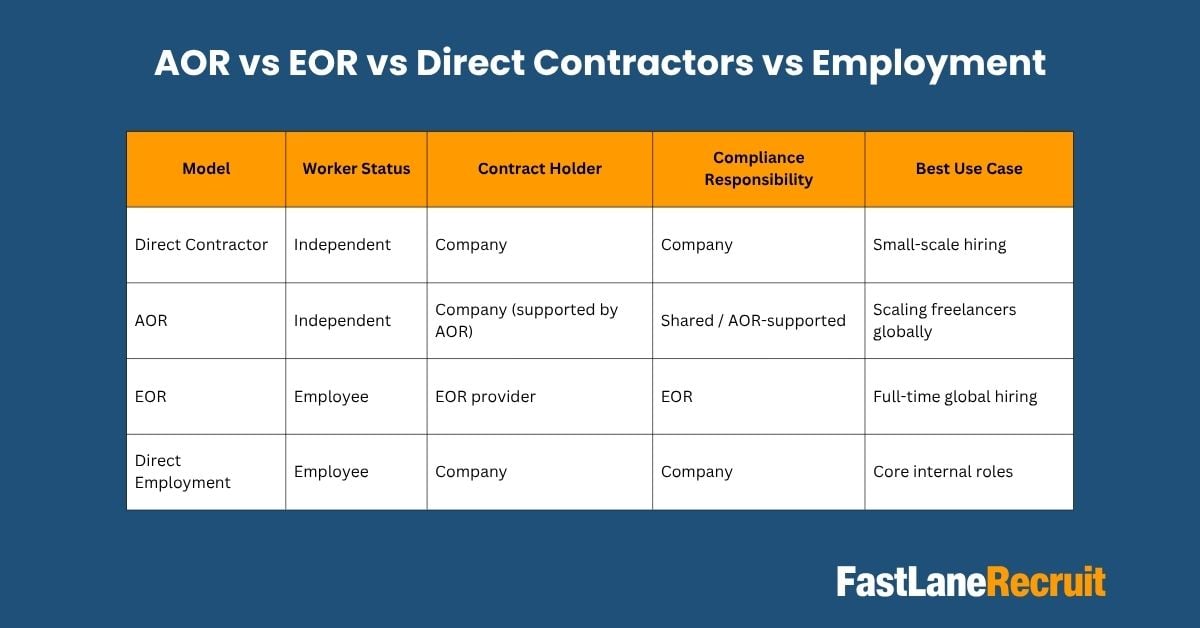
The key distinction:
AOR helps maintain contractor flexibility while strengthening compliance structure.
Why Worker Classification Is Critical
Worker classification determines whether someone is treated as an employee or an independent contractor.
Over-classification risk
If a contractor is treated like an employee:
- Companies may overpay in benefits and taxes
- Operational inefficiencies increase
Under-classification risk
If an employee is incorrectly treated as a contractor:
- Regulatory fines and penalties
- Back taxes and wage claims
- Legal exposure and audits
- Reputational damage
This is one of the main reasons companies adopt an AOR model — to create defensible, consistent classification practices.
Benefits of Using an AOR Service
A properly implemented AOR model provides:
Reduced Compliance Risk
Classification and documentation are structured and auditable.
Faster Global Scaling
Companies can hire contractors across multiple regions without rebuilding internal legal frameworks.
Administrative Efficiency
Reduces manual workload for HR, Legal, and Finance teams.
Improved Audit Readiness
Centralized documentation simplifies regulatory reviews.
Limitations of AOR Services
Despite its advantages, AOR is not a complete workforce solution.
Key limitations include:
- It does not replace employment structures
- It does not manage day-to-day contractor work
- Costs increase with scale (per contractor fees)
- Quality depends heavily on provider capability
AOR should be viewed as a compliance layer, not a workforce replacement system.
How to Choose the Right Agent of Record Provider
Selecting the right provider is critical for compliance protection.
Jurisdictional Expertise
Ensure the provider understands labor laws across your operating countries.
Compliance Capability
They should actively manage classification risk — not just document it.
Technology Infrastructure
Strong systems for onboarding, payments, and document storage are essential.
Transparency in AOR Contracts
The aor contract should clearly define:
- Liability allocation
- Service scope
- Termination terms
- Compliance responsibilities
Proven Track Record
Look for experience with companies similar in size and complexity.
When Your Business Needs an AOR
An AOR becomes valuable when:
- You are scaling freelancers across multiple countries
- Contractor management is becoming operationally heavy
- Compliance requirements are difficult to track internally
- You want to maintain flexibility without increasing legal risk
If your contractor workforce is growing beyond manual oversight, AOR is often the next logical step.
Where FastLane Recruit Helps
FastLane Recruit supports companies in building compliant, scalable global workforces through flexible hiring solutions.
Our services include:
- Global talent acquisition
- Contractor and freelance hiring support
- AOR and EOR workforce solutions
- Cross-border compliance guidance
- End-to-end recruitment support for international teams
Whether you are building a remote-first team or scaling into new markets, FastLane Recruit helps you structure hiring in a way that reduces risk and improves operational efficiency. Contact us now!
Final Takeaway
The Agent of Record (AOR) model is not a shortcut — it is a compliance framework.
When used correctly, it allows companies to scale freelance and contractor work globally while maintaining structured, defensible classification practices.
However, it is not a replacement for employment systems or internal management.
Instead, think of AOR as a guardrail:
It enables flexibility without sacrificing compliance discipline.
For growing companies, that balance is often what makes global scaling possible.
FAQ Section (for page content or schema input)
What is an Agent of Record (AOR)?
An Agent of Record (AOR) is a third-party provider that helps companies manage independent contractors by handling compliance, classification, contracts, tax documentation, and payment processes while the company maintains the direct relationship with the contractor.
What does an AOR contract do?
An AOR contract defines the responsibilities between the company, the contractor, and the AOR provider. It outlines compliance obligations, liability boundaries, payment processes, and ensures contractor engagements are structured according to applicable laws.
How is an AOR different from an EOR?
An AOR supports independent contractor engagements, while an Employer of Record (EOR) legally employs workers on behalf of a company. AOR is used for contractors, whereas EOR is used for full-time employees requiring payroll, benefits, and statutory protections.
When should a company use an AOR?
A company should use an AOR when scaling independent contractors globally, managing compliance across multiple jurisdictions, or when internal teams need support handling classification, contracts, and cross-border payment compliance.
What are the main benefits of using an AOR service?
The main benefits include reduced compliance risk, improved contractor classification accuracy, streamlined administrative processes, and better scalability when managing a global freelance workforce.
Does an AOR replace the need to manage contractors?
No. An AOR does not replace contractor management. Companies still handle hiring decisions, project management, and day-to-day work. The AOR focuses only on compliance, classification, contracts, and payment administration.