
The search for “onshore vs offshore outsourcing” has surged as companies face rising labor costs, global talent shortages, and the need for scalable workforce models.
Businesses today are no longer asking whether to outsource, but rather:
- Should we hire locally (onshore)?
- Or should we build global teams (offshore)?
- Which model delivers better ROI, speed, and talent access?
This guide breaks down both models using real-world hiring logic, cost structures, operational trade-offs, and strategic decision frameworks used by global employers and recruitment partners like FastLaneRecruit.
Content Outline
Key Summary
Onshore Outsourcing Prioritizes Control and Communication
Onshore outsourcing is best suited for roles requiring close coordination, real-time collaboration, and strong oversight, particularly in compliance-heavy and client-facing functions
Offshore Outsourcing Focuses on Cost Efficiency and Scale
Offshore models provide access to global talent pools and can significantly reduce costs (often by 40%–70%), making them ideal for operational and support functions.
The Core Trade-Off Is Cost vs Control
Onshore delivery typically offers higher cost with stronger management control, while offshore delivery reduces costs but increases coordination complexity.
Time Zones and Communication Drive Operational Differences
Differences in time zones and communication speed directly affect productivity, workflow alignment, and project management structures.
Offshore Success Depends on Process Maturity
Effective offshore operations rely on structured SOPs, clear KPIs, and strong vendor or team management systems rather than geography alone.
Hybrid Outsourcing Is the Most Common Modern Approach
Many companies now combine onshore and offshore teams to balance strategic oversight with cost-efficient execution capacity.
Compliance and Legal Factors Are Critical in Offshore Hiring
Cross-border hiring requires careful attention to employment classification, taxation, and local labor regulations to avoid legal risks.
Key Takeaways: Onshore vs Offshore Outsourcing
- Onshore outsourcing prioritizes control and communication, making it ideal for strategic, compliance-heavy, and customer-facing roles where real-time collaboration is critical.
- Offshore outsourcing prioritizes cost efficiency and scalability, offering access to global talent pools and significant cost savings (often 40%–70%), especially for operational and support functions.
- The main trade-off is cost vs control:
Onshore = higher cost but stronger oversight; Offshore = lower cost but higher management complexity. - Communication and time zones are the biggest operational differentiators, directly impacting productivity, coordination speed, and project management structure.
- Offshore success depends less on location and more on process maturity—clear SOPs, KPIs, and strong vendor or team management systems.
- A hybrid model (onshore + offshore) is now the most common strategy among scaling businesses, balancing leadership control with cost-efficient execution capacity.
- Legal and compliance factors are critical in offshore hiring, especially around employment classification, taxation, and cross-border labor regulations.
- The “best” model is not universal—it depends on business stage, budget, talent needs, and regulatory environment.
What is Onshore vs Offshore Outsourcing?
Onshore Outsourcing
Onshore outsourcing means hiring services or talent within the same country as your business headquarters.
Example:
A US company hiring a US-based accounting or IT outsourcing firm.
Offshore Outsourcing
Offshore outsourcing means hiring teams or service providers in another country, typically where labor costs are lower.
Example:
A UK company hiring customer support teams in the Philippines or Malaysia.
Key Search Intent Behind “Onshore vs Offshore”
Most users searching this keyword are looking for:
- offshore vs onshore meaning
- cost comparison of outsourcing models
- best country for offshore hiring
- pros and cons of offshore staffing
- which outsourcing model is better for business
This article addresses all of these intents directly.
Onshore vs Offshore Outsourcing: Core Differences
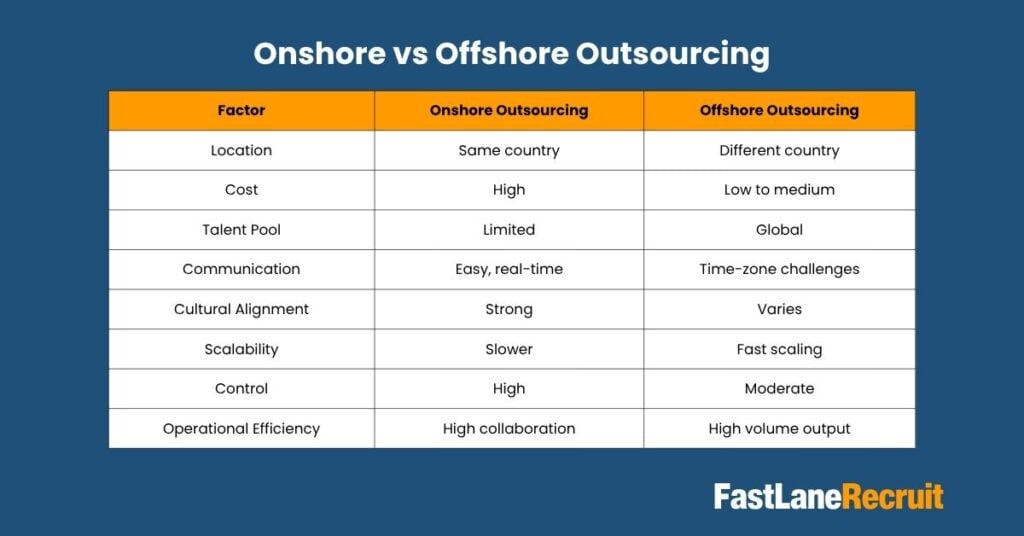
Cost Comparison: Onshore vs Offshore
Onshore Cost Structure
- Higher salaries
- Local taxes and benefits
- Office and infrastructure costs
Offshore Cost Structure
- Lower wage markets
- Reduced overhead
- Flexible staffing models
Key Insight: Offshore hiring often delivers significant cost savings, especially for operational and repetitive roles, but requires stronger process management.
Hybrid Hiring Model (Modern Approach)
Most global companies now use a hybrid workforce strategy:
- Onshore: leadership, strategy, compliance
- Offshore: execution, support, operations
This model balances:
- Cost efficiency
- Operational control
- Talent scalability
Industry Use Cases
Software Development
- Offshore: coding, QA, support
- Onshore: architecture, product strategy
Customer Support
- Offshore: 24/7 support teams
- Onshore: escalation handling
Business Operations
- Offshore: data processing, admin
- Onshore: compliance and management
Legal Considerations for Offshore Hiring
When hiring offshore talent, companies must consider:
- Worker classification laws
- Tax obligations across jurisdictions
- Data protection regulations
- Employment contracts and enforceability
- Local labor law compliance
Poor structuring can lead to legal and financial risks in cross-border hiring.
Industry Insight
Based on global outsourcing trends:
- Offshore hiring is rapidly expanding in Asia-Pacific regions
- Onshore outsourcing remains dominant in regulated industries
- Failure in offshore setups often comes from weak SOPs, not talent quality
- Structured recruitment partners reduce hiring risk and improve execution
This is why companies increasingly work with experts like FastLaneRecruit for scalable global hiring.
Why FastLaneRecruit
Choosing between onshore and offshore is not just a cost decision, it is a structural hiring strategy decision.
FastLaneRecruit helps businesses:
- Build compliant global teams
- Reduce hiring risk in offshore expansion
- Access Malaysian talent
- Scale operations efficiently across regions
- Design optimized workforce structures
If you are evaluating onshore vs offshore outsourcing, the right hiring structure can significantly improve cost efficiency, productivity, and scalability.
Explore Employer of Record solutions!
Start building your global team!
Get in touch with us to get started.
Conclusion
Choosing between onshore and offshore outsourcing is ultimately a strategic decision that shapes how a business operates, scales, and competes. It is not simply a question of cost reduction, but a broader evaluation of control, capability, and long-term growth strategy.
Onshore outsourcing provides stronger communication, tighter oversight, and better alignment with local regulations, making it ideal for sensitive, client-facing, or compliance-heavy functions. However, this comes at a significantly higher operational cost and limited access to specialized global talent.
Offshore outsourcing, on the other hand, enables companies to tap into large international talent pools at a lower cost, while improving scalability and operational coverage. When properly structured, it can deliver strong efficiency gains without compromising output quality. However, it requires mature processes, clear SOPs, and strong management systems to overcome challenges related to time zones, communication, and coordination.
Ultimately, the decision between onshore and offshore outsourcing should be guided by business priorities—whether that is speed, cost efficiency, control, or scalability. When aligned correctly with operational needs, the right outsourcing model becomes a powerful lever for sustainable growth and competitive advantage in a global market.
FAQ: Onshore vs Offshore Outsourcing
1. What are the key differences between onshore vs offshore software development services?
Onshore offers stronger communication and control, while offshore provides lower cost and broader technical talent access.
2. What are the main cost differences between onshore and offshore outsourcing models?
Onshore outsourcing is significantly more expensive due to labor and compliance costs, while offshore reduces operational expenses through lower wage markets.
3. What are reputable offshore customer support providers for small businesses?
Common offshore hubs include the Philippines, India, and Malaysia, known for scalable, English-speaking customer support teams.
4. How to choose a reliable onshore manufacturing partner in the Philippines?
Evaluate compliance, production capacity, quality control systems, and proven industry track records.
5. What are the legal considerations for hiring remote offshore talent from the Philippines?
Key considerations include:
- Employment classification
- Tax compliance
- Data privacy laws
- Contract enforceability
- Local labor regulations