Hiring in Switzerland can give international companies access to a highly skilled workforce, but employing people locally involves more than finding the right candidate. Companies need to consider employment contracts, payroll, social insurance, employee benefits, tax administration, working-time rules and, where applicable, work permits.
For businesses that want to hire in Switzerland without immediately establishing their own Swiss entity, an Employer of Record in Switzerland (EOR Switzerland) can provide a practical alternative.
An EOR acts as the local legal employer while the client company manages the employee’s day-to-day work. This allows businesses to expand their workforce while reducing the administrative burden associated with setting up and maintaining a local employment structure.
Content Outline
Key Summary
An EOR can help you hire without setting up a Swiss entity
An EOR allows an international company to employ workers in Switzerland without establishing its own local subsidiary, making it particularly useful for initial market entry and smaller teams.
Swiss employment compliance requires local knowledge
Switzerland has federal employment requirements as well as important cantonal differences. Employment contracts, payroll, social security, holidays, taxation and benefits need to be handled correctly.
EORs simplify payroll and employment administration
A suitable EOR can manage payroll, statutory deductions, employment documentation, benefits administration and other employment-related responsibilities on behalf of the client company.
Work permits still matter
Using an EOR does not automatically eliminate immigration requirements. Foreign nationals may require the appropriate work and residence authorization, with different rules applying to EU/EFTA and third-country nationals.
EORs are most useful when speed and flexibility matter
Companies entering Switzerland for the first time, hiring a small team or testing the market can often use an EOR before deciding whether establishing a permanent entity is commercially justified.
What Is an Employer of Record in Switzerland?
An Employer of Record in Switzerland is a third-party organization that legally employs a worker on behalf of another company.
The EOR becomes the formal employer responsible for employment administration and compliance, while the client company generally remains responsible for the employee’s day-to-day responsibilities, performance, team management and business objectives.
This creates a three-party relationship:
Client company → EOR → Employee
The client company identifies and manages the employee, while the EOR manages the local employment infrastructure.
How Does an EOR Work in Switzerland?
The typical process is:
- The company identifies its hiring requirements.
- The company selects an EOR provider.
- Employee and position information is provided to the EOR.
- The EOR prepares a locally compliant employment arrangement.
- The employee is onboarded.
- Payroll, deductions and employment administration are managed locally.
- The EOR supports ongoing employment compliance.
- The EOR assists with offboarding when employment ends.
The exact division of responsibilities depends on the EOR agreement, so companies should confirm which services are included before signing.
What Does an EOR Handle?
Depending on the provider and agreement, an EOR in Switzerland can support:
- Local employment contracts
- Employee onboarding
- Payroll processing
- Salary payments
- Social insurance administration
- Tax withholding administration
- Employee benefits
- Leave administration
- Employment documentation
- Work permits and immigration support
- Compensation administration
- Contractor-to-employee transitions
- Termination and offboarding
The objective is to allow the company to focus on managing its workforce rather than building an entire local employment infrastructure.
When Should You Use an EOR in Switzerland?
An EOR is not necessarily the right structure for every company. It becomes particularly useful in situations where establishing a Swiss entity would create more cost and administrative work than the business currently needs.
You Do Not Have a Swiss Entity
If your company wants to hire a Swiss employee but does not have a local subsidiary, an EOR can provide an alternative to establishing an entity solely for employment purposes.
You Are Testing the Swiss Market
If Switzerland is a new market for your company, hiring through an EOR can allow you to establish an initial local presence before committing to a permanent corporate structure.
You Need to Hire a Small Team
Setting up an entity can be difficult to justify when you initially need only one or a few employees. An EOR can provide the employment infrastructure without requiring the same level of internal administration.
You Need to Hire Quickly
Entity establishment, registration, payroll setup and local administration can add time to an international expansion project. An EOR can streamline these processes by using an existing employment structure.
In short: if your immediate priority is hiring rather than establishing a full Swiss business operation, an EOR may be the more practical starting point.
How to Use an Employer of Record in Switzerland
Once you decide that an EOR fits your expansion strategy, the process can be approached systematically.
Step 1: Assess Your Hiring Needs
Define:
- Number of employees
- Job titles and responsibilities
- Location in Switzerland
- Proposed salary and currency
- Start date
- Working arrangement
- Benefits
- Employee nationality
- Whether immigration support is required
This information allows the EOR to assess the employment and compliance requirements before onboarding begins.
Step 2: Choose an EOR Provider
Compare providers based on:
- Swiss employment expertise
- Payroll capabilities
- Benefits administration
- Work permit support
- Employment contract localization
- Pricing transparency
- Customer support
- Data security
- Offboarding processes
- Multi-country coverage
The cheapest provider is not necessarily the most cost-effective if it lacks the local expertise needed to manage Swiss employment correctly.
Step 3: Confirm Employee Details
The EOR will typically need information about the employee, including personal details, role, compensation, work location and proposed start date.
For international hires, immigration status and eligibility should also be reviewed.
Step 4: Onboard the Employee
The EOR establishes the required employment records and coordinates onboarding documentation.
The client company can then focus on introducing the employee to its team, systems, responsibilities and business objectives.
Step 5: Sign a Local Employment Contract
The employment agreement should reflect applicable Swiss employment requirements and the terms agreed between the company and employee.
Important areas can include:
- Position
- Salary
- Working hours
- Place of work
- Probation
- Holidays
- Benefits
- Notice periods
- Confidentiality
- Intellectual property
- Termination provisions
Step 6: Run Payroll
The EOR manages payroll according to the agreed compensation structure and applicable Swiss requirements.
This may include salary payments, social insurance deductions, withholding tax where applicable and other payroll-related administration.
Step 7: Manage Employment
Once the employee starts work, the relationship continues beyond payroll.
An EOR can support:
- Salary changes
- Benefits
- Leave
- Payroll changes
- Employment documentation
- Compliance administration
- Employee changes
- Immigration-related administration where included
Step 8: Terminate or Offboard
When employment ends, the EOR can support the required documentation, final payroll, benefits administration and other offboarding requirements.
Termination should be handled carefully because Swiss employment rules and contractual provisions can affect notice, compensation and dismissal procedures.
How to Hire Employees in Switzerland
International companies generally have several possible approaches.
| Hiring option | Local entity required? | Administrative burden | Speed | Best suited for |
| Swiss entity | Yes | High | Slower | Long-term operations |
| Independent contractor | Generally no | Lower initially | Fast | Genuine independent engagements |
| EOR | No client-owned entity | Lower | Faster | International expansion and small teams |
Local Entity
Establishing a Swiss company provides the greatest degree of direct control but also creates additional corporate, tax, payroll and administrative responsibilities.
Independent Contractor
Contractors can be useful when the relationship genuinely meets the requirements for independent work. However, companies should not classify employees as contractors simply to avoid employment obligations.
Misclassification can create legal, tax and financial risks.
EOR
An EOR provides a middle ground: the company can hire employees locally while the EOR provides the employment infrastructure.
For many companies entering Switzerland for the first time, this can be a practical way to validate the market before establishing a permanent entity.
Switzerland Employment Laws You Need to Know
Swiss employment law combines federal rules, contractual terms, collective agreements and, in some areas, cantonal requirements.
Companies should pay particular attention to the following.
Working Hours
Swiss rules establish maximum weekly working hours depending on the type of work. The maximum is generally 45 hours for office staff, technical employees and certain other categories, while a 50-hour maximum applies to certain other workers.
The applicable rules also cover breaks, rest periods, night work, Sunday work and overtime.
Annual Leave
Employees are generally entitled to at least four weeks of paid annual holiday per year. Employees under 20 are entitled to at least five weeks.
Additional contractual or collective-agreement leave may apply.
Minimum Wage
Switzerland does not have a single nationwide statutory minimum wage. However, several cantons have introduced minimum wages, and collective or standard employment agreements can establish minimum compensation for particular sectors.
This makes the employee’s location and industry important when determining compensation.
Social Insurance
Swiss employees are subject to mandatory social insurance arrangements, including Old-Age and Survivors’ Insurance (OASI), Disability Insurance (DI) and Income Compensation Insurance (IC), with contributions generally shared between employer and employee.
Other insurance and pension arrangements may also apply depending on the employee and employment circumstances.
Termination
Swiss employment termination can depend on the employment contract, applicable statutory provisions and collective or standard employment agreements.
Companies should therefore avoid treating termination as a simple administrative step. Local review is particularly important where the employee is protected by specific statutory rules.
Payroll and Taxes When Using an EOR in Switzerland
Swiss payroll requires more than simply transferring an employee’s monthly salary.
Payroll administration may involve:
- Gross-to-net salary calculation
- OASI/DI/IC contributions
- Unemployment insurance
- Occupational pension arrangements where applicable
- Accident insurance
- Withholding tax where applicable
- Family allowances
- Other statutory or contractual deductions
- Payslip and payroll records
Social insurance contribution requirements are updated periodically, so payroll calculations should use the rates and thresholds applicable to the relevant year. Switzerland’s social insurance authorities publish updated 2026 contribution information and calculation tools.
Tax treatment can also vary depending on the employee’s circumstances and canton. An EOR can reduce the administrative burden, but companies should still confirm what tax and payroll services are included in the EOR agreement.
Employee Benefits and Leave in Switzerland
Employee benefits can include both statutory requirements and additional benefits agreed in the employment package.
Important areas include:
- Annual leave
- Social insurance
- Occupational pension
- Accident insurance
- Family allowances
- Maternity protection
- Other parental leave
- Sick leave arrangements
- Additional contractual benefits
Maternity Leave
Eligible employees generally receive 14 weeks of maternity leave, with maternity compensation generally set at 80% of previous average income up to the statutory daily maximum.
Other Parent Leave
Eligible fathers and spouses of the biological mother generally have two weeks of paid leave, with compensation generally at 80% of income subject to the statutory maximum.
Holidays
Switzerland has one federal public holiday, 1 August, while cantons can recognize additional public holidays. Consequently, an employee’s canton should be considered when calculating working days and leave.
An EOR can help employers administer these requirements while maintaining consistent payroll and employee records.
Work Permits and Visas in Switzerland
Immigration is an important consideration when hiring foreign employees in Switzerland.
The rules differ significantly between EU/EFTA nationals and third-country nationals.
EU/EFTA Employees
EU/EFTA nationals generally have easier access to the Swiss employment market under the applicable free-movement framework. Depending on the duration and circumstances of the employment, registration or notification requirements may apply.
For certain short-term activities of up to three months or 90 days per calendar year, a notification procedure can apply rather than a conventional permit.
Non-EU/EFTA Employees
Third-country nationals face stricter admission requirements. In general, Switzerland limits access to highly qualified workers and applies requirements concerning qualifications, labour-market precedence, quotas and employment conditions.
The future employer is generally responsible for submitting the work permit application to the relevant cantonal authority.
Using an EOR can simplify the employment administration around an international hire, but it does not guarantee that an employee will qualify for a Swiss work permit. Immigration eligibility should be assessed before committing to a start date.
EOR vs Setting Up a Company in Switzerland
The right structure depends on the company’s expansion plans.
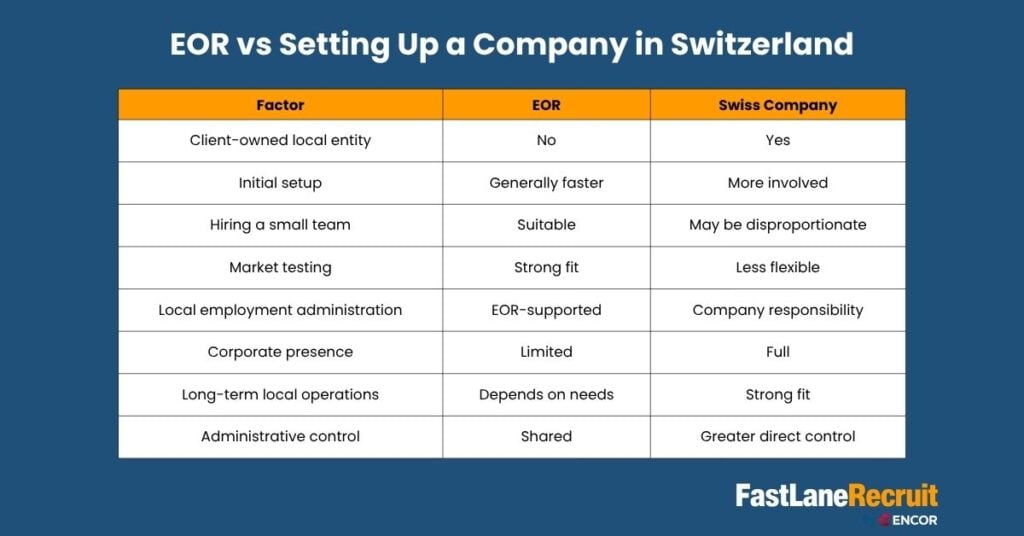
| Factor | EOR | Swiss Company |
| Client-owned local entity | No | Yes |
| Initial setup | Generally faster | More involved |
| Hiring a small team | Suitable | May be disproportionate |
| Market testing | Strong fit | Less flexible |
| Local employment administration | EOR-supported | Company responsibility |
| Corporate presence | Limited | Full |
| Long-term local operations | Depends on needs | Strong fit |
| Administrative control | Shared | Greater direct control |
An EOR is generally most attractive when the immediate objective is employment, rather than establishing a full Swiss corporate presence.
A company that eventually builds a substantial Swiss operation may decide that forming its own entity is more appropriate.
EOR vs PEO in Switzerland
EOR and PEO services are related but not identical.
An EOR becomes the legal employer of the employee, while the client company manages the employee’s day-to-day work.
A PEO typically operates through a co-employment model, where the client company generally has its own local employment structure and shares certain HR responsibilities with the PEO.
| EOR | PEO |
| EOR is the legal employer | Client typically remains the employer |
| Can support hiring without a client-owned entity | Usually works with an established local employer |
| Suitable for international expansion | Often suited to companies already operating locally |
| Employment administration handled by EOR | HR responsibilities are shared |
For an overseas company that wants to hire in Switzerland without first establishing its own entity, an EOR is generally the more relevant model.
Also Read: Co-Employment Risk: What Businesses Need to Know and How an EOR Can Help
How Much Does an EOR Cost in Switzerland?
EOR pricing typically consists of the employee’s employment costs plus an EOR service fee.
The total cost can depend on:
- Employee salary
- Employer social contributions
- Statutory insurance
- Benefits
- Payroll requirements
- Work permit requirements
- Additional HR services
- EOR pricing model
- Number of employees
- Contract duration
There is no single standard Switzerland EOR price that applies to every employee.
When comparing providers, look beyond the headline service fee. A lower monthly fee may not be cheaper if payroll, immigration, benefits or compliance services are charged separately.
A professional EOR quote should make the expected employment cost and service charges clear before onboarding.
Benefits of Using an EOR in Switzerland
For companies entering Switzerland, an EOR can provide several practical advantages.
Faster Market Entry
Companies can begin building a local team without first developing an entire employment infrastructure.
Lower Administrative Burden
Payroll, employment records, statutory deductions and other HR administration can be handled through the EOR.
Local Employment Support
An experienced EOR can help navigate Swiss employment practices and country-specific requirements.
Flexible Expansion
Businesses can hire one employee or a small team without immediately committing to a permanent local structure.
Easier International Hiring
Companies can use a single international employment partner when expanding across multiple markets.
The key benefit is not simply convenience. It is the ability to reduce the operational complexity between deciding to hire and successfully employing someone in Switzerland.
Risks and Considerations When Using an EOR
An EOR reduces administrative complexity, but it does not remove every employment risk.
Before selecting a provider, consider:
- EOR service fees
- Contractual limitations
- Employment liability
- Data protection
- Payroll accuracy
- Benefits coverage
- Immigration support
- Termination procedures
- Local expertise
- Provider financial stability
- Service-level commitments
The client company should also understand exactly which responsibilities remain with it.
An EOR should be treated as an extension of your international employment infrastructure, not as a replacement for responsible workforce management.
Who Should Use an EOR in Switzerland?
An EOR can be particularly suitable for:
- Companies entering Switzerland for the first time
- Businesses hiring their first Swiss employee
- Companies testing the Swiss market
- Startups expanding internationally
- Businesses hiring specialist talent
- Companies that do not yet have a Swiss entity
- Businesses building small or distributed international teams
- Companies that want centralized international employment administration
For larger organizations with an established Swiss operation, an owned entity may eventually provide greater control and flexibility.
How to Choose an EOR Provider in Switzerland
A strong EOR provider should offer more than payroll processing.
Before signing an agreement, evaluate:
1. Swiss Employment Expertise
The provider should understand Swiss employment requirements and relevant cantonal considerations.
2. Payroll Capability
Confirm that salary processing, statutory deductions, payroll records and reporting are included.
3. Compensation and Benefits
Ask how employee benefits, allowances and compensation changes are managed.
4. Work Visa and Permit Support
If you are hiring international talent, confirm whether the provider supports work permit and immigration processes.
5. Employment Contract Support
The provider should be able to establish an appropriate local employment arrangement.
6. Transparent Pricing
Request a complete breakdown of employment costs, service fees and optional charges.
7. Multi-Country Coverage
If Switzerland is one step in a broader expansion strategy, a provider with multi-country capabilities can make international workforce management easier.
Why FastLaneRecruit for EOR in Switzerland?
Expanding into Switzerland should not require you to build an entire HR and payroll infrastructure before you can hire your first employee.
FastLaneRecruit provides EOR support designed to help international companies hire and manage employees while reducing the administrative complexity of entering a new market.
Our services can include:
- Hiring and local employment support
- Payroll administration
- Compensation and benefits
- Work visa and permit support
- Independent contractor hiring
- Business expansion
- Ongoing employment administration
This gives companies a practical route from “We want to hire in Switzerland” to “Our employee is onboarded and being managed compliantly.”
For companies expanding beyond Switzerland, FastLaneRecruit also operates across Malaysia, Singapore, Hong Kong, China, India, the Philippines, Taiwan, Vietnam, Australia, the United Kingdom, the UAE, Saudi Arabia and Qatar.
That broader coverage can be particularly useful when Switzerland is part of a multi-country hiring strategy rather than a standalone expansion.
EOR Hiring Checklist for Switzerland
Before hiring an employee through an EOR in Switzerland, confirm:
- Hiring position and responsibilities
- Employee’s work location and canton
- Employee nationality
- Work permit or immigration requirements
- Salary and compensation structure
- Employment contract terms
- Working hours
- Annual leave
- Employee benefits
- Social insurance
- Payroll deductions
- Pension and insurance requirements
- Public holidays
- Probation and notice provisions
- EOR service fees
- Onboarding requirements
- Termination and offboarding process
If you have checked these points, you have a much clearer picture of what needs to be completed before your Swiss employee starts work.
Ready to Hire in Switzerland?
Hiring in Switzerland does not have to begin with establishing a full local entity.
For companies that want to test the market, hire a small team, access Swiss talent or expand internationally without taking on unnecessary administrative complexity, an EOR can provide a practical starting point.
FastLaneRecruit can support the employment journey from hiring and payroll to compensation and benefits, work permits and ongoing employment administration.
If you are planning to hire in Switzerland, talk to FastLaneRecruit about an EOR solution tailored to your hiring requirements.
FAQs About Using an EOR in Switzerland
What is an EOR in Switzerland?
An Employer of Record in Switzerland is a third-party organization that legally employs a worker on behalf of a client company while the client generally manages the employee’s daily work.
Can I hire someone in Switzerland without a Swiss company?
Yes, an EOR can provide a way for an international company to hire an employee in Switzerland without establishing its own Swiss entity, subject to the applicable employment and immigration requirements.
Is using an EOR legal in Switzerland?
An EOR arrangement can be used to manage employment in Switzerland, but the structure and services must comply with applicable Swiss employment, payroll and regulatory requirements.
Can an EOR handle Swiss payroll?
Yes. Payroll administration is one of the core services commonly provided by an EOR, including salary processing and applicable statutory deductions.
Can an EOR sponsor a Swiss work permit?
An EOR may support the work permit process where its service model and the applicable immigration rules allow it. However, immigration approval depends on the employee’s eligibility and Swiss admission requirements.
How long does it take to hire through an EOR in Switzerland?
The timeline depends on employee documentation, contract preparation, payroll setup and immigration requirements. EU/EFTA and third-country hires can also follow different processes.
Is an EOR cheaper than setting up a Swiss company?
Not necessarily in every situation. An EOR adds a service fee, but it can reduce the initial corporate, payroll and administrative costs associated with establishing and maintaining a local entity. The appropriate option depends on the size and duration of your Swiss operation.
What benefits are required for employees in Switzerland?
Swiss employment can involve statutory social insurance, pension, accident insurance and leave requirements, together with contractual and potentially cantonal or collective-agreement benefits.
What is the difference between an EOR and a PEO?
An EOR becomes the legal employer of the worker, while a PEO generally operates through a co-employment arrangement with a client that already has an employment structure.
Can I hire contractors through an EOR?
Some EOR providers offer independent contractor hiring or contractor management services. However, the worker’s actual status should be assessed carefully to avoid employee misclassification.
When should I establish my own Swiss company instead of using an EOR?
A Swiss entity may make more sense when you have a substantial long-term operation, need direct corporate control or require a permanent local business presence. An EOR can be more practical during initial market entry or when hiring a smaller team.