A contractor may start as a practical solution for a short-term project, specialist expertise, or entering a new market. But as the relationship grows, the role can begin to look much more like regular employment.
The contractor may become embedded in your team, work continuously on core business activities, follow company processes, report to a manager, or take on responsibilities that were never part of the original agreement.
At that point, businesses often ask: Should we convert this contractor to employee?
Converting a contractor to an employee involves more than changing a job title or issuing a new contract. You may need to reassess worker classification, compensation, benefits, payroll, tax obligations, statutory requirements, and the legal structure used to employ the individual—particularly when the contractor works in another country.
This guide explains when and how to convert a contractor to an employee, what employers should consider before making the change, and how an Employer of Record (EOR) can simplify international contractor conversion when you do not have a local entity.
Content Outline
Key Summary
Contractor status should reflect the actual working relationship
Calling someone a contractor in an agreement does not automatically make them an independent contractor. Worker classification is generally determined by the substance of the relationship, including factors such as control, independence, economic circumstances, and the nature of the work. The applicable test varies by country.
Conversion may make sense when the role becomes ongoing
A contractor may be a better fit for defined projects or independent services. An employee structure may be more appropriate when the person becomes an ongoing, closely managed, or strategically important member of the team.
Contractor-to-employee conversion involves more than payroll
Employers should consider the employment agreement, compensation, statutory benefits, payroll, taxes, leave, social contributions, termination rules, and other local employment requirements.
International conversion requires country-specific planning
If the contractor works overseas and your business does not have a legal entity there, direct employment may not be immediately available. An EOR can provide an employment structure without requiring your business to establish its own local entity.
An EOR can simplify the transition
FastLaneRecruit can support eligible contractor-to-employee conversions through its EOR infrastructure, allowing businesses to retain the worker while managing local employment, payroll, and statutory requirements.
Contractor vs Employee: What’s the Difference?
The distinction between a contractor and an employee is important because the two arrangements can create different legal, tax, payroll, and employment obligations.
| Factor | Independent Contractor | Employee |
| Nature of work | Usually independent services or defined projects | Ongoing role within the organisation |
| Control | Generally greater independence over how work is performed | Employer generally has greater control over the employment relationship |
| Payment | Often invoices for services | Usually paid through payroll |
| Benefits | Generally not entitled to employee benefits in the same way | May receive statutory and employer-provided benefits |
| Taxes | Tax treatment depends on the jurisdiction and structure | Employer may have withholding and reporting obligations |
| Working relationship | Often operates independently or serves multiple clients | Usually integrated into the employer’s workforce |
| Employment protections | Generally different from employees | Usually covered by applicable employment laws |
| International hiring | Can create classification and compliance considerations | May require a local entity or EOR |
Important: There is no universal global test for contractor classification. Employers should assess the actual working relationship under the laws of the country where the individual works.
When Should You Convert a Contractor to an Employee?
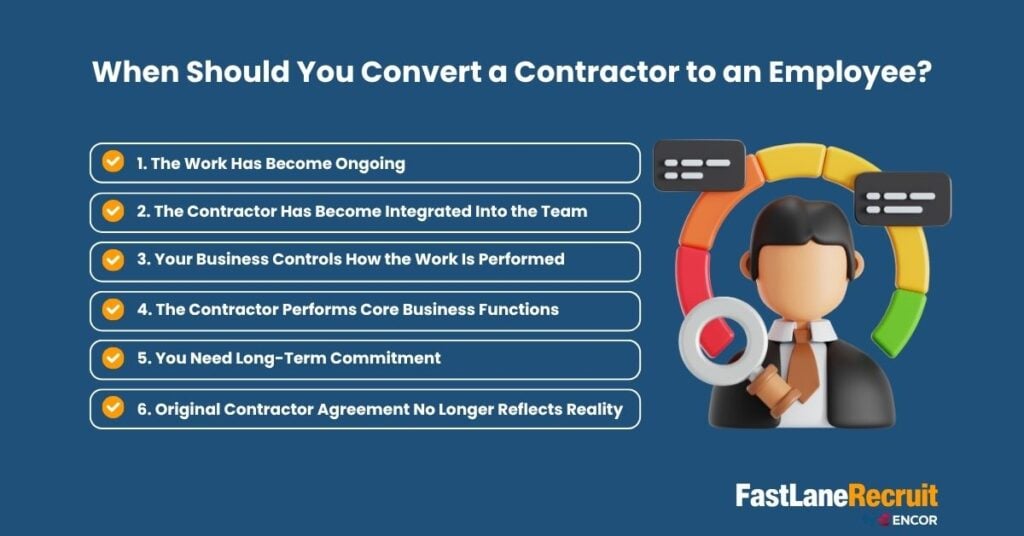
There is no universal length of time after which a contractor must become an employee. Instead, businesses should review whether the working relationship still reflects genuine independent contracting.
Consider a contractor-to-employee conversion when several of the following apply.
1. The Work Has Become Ongoing
A contractor may originally have been hired for a defined project with specific deliverables and an expected end date.
If the project ends but the contractor continues performing the same operational role indefinitely, it may be time to reassess the arrangement.
Ask:
Are we paying for a defined service, or are we effectively filling an ongoing employee position?
2. The Contractor Has Become Integrated Into the Team
Integration can be an important factor in assessing the nature of a working relationship.
Examples include:
- Attending regular internal meetings
- Working closely with permanent employees
- Taking responsibility for ongoing business functions
- Managing or mentoring other team members
- Using internal systems and processes
- Representing the company to customers
- Becoming responsible for core business activities
Integration alone does not automatically determine classification, but it can be relevant when considered alongside the wider relationship.
3. Your Business Controls How the Work Is Performed
A contractor generally operates with a degree of independence.
If the relationship increasingly involves controlling:
- Working schedules
- Daily activities
- Methods and processes
- Internal procedures
- Reporting structures
- Regular supervision
- Workplace requirements
the business should review whether the contractor arrangement remains appropriate under local law.
4. The Contractor Performs Core Business Functions
Specialist contractors can be valuable for temporary or defined assignments.
However, if a contractor becomes responsible for a continuing function that is central to your organisation, it may be appropriate to reconsider whether employee status better reflects the relationship.
5. You Need Long-Term Commitment
Conversion can also make sense for workforce planning.
An employee structure may be preferable when you want to:
- Retain valuable talent
- Build long-term team continuity
- Provide structured career development
- Offer employee benefits
- Establish clearer performance management
- Give the worker a permanent role
6. The Original Contractor Agreement No Longer Reflects Reality
Businesses sometimes continue renewing an agreement even though the actual relationship has changed substantially.
A regular contract review can help identify when the original contractor model no longer accurately reflects the work being performed.
When Should You Keep a Contractor as a Contractor?
Not every contractor should become an employee.
A contractor arrangement may remain appropriate when the individual genuinely operates an independent business and the engagement is consistent with local contractor rules.
Examples can include:
- A short-term project with defined deliverables
- Specialist advice needed occasionally
- Temporary capacity for a specific business need
- Independent consultants serving multiple clients
- Services where the contractor controls their own methods and schedule
- Work with a clearly defined scope and commercial outcome
The key question is not simply “How long has this person worked for us?”
Instead, consider:
Does the actual relationship continue to support independent contractor status under the relevant country’s laws?
What Are the Risks of Misclassifying a Contractor?
Keeping a worker as a contractor when the relationship should be treated as employment can create compliance and financial exposure.
Depending on the jurisdiction, potential consequences can involve:
- Backdated employment-related payments
- Unpaid statutory benefits
- Tax and social contribution liabilities
- Payroll compliance issues
- Interest or penalties
- Employment claims
- Leave entitlement claims
- Termination-related obligations
- Intellectual property or contractual complications
The exact consequences vary significantly by country.
For international teams, businesses should avoid assuming that a contractor arrangement that is acceptable in one country will automatically be acceptable in another.
How to Convert a Contractor to an Employee
A structured conversion process can reduce disruption and help ensure the new employment arrangement is properly established.
Step 1: Review the Existing Contractor Relationship
Start by documenting how the contractor currently works with your business.
Review:
- Contractor agreement
- Scope of work
- Payment terms
- Working arrangements
- Reporting structure
- Working hours or schedule
- Level of supervision
- Exclusivity
- Use of company equipment and systems
- Length and continuity of the engagement
- Nature of the contractor’s business
The goal is to understand the relationship as it operates in practice—not simply how it is described in the contract.
Step 2: Assess Worker Classification
Determine whether the existing relationship remains consistent with independent contractor status under the applicable law.
Because classification rules differ between jurisdictions, this assessment should be based on the country where the individual performs the work and, where appropriate, professional legal or employment advice.
Do not assume that simply changing the contract will resolve an existing classification issue.
Step 3: Decide Whether Direct Employment or an EOR Is Appropriate
If you already have a legal entity capable of employing workers in the contractor’s country, you may be able to employ the individual directly.
If you do not have a local entity, consider whether establishing one is commercially justified.
For businesses that need to convert an overseas contractor without setting up a subsidiary, an Employer of Record (EOR) can provide an alternative employment structure.
Step 4: Determine Compensation and Benefits
Moving from contractor pay to employee compensation requires a broader cost assessment.
Consider:
- Base salary
- Statutory contributions
- Required benefits
- Paid leave
- Insurance
- Bonuses or commissions
- Allowances
- Equity or other incentives
- Employer payroll costs
- EOR fees, if applicable
Do not simply convert a contractor’s invoice amount into an employee salary.
The total employment cost can include obligations that were not part of the contractor arrangement.
Step 5: Discuss the Change With the Contractor
The transition should be clearly communicated to the worker.
Explain:
- Why the business is proposing the conversion
- The new employment structure
- Salary and benefits
- Employment start date
- Working arrangements
- Changes to payment
- Relevant employee benefits
- Any changes to responsibilities
A clear conversation can make the transition smoother and reduce uncertainty.
Step 6: Close the Contractor Arrangement
The contractor agreement should be properly concluded according to its terms and applicable law.
Document:
- Final contractor service date
- Outstanding invoices
- Final payment
- Return of company property, where applicable
- End of contractor obligations
- Effective employment date
Avoid leaving an unclear overlap between contractor and employee arrangements.
Step 7: Establish the Employment Relationship
The employee should receive the appropriate employment documentation for the relevant country.
Depending on the jurisdiction, this can include:
- Employment agreement
- Employee handbook or policies
- Compensation documentation
- Benefits information
- Tax and payroll documentation
- Statutory registrations
- Required employment notices
Step 8: Set Up Payroll and Benefits
Once employment begins, ensure the worker is properly incorporated into the relevant payroll and benefits systems.
This can include:
- Payroll processing
- Tax withholding
- Social security or equivalent contributions
- Statutory benefits
- Paid leave
- Insurance
- Expense policies
- Other mandatory employment requirements
Step 9: Complete Employee Onboarding
Even if the individual has already worked with your company for months, treat the conversion as an important employment transition.
Update:
- HR records
- Job title
- Reporting structure
- Employee policies
- Benefits enrollment
- Performance processes
- Internal access
- Employment documentation
How to Convert an International Contractor to an Employee Without a Local Entity
International contractor conversion becomes more complex when your business does not have a registered entity in the contractor’s country.
You generally need an employment structure that complies with the local employment framework.
Option 1: Establish Your Own Local Entity
Setting up a subsidiary can provide greater long-term control, but it can involve:
- Incorporation
- Registration
- Tax administration
- Banking
- Payroll infrastructure
- Local employment compliance
- Ongoing corporate maintenance
This can make sense when you expect significant and sustained operations in the country.
Option 2: Use an Employer of Record
An EOR can provide a practical alternative when establishing a local entity is not necessary or not yet justified.
Under an EOR arrangement, the EOR becomes the local legal employer while your business continues directing the employee’s day-to-day work.
The EOR can support areas such as:
- Employment contracts
- Local payroll
- Statutory contributions
- Employee benefits
- Employment documentation
- Local compliance administration
This can be particularly useful when you want to retain an existing international contractor without creating a legal entity solely for one or a small number of employees.
When Is an EOR the Right Choice for Contractor-to-Employee Conversion?
An EOR may be worth considering when:
You Don’t Have a Local Entity
You want to employ a contractor in another country but do not have a registered entity there.
You Need a Compliant Employment Structure
The contractor’s role has evolved into employment and you need to establish the appropriate employment arrangement.
You Want to Retain Existing Talent
The contractor already understands your business, systems, customers, and culture, so replacing them may create unnecessary recruitment and knowledge-transfer costs.
You Are Testing a New Market
You want to build a small international team without immediately committing to establishing a subsidiary.
You Need Local Payroll and Employment Administration
You want local employment requirements, payroll, statutory contributions, and benefits managed through an established employment infrastructure.
Contractor vs Employee vs EOR: Which Option Fits Your Business?
| Your situation | Potential approach |
| Short-term project with defined deliverables | Contractor |
| Genuine independent service provider | Contractor |
| Ongoing role closely integrated with your team | Employee |
| Long-term role in a country where you already have an entity | Direct employment |
| International employee but no local entity | EOR |
| Testing a market with a small team | EOR may be suitable |
| Large, established long-term operation in a country | Consider whether a local entity is commercially justified |
The right structure depends on the actual relationship, local employment law, business plans, cost, and the level of administrative infrastructure you need.
What Does Contractor-to-Employee Conversion Cost?
There is no universal conversion cost because employment obligations differ by country and by the worker’s compensation package.
Your cost assessment should include:
| Cost area | What to consider |
| Salary | Base compensation agreed with the employee |
| Employer contributions | Statutory payroll or social contributions |
| Benefits | Mandatory and company-provided benefits |
| Paid leave | Statutory and contractual leave |
| Insurance | Required or employer-provided coverage |
| Payroll | Payroll processing and administration |
| Compliance | Local employment and reporting requirements |
| EOR | Service fees if using an Employer of Record |
| Entity | Incorporation and ongoing administration if establishing a local entity |
The important comparison is total employment cost, not simply contractor invoice value versus employee salary.
Contractor-to-Employee Conversion Checklist
Before completing the transition, confirm that you have reviewed:
Classification
- Existing contractor relationship reviewed
- Worker classification assessed under local law
- Potential misclassification concerns identified
Employment structure
- Direct employment or EOR selected
- Local entity requirement confirmed
- Employment start date agreed
Compensation
- Salary agreed
- Statutory contributions assessed
- Benefits reviewed
- Total employment cost calculated
Documentation
- Contractor agreement reviewed
- Contractor relationship properly concluded
- Employment agreement prepared
- Required employment documents completed
Payroll and compliance
- Payroll setup completed
- Tax requirements addressed
- Statutory registrations completed where required
- Benefits enrollment completed
Onboarding
- HR records updated
- Employee policies provided
- Reporting structure confirmed
- Access and systems updated
Why Businesses Choose FastLaneRecruit
Converting an international contractor to an employee can be straightforward in principle but operationally complex when local employment requirements are involved.
FastLaneRecruit helps businesses transition eligible contractors into compliant employment arrangements through its Employer of Record infrastructure.
Keep the Talent You Already Know
You do not necessarily need to replace a contractor simply because their working relationship has evolved.
FastLaneRecruit can help businesses transition existing contractors into employment while maintaining continuity in the team.
Employ Without Establishing a Local Entity
Where an EOR structure is appropriate, businesses can employ talent without establishing their own local entity in the country.
Local Employment Administration
FastLaneRecruit supports key employment processes including employment contracts, payroll, and statutory requirements, while your business continues to manage the employee’s day-to-day responsibilities.
Support for Growing Global Teams
FastLaneRecruit operates across:
Malaysia, Singapore, Hong Kong, China, India, Philippines, Taiwan, Vietnam, Australia, United Kingdom, Switzerland, UAE, Saudi Arabia, Qatar.
This gives businesses a structured option for converting contractors as their international workforce grows.
How FastLaneRecruit Can Support Contractor-to-Employee Conversion
FastLaneRecruit can support businesses that need to move from an independent contractor arrangement to an employment model through EOR services.
Our support can include:
- Assessing the employment structure needed for the target country
- Preparing the local employment arrangement
- Managing employment contracts
- Supporting payroll administration
- Managing statutory employment requirements
- Supporting employee benefits and related administration
- Helping businesses retain existing international talent
- Providing an employment structure without requiring the business to establish its own local entity, where an EOR model is appropriate
Your business retains responsibility for the employee’s day-to-day work, management, performance, and business objectives.
Convert Your Contractor to an Employee With FastLaneRecruit
Your contractor may already know your business, understand your processes, and deliver work that has become essential to your operations.
If the relationship has evolved beyond independent project work, it may be time to review whether an employee structure is more appropriate.
With FastLaneRecruit’s EOR services, you can explore a compliant employment structure for eligible international contractors without immediately establishing a local entity.
Ready to convert your contractor to an employee?
Talk to FastLaneRecruit about contractor conversion and EOR solutions for your international team.
Frequently Asked Questions About Contractor-to-Employee Conversion
Can you convert an independent contractor to an employee?
Yes. A business can transition an independent contractor into an employment arrangement, provided the new relationship is established in accordance with the applicable employment and tax requirements.
For international workers, the process should be assessed under the laws of the country where the employee works.
When should I convert a contractor to an employee?
Consider reviewing the relationship when the work becomes ongoing, the contractor becomes closely integrated into the organisation, the business exercises increasing control over the work, or the role has become a core and continuing function.
There is no universal time limit that automatically requires conversion.
Can I convert an overseas contractor to an employee without a local entity?
An EOR may provide an employment structure where your business does not have its own local entity, subject to the laws and requirements of the relevant country.
FastLaneRecruit provides EOR services across selected markets in Asia-Pacific, Europe, and the Middle East.
Does converting a contractor to an employee reduce misclassification risk?
Establishing the correct employment relationship can address the forward-looking classification issue, but conversion does not automatically resolve potential historical liabilities or compliance issues arising from the previous arrangement.
Businesses should assess the prior relationship and obtain appropriate professional advice where concerns exist.
Do contractors receive benefits after becoming employees?
Employees may become entitled to statutory and contractual benefits that do not apply to independent contractors. The specific benefits depend on the country, employment contract, and company policy.
Does contractor pay need to be converted directly into a salary?
Not necessarily.
Employee compensation should be assessed as a complete package, including salary, statutory employer contributions, benefits, leave, taxes, and other employment costs.
Should I establish a local entity or use an EOR?
An EOR can be useful when you need to employ one or a small number of people in a country without establishing your own entity.
A local entity may make more sense when your business plans substantial, long-term operations in that market. The appropriate choice depends on your hiring plans, costs, compliance requirements, and business strategy.
Can I keep managing the employee after using an EOR?
Yes. Under an EOR model, the EOR serves as the legal employer while your business generally continues to manage the employee’s day-to-day work, responsibilities, performance, and business objectives, subject to the applicable arrangement and local law.
How long does contractor-to-employee conversion take?
There is no single global timeline. The timeframe depends on the country, employment structure, documentation, payroll requirements, and whether an existing local entity or EOR is used.
International conversions can require additional coordination because employment requirements differ by jurisdiction.