Expanding into Asia-Pacific can open access to new customers, skilled talent and regional business opportunities. However, choosing where to establish your first international team involves more than identifying attractive markets. Each country has different employment laws, payroll systems, statutory contributions, hiring practices and business requirements.
For companies planning to enter multiple markets, establishing a local legal entity in every country may create unnecessary administrative and financial commitments before the business has validated its expansion plans.
An Employer of Record (EOR) offers an alternative. Through an EOR arrangement, businesses can employ eligible workers in supported countries without first establishing their own local employing entity. The EOR manages the applicable local employment administration, including employment contracts, payroll, statutory contributions and employee documentation, while the client company directs employees’ day-to-day work.
But which countries should you prioritize first?
The answer depends on your business objectives, talent requirements, expected workforce size and long-term market strategy. This guide explores key Asia-Pacific markets, explains when an EOR makes sense and outlines how FastLaneRecruit supports international hiring across multiple regions.
Content Outline
Key Summary
Choose Countries Based on Business Objectives, Not Just Market Size
The right expansion market depends on where your business needs customers, operational support, technical expertise or regional employees. Singapore, Malaysia, Hong Kong, China, India, the Philippines, Taiwan, Vietnam and Australia each offer different business and workforce considerations.
An EOR Can Simplify Initial Market Entry
An Employer of Record allows businesses to hire eligible employees in supported countries without establishing their own local employing entity. This can be useful when hiring a first employee, testing a market or building a small international team.
Local Employment Compliance Must Be Assessed Country by Country
Employment contracts, minimum employment standards, payroll taxes, social security contributions, benefits and termination requirements differ across Asia-Pacific. A suitable EOR should understand the applicable requirements in each employment jurisdiction.
EOR and Subsidiary Structures Serve Different Purposes
An EOR can be practical for initial hiring and limited workforce expansion. Establishing a subsidiary may be more suitable when a business needs its own legal presence, local commercial operations or a long-term corporate structure.
Multi-Country Hiring Benefits from Centralised EOR Support
Working with one EOR partner across supported markets can reduce the need to coordinate separate employment administration providers in every country.
Why Asia Pacific Expansion Requires a Country-by-Country Hiring Strategy
Asia-Pacific is not a single employment market. Businesses entering the region encounter different regulatory frameworks, payroll practices, workforce costs and operational requirements.
A hiring strategy that works in Singapore may not be suitable for China, Vietnam or Australia. Employers must evaluate local employment conditions before deciding where to recruit, how to structure employment and whether to establish a legal entity.
Understand the Business Purpose of Each Market
Before selecting a country, identify what your business expects to achieve through expansion.
| Expansion objective | Markets to consider | Key considerations |
| Regional business development | Singapore, Hong Kong | Regional business operations, professional talent and commercial requirements |
| Finance and professional services | Singapore, Hong Kong, Australia | Specialist talent, regulatory requirements and employment costs |
| Technology and engineering teams | India, Taiwan, Vietnam, China | Technical skills, role requirements and talent availability |
| Customer support and shared services | Malaysia, Philippines, India | Language capabilities, workforce availability and operating costs |
| Manufacturing and supply chain operations | China, Vietnam, Malaysia | Operational requirements, local presence and workforce structure |
| Regional workforce diversification | Australia, Singapore, Malaysia | Talent requirements, employment standards and long-term business strategy |
These are indicative market-entry considerations, not a universal ranking. Actual suitability depends on the industry, target roles, budget and commercial activities.
Assess Your Hiring Requirements Before Entering a Market
Consider the following questions:
- How many employees do you need to hire in the country?
- Are you recruiting one specialist or building an entire department?
- Do you need permanent employees or genuinely independent contractors?
- Will employees work remotely or from a local office?
- Do you need to establish commercial operations or only employ local talent?
- How long do you expect to maintain a presence in the market?
- Does your business need a local legal entity for licensing, contracts or other activities?
These questions help determine whether EOR, direct employment through a subsidiary or another employment arrangement is appropriate.
Planning your first international hire? Assess your workforce requirements before committing to a local entity structure.
Which Asia Pacific Countries Should You Enter First?
There is no single best country for every Asia-Pacific expansion strategy. The right starting point depends on your hiring priorities, business model and target workforce.
The following comparison highlights nine markets where businesses can consider EOR-supported employment through FastLaneRecruit.
1. Singapore: For Regional Business and Professional Teams
Singapore is frequently considered by businesses seeking a regional base for commercial activities, professional services and international business coordination.
Its established business environment makes it relevant for companies recruiting regional managers, finance professionals, technology specialists and commercial employees.
What businesses should consider:
- Employment Act requirements and applicable employment protections.
- Central Provident Fund (CPF) contributions for eligible employees.
- Work pass requirements for foreign employees.
- Salary expectations and employment benefits.
- Payroll administration and tax-related responsibilities.
When is an EOR suitable in Singapore?
An EOR may be appropriate when a company wants to hire a local employee or eligible foreign worker without immediately establishing its own Singapore employing entity, subject to applicable work authorisation and regulatory requirements.
FastLaneRecruit supports Singapore employment arrangements through EOR services, including local employment documentation, payroll administration and applicable statutory obligations.
2. Malaysia: For Shared Services, Technology and Regional Support Teams
Malaysia is worth considering for companies looking to build operational support, accounting, customer service, technology and administrative teams.
Its multilingual workforce and established business services sector can make it relevant for regional and international employers.
What businesses should consider:
- Employment Act 1955 and applicable employment standards.
- Employees Provident Fund (EPF) contributions.
- Social Security Organisation (SOCSO) requirements.
- Employment Insurance System (EIS) contributions where applicable.
- Monthly tax deductions and payroll administration.
- Foreign worker and expatriate employment requirements where relevant.
When is an EOR suitable in Malaysia?
An EOR can help businesses employ eligible Malaysian workers without setting up their own local company. This is particularly useful when establishing a small offshore team or hiring initial employees before committing to a larger local operation.
FastLaneRecruit supports employment contracts, payroll administration and applicable statutory employment requirements through its Malaysian EOR services.
3. Hong Kong: For Finance, Professional Services and Regional Operations
Hong Kong is relevant to businesses seeking access to international commercial networks, financial services and professional talent.
Companies may consider Hong Kong when recruiting regional business development professionals, finance specialists, management personnel and client-facing teams.
What businesses should consider:
- Employment Ordinance requirements.
- Mandatory Provident Fund (MPF) contributions for eligible employees.
- Statutory holidays and annual leave entitlements.
- Employees’ Compensation Insurance requirements.
- Payroll tax reporting and employment documentation.
- Employment visa requirements for overseas workers.
When is an EOR suitable in Hong Kong?
An EOR can support companies that need to employ eligible local workers without incorporating their own Hong Kong entity.
This can provide a practical starting point for companies entering the market with a limited workforce while evaluating their longer-term operating structure.
FastLaneRecruit supports Hong Kong employment administration, including employment contracts, payroll and applicable MPF-related processes.
4. China: For Manufacturing, Technology and Market-Specific Operations
China remains an important market for businesses involved in manufacturing, technology, supply chains and commercial activities.
However, hiring in China requires careful attention to local employment regulations, documentation and social insurance requirements.
What businesses should consider:
- PRC Labour Contract Law.
- Written employment contract requirements.
- Social insurance contributions and housing provident fund obligations where applicable.
- Individual income tax withholding.
- Local employment administration and documentation.
- Work permits and residence requirements for foreign employees.
When is an EOR suitable in China?
An EOR may provide a practical employment arrangement for businesses that want to hire eligible employees without immediately establishing their own foreign-invested entity.
The structure must be assessed against the nature of the work, applicable local regulations and any restrictions on the proposed employment arrangement.
FastLaneRecruit supports China EOR arrangements, helping businesses manage local employment administration, payroll and applicable statutory responsibilities.
5. India: For Technology, Engineering and Business Support Teams
India is a significant consideration for companies seeking technology professionals, engineering talent, finance teams, customer support specialists and other skilled employees.
Its large and diverse labour market can support different hiring strategies, from individual specialist recruitment to larger distributed teams.
What businesses should consider:
- Applicable central and state employment regulations.
- Employees’ Provident Fund (EPF) requirements where applicable.
- Employees’ State Insurance (ESI) eligibility and contribution requirements.
- Professional tax requirements in applicable states.
- Gratuity and other statutory employment benefits.
- State-specific Shops and Establishments requirements.
When is an EOR suitable in India?
An EOR can help companies hire eligible employees without establishing their own Indian employing entity. This can be useful when recruiting an initial specialist or building a small team before making a larger investment in local infrastructure.
FastLaneRecruit supports employment administration and payroll-related processes according to applicable local requirements.
6. Philippines: For Customer Support, Business Services and Shared Services Teams
The Philippines is an attractive market to assess when building customer support, business process outsourcing, administrative and international service teams.
Its English-speaking workforce is particularly relevant for businesses that require customer-facing and internationally coordinated operations.
What businesses should consider:
- Philippine Labor Code requirements.
- Social Security System (SSS) contributions.
- PhilHealth contributions.
- Home Development Mutual Fund (Pag-IBIG) contributions.
- 13th-month pay requirements.
- Statutory leave and termination requirements.
When is an EOR suitable in the Philippines?
An EOR may suit businesses that want to employ local professionals without establishing their own Philippine legal entity.
It can help centralise employment documentation, payroll administration and applicable statutory obligations while the client company manages the employees’ operational responsibilities.
7. Taiwan: For Technology, Semiconductor and Engineering Talent
Taiwan is worth considering for businesses seeking technology, electronics, engineering and specialised manufacturing talent.
Companies recruiting technical specialists or building regional product and engineering teams may find Taiwan relevant to their expansion plans.
What businesses should consider:
- Labour Standards Act requirements.
- Labour insurance obligations.
- National Health Insurance requirements.
- Labour pension contributions.
- Overtime, working hours and leave requirements.
- Work permit requirements for foreign employees.
When is an EOR suitable in Taiwan?
An EOR may be appropriate for businesses seeking to employ eligible local professionals without immediately establishing their own Taiwanese entity.
The arrangement should account for applicable employment standards, statutory insurance and pension requirements.
FastLaneRecruit supports EOR employment in Taiwan, including local employment administration and payroll-related processes.
8. Vietnam: For Technology, Manufacturing and Operational Teams
Vietnam is a relevant market for businesses exploring manufacturing, technology, product development and operational expansion.
Companies may consider Vietnam when recruiting technical professionals, engineers, operational employees and local business support teams.
What businesses should consider:
- Vietnam Labour Code requirements.
- Compulsory social insurance.
- Health insurance and unemployment insurance obligations where applicable.
- Personal income tax withholding.
- Employment contract requirements.
- Work permits and foreign employee eligibility.
When is an EOR suitable in Vietnam?
An EOR may provide an alternative for companies that need to employ eligible workers without immediately setting up their own local company.
However, employers should assess the proposed work, local employment structure and any restrictions on the use of EOR arrangements before proceeding.
FastLaneRecruit supports Vietnam employment arrangements, including local employment administration and applicable payroll processes.
9. Australia: For Professional Services, Technology and Regional Business Growth
Australia may be a suitable expansion market for companies seeking professional, technical, financial and specialised business talent.
Businesses should evaluate its employment costs and regulatory requirements before establishing a local workforce.
What businesses should consider:
- Fair Work Act 2009 and applicable employment standards.
- National Employment Standards (NES).
- Modern awards and enterprise agreements where applicable.
- Superannuation Guarantee obligations.
- Workers’ compensation requirements.
- Work health and safety obligations.
- Tax withholding and payroll administration.
When is an EOR suitable in Australia?
An EOR can support businesses that need to hire eligible employees without first establishing their own Australian employing entity.
It may be useful for initial market entry, hiring a specialist or building a limited team while assessing long-term business requirements.
FastLaneRecruit supports Australian EOR employment, including employment documentation, payroll administration and applicable statutory employment processes.
Asia Pacific Country Comparison: Where Should You Hire First?
The following table provides a quick decision-making reference for businesses comparing their initial expansion markets.
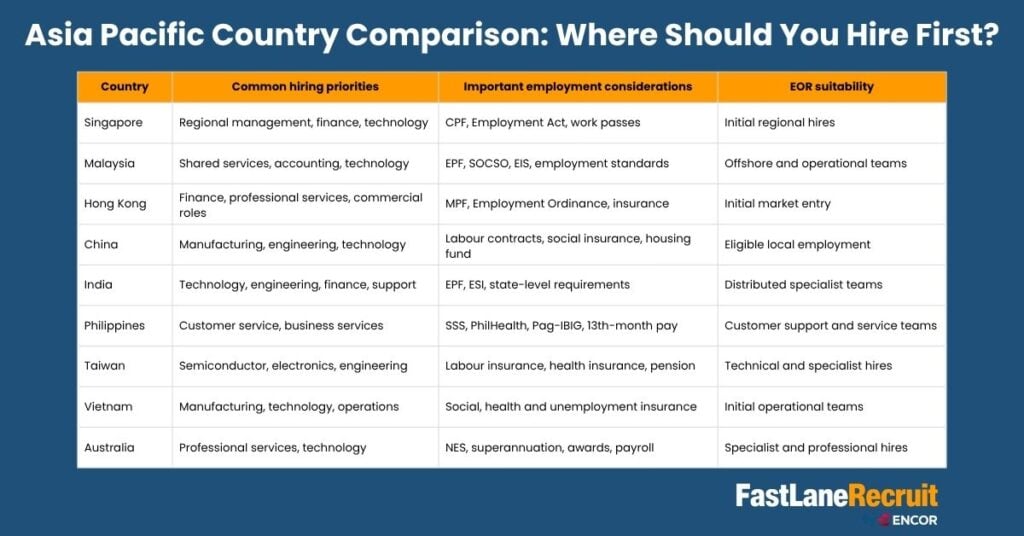
| Country | Common hiring priorities | Important employment considerations | EOR suitability |
| Singapore | Regional management, finance, technology | CPF, Employment Act, work passes | Initial regional hires |
| Malaysia | Shared services, accounting, technology | EPF, SOCSO, EIS, employment standards | Offshore and operational teams |
| Hong Kong | Finance, professional services, commercial roles | MPF, Employment Ordinance, insurance | Initial market entry |
| China | Manufacturing, engineering, technology | Labour contracts, social insurance, housing fund | Eligible local employment |
| India | Technology, engineering, finance, support | EPF, ESI, state-level requirements | Distributed specialist teams |
| Philippines | Customer service, business services | SSS, PhilHealth, Pag-IBIG, 13th-month pay | Customer support and service teams |
| Taiwan | Semiconductor, electronics, engineering | Labour insurance, health insurance, pension | Technical and specialist hires |
| Vietnam | Manufacturing, technology, operations | Social, health and unemployment insurance | Initial operational teams |
| Australia | Professional services, technology | NES, superannuation, awards, payroll | Specialist and professional hires |
How to use this comparison: Start with your business objective, identify the roles you need to recruit and then assess the applicable employment requirements. The EOR decision should follow from the intended workforce structure, not simply the country’s perceived attractiveness.
When Does Your Business Need an EOR for Asia Pacific Expansion?
An EOR is not necessarily required for every international expansion. However, it can be particularly useful when a business needs to employ people in another country but does not have its own local employing entity.
1. You Need to Hire Before Establishing a Local Entity
Setting up a subsidiary can involve incorporation, company secretarial obligations, accounting, tax administration and ongoing corporate maintenance.
If your immediate priority is employing one or several local professionals, an EOR may provide a more practical employment structure.
2. You Want to Test a New Market
Businesses entering a new country may not know whether they will eventually need a permanent office or a larger workforce.
An EOR can support initial hiring while management evaluates market demand, operational requirements and long-term investment plans.
However, an EOR does not replace business licences or other approvals required for the company’s commercial activities.
3. You Need to Hire Across Multiple Countries
Managing employees in Singapore, Malaysia, Hong Kong and other markets can create different payroll calendars, employment documentation requirements and statutory obligations.
Working with one EOR partner across supported countries can help centralise employment administration and reduce the number of separate providers a company needs to coordinate.
4. You Need Local Employment Administration
Companies without in-country HR infrastructure may struggle to manage employment documentation, statutory contributions, payroll and employee lifecycle requirements.
An EOR provides a local employment framework to support these responsibilities.
5. You Want to Scale Without Immediately Expanding Corporate Infrastructure
A growing business may need international talent before it is ready to establish separate legal entities.
An EOR can provide a practical route for eligible hiring while the company evaluates whether a subsidiary or another structure is appropriate in the future.
Important: An EOR does not automatically remove corporate tax, permanent establishment, licensing, immigration or other legal obligations arising from a company’s wider activities in a country.
EOR vs Subsidiary: Which Is Better for Asia Pacific Expansion?
Choosing between an Employer of Record and a local subsidiary depends on how your business intends to operate in the target market.
An EOR focuses on the local employment relationship. A subsidiary gives the company its own local corporate structure and may be necessary for wider commercial operations.
EOR vs Local Entity Comparison
| Consideration | Employer of Record (EOR) | Local Subsidiary |
| Company incorporation | Not required for the EOR employment arrangement | Required |
| Hiring employees | Through the EOR’s local employment structure | Through the company’s own entity |
| Employment contracts | Managed through the EOR arrangement | Issued by the local company |
| Payroll administration | Supported by the EOR | Managed by the subsidiary or its providers |
| Statutory employment obligations | Administered through the EOR structure as applicable | Managed by the subsidiary |
| Corporate governance | No separate subsidiary required for EOR employment | Local corporate governance required |
| Commercial operations | Does not independently provide all required commercial permissions | Can conduct permitted local business activities |
| Long-term presence | Suitable depending on workforce and legal requirements | Often more appropriate for an established operation |
When Should You Choose an EOR?
Consider EOR when:
- You need to hire your first employee in a supported market.
- Your company does not have a local employing entity.
- You want to test a market before committing to incorporation.
- You need employment administration across several countries.
- Your immediate requirement is hiring rather than establishing a complete local business operation.
When Should You Establish a Subsidiary?
A subsidiary may be more appropriate when:
- You intend to establish substantial and permanent local operations.
- You need to enter into local commercial contracts through your own entity.
- Your business activities require a locally registered company or specific licences.
- You need direct ownership of the local corporate structure.
- Your expected workforce and operating scale justify the ongoing administrative costs.
Professional recommendation: EOR and subsidiary arrangements are not mutually exclusive long-term strategies. Some businesses begin with EOR-supported hiring and later establish their own entity when their operational requirements change. Any employee transfer must be structured in accordance with local employment laws.
Also Read: Foreign Subsidiary vs EOR: Which Costs Less and Is Faster to Set Up?
What Should You Check Before Choosing an EOR Provider in Asia?
Country coverage alone is not enough to determine whether an EOR provider is suitable. Businesses should evaluate the provider’s local employment capabilities, service scope and ability to support their intended workforce.
1. Local Employment Infrastructure
Ask whether the provider operates through its own local entities or relies on third-party partners. Understand who will legally employ your employees and which organisation is responsible for the applicable employment obligations.
2. Country-Specific Compliance Knowledge
Check whether the provider understands local employment contracts, statutory contributions, payroll taxation, benefits and termination procedures.
A provider should be able to explain how requirements differ between countries rather than offering a generic regional solution.
3. Payroll and Statutory Contribution Management
Confirm how payroll is calculated, processed and reported. Ask how statutory deductions, employer contributions, employee benefits and payment schedules are handled.
4. Employee Onboarding and Documentation
Review the provider’s onboarding process, employment contract arrangements, documentation requirements and expected timelines.
5. Pricing and Service Scope
Request a clear breakdown of:
- Monthly EOR management fees.
- Employee salary and employer contributions.
- Mandatory insurance and benefits.
- Onboarding and offboarding fees.
- Additional administrative charges.
- Any country-specific costs.
6. Ongoing Employee Support
Understand how the provider manages payroll queries, employment changes, leave administration, employee documentation and offboarding.
7. Multi-Country Service Coordination
If your expansion involves several countries, assess whether the provider can coordinate employment administration across all your intended markets.
A suitable EOR partner should offer more than access to a country. It should provide a clearly defined local employment structure and reliable administrative support throughout the employment lifecycle.
Also Read: How to Meet Data Protection Obligations When Hiring Through an EOR
How FastLaneRecruit Supports Asia Pacific Expansion Through EOR
Expanding across borders requires a practical employment structure that accounts for local regulations without creating unnecessary administrative complexity.
FastLaneRecruit provides Employer of Record services to businesses hiring employees across APAC including Malaysia, Singapore, Hong Kong, China, India, Philippines, Taiwan, Vietnam, and Australia.
Our EOR solution helps companies employ eligible workers without establishing their own local employing entity in every supported country.
We support the employment administration process while your business retains responsibility for employees’ day-to-day direction, work assignments and performance management.
Our EOR Services Include
Local Employment Contracts
We support the preparation and administration of employment documentation in accordance with applicable local requirements.
Employee Onboarding
We coordinate employment onboarding and required documentation to help employees begin work under the appropriate local employment arrangement.
Payroll Administration
We manage payroll processes, including salary payments and applicable statutory deductions and contributions according to local requirements.
Statutory Contributions and Benefits
We support the administration of relevant statutory employment obligations and applicable employee benefits based on the country.
Ongoing Employment Administration
We assist with employment-related administrative processes throughout the employee lifecycle.
Offboarding Support
We support employment termination administration in accordance with applicable local procedures and requirements.
How Our EOR Process Works
- Discuss Your Expansion Requirements: Tell us which countries you are targeting, the roles you need to fill and your expected hiring timeline.
- Review Country-Specific Requirements: We assess the proposed employment arrangement, local requirements and service availability.
- Prepare Employment Documentation: We coordinate the appropriate local employment contract and onboarding documentation.
- Onboard Your Employees: We support the employment onboarding process and required administrative steps.
- Manage Payroll and Ongoing Employment: We handle the applicable payroll and employment administration throughout the engagement.
Our objective is to make international employment more manageable while allowing your business to concentrate on workforce development and regional growth.
Why Businesses Choose FastLaneRecruit
Selecting an EOR provider is an important part of an international hiring strategy. Businesses need a partner that understands local employment requirements and can coordinate employment administration across multiple jurisdictions.
1. Multi-Country EOR Support
FastLaneRecruit supports EOR employment across selected markets in Asia Pacific, Europe and the Middle East & Africa. Businesses can work with one EOR partner when hiring across multiple supported jurisdictions.
2. Regional Employment and Payroll Expertise
Our services address the employment documentation, payroll administration and statutory requirements associated with international hiring.
3. Employment Support Without Setting Up a Local Entity
Businesses can employ eligible workers through our EOR arrangements without first establishing their own local employing entity in each supported market.
4. Support Throughout the Employee Lifecycle
From employment documentation and onboarding to payroll administration and offboarding, we support key employment processes based on local requirements.
5. Practical Support for Different Business Sizes
Whether you are hiring your first overseas employee or building a distributed international team, we can assess an appropriate EOR arrangement based on your workforce requirements.
6. Backed by FastLane Group
As part of FastLane Group, FastLaneRecruit combines recruitment experience, regional HR knowledge and international employment support to help businesses manage their workforce expansion.
FastLaneRecruit EOR Service Coverage
FastLaneRecruit supports international employment beyond APAC. Our country coverage includes:
- Asia Pacific: Malaysia, Singapore, Hong Kong, China, India, Philippines, Taiwan, Vietnam, Australia,
- Europe: United Kingdom, Switzerland
- Middle East & Africa: UAE, Saudi Arabia, Qatar
This coverage allows businesses to explore multi-country hiring through one EOR partner rather than coordinating separate providers in every market.
Employment arrangements, onboarding requirements and service availability are assessed according to the relevant country and employee circumstances.
Plan Your Asia Pacific Expansion with FastLaneRecruit
Choosing the right countries is only the first step in building an international workforce. You also need an employment structure that supports local hiring requirements, payroll administration and ongoing workforce management.
Whether you are planning your first overseas hire in Singapore, building an operational team in Malaysia, recruiting technical professionals in India or expanding into several Asia-Pacific markets, FastLaneRecruit can help assess your EOR requirements.
Our team can help you understand:
- Which supported countries are suitable for your hiring plans.
- Whether an EOR is appropriate for your proposed employment structure.
- What local employment and payroll requirements need to be considered.
- Which onboarding documents and procedures are required.
- How to coordinate employment administration across multiple markets.
Ready to expand into Asia Pacific without establishing a local employing entity in every market?
Book a Free Consultation with a FastLaneRecruit EOR Specialist to discuss your target countries, workforce requirements and international hiring strategy.
Frequently Asked Questions About Asia Pacific Expansion and EOR
1. What is the best country to start with for Asia Pacific expansion?
There is no universally best country. Singapore and Hong Kong may suit businesses seeking regional commercial and professional teams, while Malaysia and the Philippines may be relevant for shared services and customer support. India, Taiwan, China and Vietnam may be worth assessing for technical, engineering and manufacturing-related hiring. Australia may suit businesses seeking professional and specialised talent.
The right choice depends on your industry, workforce requirements, operating budget and long-term expansion objectives.
2. Which Asia-Pacific countries can I hire employees in through an EOR?
EOR availability depends on the provider and the applicable local employment framework. FastLaneRecruit supports EOR services in Malaysia, Singapore, Hong Kong, China, India, the Philippines, Taiwan, Vietnam and Australia.
Businesses should confirm role eligibility, employment requirements and service availability before proceeding.
3. Do I need to establish a company before hiring employees in Asia?
Not necessarily. An Employer of Record can employ eligible workers on your behalf in supported countries without requiring you to establish your own local employing entity for that employment arrangement.
However, an EOR does not replace company incorporation, business licensing or other registrations that may be required for your wider commercial activities.
4. Is EOR better than establishing a subsidiary for Asia Pacific expansion?
It depends on your objectives. EOR is often practical when hiring a small team, entering a market for the first time or employing people before committing to a local entity. A subsidiary may be more appropriate for substantial long-term operations, local commercial activities or situations requiring your own corporate presence.
5. Can I hire one employee in multiple Asia-Pacific countries through an EOR?
Yes, subject to the provider’s country coverage and local employment requirements. An EOR can support eligible employment arrangements across multiple countries, even when the client company does not have its own employing entities in those markets.
6. What responsibilities does an EOR handle?
An EOR generally manages the local legal employment relationship and applicable employment administration. This can include employment contracts, payroll, statutory contributions, benefits administration, employment documentation and offboarding.
The client company typically retains control over day-to-day work, business responsibilities and employee performance.
7. How much does an EOR cost in Asia Pacific?
EOR costs vary by country, employee salary, statutory employer contributions, benefits, insurance requirements and provider service fees.
Businesses should request a country-specific quotation that separates employee compensation, mandatory employment costs and EOR management fees.
8. How long does it take to hire through an EOR in Asia?
The timeline depends on the country, employment documentation, employee eligibility, background requirements and any applicable work authorisation procedures.
A provider should confirm the expected onboarding timeline after reviewing the employee’s details and proposed employment arrangement.
9. Can an EOR sponsor work visas in Asia-Pacific countries?
Immigration requirements differ by jurisdiction. An EOR may support relevant employment documentation or immigration-related administration where its service scope and local rules permit, but it cannot guarantee visa approval. Work authorisation decisions remain subject to the relevant government authorities.
10. Can I transfer employees from an EOR to my own subsidiary later?
In many circumstances, a business can transition employees to its own local entity after incorporation. However, this is not an automatic transfer. The process may require a new employment agreement, employee consent, appropriate termination or transfer procedures and settlement of outstanding employment entitlements, depending on local law.
11. Can one EOR provider manage employees across Asia, Europe and the Middle East?
Yes, provided the provider supports the relevant countries and can establish appropriate local employment arrangements. FastLaneRecruit supports selected markets across Asia Pacific, Europe and the Middle East & Africa, giving businesses access to multi-country EOR support through one provider.
12. Does using an EOR eliminate permanent establishment or corporate tax risks?
No. An EOR arrangement does not automatically eliminate a company’s corporate tax, permanent establishment, transfer pricing or other tax exposure. These matters depend on the company’s activities, contractual arrangements, decision-making and applicable tax rules in each jurisdiction. Businesses should obtain appropriate corporate tax and legal advice before expanding.