Entering a promising foreign market can create significant growth opportunities. But before committing to a subsidiary, branch office or permanent local operation, businesses need to answer a more fundamental question: Is this market worth the investment?
A new market may look attractive on paper, but actual demand, customer behaviour, recruitment conditions and operating costs can be very different. Establishing a legal entity too early may also create ongoing administrative and compliance responsibilities before the business has confirmed its commercial potential.
An Employer of Record (EOR) offers another way to approach foreign market entry. Where legally permitted, an EOR can employ local talent on your behalf, allowing your business to build an initial presence, develop customer relationships and assess market opportunities without first establishing its own local employing entity.
This approach gives businesses more flexibility during the early stages of international expansion. Instead of immediately investing in permanent infrastructure, you can test specific business assumptions, evaluate local hiring needs and make a more informed decision about long-term investment.
FastLaneRecruit helps businesses hire and manage employees across selected international markets through EOR services, supporting employment contracts, payroll administration, statutory requirements and local employment processes.
Content Outline
Key Summary
Test before investing
An EOR can help businesses assess a new market before committing to the cost and administration of establishing their own local employing entity.
Hire local talent
Employ an initial sales representative, business development manager or other eligible employee to understand the market from the ground.
Validate commercial opportunities
Use local employees to support customer research, relationship development, market feedback and business development.
Manage employment responsibilities
An EOR can coordinate local employment contracts, payroll, statutory contributions and other agreed employment administration.
Compare long-term costs
Evaluate EOR fees against incorporation, accounting, payroll, tax, HR and ongoing entity-maintenance costs.
Know when to incorporate
A permanent local entity may become more appropriate when hiring needs, business activities, regulatory requirements or long-term investment justify it.
Check local requirements first
EOR suitability depends on the country, the employee’s role and the nature of the business activities.
Why Foreign Market Entry Does Not Always Require Immediate Incorporation
Establishing a local company is a common route for international expansion, but it is not necessarily the best first step for every business.
Incorporation can involve company registration, legal and professional fees, accounting arrangements, tax administration, corporate governance and ongoing filing obligations. Businesses may also need to establish local banking, office arrangements and internal administrative processes.
These commitments can be difficult to justify when a company is still evaluating demand or hiring its first employee in a new country.
The challenge of entering an unfamiliar market
Before making a long-term investment, businesses need to understand several factors:
- Market demand: Are local customers interested in the product or service?
- Sales potential: Can the business generate sufficient leads, revenue and customer relationships?
- Talent availability: Can the company recruit employees with the necessary language skills, experience and market knowledge?
- Employment costs: What salary levels, statutory contributions and employee benefits should be budgeted?
- Regulatory requirements: Does the proposed activity require a local licence, registration or specific business structure?
- Long-term viability: Is there enough commercial potential to justify maintaining a permanent operation?
Without reliable local insight, a company may invest in infrastructure before understanding whether the market can support it.
How an EOR changes the initial expansion approach
An EOR provides a way to establish a local employment arrangement without immediately setting up the client’s own employing entity, where the model is permitted.
Under an EOR arrangement:
- Your business identifies the role and selects the candidate.
- The EOR becomes the legal employer under the local employment arrangement.
- The EOR manages agreed employment administration, including contracts and payroll.
- Your business directs the employee’s day-to-day work, responsibilities and performance, subject to the service agreement and applicable law.
This allows a company to begin building its local team while evaluating whether a larger investment is justified.
The key distinction: An EOR can simplify the employment side of foreign market entry. It does not automatically remove the need for separate corporate, tax, licensing or regulatory assessments.
How Does an EOR Help Businesses Test a New Market?
An EOR can support a structured market-entry strategy by allowing businesses to hire locally before committing to their own employment infrastructure.
Rather than building a full operation immediately, companies can start with the people needed to evaluate a specific commercial opportunity.
Hire an initial local employee
A business does not always need an entire overseas department to begin exploring a new market.
It may only need one or two employees with relevant local knowledge and professional experience.
For example, a company entering Singapore may initially hire a business development manager to identify potential clients, build partnerships and gather feedback. A company exploring Malaysia may hire a sales representative who understands local customer expectations and industry relationships.
An EOR can support eligible employment arrangements while the business evaluates whether additional recruitment is necessary.
Understand local customer behaviour
Market research provides useful background, but direct local engagement can reveal practical information that desk research may not capture.
An employee based in the target country can help your business:
- Understand customer preferences and purchasing behaviour.
- Identify potential business partners and distribution opportunities.
- Gather feedback on product positioning and pricing.
- Evaluate competitor activity and customer expectations.
- Identify differences in communication styles and business practices.
These insights can help management refine its market-entry strategy before making a larger investment.
Evaluate recruitment and employment costs
Hiring locally also helps businesses understand the actual cost of building a workforce in the target market.
Beyond gross salary, employers may need to consider:
- Employer statutory contributions.
- Mandatory or customary employee benefits.
- Payroll administration.
- Paid leave and other employment entitlements.
- Insurance requirements, where applicable.
- Recruitment and onboarding expenses.
- Notice periods and termination-related costs.
An EOR can provide a clearer view of employment-related expenditure through an agreed service and pricing structure.
Build local relationships before scaling
An initial employee can help establish business relationships, support customer communication and identify opportunities for future growth.
This is particularly useful for businesses that need a local point of contact but are not yet ready to establish a permanent office or larger team.
However, the activities assigned to the employee should be reviewed carefully. Contract negotiation, authority to conclude agreements, local sales activities and other commercial functions may have tax or regulatory implications depending on the country.
What Can You Test Before Establishing a Local Entity?
Using an EOR should be part of a defined market-validation plan. Businesses should identify what they want to learn, how they will measure progress and what results would justify further investment.
| What to validate | How an initial local employee can help | Example performance indicators |
| Customer demand | Identify prospects and gather customer feedback | Qualified leads, enquiries and customer interest |
| Sales potential | Develop sales relationships and support business development | Sales pipeline, conversion rate and revenue |
| Talent availability | Assess recruitment conditions and required skills | Candidate availability, salary expectations and time to hire |
| Market positioning | Gather feedback on pricing and product suitability | Customer feedback, objections and pricing acceptance |
| Local partnerships | Identify distributors, suppliers or strategic partners | Qualified partnerships and partnership discussions |
| Operating requirements | Identify practical local business and employment needs | Compliance requirements, operating costs and resource needs |
| Expansion potential | Evaluate whether a larger team or permanent presence is justified | Revenue outlook, hiring demand and projected operating costs |
Set measurable market-entry milestones
A market test should have a clear evaluation period and measurable objectives. The appropriate timeframe depends on the industry, sales cycle, role and market conditions.
Consider setting milestones such as:
First stage: Market discovery
- Identify the target customer segments.
- Research competitors and local market positioning.
- Establish an initial prospect list.
- Gather feedback on product or service suitability.
Second stage: Commercial validation
- Develop qualified sales opportunities.
- Build relationships with prospective customers.
- Assess pricing and customer objections.
- Evaluate the feasibility of local partnerships.
Third stage: Expansion decision
- Review sales pipeline and customer demand.
- Compare actual employment costs against the original budget.
- Identify additional recruitment requirements.
- Assess whether a local entity is commercially and legally appropriate.
A structured review helps management decide whether to expand, continue testing, change its strategy or withdraw from the market.
Also Read: Contract vs Permanent Employment Malaysia: A Complete Guide for Employers Hiring Locally or Remotely
EOR vs. Local Entity Setup: Which Is Better for Foreign Market Entry?
An EOR and a local entity serve different business needs. The right choice depends on how much local infrastructure the company requires, the activities it plans to conduct and its long-term expansion objectives.
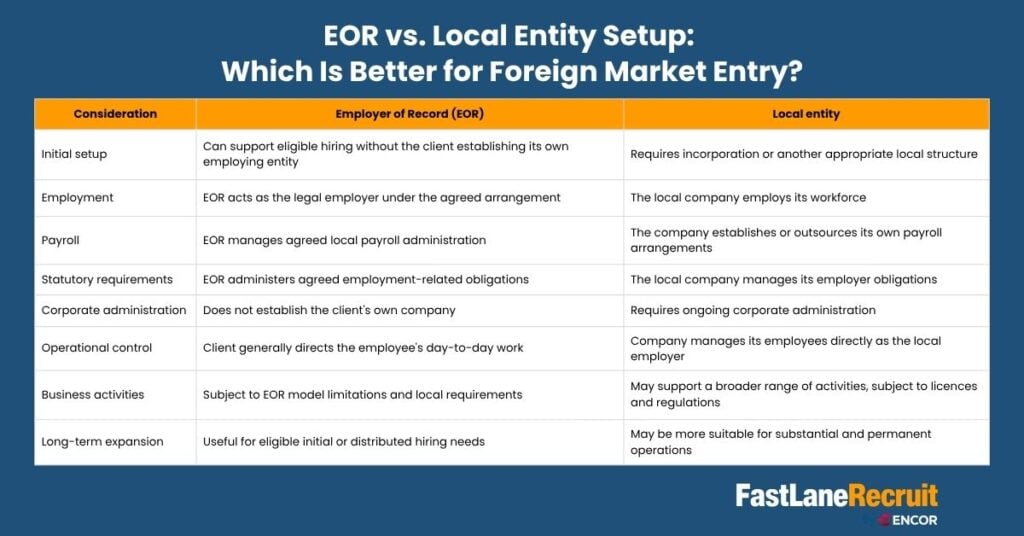
| Consideration | Employer of Record (EOR) | Local entity |
| Initial setup | Can support eligible hiring without the client establishing its own employing entity | Requires incorporation or another appropriate local structure |
| Employment | EOR acts as the legal employer under the agreed arrangement | The local company employs its workforce |
| Payroll | EOR manages agreed local payroll administration | The company establishes or outsources its own payroll arrangements |
| Statutory requirements | EOR administers agreed employment-related obligations | The local company manages its employer obligations |
| Corporate administration | Does not establish the client’s own company | Requires ongoing corporate administration |
| Operational control | Client generally directs the employee’s day-to-day work | Company manages its employees directly as the local employer |
| Business activities | Subject to EOR model limitations and local requirements | May support a broader range of activities, subject to licences and regulations |
| Long-term expansion | Useful for eligible initial or distributed hiring needs | May be more suitable for substantial and permanent operations |
When should you choose an EOR?
An EOR may be worth considering when your business:
- Wants to hire its first employee in a foreign market.
- Needs a local sales or business development representative.
- Wants to assess demand before committing to a permanent structure.
- Is not ready to establish a subsidiary or branch.
- Needs local employment and payroll administration.
- Wants to build a small international team across several supported markets.
When should you establish a local entity?
Incorporation may be more appropriate when your business:
- Plans to maintain a substantial and long-term local workforce.
- Needs to conduct activities that require a locally registered business.
- Requires local licences, permits or regulated operations.
- Needs to own or lease local assets through a local company.
- Plans to build a permanent office, operational facility or local management structure.
- Has commercial, tax or contractual reasons to operate through its own local entity.
Decision point: If your immediate objective is to hire eligible employees and evaluate market potential, an EOR may offer a practical starting point. If your business needs a permanent commercial presence or activities that require its own local structure, assess incorporation and other available arrangements before proceeding.
How Much Does It Cost to Enter a Foreign Market Through an EOR?
The cost of foreign market entry depends on the country, hiring requirements, employee compensation and the business activities involved.
An EOR can help businesses avoid some of the initial costs associated with establishing and maintaining their own employing entity. However, it should not be assumed that an EOR is always cheaper than incorporation.
The more useful comparison is the total cost of each employment and operating model over the expected market-testing period.
Costs to consider when using an EOR
An EOR budget may include:
- Employee gross salary.
- Employer statutory contributions.
- Mandatory or agreed employee benefits.
- Monthly EOR service fees.
- Payroll and employment administration charges.
- Recruitment or onboarding fees, if applicable.
- Insurance or other country-specific employment costs.
- Notice, termination or offboarding costs, where applicable.
Costs to consider when incorporating
A local entity budget may include:
- Company registration and professional fees.
- Registered office or local address requirements.
- Corporate secretarial services, where required.
- Accounting and bookkeeping.
- Tax registration and filing.
- Payroll setup and administration.
- Employment contracts and HR administration.
- Statutory contributions and employee benefits.
- Annual compliance and reporting costs.
- Banking, licensing and other operational expenses.
Compare the total cost, not just the monthly fee
| Cost factor | EOR model | Local entity model |
| Company incorporation | Generally not required for the client’s employment arrangement | Applicable setup costs |
| Monthly employment administration | EOR service fee and agreed employment costs | Internal or outsourced HR and payroll costs |
| Payroll and statutory administration | Managed within the agreed EOR scope | Managed by the local company or its providers |
| Corporate compliance | Client’s own corporate compliance obligations remain relevant | Ongoing local entity obligations apply |
| Scaling the workforce | Depends on EOR pricing and service availability | Depends on internal infrastructure and local operating costs |
| Exit or transition | Requires an organised employee and contractual transition | Requires entity closure, restructuring or continued maintenance, as applicable |
Before selecting a provider, request an itemised quotation that identifies the service fee, salary costs, statutory expenses, benefits, deposits, additional charges and offboarding terms.
Professional recommendation: Estimate the cost of maintaining each structure over the period you expect to test the market. A short-term hiring requirement may favour an EOR, while a larger and sustained operation may justify the investment in a local entity.
What Are the Compliance Risks of Using an EOR for International Expansion?
An EOR can support compliant local employment, but businesses should not treat it as a complete solution for every legal or tax issue associated with foreign market entry.
Employment, corporate tax, immigration, licensing and commercial regulations can operate independently. The responsibilities of the EOR and client company should be understood before the employee starts work.
Employment law and worker classification
The employment relationship must be structured in accordance with local law.
This includes reviewing:
- Employment contract requirements.
- Minimum employment standards.
- Working hours and overtime.
- Paid leave and public holidays.
- Statutory contributions.
- Employee benefits.
- Notice and termination requirements.
The EOR should explain which employment responsibilities it manages and which responsibilities remain with the client.
Permanent establishment and corporate tax exposure
Hiring an employee through an EOR does not automatically prevent a foreign company from creating a taxable presence in the target country.
Depending on local law and the relevant tax treaty, factors such as the employee’s activities, authority to conclude contracts, business premises and the nature of the company’s operations may be relevant to a permanent establishment assessment.
Businesses should obtain country-specific tax advice before assigning activities that could create a taxable presence.
Business licensing and regulated activities
Certain business activities may require local licences, permits or registrations regardless of whether employees are hired through an EOR.
This can apply to regulated industries, financial services, professional activities and other sectors subject to local authorisation requirements.
An EOR employment arrangement should not be treated as permission to conduct activities that require separate regulatory approval.
Immigration and work authorisation
Businesses must also consider whether the employee has the appropriate right to work in the country.
Where visa sponsorship or work authorisation is required, the relevant arrangements should be reviewed before employment begins. The availability of immigration support depends on the country, employee circumstances and service scope.
Data protection and confidentiality
Local employees may access customer information, commercial records and internal systems.
Businesses should establish appropriate confidentiality agreements, data access controls, information-security procedures and cross-border data transfer arrangements where relevant.
Compliance checklist before hiring through an EOR
- Confirm that the EOR model is available and appropriate in the target country.
- Review the proposed employee’s role and responsibilities.
- Identify any licensing or business registration requirements.
- Assess permanent establishment and corporate tax considerations.
- Confirm employment contract and statutory requirements.
- Review work authorisation and immigration needs.
- Agree on payroll, benefits and employment administration responsibilities.
- Document the division of responsibilities between the EOR and client company.
Also Read: How to Meet Data Protection Obligations When Hiring Through an EOR
How to Use an EOR as Part of a Foreign Market Entry Strategy
A successful market test requires more than hiring an employee. Businesses should follow a clear process that connects recruitment decisions with commercial objectives.
Step 1: Select the target market
Identify the country that best aligns with your business objectives.
Evaluate market demand, customer demographics, industry conditions, competition, talent availability, salary expectations and local regulations.
Avoid selecting a market based only on its size or perceived growth potential. Consider whether your product or service can realistically compete there.
Step 2: Define what you want to validate
Establish the main business assumptions you need to test.
For example:
- Is there sufficient demand for your product?
- Can you acquire customers at a commercially viable cost?
- Can you recruit suitable local talent?
- Is the expected revenue sufficient to support a permanent team?
- Are local operating and compliance requirements manageable?
Set measurable objectives before hiring so you can evaluate the results objectively.
Step 3: Identify the first role to hire
Choose a role that directly supports your market-testing objectives.
Common initial hires include:
- Business Development Manager: Identifies commercial opportunities and develops local partnerships.
- Sales Representative: Builds a prospect pipeline and supports customer acquisition.
- Market Research Specialist: Gathers customer, competitor and industry insights.
- Customer Success Representative: Evaluates customer expectations and supports early client relationships.
- Technical or Project Specialist: Supports local project delivery or assesses operational requirements.
The right role depends on your industry, business model and the activities legally permitted under the proposed arrangement.
Step 4: Select an appropriate EOR provider
Before signing an agreement, evaluate the provider’s local capabilities.
Ask about:
- Whether it operates through its own local entity or an appointed partner.
- Country-specific employment expertise.
- Employment contract preparation.
- Payroll processing and statutory contributions.
- Employee benefits administration.
- Onboarding and offboarding support.
- Service fees and additional charges.
- Responsibilities if employment issues arise.
- Procedures for transitioning employees to your own entity later.
Step 5: Hire and begin market validation
Once the employment arrangement is approved, the EOR can coordinate the agreed onboarding and employment administration.
Your company can then direct the employee’s day-to-day work, monitor performance and evaluate the market against the original objectives.
Step 6: Review the results and decide what comes next
At agreed review points, assess whether the market has demonstrated sufficient potential.
There are three possible outcomes:
| Market-test outcome | Recommended next step |
| Strong demand and a clear growth opportunity | Evaluate a permanent local entity and a larger workforce |
| Some demand, but commercial potential remains uncertain | Continue testing with a defined budget and measurable objectives |
| Weak demand or an unsuitable market | Review the strategy, reduce the commitment or plan an orderly exit |
This approach helps businesses make expansion decisions based on evidence rather than assumptions.
When Should You Transition from an EOR to Your Own Local Entity?
An EOR can serve as an initial employment solution, but it may not remain the most suitable structure as your business grows.
The decision to incorporate should be based on commercial needs, workforce size, operational requirements and local legal and tax considerations.
Signs that your business may be ready to incorporate
Consider reviewing a permanent local structure when:
Your workforce is growing: A larger local team may make direct employment and internal HR infrastructure more practical.
Your revenue is becoming established: Consistent commercial activity may justify a permanent operating presence.
Your business needs local licences: Certain activities may require a locally registered entity or other authorised structure.
You need direct commercial operations: Local contracts, assets, facilities or operational arrangements may require a different legal structure.
Your long-term investment is confirmed: If the market has demonstrated sustainable potential, incorporating may better support your expansion strategy.
How to plan an EOR-to-entity transition
Moving employees from an EOR arrangement to your own company requires coordination.
Businesses should review:
- Employment continuity: Determine how existing employment arrangements can be transferred or replaced under local law.
- Employee entitlements: Review accrued leave, benefits, seniority and other employment rights.
- Contractual requirements: Check notice periods, consent requirements and relevant service agreements.
- Payroll transition: Plan the transfer of payroll records, statutory registrations and payment arrangements.
- Tax and corporate compliance: Confirm that the new entity is properly registered and ready to employ staff.
- Communication: Explain the transition clearly to employees and relevant stakeholders.
An employee should not be treated as automatically transferred simply because the client has incorporated a local company. The transition must follow the applicable employment requirements and agreed contractual procedures.
Why Businesses Choose FastLaneRecruit for Foreign Market Entry
Entering a new market requires more than identifying a suitable employee. Businesses also need a reliable employment structure, local payroll administration and an understanding of country-specific requirements.
FastLaneRecruit supports international hiring through Employer of Record services, helping businesses employ eligible talent in selected markets without first establishing their own local employing entity.
Local employment and compliance support
We support key employment processes, including:
- Locally compliant employment contracts.
- Employee onboarding.
- Payroll processing and administration.
- Statutory contributions and employment-related requirements.
- Benefits administration, subject to the agreed service scope.
- Ongoing employment administration.
- Employee offboarding support.
Our approach helps businesses manage the employment side of international expansion while maintaining control over their employees’ day-to-day responsibilities.
Multi-market support through one EOR partner
FastLaneRecruit operates in selected markets across Asia Pacific, Europe and the Middle East & Africa.
- Asia Pacific: Malaysia, Singapore, Hong Kong, China, India, Philippines, Taiwan, Vietnam, Australia,
- Europe: United Kingdom, Switzerland
- Middle East & Africa: UAE, Saudi Arabia, Qatar
Country coverage, employment structures and service availability should be confirmed with our team for your specific hiring requirements.
Flexible support for different expansion stages
Whether you are hiring your first international employee or building a team across several markets, FastLaneRecruit can help you assess the appropriate employment arrangement.
Our EOR services can support businesses that want to:
- Test a foreign market before establishing their own employing entity.
- Hire local sales and business development professionals.
- Build an international workforce.
- Manage employment and payroll across supported markets.
- Evaluate long-term hiring requirements before expanding operations.
Transparent pricing and regional expertise
International hiring costs should be clear before an employee is onboarded.
We help businesses understand the agreed service scope and employment-related costs so they can plan their workforce budget and compare available expansion options.
As part of FastLane Group, FastLaneRecruit combines regional employment, HR and corporate services experience to support businesses navigating international workforce requirements.
Test Your Next Foreign Market with FastLaneRecruit
You do not need to commit to a permanent local employment structure before understanding whether a new market is right for your business.
With the right EOR arrangement, you can hire local talent, develop customer relationships and evaluate commercial opportunities while keeping your initial employment setup more flexible.
FastLaneRecruit helps businesses navigate international hiring through EOR services across selected markets in Asia Pacific, Europe and the Middle East & Africa. We support employment contracts, payroll administration, statutory requirements and agreed employment processes so you can focus on evaluating your next growth opportunity.
Ready to explore a new market before incorporating?
Speak with FastLaneRecruit about your target country, hiring plans and employment requirements. Our team can help you assess whether an EOR arrangement is suitable for your foreign market entry strategy.
Book a Free Consultation with an Expert.
Frequently Asked Questions About Foreign Market Entry and EOR
1. Can I enter a foreign market without setting up a local company?
In many situations, yes. An Employer of Record can employ eligible workers in a supported country on behalf of a foreign business without requiring that business to establish its own local employing entity solely for that employment arrangement.
However, the business may still have separate corporate registration, tax, licensing or regulatory obligations depending on its activities in the country.
2. How can an EOR help test a new market?
An EOR allows a business to hire local employees while it evaluates commercial opportunities. An initial employee can support market research, customer engagement, business development and local relationship building.
The company can use the results to decide whether to continue testing, expand its workforce or establish a permanent local entity.
3. Is an EOR a good market-entry strategy?
An EOR may be suitable when a business wants to hire a small initial team, validate demand or establish a local employment arrangement without immediately building its own employment infrastructure.
It is not a universal solution for every market-entry requirement. Businesses should review local laws, tax exposure, licensing and the nature of their planned activities.
4. What is the difference between an EOR and a local subsidiary?
An EOR legally employs workers on behalf of a client company under the agreed local arrangement and manages specified employment responsibilities. The client generally directs the employees’ day-to-day work.
A subsidiary is a separate legal entity owned by the parent company. It can employ staff directly and conduct business within the scope of its registrations, licences and applicable laws.
5. Is using an EOR cheaper than incorporating?
It depends on the country, workforce size, employment duration and operating requirements.
An EOR may reduce the initial costs and administration associated with establishing a local employing entity. However, EOR service fees and employment costs must be compared with incorporation, accounting, payroll, tax and ongoing corporate expenses.
Businesses should compare the total expected cost over the intended market-entry period rather than looking at one monthly fee.
6. Can I hire just one employee through an EOR?
Yes. An EOR may be suitable for businesses hiring a single employee in a supported market, provided the role and employment arrangement meet local requirements.
This can be useful when hiring a first sales representative, business development manager or other specialist to evaluate a new market.
7. Does using an EOR eliminate permanent establishment risk?
No. An EOR does not automatically eliminate permanent establishment or corporate tax exposure.
The tax treatment depends on the relevant country’s laws and applicable tax treaties, as well as the company’s activities, employee responsibilities and other facts. Businesses should obtain appropriate tax advice before entering a market.
8. Can I establish my own entity after using an EOR?
Yes, a business may establish its own entity later if the market proves commercially viable and a permanent structure is appropriate.
However, transferring employees from an EOR to the new entity requires careful planning. Employment continuity, employee entitlements, contracts, payroll and local legal requirements should be reviewed.
9. Which roles are suitable for an initial EOR hire?
Common roles include sales representatives, business development managers, market research specialists, customer success professionals and technical specialists.
The appropriate role depends on the company’s objectives and the activities permitted under local employment, tax and regulatory rules.
10. Which countries does FastLaneRecruit support for EOR services?
FastLaneRecruit supports EOR services across selected markets in Asia Pacific, Europe and the Middle East & Africa:
- Asia Pacific: Malaysia, Singapore, Hong Kong, China, India, Philippines, Taiwan, Vietnam and Australia.
- Europe: United Kingdom and Switzerland.
- Middle East & Africa: UAE, Saudi Arabia and Qatar.
Service availability and the appropriate employment arrangement should be confirmed with our team before hiring.
11. How long does it take to hire an employee through an EOR?
The timeline depends on the country, employee documentation, employment requirements and onboarding process. An EOR may help businesses avoid waiting for their own entity setup before beginning eligible employment arrangements, but onboarding times are not identical across markets.
Ask your EOR provider for a country-specific timeline before confirming a start date.
12. What should I check before choosing an EOR provider?
Evaluate the provider’s local employment capabilities, entity structure, country coverage, payroll processes, statutory compliance support, pricing transparency, employee benefits administration and offboarding procedures.
You should also confirm who is responsible for each employment obligation and how the provider handles employee issues or a future transition to your own entity.